


AT-6 Texan
| Country | United States |
| Manufacturer | North American Aviation |
| Primary Role | Other |
| Maiden Flight | 1 April 1935 |
Contributor: C. Peter Chen
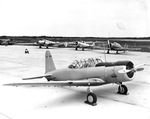
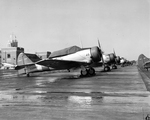
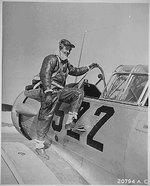
ww2dbaseThe AT-6 Texan single-engine trainer aircraft entered production in 1937 after the United States Army Air Corps made an order for 180 aircraft and the British Royal Air Force for 400. The USAAC designated their aircraft as BC-1, while the RAF called theirs the Harvard I. The US Navy received 16 modified aircraft, which they designated SNJ-1, and then 61 more as SNJ-2. As the war began in Europe, a total of 1,173 were contracted to be given to the RAF and the Royal Canadian Air Force via Lend Lease; these were the AT-6 Harvard II variants with squared-off wingtips and straight-edged rudders. As the United States geared for war, the US Army Air Force received 1,549 AT-6A aircraft and the Navy 270 SNJ-3 aircraft, which were trainers equipped with the more powerful Pratt & Whitney R-1340-49 Wasp radial engines. To boost production, North American Aviation gave Canadian firm Noorduyn Aviation the license to build R-1340-AN-1 powered version of the AT-6A variant, which were sold back to the USAAF as the AT-16 aircraft and the RAF and RCAF as the Harvard IIB aircraft. Several more variants entered production as the war progressed. The AT-6 Texan design was so successful that new variants continued to be built after the war. In 1948, they were redesignated T-6. In the 1950s, Canada Car and Foundry continued to build aircraft based on the T-6 Texan design, and supplied the finished products to the RCAF, RAF, and the German Bundeswehr. During the design's production life, 15,495 were built. They served during the Korean and Vietnam Wars in the rear as trainers and in the front as forward air control aircraft. Many countries used them as counter-insurgency aircraft well into the 1970s.
ww2dbaseSource: Wikipedia
Last Major Revision: Aug 2007
SPECIFICATIONS
T-6G
| Machinery | One Pratt & Whitney R-1340-AN-1 Wasp radial engine rated at 600hp |
| Armament | Provision for 1×7.62mm machine gun |
| Crew | 2 |
| Span | 12.81 m |
| Length | 8.84 m |
| Height | 3.57 m |
| Wing Area | 23.60 m² |
| Weight, Empty | 1,886 kg |
| Weight, Loaded | 2,548 kg |
| Speed, Maximum | 335 km/h |
| Speed, Cruising | 233 km/h |
| Rate of Climb | 6.10 m/s |
| Service Ceiling | 7,400 m |
| Range, Normal | 1,175 km |
Photographs
 |  |  |  |
Did you enjoy this article or find this article helpful? If so, please consider supporting us on Patreon. Even $1 per month will go a long way! Thank you. Share this article with your friends: Stay updated with WW2DB: |


Visitor Submitted Comments
All visitor submitted comments are opinions of those making the submissions and do not reflect views of WW2DB.
- » WW2DB's 19th Anniversary (29 Dec 2023)
- » Looted Painting "Madonna with Child" Returned to Poland (2 Jun 2023)
- » Wreck of USS Mannert L. Abele Found (29 May 2023)
- » Wreck of Montevideo Maru Found (25 Apr 2023)
- » Accidental Detonation of a WW2-Era Bomb in Great Yarmouth (10 Feb 2023)
- » See all news
- » 1,146 biographies
- » 336 events
- » 43,422 timeline entries
- » 1,237 ships
- » 349 aircraft models
- » 207 vehicle models
- » 372 weapon models
- » 123 historical documents
- » 259 facilities
- » 468 book reviews
- » 28,395 photos
- » 432 maps
Lt. Gen. Lewis B. "Chesty" Puller, at Guadalcanal

Please consider supporting us on Patreon. Even $1 a month will go a long way. Thank you!

Or, please support us by purchasing some WW2DB merchandise at TeeSpring, Thank you!
14 Oct 2013 05:59:31 AM
AT-6 trainer was the body all alumiun??