


La-7
| Country | Russia |
| Manufacturer | Lavochkin |
| Primary Role | Fighter |
| Maiden Flight | 1 November 1943 |
Contributor: C. Peter Chen
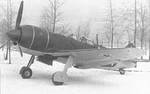
ww2dbaseThe La-7 (Ла-7) fighters were based on the design of La-5. The characteristic that set the La-7 fighters apart from their predecessors was the usage of metal alloy components, where their predecessors were made of mostly wood. The prototype took flight in Nov 1943, and by next spring they were already in combat service. Though few in number, La-7 fighters were rather liked by those pilots who flew them. On 15 Feb 1945, Ivan Nikitovich Kozhedub's La-7 shot down a Messerschmitt Me-262 jet fighter, the only Russian fighter pilot to achieve that in the war. Later in the war, the La-7 platform was used to test rocket and jet propulsion, though none of them came to fruition as the next generation of Russian fighter aircraft. A total of 5,753 were built.
ww2dbaseSource: Wikipedia.
Last Major Revision: Sep 2006
SPECIFICATIONS
La-7
| Machinery | One Shvetsov ASh-82FN radial engine rated at 1,850hp |
| Armament | 2x or 3x20mm ShVAK cannons, 200kg of bombs |
| Span | 9.80 m |
| Length | 8.60 m |
| Height | 2.54 m |
| Wing Area | 17.50 m² |
| Weight, Empty | 2,638 kg |
| Weight, Loaded | 3,265 kg |
| Weight, Maximum | 3,400 kg |
| Speed, Maximum | 680 km/h |
| Rate of Climb | 15.72 m/s |
| Service Ceiling | 9,500 m |
| Range, Normal | 990 km |
Photographs
 |
Did you enjoy this article or find this article helpful? If so, please consider supporting us on Patreon. Even $1 per month will go a long way! Thank you. Share this article with your friends: Stay updated with WW2DB: |


Visitor Submitted Comments
 Hobilar says:
22 Sep 2007 03:24:35 AM
During 1944 attempts were made to improve the performance of the La-7 for short periods by installing a liquid-fuel rocket motor in the extreme rear fuselage. This rocket motor, the power of which has never been revealed, boosted maximum speed by ten to fifteen per cent for brief periods, and was considered sufficient to permit its service introduction on a small scale, although it is believed that La-7s so equipped were confined to the units of the PVO (Protivozdushnoi Oborony, or Protective Air Force).
All visitor submitted comments are opinions of those making the submissions and do not reflect views of WW2DB.
- » WW2DB's 19th Anniversary (29 Dec 2023)
- » Looted Painting "Madonna with Child" Returned to Poland (2 Jun 2023)
- » Wreck of USS Mannert L. Abele Found (29 May 2023)
- » Wreck of Montevideo Maru Found (25 Apr 2023)
- » Accidental Detonation of a WW2-Era Bomb in Great Yarmouth (10 Feb 2023)
- » See all news
|
- » 1,146 biographies
- » 336 events
- » 43,422 timeline entries
- » 1,237 ships
- » 349 aircraft models
- » 207 vehicle models
- » 372 weapon models
- » 123 historical documents
- » 259 facilities
- » 468 book reviews
- » 28,395 photos
- » 432 maps
Winston Churchill

Please consider supporting us on Patreon. Even $1 a month will go a long way. Thank you!

Or, please support us by purchasing some WW2DB merchandise at TeeSpring, Thank you!
20 Dec 2006 05:39:20 PM
Again, as in many other places, the same mistake: the maximal speed for Russian La-7 is 425 mlsh, not kmh. This speed stands for respectable ~700 kmh, which is pretty much true for this outstanding aircraft.