


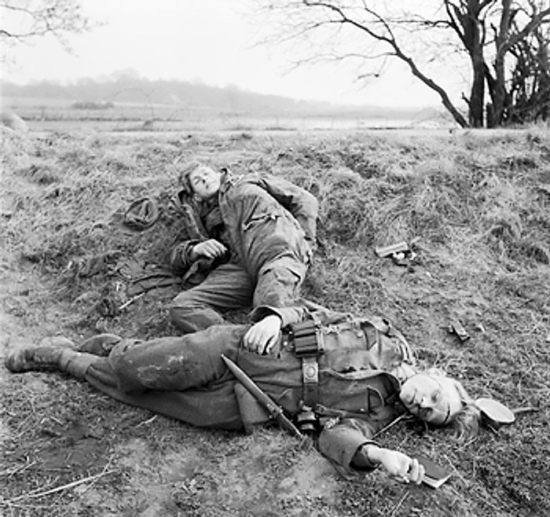
| Caption | Two young German soldiers, one injured, the other dead, east of the Rhine River, Germany, late Mar 1945 ww2dbase | |||||
| Photographer | Dennis Smith | |||||
| Source | ww2dbaseImperial War Museum | |||||
| Identification Code | 4700-30 BU 2344 | |||||
| More on... |
| |||||
| Photos on Same Day | 29 Mar 1945 | |||||
| Added By | C. Peter Chen | |||||
| Licensing | According to the United Kingdom National Archives, Crown copyright material that has been created prior to 1 Jun 1957 is considered to be in the public domain. Please contact us regarding any inaccuracies with the above information. Thank you. |
Did you enjoy this photograph or find this photograph helpful? If so, please consider supporting us on Patreon. Even $1 per month will go a long way! Thank you. Share this photograph with your friends: Stay updated with WW2DB: |


Visitor Submitted Comments
2. BH says:
1 Mar 2009 01:54:28 PM
look at that gash!
1 Mar 2009 01:54:28 PM
look at that gash!
3.  Bill says:
9 May 2011 06:41:27 PM
POLITICANS TALK OF COURAGE, BUT ITS THE BRAVE
ONES WHO DIE, THE SOLDIERS:
I don't see any weapons on them, but the uniforms are late pattern.
The soldier facing is equipped with ankle boots w/gaiters, S84/98 bayonet w/scabbard,
7.92mm ammo pouch w/suspender, of interest is
the belt buckle that says "God Is With Us".
At his left hand looks like it could be his paybook or maybe even a Bible and by his head
looks like his mess kit.
"The German Soldier is to be tough as leather, fleet as a grayhound, and hard as Krupp Steel"
-Adolf Hitler-
Bill says:9 May 2011 06:41:27 PM
POLITICANS TALK OF COURAGE, BUT ITS THE BRAVE
ONES WHO DIE, THE SOLDIERS:
I don't see any weapons on them, but the uniforms are late pattern.
The soldier facing is equipped with ankle boots w/gaiters, S84/98 bayonet w/scabbard,
7.92mm ammo pouch w/suspender, of interest is
the belt buckle that says "God Is With Us".
At his left hand looks like it could be his paybook or maybe even a Bible and by his head
looks like his mess kit.
"The German Soldier is to be tough as leather, fleet as a grayhound, and hard as Krupp Steel"
-Adolf Hitler-
4. Bill says:
12 May 2011 08:16:44 PM
JUST BOYS, ALL OF THEM JUST BOYS:
The young German soldier laying on his side, has been issued M43 type field trousers with ankle boots/canvas gaiters, and were issued and produced up to war's end.
From 1941 on this type of footware was issued to new recruits, by 1943 they became
universal to the end of the war.
The soldier facing forward, by his head looks like it could be a visored field cap M43 he's been issued some type of one-piece jumpsuit most of his field equipment has been stripped from him.
In 1944 the Wehrmacht introduced the M44 pattern uniform with trousers, the jacket looked like the US Army "Ike" jacket.
This was the first major change in uniform design since 1936 the eagle insignia was still worn over the right pocket and rank was still used with shoulder boards.
This uniform was seen at the front in the last months of the war.
Bill says:12 May 2011 08:16:44 PM
JUST BOYS, ALL OF THEM JUST BOYS:
The young German soldier laying on his side, has been issued M43 type field trousers with ankle boots/canvas gaiters, and were issued and produced up to war's end.
From 1941 on this type of footware was issued to new recruits, by 1943 they became
universal to the end of the war.
The soldier facing forward, by his head looks like it could be a visored field cap M43 he's been issued some type of one-piece jumpsuit most of his field equipment has been stripped from him.
In 1944 the Wehrmacht introduced the M44 pattern uniform with trousers, the jacket looked like the US Army "Ike" jacket.
This was the first major change in uniform design since 1936 the eagle insignia was still worn over the right pocket and rank was still used with shoulder boards.
This uniform was seen at the front in the last months of the war.
5. Bill says:
13 May 2011 06:04:35 PM
Veteran from Latin, Vetus meaning "Old"
A person who has served or serving in the Armed forces in peace or with exposure to
military conflict.
For many combat veterans, memories of combat
and other wartime experiences leave emotional
changes for the rest of their lives veterans will see or feel things very differently from that time on.
If you have killed people, would you be proud
of it? and want to talk about it. If the comments above sound insensitive, its because
I've seen it before, did my job the best I could and survive to return home.
For posterity I was never a R.E.M.F., but a field soldier. I have never joined the V.F.W.
I'll never ware any type of hat or cap again ever!, or join other veteran organizations, except one the D.A.V. Disabled American Veterans.
I thank the editor/ww2db for allowing me to leave this comment.
Bill says:13 May 2011 06:04:35 PM
Veteran from Latin, Vetus meaning "Old"
A person who has served or serving in the Armed forces in peace or with exposure to
military conflict.
For many combat veterans, memories of combat
and other wartime experiences leave emotional
changes for the rest of their lives veterans will see or feel things very differently from that time on.
If you have killed people, would you be proud
of it? and want to talk about it. If the comments above sound insensitive, its because
I've seen it before, did my job the best I could and survive to return home.
For posterity I was never a R.E.M.F., but a field soldier. I have never joined the V.F.W.
I'll never ware any type of hat or cap again ever!, or join other veteran organizations, except one the D.A.V. Disabled American Veterans.
I thank the editor/ww2db for allowing me to leave this comment.
6. Bill says:
17 May 2011 02:06:25 PM
These two German soldiers could have been hit
by shrapnel. Looking at the one laying on his side you can see what looks like shrapnel
wounds to his right leg and chest, he has
also received a nasty head wound.
Survivors from such wounds suffer from disfigurement and scars with injuries to flesh, bone and muscle.
The term shrapnel came from the British Officer, who invented it Henry Shrapnel (1761-1842) a projectile that exploded in flight over troops that resulted in
high-velocity fragments. Shrapnel became a new word in warfare.
The dead and wounded don't always look this good it can be very messy and nasty to look at...
Bill says:17 May 2011 02:06:25 PM
These two German soldiers could have been hit
by shrapnel. Looking at the one laying on his side you can see what looks like shrapnel
wounds to his right leg and chest, he has
also received a nasty head wound.
Survivors from such wounds suffer from disfigurement and scars with injuries to flesh, bone and muscle.
The term shrapnel came from the British Officer, who invented it Henry Shrapnel (1761-1842) a projectile that exploded in flight over troops that resulted in
high-velocity fragments. Shrapnel became a new word in warfare.
The dead and wounded don't always look this good it can be very messy and nasty to look at...
7. Bill says:
21 May 2011 03:57:04 PM
Continued from comment number 3
One of the fallen soldiers was armed with a
Mauser 98K, Karabiner that was a bolt-action
rifle with a 5 round internal magazine.
This weapon dated back to 1898 and adopted by the Imperial German Army and was standard
issue to troop during WWI.
The other soldier doesn't have any type of ammo pouch that I can see, so I don't know what type of weapon he carried. It looks like as they lay dead and wounded they were stripped of weapons and other field gear.
The 98K was modified and shortened and the
(K for kurz or short) was issued to troops
during WWII over 14,000,000 98Ks were built.
Bill says:21 May 2011 03:57:04 PM
Continued from comment number 3
One of the fallen soldiers was armed with a
Mauser 98K, Karabiner that was a bolt-action
rifle with a 5 round internal magazine.
This weapon dated back to 1898 and adopted by the Imperial German Army and was standard
issue to troop during WWI.
The other soldier doesn't have any type of ammo pouch that I can see, so I don't know what type of weapon he carried. It looks like as they lay dead and wounded they were stripped of weapons and other field gear.
The 98K was modified and shortened and the
(K for kurz or short) was issued to troops
during WWII over 14,000,000 98Ks were built.
8. dice says:
20 Feb 2015 07:27:37 PM
These two soldiers were shot walking toward American soldiers, this photo is a still frame from a video
20 Feb 2015 07:27:37 PM
These two soldiers were shot walking toward American soldiers, this photo is a still frame from a video
All visitor submitted comments are opinions of those making the submissions and do not reflect views of WW2DB.
Search WW2DB
News
- » WW2DB's 19th Anniversary (29 Dec 2023)
- » Looted Painting "Madonna with Child" Returned to Poland (2 Jun 2023)
- » Wreck of USS Mannert L. Abele Found (29 May 2023)
- » Wreck of Montevideo Maru Found (25 Apr 2023)
- » Accidental Detonation of a WW2-Era Bomb in Great Yarmouth (10 Feb 2023)
- » See all news
Random Photograph

Current Site Statistics
- » 1,146 biographies
- » 336 events
- » 43,422 timeline entries
- » 1,237 ships
- » 349 aircraft models
- » 207 vehicle models
- » 372 weapon models
- » 123 historical documents
- » 259 facilities
- » 468 book reviews
- » 28,395 photos
- » 432 maps
Famous WW2 Quote
"All that silly talk about the advance of science and such leaves me cold. Give me peace and a retarded science."Thomas Dodd, late 1945
Support Us

Please consider supporting us on Patreon. Even $1 a month will go a long way. Thank you!

Or, please support us by purchasing some WW2DB merchandise at TeeSpring, Thank you!
16 Oct 2008 02:33:30 PM
were they ever identified ?