


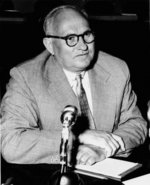
Beardsley Ruml
| Surname | Ruml |
| Given Name | Beardsley |
| Born | 5 Nov 1894 |
| Died | 18 Apr 1960 |
| Country | United States |
| Category | Commerce-Industry |
| Gender | Male |
Contributor: C. Peter Chen
ww2dbaseBeardsley Ruml was born in Cedar Rapids, Iowa, United States to a physician. He completed his college degree from Dartmouth College in 1915, and received his Ph.D. degree in psychology and education from the University of Chicago in 1917. In 1917, he married Lois Treadwell, with whom he had three children. In 1918, he helped design aptitude and intelligence tests for the United States Army; he viewed society as groups whose traits could be measured on a scale of normality and deviance. Between 1922 and 1929, he directed the fellowship program of the Laura Spelman Rockefeller Memorial Fund, then became an adviser to President Herbert Hoover in 1930. In 1931, he was the dean of the Division of Social Sciences at the University of Chicago, which was known for quantitative research.
ww2dbaseIn 1934, Ruml became an economist and treasurer of R. H. Macy & Company in New York City, New York, United States, the owner of Macy's department stores. He noticed that when Macy's employees retired and began living on their pensions, they enter financial difficulty. He found that the recent retirees had to pay their previous year's income taxes while having to live at a lower income level. Looking beyond his own company, he found that a widow he knew suffered a heavy burden having to pay for her recently-deceased husband's taxes while not having any income to pay them with. Realizing that a similar scenario would play out to all draftees leaving their high-paying jobs for United States Army pay of only $50 a month once the US entered WW2, he warned that the system would collapse. Some time during the winter of 1940 to 1941, he came up with a "pay-as-you-go" system, as he called it, of paying income taxes; it called for everyone to pay the current year's taxes by having the money deducted from paychecks, thus allowing everyone to start a new tax year free of tax burden. The idea initially faced serious opposition because it required an one-time forgiveness as the system switched from one to another. On 1 Jul 1943, this idea of Ruml's entered into American law with a forgiveness to lower income families only, while the rich only received a partial forgiveness. This innovative way to collect income tax survived through the WW2 era and lasted until today.
ww2dbaseIn 1945, Ruml became the chairman of R. H. Macy & Company while serving as a director of the New York Federal Reserve Bank between 1937 and 1947.
ww2dbaseSources: Washington Goes to War, Wikipedia.
Last Major Revision: Mar 2008
Beardsley Ruml Interactive Map
Photographs
 |
Beardsley Ruml Timeline
| 5 Nov 1894 | Beardsley Ruml was born. |
| 18 Apr 1960 | Beardsley Ruml passed away. |
Did you enjoy this article or find this article helpful? If so, please consider supporting us on Patreon. Even $1 per month will go a long way! Thank you. Share this article with your friends: Stay updated with WW2DB: |


» Washington Goes to War
|
- » 1,146 biographies
- » 336 events
- » 43,422 timeline entries
- » 1,237 ships
- » 349 aircraft models
- » 207 vehicle models
- » 372 weapon models
- » 123 historical documents
- » 259 facilities
- » 468 book reviews
- » 28,395 photos
- » 432 maps
James Forrestal, Secretary of the Navy, 23 Feb 1945

Please consider supporting us on Patreon. Even $1 a month will go a long way. Thank you!

Or, please support us by purchasing some WW2DB merchandise at TeeSpring, Thank you!