


William Halsey
| Surname | Halsey |
| Given Name | William |
| Born | 30 Oct 1882 |
| Died | 20 Aug 1959 |
| Country | United States |
| Category | Military-Sea |
| Gender | Male |
Contributor: C. Peter Chen
ww2dbaseWilliam Frederick Halsey, Jr. was born in Elizabeth, New Jersey, United States, to Master William F. Halsey, Sr. of the US Navy. Growing up hearing his father's stories, he attended the United States Naval Academy and graduated 43 out of 62. During his early career he served aboard battleships and torpedo craft.
ww2dbaseDuring WW1, Halsey was a lieutenant commander who commanded the USS Shaw in 1918 and also saw action as the commander of Atlantic Fleet's Torpedo Flotilla; he earned a Navy Cross before the end of WW1. In the interwar years, Halsey served as Naval Attaché to Germany, Norway, Denmark and Sweden. After several sea-going commands, he attended Naval War College and then learned to pilot an aircraft in 1935, which changed the direction of his career. He went on to command the carrier USS Saratoga and then commanded the Naval Air Station at Pensacola, Florida, United States. He trained pilots who were destined to fill squadrons for the modern carriers Enterprise and Yorktown. In 1938, when the war had already broken out in Asia, Halsey was promoted to the rank of rear admiral and commanded carrier divisions. In 1940 he was promoted vice admiral.
ww2dbaseVice Admiral Halsey was at sea in his flagship USS Enterprise when the Japanese struck Pearl Harbor. He was overseeing a mission to deliver Marine Corps fighters to bases in the Pacific, and luckily evaded the devastating Japanese raid. His carrier task force took parts in raids to deter further Japanese advance in the early stages of the Pacific War, as well as transporting James Doolittle's raiders on their famous raid on Tokyo. Halsey was absent from the major battle at Midway due to skin disease, which built up his later aggressiveness to hunt down Japanese carriers to avenge the deaths of so many American lives at the hands of Japanese naval pilots. Promoted to admiral in Nov 1942, Halsey was instrumental in both King and Nimitz's island hopping campaign and MacArthur's "hit 'em where they ain't" campaign. During the Guadalcanal Campaign, Halsey's forces were credited with sinking two Japanese battleships, two destroyers, and six transports at the loss of two cruisers and four destroyers.
ww2dbaseHalsey led a raid to Taiwan with the target being the land-based aircraft that might be used by the enemy during the subsequent Allied invasion of the Philippines. During an engagement that the Japanese lost 312 fighters, the exaggeration of damage inflicted on Halsey's fleet soared as high as eleven carriers and two battleships sunk. Halsey, upon hearing enemy propaganda based on the exaggerations, being true to himself sent Nimitz the sarcastic radio message "the Third Fleet's sunken and damaged ships have been salvaged and are retiring at high speed toward the enemy.
ww2dbaseFrom Sep 1944 to Jan 1945, Halsey led the US Third Fleet to assist Douglas MacArthur reclaim the Philippines. His fleet participated in the campaigns to take Palau Islands for staging the Philippines invasion, and then the Philippines campaign itself. During the Leyte Gulf Campaign, after launching a successful air strike that sank the battleship Musashi, Halsey's aggressiveness and personal ambition to sink Japanese carriers was taken advantage upon by Japanese admiral Jisaburo Ozawa, who baited Halsey with a decoy force successfully, allowing Takeo Kurita's Center Force of heavy surface ships to attack American Task Force 34 consisted of destroyers, destroyer escorts, and escort carriers. Task Force 34's message "Where is [repeat] where is Task Force 34" became a motto for those who criticized Halsey's over-aggressiveness that cost American lives unnecessarily. Despite heroic efforts by American destroyers, the Japanese fleet overwhelmed the outgunned American ships, though Kurita's over-carefulness in withdrawing the attack earlier than necessary saved the doom of entire American task forces. Halsey's subsequent run-in with typhoons, which resulted in loss of ships and lives, again put him in scrutiny.
ww2dbaseHalsey was aboard USS Missouri, his flagship, when the Japanese delegation signed the surrender document in Tokyo Bay.
ww2dbaseIn MacArthur's Reminiscences, the general wrote
ww2dbaseMacArthur regarded Halsey very highly for his aggressive style, ranking him among one of the very few naval personnel that he trusted.
ww2dbaseHalsey retired from the US Navy in Mar 1947 and became director of several large corporations. He passed away in Pasadena, California in 1959 and was interred in Arlington National Cemetery.
ww2dbaseSources:
Douglas MacArthur, Reminiscences
William Manchester, American Caesar
United States Navy Naval History and Heritage Command
Wikipedia
Last Major Revision: Aug 2006
Famous Quote(s)
- "Before we're through with them, the Japanese language will be spoken only in hell."
» On the Japanese attack of Pearl Harbor, 8 Dec 1941
William Halsey Interactive Map
Photographs
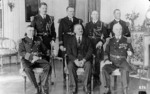 | 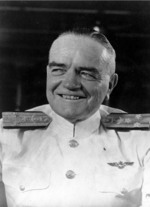 | 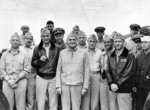 | 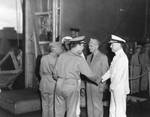 |
William Halsey Timeline
| 30 Oct 1882 | William Halsey was born. |
| 6 Feb 1906 | William Halsey was promoted to the rank of ensign. |
| 2 Feb 1909 | William Halsey was promoted to the rank of lieutenant. |
| 29 Aug 1916 | William Halsey was promoted to the rank of lieutenant commander. |
| 1 Feb 1918 | William Halsey was promoted to the rank of commander. |
| 10 Feb 1927 | William Halsey was promoted to the rank of captain. |
| 1 Mar 1938 | William Halsey was promoted to the rank of rear admiral. |
| 13 Jun 1940 | William Halsey was promoted to the rank of vice admiral. |
| 13 Jun 1940 | Rear Admiral William F. Halsey, Jr. relieved Vice Admiral Charles A. Blakely as Commander Aircraft, Battle Force of the US Navy on board carrier USS Yorktown at Lahaina Roads, Maui, US Territory of Hawaii. Halsey received the temporary rank of vice admiral for this assignment. |
| 18 May 1942 | At Pearl Harbor, US Territory of Hawaii, Edwin Layton informed Joseph Rochefort that while Chester Nimitz would like to receive further evidence that Midway Atoll was indeed the next Japanese target. Meanwhile, Chester Nimitz ordered William Halsey to bring his carrier group back to the Hawaiian Islands as a precaution. |
| 26 May 1942 | US Navy Vice Admiral Halsey fell ill. |
| 18 Oct 1942 | US Navy Vice Admiral William F. Halsey was designated the commander of the South Pacific Area, and was made directly responsible for the campaign in New Guinea and the Solomon Islands. |
| 8 Nov 1942 | William Halsey inspected Henderson Field, Guadalcanal, Solomon Islands. Staying overnight, he personally experienced a Japanese naval bombardment which he later admitted filled him with fright. |
| 18 Nov 1942 | William Halsey was promoted to the rank of admiral. |
| 15 Apr 1943 | William Halsey traveled to Brisbane, Australia aboard a PB2Y Coronado aircraft. |
| 16 Apr 1943 | William Halsey met with Douglas MacArthur at the latter's headquarters in Brisbane, Australia. |
| 25 May 1944 | William Halsey gave a farewell speech to SOPAC personnel at Emirau, Bismarck Islands. |
| 3 Nov 1944 | William Halsey personally inspected USS Franklin at Ulithi, Caroline Islands; she was the first major American ship to be damaged by "kamikaze" special attacks. |
| 18 Dec 1944 | Many ships from the United States Third Fleet, Task Force 38 sailed into Typhoon Cobra in the Philippine Sea. Three destroyers and 790 men were lost. |
| 29 Dec 1944 | Admiral William Halsey came aboard destroyer escort USS Tabberer at Ullithi and presented awards to the commanding officer, LtCdr Henry Plage, as well as several crewmembers for their performance in rescuing 55 sailors from ships sunk during Typhoon Cobra. USS Tabberer and all hands were also awarded the Navy Unit Commendation for these same efforts. |
| 4 Jun 1945 | Many ships from the United States Third Fleet, primarily Task Groups 38.1 and 30.8 sailed into Typhoon Connie south of Japan. No ships were lost but 7 men lost their lives. |
| 4 Jun 1945 | At 1848/I, USS Ancon's radar captured a clear image of a well-formed tropical storm on a rapid northeasterly track heading directly toward Rear Admiral J.J Clark's 76-ship formation of ships including carriers, battleships, and a replenishment group. Ancon prepared a message for Clark and Fleet Commander Admiral William Halsey but because of coding requirements and a heavy volume of similarly coded weather reports from other sources, Ancon's report was not fully appreciated by Clark or Halsey for over five hours. By then, Clark's ships had already sailed into Typhoon Connie. |
| 15 Jun 1945 | A United States Navy Court of Inquiry was convened aboard USS New Mexico in San Pedro Bay, Leyte to investigate what led 76 ships to sail into Typhoon Connie ten days before. Responsibility was placed squarely on Admiral William Halsey and Vice-Admiral John McCain, although no action was taken against Halsey. |
| 16 Aug 1945 | British Admiral Bruce Fraser awarded William Halsey the Order of the Knight of the British Empire aboard USS Missouri. |
| 11 Dec 1945 | William Halsey was promoted to the rank of fleet admiral. |
| 14 Dec 1945 | William Halsey was honored with a ticker tape parade in New York, New York, United States. |
| 20 Aug 1959 | William Halsey passed away. |
Did you enjoy this article or find this article helpful? If so, please consider supporting us on Patreon. Even $1 per month will go a long way! Thank you. Share this article with your friends: Stay updated with WW2DB: |


Visitor Submitted Comments
25 Jun 2010 12:37:34 AM
This needs to be rewritten. TF34 was 3rd Fleet battleline under VADM Lee.Halsey had said he was forming TF34.Nimitz/King were under impression that TF34 was guarding the S.B Straits exit.Halsey had taken TF 34 with him chasing the decoy jap fleet. Where is TF34 was sent by Nimitz the coding officer had put padding around the message.Turkey trots to water (the message) The whole world wonders? Halsey was given the message with the whole world wonders still attached. He threw a tamtrum, jumped on his cover, etc. The Taffie's 1,2,and 3 were part of the 7th Fleet not the 3rd.MacArthur comments about Halsey were self serving. He was jealous of Nimitz and that the Central Pacific was a higher priority, and drew the publicity with the island fighting and naval battles. MacArthurs SouthWest Pacific was the back water theater with lowest priority. The 7th Fleet was assigned to him. It was mostly older ships, no large or medium carriers. It was not the A team that the 3rd/5th Fleet was. Also if you notice Nimitz gave command of almost all landings to Spruance. He did not trust Halsey to be rational.Halsey proved Nimitz right when he went after the bait carriers and leaving the Army landing at Leyte to the mercy of the *** Fleet. Nimitz/King would rather have seen Spruance get the 5th star, but Halsey was good press and had the support of Congress.Spruance made it clear he would not accept the 5 star if Halsey did not get it also. Halsey had been there for Spruance over the years. Basically Spruance was a thinking man, no one accused Halsey of being that.
25 Jun 2010 12:44:19 AM
Nimitz took Halsey to task when he came aboard the Missouri in Tokyo Bay.Halsey did not break out Nimitz's flag. Nimitz being senior his flag should of been flying. I guess you could also conclude that it was Nimitz's flagship as long as he was on it.
It is interesting that Halsey's flagship had been the New Jersey until Truman from Missouri became president. Kind of sounds like someone was a Kiss Ass?
30 Jun 2010 01:32:22 PM
I was on the USS Hornet CV-8 and was on the Island New Caledonia where Admiral Husley had his COMCOPAC headquarters. I joined the Navy May 3rd 1942 made Midway battle, Santa Cruiz aborad the Hornet. When she was sunk Oct. 26, 1942 I was in the water when a *** plane drop a bomb missing the Hornet and hit the water near the gun crews in the water. We were the last to leave the Hornet. I was knock out and was hauled up to the deck of the USS Barton DD-599. I was in sick bay when they tranfered the Hornets crew at Noumrea. New Caledonia. The Barton was nine hours underway when It was discovered I was Still Aboard. The captain came down and ask me how I felt.I said my stomach was a little sore but ok. He said welcome aboard your now a crewmember of the USS Barton. He asked me if I knew any thing about a 20MM dun. I mentioned I shot one during the time in Pearl Harbor when the Navy and Marines were given training at Pearl Harbor. I told him I could shoot one but I couldnt load one. I only weighed 130 Lbs. I was assigned to a 20MM gun on the port side. This was not original place fo9r a 20MM gun I was told. On the night of Nov.13 when the battle at Guadalcanal the Barton took 2 torpedos amid ship. She broke into and the steel plate the 20MM gun was broke loose sending me and the loader to safety. We were picked up by boats and take to Guadalcanal. Later we were taken to New Caledonia. I was working on the docks when a chief ask me if any could type on a typewriter. I said I could. He told me to shower and get into clean uniform and report to a chief in the Supply Office. I srarted to work for Cat. Nuber the supply officer. Our office was in the area where Admiral Hausley usually walk to work. One morning I walked out of the office with two buckets of dirty coffee cups and a cigar in my mouth. Admiral Hausley walked by about this time. I dropped one bucket and saluted him. He asked me "sailor do you usually salute a Admiral with a cigar in your mouth. I dropped the cigar and the other bucket of cups and saluted him. He mention to Capt. Knuber. if he could check the incoming ships to see if they had any Fancy Tail Cigars. No kidding.Apparently there was such a cigar. Capt. Knuber said he waould have a Chief check it out. Admiral said "why not Johnson". If I found some at least he would get them". Can you guess what the people on the ship thought when a Admiral boat came along side and I stepped off requesting to see the Captain. I didn't get many at first. BUT EVERY SHIP COMING IN FROM THE sTATES HAD A GOOD SUPPLT WHO WOULD ME GIVEN TO HIM BY THEIR SKIPPER. There were a lot of things that happened there in Noumea and nothing has been found on the internet. Its a shame.
5 May 2015 09:36:48 AM
edit this page please
23 Apr 2016 07:09:00 PM
Halsey's heading north to attack a
TF of Japanese Carriers was the only prudent thing
to do. This is not Monday morning quarterbacking.
If he did not sail north to meet the Japanese
and there had been carries full of plans and
pilots, it could have been another Okinawa, or
worse. He had no way of knowing what those carries
had on the decks. Second there was no, none, chance
in Hell for the Japanese surface fleet to do
any real damage to the invasion force... Yes
Taffie 3 took a beating, and so did some DE
We could look back at Guadalcanal and say
that Halsey lost a lot of ships, yes but in the end
the Japanese were stopped... Being a commander
is not easy, choices usually get men killed and
ships sunk..
As a last thought, in every battle the Japanese
retreated once they got a bloody nose. But it
was Halsey who at the right time, right place
pushed them back and kept on pushing them...
James Johnson, thank you for defending
freedom. But after having to ships sunk from
under you. please never offer to give me a boat
ride!!!!!
EX Navy man myself
24 Jul 2016 07:15:20 PM
These comments are most interesting especially form those who were there with Halsey. Every Commander makes mistakes. Certainly the *** Commanders made many. It is the one who makes the least mistakes who wins the battle and thus the war.
Do wish more could have posted similar comments. But then most who did survive the war have since departed these earthly bounds.
Recommend an excellent movie The Gallant Hours which chronicles the high points of Halsey's Pacific Command during WWII.
 David Stubblebine says:
25 Jul 2016 04:26:39 PM
I know it has been several years since the earlier comments were posted, but two of them still require a response.
Comment #1 (picuri):
You are correct that “there is no mention of Halsey relieving Spruance at Okinawa because of heavy ship losses to Japanese kamikazes” because this never happened. Starting in mid-1944 Halsey and Spruance traded off commanding the carrier fleet and their changes of command were well scheduled. Additionally, many would consider Spruance the better commander. When Nimitz hedged his bets by not bringing any of his large carriers into Tokyo Bay for the surrender ceremony in case the whole thing turned out to be a Japanese trap, who did he leave in command of the carriers waiting just off shore? Spruance, not Halsey.
Comment #3 (Anonymous):
I cannot imagine what your sources could be. First off, if Nimitz had an issue with his flag not being flown, his staff would have taken it up with the ship’s captain, not Halsey. Second off, the Missouri’s captain at the time, Stuart S Murray, wrote a very detailed description of the preparations that took place aboard ship before and during the surrender ceremony and part of that was the story of the very careful juggling of hoisting Nimitz’ blue Fleet Admiral flag and MacArthur’s red General of the Army flag. During the time both were aboard, both flags were flying – something that is normally outside Navy guidelines. They paid close attention to this.
http://ww2db.com/doc.php?q=502
18 Nov 2016 08:40:28 PM
This may be 'off topic' but I have to share my experence (sic) w/ Halsey! (NO I am not a WWII Vet.) I was born & raised in Elizabeth, N.J..My older brother had an office cleaning co., & I worked for him. One of the offices I cleaned was 'The M. C. A. Ins.co in Elizabeth off of Westrminster Ave. It was late @ night & I was by myself , I heard 'footsteps' coming from up in the attic, going from one side to the other side, then LOUD dragging sounds (like someone moving something heavy) going from side to side ! I went up to the attic , the light was on & on both sides were large metal file cabinets. I called out but no one was there. I shut off the light & went back to my cleaning. A short time later I heard the SAME footsteps followed by the LOUD dragging sound ! It sounded like the metal file cabinets were being moved ! I went back up & THE LIGHT WAS ON AGAIN , but the files cabs. seemed not to have been MOVED ! I shut off the light & finished my work ( VERY quickly)! Some time later I was there early in the evening , & some of the Ins. agents were working late. I asked if any one knew what caused all the noise I heard the other night. One of the men laugh and said : "That's the Admiral ". I asked : "WHAT ADMIRAL ?", as I did NOT KNOW the history of the building ! He told me that this 'house' was the childhood home of Admiral 'Bull' Halsey & he IS STILL HERE ! (again ,I knew NOTHING of the history of the building or Halsey !) I DO NOT WORK there anymore, but I know one thing; the Admiral's SPIRIT IS NOT AT REST ! ( 4 WHAT EVER REASON !) This is the God' honest TRUTH & maybe we should ALL pray 4 him !
18 Nov 2016 09:47:59 PM
PS : The 'footsteps' sounded more like : "clip-clop, clip-clop" , like someone walking w/ a limp or using a cane . Does anyone know if Wm. Halsey walked w/ a limp or used a cane later in his life ? FYI: I am NOT some 'ghost hunter' NUT case , nor do I do ANY drugs or drink , BUT something is/was going on in his childhood home ! I moved from Elizabeth, NJ years ago, but I remember going past his old house @ night (after I QUIT) & THE LIGHT WAS ALWAYS ON IN THE ATTIC !
13 Dec 2022 07:37:58 PM
My grandmother, Ruth Halsey McQuain Hall was related to him. She is from Greenbrier countyWV. I find this very interesting, especially to think that Admiral Halsey may be a branch in my family tree
All visitor submitted comments are opinions of those making the submissions and do not reflect views of WW2DB.
» Doolittle Raid
» Guadalcanal Campaign
» Solomon Islands Campaign
» Operation Vengeance
» Palau Islands and Ulithi Islands Campaigns
» Philippines Campaign, Phase 1, the Leyte Campaign
» Typhoon Cobra
» Raid into the South China Sea
» Typhoon Connie
» Preparations for Invasion of Japan
» Japan's Surrender
Ship(s) Served:
» Missouri
» New Jersey
Related Books:
» American Caesar: Douglas MacArthur 1880-1964
- » 1,146 biographies
- » 336 events
- » 43,422 timeline entries
- » 1,237 ships
- » 349 aircraft models
- » 207 vehicle models
- » 372 weapon models
- » 123 historical documents
- » 259 facilities
- » 468 book reviews
- » 28,395 photos
- » 432 maps
Joachim von Ribbentrop, German Foreign Minister, Aug 1939

Please consider supporting us on Patreon. Even $1 a month will go a long way. Thank you!

Or, please support us by purchasing some WW2DB merchandise at TeeSpring, Thank you!
19 Mar 2007 10:39:41 AM
tere is no mentioin of halsy relieving spruance at okinawa because of heavy ship losses to japanese kamikazes