


Kfz. 305 Blitz
| Country | Germany |
| Manufacturer | Adam Opel AG |
| Primary Role | Transport |
Contributor: Alan Chanter
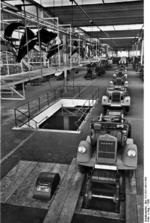
ww2dbaseIn order to standardise their vehicle fleet the German Army (which by the late 1930s had more than 100 different vehicle designs in service, leading to massive logistical difficulties), opted for a pre-war commercial truck design by Adam Opel AG of Brandenburg to become their standard cargo truck With only slight modifications to meet military requirements, the Opel Blitz would quickly become one of the most widely used Axis vehicles throughout the war years, being used in all theatres of the war and in a variety of roles. The usual body style was a flat cargo bed with a canvass cover, but others were fitted out for such roles as Field Ambulance, Mobile Workshop and Command vehicles.
ww2dbasePowered by a 3,600cc Opel six-cylinder petrol engine developing 73.5 hp (54.8 kW) driving only the twin rear wheels, the Blitz had an enclosed steel cab and wooden bodywork (although late in the war some were built out of pressed card to conserve steel), the Blitz could carry a payload of 3,000kg, or tow a load of up to 5,000kg, and although well built, suffered from being rather too complicated for reliability in the rugged conditions found on the Eastern Front.
ww2dbaseTo improve cross-country performance, from 1940, a limited number were built with four-wheel drive (under the designation "Allrad"). Additionally, in 1942-1943 a number of these trucks were converted in to half-tracks (Maultier) by replacing the rear wheels with a Carden-Loyd pattern track unit with two bogies on each side. Although these performed quite well the track units was not really designed for heavy load-bearing, and thus the payload was limited to a maximum of 2,000 kg (or 3,000 kg towed).
ww2dbaseIn total over 70,000 Opel Blitz trucks were supplied to the German Armed Forces during the war years with production only ending in 1944, when a combination of Allied bombing and ground advances resulted in the closure of the factories.
ww2dbaseSources: The Illustrated Encyclopaedia of Military Vehicles (Ian V Hogg & John Weeks,-Hamlyn, 1980), Armoured Fighting Vehicles (Philip Trewbitt, Dempsey-Parr,1999).
Last Major Revision: Aug 2009
SPECIFICATIONS
Kfz. 305 Blitz
| Machinery | One Opel 3600cc 6-cylinder gasoline engine rated at 73.5hp |
| Crew | 1 |
| Length | 6.02 m |
| Width | 2.26 m |
| Height | 2.17 m |
| Weight | 3.2 t |
| Speed | 80 km/h |
| Range | 410 km |
Photographs
 |  |  |  |
Did you enjoy this article or find this article helpful? If so, please consider supporting us on Patreon. Even $1 per month will go a long way! Thank you. Share this article with your friends: Stay updated with WW2DB: |


Visitor Submitted Comments
6 Apr 2016 04:45:56 PM
In all the information I've found on Opel blitzes , they never say how many troops are transported on board
9 Nov 2018 10:03:25 AM
The 3 ton blitz could seat 10 men in the cargo bed a 2 men in the cab.
22 Jan 2023 11:49:25 AM
The 1944 Fallschirmjager platoon was allocated 2 of these trucks to carry a platoon of 36. If the platoon leader & platoon sergeant each rode in the cabs - that left 17 men & their equipment in the back of each truck. This would be the long-bed 3-ton. The standard truck could carry 12 men in the bed.
19 Feb 2023 07:19:26 AM
Great article. Could anyone inform me if the Opal Blitz Truck could be turned over by hand. Inertia starting by hand crank? Many Thanks in advance.
All visitor submitted comments are opinions of those making the submissions and do not reflect views of WW2DB.
- » WW2DB's 19th Anniversary (29 Dec 2023)
- » Looted Painting "Madonna with Child" Returned to Poland (2 Jun 2023)
- » Wreck of USS Mannert L. Abele Found (29 May 2023)
- » Wreck of Montevideo Maru Found (25 Apr 2023)
- » Accidental Detonation of a WW2-Era Bomb in Great Yarmouth (10 Feb 2023)
- » See all news
- » 1,146 biographies
- » 336 events
- » 43,422 timeline entries
- » 1,237 ships
- » 349 aircraft models
- » 207 vehicle models
- » 372 weapon models
- » 123 historical documents
- » 259 facilities
- » 468 book reviews
- » 28,395 photos
- » 432 maps
James Forrestal, Secretary of the Navy, 23 Feb 1945

Please consider supporting us on Patreon. Even $1 a month will go a long way. Thank you!

Or, please support us by purchasing some WW2DB merchandise at TeeSpring, Thank you!
12 Nov 2009 05:59:03 PM
During World War II German Industry produced
130,000 vehicles, built in different versions
over 25,000 were built as four-wheel drive.
The blitz was in development from 1931 onward it was reliable, easy to maintain,
It was built as a 1.5 or 3 ton truck, a half-
track version was also built.
With most military equipment, it was used for
other duties mounted anti-aircraft and anti-
tank guns. The Opel Blitz was a jack of all
trades.
The production of the blitz continued after the war. I saw many different versions of the blitz in civilian livery, working the
streets in West Germany during the 1960's.
The best one was the beer tankers, we see
fuel tankers bringing fuel to the gas stations,here in the states,in Germany they haul that great german beer!. What was the price of that beer back then, one mark, now that was a deal and you could buy yourself a
steak dinner for eight marks little over two
dollars.
"Those were the days my friend, we thought
they would never end ,we'd drink and laugh
the night away"...
Remember that 1960's song