


Typhoon
| Country | United Kingdom |
| Manufacturer | Hawker Aviation |
| Primary Role | Fighter |
| Maiden Flight | 24 February 1940 |
Contributor: C. Peter Chen
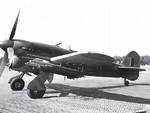
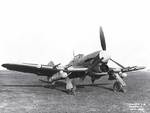
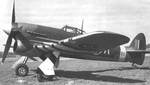
ww2dbaseThe Typhoon fighters were designed as the replacement for the Hawker Hurricanes. The design began in Mar 1937 by Sidney Camm. It received the confirmation to continue in Jan 1938 when the design matched what the British Air Ministry was requesting in the next generation of fighters. The first fighter of this design took flight in Oct 1939 with a Rolls-Royce engine; it immediately impressed the Royal Air Force, but the first batch of these fighters delivered was full of problems. The original designation for these new fighters was Tornado, and they suffered compression effects and a slow climb performance. The next batch, delivered in Feb 1940, named Typhoon, suffered from a damaging engine vibration problem. The design was cancelled by the RAF in May 1940, but in Oct 1940 the demand for aircraft gave this design another chance. In early 1941 the first Typhoon fighters rolled off the production line (actually, their design was of the Tornado). The first few fighters were rushed to the front lines to dogfight with the German Fw 190 fighters, and they performed poorly; their tails sometimes broke off when pulling out of dives. Subsequent Typhoon fighters were equipped with strengthening plates at key locations to remedy this problem. Another problem these production Typhoon fighters suffered was the leak of exhaust fumes into the cockpit, which required the pilots to always use oxygen. Despite the problems, the Typhoon design continued to be in production due to the demands of the war.
ww2dbaseRobert Rogge recalled seeing Typhoon fighters overhead as he fought in the Canadian Army in Normandy:
ww2dbaseThe Tiffies were big planes for single-seaters and the under-slung radiators gave them a bulldog look.... When the rocket smoke squirted out, it looked like the plane had been hit. Then the fiery red rockets shot ahead, trailing white smoke to their targets. Nothing could stand up to a Tiffie rocket, not even a Tiger tank.
ww2dbase[The Germans] feared and hated the Tiffies. They had helped make the hell of Falaise. Everything they attacked was reduced to a fearsome shambles.
ww2dbaseBy 1943, most of the production problems with the Typhoon fighters were worked out of the system, and new fighter-bomber variants were being released. Some of the newly equipped fighter-bombers performed superbly in the landing phase of the Normandy Campaign, destroying over 100 German vehicles and armor and disrupted German reinforcements. In the following months, hundreds of Typhoon fighters formed the backbone of the 2nd Tactical Air Force and operated around the clock from rough forward airfields against German ground forces.
ww2dbaseSources: Aircraft of the Second World War, Fearsome Battle, Wikipedia.
Last Major Revision: May 2007
Typhoon Timeline
| 23 Jul 1940 | Sydney Camm, Chief Designer at Hawker aviation, managed to get the Typhoon and Tornado programmes reinstated with reduced priority after the British Air Ministry had decided to throw all resources at the manufacture and repair of existing types. |
| 1 Nov 1941 | A newly issued Typhoon fighter of British No. 56 Squadron plunged into the ground near East Harling, Norfolk, England, United Kingdom, killing Pilot Officer J. F. Deck. Subsequent investigations revealed that he had suffered from carbon monoxide poisoning leading to the entire Typhoon fleet being grounded for modifications to cockpit sealing and the fitting of improved extended exhausts, although the problem was never satisfactorily resolved. |
| 25 Oct 1943 | Typhoon fighter-bombers of No. 181 Squadron RAF used rockets for the first time during an attack on a power station at Caen, France. Although the target was hit, three of the Typhoon aircraft were shot down by anti-aircraft weapons, including that of the squadron commander Squadron Leader Frank Jensen. |
SPECIFICATIONS
1B
| Machinery | One Napier Sabre II 24-cylinder flat-H liquid-cooled engine rated at 2,180hp |
| Armament | 4x20mm Hispano cannons, optional 8 rockets or 2x227kg bombs |
| Crew | 1 |
| Span | 12.67 m |
| Length | 9.73 m |
| Height | 4.66 m |
| Weight, Empty | 3,992 kg |
| Weight, Loaded | 6,010 kg |
| Speed, Maximum | 664 km/h |
| Service Ceiling | 10,730 m |
| Range, Normal | 821 km |
| Range, Maximum | 1,577 km |
Photographs
 |  |  |  |
Please consider supporting us on Patreon. Even $1 per month will go a long way! Thank you. Please help us spread the word: Stay updated with WW2DB: |


Visitor Submitted Comments
All visitor submitted comments are opinions of those making the submissions and do not reflect views of WW2DB.

» Normandy Campaign, Phase 1
- » 1,182 biographies
- » 337 events
- » 45,119 timeline entries
- » 1,248 ships
- » 350 aircraft models
- » 207 vehicle models
- » 376 weapon models
- » 123 historical documents
- » 261 facilities
- » 470 book reviews
- » 28,409 photos
- » 365 maps
Winston Churchill

Please consider supporting us on Patreon. Even $1 a month will go a long way. Thank you!

Or, please support us by purchasing some WW2DB merchandise at TeeSpring, Thank you!
13 May 2020 12:28:54 PM
The aircraft is said to have a major problem, that it would overheat in a climb. I don't know wether or not it was ever fixed.