


F4U Corsair
| Country | United States |
| Manufacturer | Chance Vought Corporation |
| Primary Role | Fighter |
| Maiden Flight | 29 May 1940 |
Contributor: C. Peter Chen
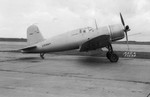
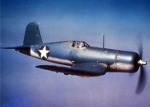
ww2dbaseThe F4U Corsair fighters first took flight in 1940. Jointly designed by Rex Beisel and Igor Sikorsky, the fighters with inverted gull wings were designed as carrier fighters from the ground up but without sacrificing much of the capabilities. The Corsair fighters were the first American fighters to reach the speech of over 717-km/h in level flight thanks to its streamlined body design (retractable landing gears, streamlined air intakes, etc.) and they packed ample firepower which led to their usage of close ground support fighters in Pacific landing operations.
ww2dbaseF4U Corsair fighters' complex design gave them superior performance, but it also gave the aircraft mechanics aboard carriers difficulties, particularly when the model was initially introduced. Additionally, the fighters' long noses hampered visibility during landings, causing many fatal crashes. Such growing pains caused some disliking for the model in the US Navy airmen; initially, the US Navy actually deemed Corsair aircraft unsuitable for carrier operation and assigned them to the US Marines.
ww2dbaseWhile the US Navy took a more cautioned approach, the British Royal Navy Fleet Air Arm introduced the Corsair fighters first. This move was largely because while the US Navy had the proven F6F Hellcat fighters, the British existing carrier fighters were less capable. 424 Corsair fighters were also given to the British Commonwealth Forces of New Zealand. British and Commonwealth operational experiences were fed back to Chance Vought, the manufacturers of the model, while British pilots shared an alternate landing technique with the US Navy. It was then that the US navy began adopting them for carrier service. As the Japanese began operating Special Attack tactics, the now-nicknamed "Sweethearts of the Marianas" began to display their strengths as their faster speed and climb rate were much better suited for intercepting special attack aircraft than anything else in the Allied arsenal.
ww2dbaseOverall, 12,500 F4U Corsair fighters of 16 separate models were built by Chance Vought, Goodyear, and Brewster. They achieved a kill:loss ratio of 10:1, and remained flight worthy to participate in the Korean War and the war in Indochina, both in the first half of the 1950s. A few Corsair fighters were also seen during the Football War between Honduras and El Salvador in 1969.
ww2dbaseSources: Inferno, Wikipedia.
Last Major Revision: Oct 2007
F4U Corsair Timeline
| 11 Apr 1938 | Aircraft manufacturers Bell, Brewster, Curtiss, Grumman, and Vought-Sikorsky submitted proposals for the US Navy Jan 1938 requirement for a lightweight high-performance shipboard fighter. |
| 30 Jun 1938 | US Navy ordered one prototype of Grumman XF5F-1 Skyrocket and one prototype of Vought XF4U-1 Corsair for trials. |
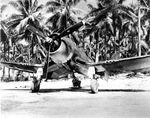
| 13 Feb 1943 | F4U-1 Corsair aircraft of US Marines squadron VMF-124 made their first operational debut, escorting a US Navy Catalina aircraft on a Dumbo search and rescue mission, 200 miles north of Guadalcanal, Solomon Islands. |
| 31 Oct 1943 | The US Navy scored its first radar aided aerial victory when an F4U-2 Corsair fighter destroyed a Japanese aircraft it had intercepted over New Georgia. |
SPECIFICATIONS
F4U-4
| Machinery | Pratt & Whitney R-2800-18W Double Wasp 18-cyl radial engine rated at 2,450hp |
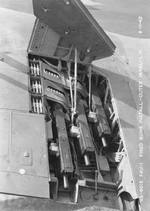
| Armament | 6x0.50in Browning M2 machine guns, optional 8x127mm rockets or optional 2x454kg bombs |
| Crew | 1 |
| Span | 12.50 m |
| Length | 10.20 m |
| Height | 4.90 m |
| Wing Area | 32.50 m² |
| Weight, Empty | 4,175 kg |
| Weight, Loaded | 6,350 kg |
| Weight, Maximum | 6,654 kg |
| Speed, Maximum | 717 km/h |
| Service Ceiling | 12,649 m |
| Range, Maximum | 2,510 km |
Photographs
 |  |  |  |
Please consider supporting us on Patreon. Even $1 per month will go a long way! Thank you. Please help us spread the word: Stay updated with WW2DB: |


Visitor Submitted Comments
30 Apr 2007 11:35:33 AM
No kidding...the Japanese nicknamed it Whistling Death because of the whistling sound the inverted gull wings made in the air...awesome.
 Alan Chanter says:
30 Oct 2007 06:52:23 AM
The Royal Navy actually took delivery of ninety-five F4U-1 (Corsair I), 510 F4U-1A (Corsair II, 430 F3A-1D (Corsair III) and 977 FG-1D (Corsair IV) operating in nineteen squadrons. In addition a further 370 F4U-1Ds were supplied to the R.N.Z.A.F operating in three squadron.
Alan Chanter says:30 Oct 2007 06:59:14 AM
Royal Navy Corsair Is were modified with a bulged front cockpit canopy to allow the pilot to improve visibility by raising his seat. Other modifications included clipping 16 inchs from the wingtips to enable storage on the smaller British carriers, fitting Rocket rails, and on some earlier machines providing a fuel drop-tank beneath the fuselage.
Alan Chanter says:30 Oct 2007 07:03:15 AM
Deliveries to the F.A.A. commenced on June 1, 1943 when No.1830 squadron formed with Corsair Is at Quonset. By the end of that year seven more squadrons were forming up with Corsair Is or IIs
Alan Chanter says:30 Oct 2007 07:06:49 AM
The first operational sorties by F.A.A. Corsairs occurred on April 3, 1944, when Corsair IIs of No.1834 squadron provided air cover for torpedo bombers attacking the German Battleship Tirpitz
Alan Chanter says:30 Oct 2007 07:10:52 AM
British Corsairs were built by Chance-Vought (Corsair I and II), Brewster (Corsair III) and Goodyear (Corsair IV).
1 May 2008 08:21:20 AM
what the hell this isnt a bad page if you were looking for a little bit on it but ive seen sights much better composed. my definition this sucks hairy balls like the rest of this *** sight. ty but otherwise not to bad
1 Oct 2008 02:04:31 AM
great flying machines
Bill says:15 Feb 2009 04:01:38 PM
the last production corsair was the F2G-1 the aircraft was powered by a Pratt & Whitney R-4360 Wasp Major Powerplant, and it was the largest piston engine ever produced for a propeller driven fighter delivering 3,000 horse power! the aircraft had a full bubble canopy, and cut down spine. ww2 ended any full production of this model. only five aircraft were built for testing. later on several F2G's became racing planes for many year's one of these aircraft, won the Thompson Trophy in 1947.
26 Nov 2009 05:21:05 AM
A good site but you and some of your followers have some misunderstood errors.
12 Jul 2010 01:03:16 PM
How many were shot down in WW2 out of the 12,500 made?
5 Oct 2010 03:54:11 PM
What does VBF stand for?
6 Oct 2010 03:34:53 PM
To- JC Wagner Regarding the number of Corsairs shot down during WWII, a site called Aviation Enthusiast Corner shows that Corsairs shot down 2,180 enemy aircraft and lost only 190 Corsairs. Don't know if this accurate or not but that is the only info I have found. Italso stated that a large number of Corsairs were lost during the Korean Conflict.
25 Jan 2014 04:26:07 PM
In answer to Moe's question in #13; the V in naval nomenclature stood for heavier than air aircraft. Before and during WWII several lighter than air (blimps) were operated by the Navy. A fighter squadron could be VF 5 or VF 10. Add an M and it was a Marine squadron, like VMF 214. The other letters stood for Scouting, Bombing, Torpedo, and Fighter. Numbering could be confusing also with the first types "1" left out. Example; a PBJ was a patrol bomber built by North American. Since it was the first type, there is no "1". The AAF called them B-25s. A PBY was built by Consolidated Aircraft. No Number "1" again. A PB4Y was actually a B-24 used by the Navy. Confused enough yet? Then add the manufacturer's code at the end. F stood for Gruman, M for General motors, U for Chance Vought.
David Stubblebine says:25 Jan 2014 05:17:29 PM
More for Moe #13:
Adding to Ray’s reply, in WWII Navy lingo VBF stood for Fighting-Bombing Squadron. By the end of 1944 with the growing use of Japanese Special Attack aircraft (kamikaze), US carrier air groups expanded the size of the fighter component, nearly doubled it actually. So many fighter pilots became unwieldy to manage administratively so they were split into two squadrons, 1 Fighting Squadron (VF) and 1 Fighting-Bombing Squadron (VBF). Despite the implication in the names, both squadrons served identical functions flying F6F Hellcats that carried light bomb loads or rockets.
For more on the huge collection of abbreviations and acronyms used by the Navy, see: http://www.history.navy.mil/books/OPNAV20-P1000/index.html.
21 Oct 2014 01:13:41 PM
My father told me of a f4u Corsair. It was silver. He remember d it beacuse it stuck out. He passed away with any more info went with. Any one heard of this plain. Or were it flew out of.
28 Nov 2016 02:03:40 AM
I have a question in relation to the p-38 L, as one aircraft was unnamed why was this and could it have been just a prototype.
11 Jun 2017 07:27:38 AM
Did the drop tanks that were fit to the F4u Corsair have any nomenclature (stenciled markings or plackards) painted or stuck on them?
28 Oct 2017 01:50:17 PM
Interesting sidenote regarding he Brewster built variants. It's rumored that none of them saw combat and the planes themselves were suspect at best, due to sabotage on the assembly lineperpetrated by disgruntled line workers
30 Nov 2018 10:55:07 AM
The statement that the F4U climbed faster and was a better interceptor than anything else in the allied arsenal is debatable.
The British Carrier fleet was used for interception duties against kamakazes because the Seafire (designed specifically as a purpose built interceptor) could outclimb anything else in the Pacific in spades. Radar based interception was what God made it for. While no one would tout the Seafire as the better carrier aircraft in this specific role it shone.
4 Mar 2021 06:22:40 AM
how many corsairs could fit on an aircraft carrier?
9 May 2021 10:00:19 AM
The number and types of aircraft assigned to US Aircraft carriers depended upon:
- the type of carrier [CV (Aircraft Carrier), CVB (Large Aircraft Carrier), CVL (Light Aircraft Carrier), CVE (Escort Aircraft Carriers)]
- the squadron (USN VF had 36 aircraft & USMC VMF had 48 aircraft)
- the composition of the air group (mix of fighters, bombers, torpedo squadrons) which changed over time from 1941 to 1945.
So, the number of fighters on a CV Essex-class carrier was 36 F4F or F6F in 1943 and increased to 73 F6F or F4U in 1945. The smallest carriers, the Commencement Bay-class CVE carriers deployed with as many as 18 F4U fighter aircraft in 1945.
9 May 2021 04:34:12 PM
Initial Rate of climb at SL:
- Seafire MKIII=2500 ft/min
- F4U-1=2890 ft/Min
Time to 10k ft:
- Seafire Mk III = 3.95 min
- F4U-1 = 3.65 min
IOW, the early Corsair did climber better then the early Seafire. Granted, there may be differences at high altitude or for different marks, but I suspect the later F4Us were still better then the Seafire below 10k ft.
25 May 2024 07:42:19 AM
I need info on the fleet oiler AO-30 Chemung. My father was a crewman on it in WW2.
Thanks. Robt.
All visitor submitted comments are opinions of those making the submissions and do not reflect views of WW2DB.

» Mariana Islands Campaign
» Battle of Iwo Jima
Related Document:
» Carrier Aircraft Specifications
- » 1,178 biographies
- » 337 events
- » 45,089 timeline entries
- » 1,245 ships
- » 350 aircraft models
- » 207 vehicle models
- » 376 weapon models
- » 123 historical documents
- » 261 facilities
- » 470 book reviews
- » 28,480 photos
- » 365 maps
Winston Churchill, 1935

Please consider supporting us on Patreon. Even $1 a month will go a long way. Thank you!

Or, please support us by purchasing some WW2DB merchandise at TeeSpring, Thank you!
15 Mar 2007 05:30:01 AM
These things are sweet.