


Normandy Campaign, Phase 2
Contributor: C. Peter Chen
ww2dbaseOperation Cobra
25-30 Jul
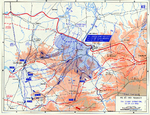
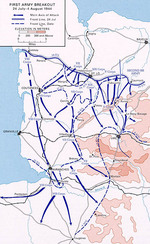
ww2dbaseBy Jul, it was apparent that despite a generally successful campaign in Normandy thus far, Allied progress had been excruciatingly slow. By mid-Jul the front lines were what the Allied high command planned to be five days after a successful landing. The first attempt at a breakout, Operation Goodwood, was a failure; the predominantly British attempt utilized a large armor formation to, unsuccessfully, create a gap. On 25 Jul Omar Bradley launched Operation Cobra, using VII Corps' infantry divisions to create and hold a gap in the German lines while sending three divisions of men through the gap, bring the war beyond the hedgerow country that had frustrated the Allied troops so much. Preceding this massive breakout operation was an even larger air bombardment. American artillery officer Donald Bennett recalled the morning of 25 Jul when the bombing by 1,500 aircraft started:
ww2dbaseA total of 600 tons of bombs was released. The earlier waves of bombs were dropped on top of Germans as planned, but as the smoke and fire blurred boundaries, bombardiers of the final few waves had a tough time figuring out where the Germans were. As a result, some of the bombs landed on top of American units. US Army Lieutenant Charles Scheffel and his unit was among those bracketed by friendly fire.
ww2dbase150 Americans were killed by accident by these bombs. The highest ranking fatality of this massive friendly fire incident was a three-star general of the US Army, "blown out of his slit trench some two miles behind where I had been hole up", recalled Scheffel.
ww2dbaseImmediately after the bombings, the American 4th, 9th, and 30th Infantry Divisions charged into German lines even as smaller bombers and fighters continued to attack German positions further beyond the line. "[T]he few Germans who were encountered were out of their heads with shock", recalled Bennett as his M-7 artillery pieces went in. Indeed, the elite Panzer Lehr Division lost much effectiveness with some of their tanks overturned and two thirds of personnel becoming casualties of the bombing. The advancing infantry divisions gained 12,000 yards on 25 and 26 Jul, supplying the mobile breakthrough to occur on 27 Jul. The American 2nd, 3rd, and 4th Armored Divisions, supported by the 1st Infantry Division, charged through the gap created. The German forces, already ill-equipped due to the Allied air superiority and now struck in daze by the bombardment, fell back 12 miles by the end of 28 Jul. The German troops were now on a general retreat in attempt to regroup. The defeat of the German forces during Operation Cobra cost Germany over 400,000 men and 1,500 tanks and self-propelled guns, while key positions such as Avranches and openings to Brittany were now in Allied hands.
ww2dbaseOperation Lüttich
7-13 Aug
ww2dbaseOn 7 Aug 1944, Operation Lüttich was launched by German forces, a counterattack with the goal to halt the Allied momentum. While achieving some surprise, Field Marshal von Kluge was not able to break the Allied defense. The southern approaches to Mortain, the German objective, were breached, however at a heavy cost of fourteen tanks. Allied air superiority played an important role in stopping this German counterattack, with American medium bombers bombing German movements and British Typhoon fighters attacking targets on the ground with rockets. "We could do nothing against them", said General von Luttwitz, reporting his frustration in his inability to counter the Allied air raids. Within the day, the German counterattack was foiled. The German offensive was fully halted by 13 Aug, largely defeated by the US 1st Army under Bradley, later reinforced by US 3rd Army under George Patton which had been rushed from the Le Mans region about 120 kilometers to the southeast.
ww2dbaseBattle of the Falaise Pocket
7-22 Aug
ww2dbaseWith the German counterattack failed and generally on the retreat, Bradley and Bernard Montgomery planned to encircle the region and capture or destroy the broken German units.
ww2dbaseIn the south, General Leclerc's French Second Armored Division took Le Mans on 9 Aug, covering the American XV Corps' move northward the next day. On 12 Aug Alençon was under Allied control, Ecouché the next day, and Argentan on 14 Aug. The Americans were then ordered to halt for a day so to prevent further confusion from the rapid advance. Dwight Eisenhower, who ordered the halt, was criticized for that it allowed thousands of Germans to escape through the incomplete envelopment. Eisenhower insisted that a complete though momentary halt was required in order to prevent mix-ups.
ww2dbaseFrom the north, Canadians and Poles of General Maczek's First Armored Division moved southward against Falaise on 9 Aug under the code name Operation Totalize. They faced heavy resistance from the Germans despite that the earlier German attack at Mortain called for these units' armor. The Germans held on to Falaise (and allowed thousands of Germans to escape back into Germany) until 17 Aug. The Fourth Canadian Armored Division then captured Trun and Saint-Lambert-sur-Dives on 18 and 19 Aug, respectively.
ww2dbaseThe northern and southern forces completely fortified the newly formed pocket on 19 Aug, after they had met up near Chambois. The German forces caught inside the pocket fought fiercely in attempt to break the newly formed Allied lines to the east. On 18 Aug, a German attack at Saint-Lambert-sur-Dives killed 200 Canadian troops at a cost of 3,000 Germans, while on 20 Aug an assault near Mont-Ormel by the II SS Panzer Corps attacked from the east, killing 325 Poles at a high cost of 2,000 men lost. The 150,000 German troops within the Falaise Pocket finally surrendered on 21 Aug 1944. An estimated 100,000 German troops succeeded in escaping back to Germany before the pocket was completed. Among the Allies, the Canadian elements suffered heaviest casualty with 18,000 killed or wounded.
ww2dbaseBefore the Allies closed the pocket, the death and destruction dealt against the German Army was horrifying even though a number of Panzer divisions were able to escape from the envelopment. "The battlefield at Falaise was unquestionably one of the greatest 'killing fields' of any of the war areas", Eisenhower noted in his memoirs. "Forty-eight hours after the closing of the gap I was conducted through it on foot, to encounter scenes that could be described only by Dante. It was literally possible to walk for hundreds of yards at a time, stepping on nothing but dead and decaying flesh." Robert Rogge, who fought with the Canadian Army in Falaise, recalled the destruction:
ww2dbaseIt reeked of the destroyed [German] army. Burned-out tanks, lorries, motorcycles, and carts were in ruinous heaps. Bloated, black-faced corpses lay everywhere, and the summer stench was overpowering. Dead, grossly swollen horses were carelessly mingled with human corpses and savaged equipment.
ww2dbaseThe men held dirty handkerchiefs over their faces, but nothing could keep out the stench. It got into their clothes and remained with them for days.
ww2dbaseEight infantry divisions and two Panzer divisions were captured as German resistance in the pocket died down. The nightmarish narrow escape route was later named the "Corridor of Death" by the Germans who survived it.
ww2dbaseSources: Crack! and Thump, Crusade in Europe, Fearsome Battle, Honor Untarnished, Wikipedia.
Last Major Update: May 2007
Normandy Campaign, Phase 2 Interactive Map
Photographs
 |  |  |  |
Maps
 |  |  |  |
Normandy Campaign, Phase 2 Timeline
| 12 Jul 1944 | Omar Bradley, his staff, and his generals met and created a preliminary plan for what was to become the Operation Cobra offensive in France. |
| 24 Jul 1944 | The USAAF 306th Bomb Group flying from RAF Thurleigh launched a bombing raid against targets around Saint-Lô, France. |
| 25 Jul 1944 | Operation Cobra, the US breakout operation in France, began. Canadian troops attacked south of Caen, France. |
| 26 Jul 1944 | US forces broke through near Saint-Lô, France, forcing a German withdrawal from the Normandy region. |
| 28 Jul 1944 | American troops captured Coutances, France. |
| 30 Jul 1944 | British troops attack Caumont, France, east of Saint-Lô. |
| 31 Jul 1944 | British VIII Corps launched Operation Bluecoat towards Vire River in Normandy, France. Meanwhile, US 4th Armored Division captured Avranches and 20,000 prisoners of war in 6 days. |
| 1 Aug 1944 | Two brand-new Allied armoured divisions, the 4th Canadian and 1st Polish, arrived in Normandy, France. They were tasked with executing the final great break-out from the British sector to trap and destroy the German armies in Normandy or send them reeling back to the Seine. |
| 1 Aug 1944 | General Philippe Leclerc's 2nd French Division landed on "Utah" beach, Normandie, France. |
| 2 Aug 1944 | US VIII Corps moved west along Brittany coast from Avranches, France. |
| 3 Aug 1944 | Hitler ordered a counterattack east of Avranches, France to regain the coast. |
| 4 Aug 1944 | German aircraft attempted to bomb the vital bridges at Pontaubault, Basse-Normandie, France. The railway bridge was damaged by a conventional bomb, but the V-1 flying bombs failed to hit their intended targets. One of the bombers was brought down by a Mosquito aircraft from 604 Squadron RAF. |
| 4 Aug 1944 | Allies captured Rennes, France. |
| 5 Aug 1944 | Finding an unguarded track, Captain Denny of the 13/18th Hussars of the British Army led two troops of tanks to the summit of Mont Pinçon, the most formidable feature in Normandy, France. During the night his small force was reinforced by the battle-weary 4th Wiltshires (Lieutenant Colonel Luce) which on the following day then repulsed a rather half-hearted German counter-attack to regain the feature. Elsewhere, to the south, US XV Corps reached Mayenne, France. |
| 6 Aug 1944 | US XX Corps reached Laval, France. |
| 7 Aug 1944 | German troops counterattacked in Avranches, France; the offensive was code named Operation Lüttich. |
| 8 Aug 1944 | The German offensive at Mortain, France, Operation Lüttich, was called off after it suffered severe losses to armoured columns from Allied air attacks. Inaccuracy of the American bombing, however, would kill many Canadians, Polish and British ground troops and would wound Major General R. F. L. Keller, commanding officer of Canadian 3rd Infantry Division. Meanwhile, Canadian forces launched Operation Totalize to the south of Caen while the US 15th Army Corp occupied Le Mans, France. |
| 10 Aug 1944 | US 5th and French 2nd Armored Divisions moved to Alençon, France. |
| 11 Aug 1944 | Lieutenant General Guy Simmonds of the 11 Canadian Corps called off Operation Totalize after it became clear that the expected breakthrough would not be achieved. Nevertheless the Canadian and Polish armoured divisions had advanced eight miles, against numerous well-constructed enemy bunkers which were immune to bombing, and were now half way between Caen and Falais. Whilst Simmonds blamed ther lack of success on the inexperience of the two divisions, General Maczek of the Polish Armoured Division was more realistic in stating that the troops had been given just too much to do. The Poles had lost 66 tanks and the Canadian slightly more during Operation Totalize. On the same day, US forces captured Nantes and Angers and then moved across the Loire River; in response, the German Navy scuttled 26 warships and 28 merchant vessels stranded at Nantes, Bordeaux, and in the Gironde and Seine estuaries. |
| 14 Aug 1944 | British troops launched Operation Tractable towards Falaise, France, preceded by 800 bombers. 150 Polish soldiers were killed as the second of the three waves of RAF Lancaster bombers released their bombs too early. |
| 17 Aug 1944 | Canadian troops captured Falaise, France, and the German troops in the region began to be threatened with being surrounded. Montgomery ordered troops to move to seal the pocket. Meanwhile, US forces captured Chartres, Orleans, and Chateaudun. |
| 18 Aug 1944 | German Seventh Army retreated across Orne River in France, leaving 18,000 men behind to be captured. |
| 19 Aug 1944 | German troops in the Falaise pocket in France were ordered to break out. |
| 20 Aug 1944 | The Falaise pocket in France began to close around German troops; the Allies captured over 4,000 prisoners of war. |
| 21 Aug 1944 | Lieutenant General Henry D. G. Crerar, commander of the 1st Canadian Army, sacked Major-General George Kitching, commander of the 4th Canadian Armoured Division, as a recrimination for the accusation that II Canadian Corps had moved too slowly to close the Falaise Gap in France, thereby allowing some 20,000 to 50,000 enemy troops to escape encirclement. |
| 2 Sep 1944 | The British 51st Highland Division entered Saint-Valery-en-Caux, France, where most of the original division had been taken prisoner in Jun 1940. |
| 6 Sep 1944 | The German garrison in Calais, France became surrounded by Canadian troops. |
| 10 Sep 1944 | The British 1st Corps (49th West Riding and 51st Highland Divisions) of the Canadian Army commenced the siege of Le Havre, the largest port in northern France, which had been earmarked for American use. The approaches to Le Havre were well protected by flooding, mines, anti-tank ditches and huge concrete gun emplacements primarily designed for sea defence. The German garrison of 11,000 (underestimated by Allied Intelligence as being around 8,700) was strongly provided with artillery. The siege opened with Allied aircraft dropping 4,000 tons of bombs on to the defences (followed by a further 5,500 tons over the two day battle). The 15-inch guns of HMS Erebus and Warspite were also brought to bear on the largest gun emplacements, although Erebus did receive some damage from return fire from the shore batteries. In addition, two heavy and six medium batteries added their support to the Divisional artillery Regiments during the softening-up process. The German resistance however proved less tenacious than expected resulting in a comparatively light Allied casualty rate of less than 400. Nevertheless on its capture the docks were found to have been thoroughly wrecked and it was over four weeks before the port could be used. |
| 17 Sep 1944 | The siege of Boulogne, Pas-de-Calais, France began. With 1 Corps grounded from lack of transport, the only available formation was 3rd Canadian Division, less one brigade, but reinforced with some armour and medium regiments of artillery. Despite being smaller than Le Havre, Boulogne proved to be a hard nut to crack, with deep underground fortifications, as well as surrounding forts, minefields and anti-tank ditches. Heavy bombing on the opening day failed to destroy the many German gun batteries, making the siege more difficult than expected. |
| 23 Sep 1944 | After a six-day siege, Canadian troops forced the German troops at Boulogne, Pas-de-Calais, France to surrender. The Canadians suffered 634 casualties and captured 9,500 prisoners (many driven from their bunkers by driving flame down the ventilation shafts). |
| 1 Oct 1944 | The German garrison at Calais, France capitulated. The 3rd Canadian Division had suffered just 300 casualties in the siege of the town but had captured 7,500 Germans bringing their toll of prisoners taken in clearing the Channel ports to almost 30,000. Wreckage to the dock facilities were however extensive and the port would not be available for shipping until Nov 1944. |
Did you enjoy this article or find this article helpful? If so, please consider supporting us on Patreon. Even $1 per month will go a long way! Thank you. Share this article with your friends: Stay updated with WW2DB: |


Visitor Submitted Comments
10 Apr 2010 04:20:59 PM
Looking for information or details about soldiers killed in operation cobra. My uncle Arthur Twitchell was killed on July 28th 1944. His family was from a very small farming town in Utah and nobody real knows what happened
23 Oct 2012 10:48:04 AM
I am looking for information concerning the death of my Uncle PVT Irving G. Barteau killed in the Normandy Invasion. The record shows he was killed @ St. Lo, France on July 30, 1944. His grave is in the Brittany American Cemetery and memorial in St.James France. Any information about him would be greatly appreciated by a nephew who wants to keep his memory alive and his sacrificed honored.
30 Oct 2012 04:39:06 AM
There is no mention of French civilian casualties. This information should be included as part of your WW2 database information. Civilian casualties are often set aside for the
26 May 2014 11:01:45 AM
Looking for information on the death of my cousin Harry Shaw, of Baltimore, Maryland. He was killed at St. Lo, July 25, 1944, the day a 111 American soldiers were killed by American bombers dropping their loads in the wrong place. Many thanks.
22 Aug 2016 07:06:22 PM
Hello- I too am looking for information on a soldier killed on July 30, 1944, in France. His name was Ernest "Doc" McIllwain, and be was a colonel in the 2nd Infantry Division of he U.S. Army, a Technician 5th grade in the medical field. This is my husband's grandfather and his family has very little information.
2 Oct 2019 04:05:26 PM
Pic with the kids is St-Lô, not Calais. It is a very famous image. Kid on the right was named Max Robin. Died in 2017.
6 Jun 2024 09:56:09 AM
The battle of hill 314 Mortain France lasted 7 days - The 30th division 120 inf held the hill position for 7 days surrounded and cut off. I do not think Mortain was retaken the same day as mentioned above and I don't think it was Patton's command that releived them. My dad was there and refused the demand for surrender from the Germans - Lt R A Kerley
All visitor submitted comments are opinions of those making the submissions and do not reflect views of WW2DB.
» Bennett, Donald
» Bradley, Omar
» Brooks, Edward
» Coningham, Arthur
» de Hautecloque, Philippe
» Eddy, Manton
» Hausser, Paul
» Keller, Rodney
» Leigh-Mallory, Trafford
» Maczek, Stanislaw
» Simonds, Guy
» Urban, Matthew
» Walker, Walton
» Wünsche, Max
Location:
» France
Related Books:
» Currahee! A Screaming Eagle at Normandy
» Six Armies in Normandy: From D-Day to the Liberation of Paris
- » 1,150 biographies
- » 337 events
- » 44,024 timeline entries
- » 1,242 ships
- » 350 aircraft models
- » 207 vehicle models
- » 375 weapon models
- » 123 historical documents
- » 260 facilities
- » 470 book reviews
- » 28,622 photos
- » 431 maps
Winston Churchill, 1935

Please consider supporting us on Patreon. Even $1 a month will go a long way. Thank you!

Or, please support us by purchasing some WW2DB merchandise at TeeSpring, Thank you!
16 Oct 2006 05:46:44 AM
looking for records of soldiers killed at normandy