


Japan's Surrender
Contributor: C. Peter Chen
ww2dbaseWith the Japanese cities of Hiroshima and Nagasaki destroyed by atomic weapons, the will of the Japanese leadership was tested. Then it came the news that the Soviet Union declared war on Japan, with troops crossing into northeastern China an hour later. These three reasons led to Emperor Showa's decision to break the deadlock at his council which debated fruitlessly whether or not to respond to the Allies' call for unconditional surrender. The Emperor said at the Imperial conference:
ww2dbaseThe council obeyed the Emperor's edict, and started the negotiation process with the Allies through the neutral Switzerland, making only one demand that Emperor Showa would not be removed from power.
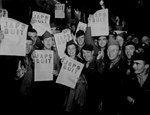
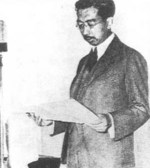
ww2dbaseSurprising most of Japan, Emperor Showa of Japan announced his intention to surrender to the Allies unconditionally over public radio on 15 Aug 1945. It was the first time Japanese commoners heard an Emperor's voice, and most of them did not understand his Imperial court dialect, adding to his mysteriousness. His message, however defeated, did not once include the word "defeat", perhaps reflecting his refusal to face the reality that Japan had lost the war. His radio address was translated as follows:
ww2dbaseTo our good and loyal subjects:
ww2dbaseAfter pondering deeply the general trends of the world and the actual conditions obtaining in our Empire today, we have decided to effect a settlement of the present situation by resorting to an extraordinary measure.
ww2dbaseWe have ordered our Government to communicate to the Governments of the United States, Great Britain, China, and the Soviet Union that our Empire accepts the provisions of their joint declaration.
ww2dbaseTo strive for the common prosperity and happiness of all nations as well as the security and well- being of our subjects is the solemn obligation that has been handed down by our Imperial Ancestors, and we lay it close to the heart.
ww2dbaseIndeed, we declared war on America and Britain out of our sincere desire to ensure Japan's self- preservation and the stabilization of East Asia, it being far from our thought either to infringe upon the sovereignty of other nations or to embark upon territorial aggrandizement.
ww2dbaseBut now the war has lasted for nearly four years. Despite the best that has been done by everyone-- the gallant fighting of the military and naval forces, the diligence and assiduity of our servants of the state and the devoted service of our 100 million people--the war situation has developed not necessarily to Japan's advantage, while the general trends of the world have all turned against her interest.
ww2dbaseMoreover, the enemy has begun to employ a new and most cruel bomb, the power of which to do damage is, indeed, incalculable, taking the toll of many innocent lives. Should we continue to fight, it would not only result in an ultimate collapse and obliteration of the Japanese nation, but also it would lead to the total extinction of human civilization.
ww2dbaseSuch being the case, how are we to save the millions of our subjects, or to atone ourselves before the hallowed spirits of our Imperial Ancestors? This is the reason why we have ordered the acceptance of the provisions of the joint declaration of the powers.
ww2dbaseWe cannot but express the deepest sense of regret to our allied nations of East Asia, who have consistently cooperated with the Empire toward the emancipation of East Asia.
ww2dbaseThe thought of those officers and men as well as others who have fallen in the fields of battle, those who died at their posts of duty, and those who met with death and all their bereaved families, pains our heart night and day.
ww2dbaseThe welfare of the wounded and the war sufferers, and of those who have lost their homes and livelihood is the object of our profound solicitude. The hardships and suffering to which our nation is to be subjected hereafter will be certainly great.
ww2dbaseWe are keenly aware of the inmost feelings of all you, our subjects. However, it is according to the dictates of time and fate that we have resolved to pave the way for a grand peace for all the generations to come by enduring the unendurable and suffering what is insufferable. Having been able to save and maintain the structure of the Imperial State, we are always with you, our good and loyal subjects, relying upon your sincerity and integrity.
ww2dbaseBeware most strictly of any outbursts of emotion that may engender needless complications, and of any fraternal contention and strife that may create confusion, lead you astray and cause you to lose the confidence of the world.
ww2dbaseLet the entire nation continue as one family from generation to generation, ever firm in its faith in the imperishableness of its divine land, and mindful of its heavy burden of responsibilities, and the long road before it. Unite your total strength to be devoted to the construction for the future. Cultivate the ways of rectitude, nobility of spirit, and work with resolution so that you may enhance the innate glory of the Imperial State and keep pace with the progress of the world.
ww2dbaseAll you, our subjects, we command you to act in accordance with our wishes.
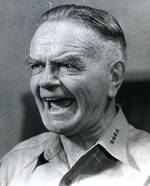
ww2dbaseDespite the Emperor's urging, a small group refused to admit defeat. A group of military servicemen, many of them special attack pilots, mutinied. Believing that the Emperor had been abducted by defeatists, they attacked the Imperial Palace, killing the general of the Imperial Guard Division before the small rebellion was subdued. This small rebellion made the Allies nervous. By sending Douglas MacArthur to Japan, would they be sending the Allied commander into a trap? MacArthur did not believe so, and he was right. Upon reaching Atsugi Airfield outside of the naval district of Yokohama, he was treated with utmost respect. Two Japanese divisions guarded the roadway between the airfield and Yokohama's New Grand Hotel, with their backs facing MacArthur, which was the same respect they would give the Emperor. As MacArthur planned the formal surrender, he also immediately embarked on a mission to free prisoners of war, including his comrade of the Philippines days Jonathan Wainwright from a camp in Mukden in northeastern China.
ww2dbaseTokyo Bay Surrender Ceremony
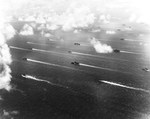
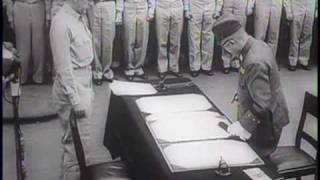
ww2dbaseThe date of Japan's formal surrender was 2 Sep 1945, and it took place aboard American battleship Missouri in Tokyo Bay. That morning, the Japanese delegation boarded American destroyers for Missouri. Toshikazu Kase of the Foreign Ministry was a member of the delegation, who noted his impression of the Allied show of force in Tokyo Bay as he approached in USS Landsdown.
ww2dbaseAfter Kase arrived, he observed that
ww2dbase"We are gathered here, representatives of the major warring powers, to conclude a solemn agreement whereby peace may be restored", said MacArthur to start the ceremony. Amidst American, British, and other Allied warships, Japanese foreign minister Mamoru Shigemitsu "[b]y Command and on behalf of the Emperor of Japan and the Japanese Government" and General Yoshijiro Umezu "[b]y Command and on behalf of the Japanese Imperial General Headquarters" surrendered. For the Allies, MacArthur represented the United States and the Allied command, Chester Nimitz represented the United States, Hsu Yung-Ch'ang for China, Bruce Fraser for the United Kingdom, Kuzma Derevyanko for the Soviet Union, Thomas Blamey for Australia, Colonel Lawrence Moore Cosgrave for Canada, General Philippe LeClerc for France, Conrad E.L. Helfrich for the Netherlands, and Leonard Isitt signed the surrender document for New Zealand. British Arthur Percival and American Jonathan Wainwright, generals who were imprisoned by the Japanese early on in the war, were invited to witness the historical event.
ww2dbaseThe text of the instrument of surrender was as follows:
ww2dbaseWe, acting by command of and in behalf of the Emperor of Japan, the Japanese Government and the Japanese Imperial General Headquarters, hereby accept the provisions set forth in the declaration issued by the Heads of the Governments of the United States, China, and Great Britain on 26 July 1945 at Potsdam, and subsequently adhered to by the Union of Soviet Socialist Republics, which four powers are hereafter referred to as the Allied Powers.
ww2dbaseWe hereby proclaim the unconditional surrender to the Allied Powers of the Japanese Imperial General Headquarters and of all Japanese armed forces and all armed forces under the Japanese control wherever situated.
ww2dbaseWe hereby command all Japanese forces wherever situated and the Japanese people to cease hostilities forthwith, to preserve and save from damage all ships, aircraft, and military and civil property and to comply with all requirements which may be imposed by the Supreme Commander for the Allied Powers or by agencies of the Japanese Government at his direction.
ww2dbaseWe hereby command the Japanese Imperial Headquarters to issue at once orders to the Commanders of all Japanese forces and all forces under Japanese control wherever situated to surrender unconditionally themselves and all forces under their control.
ww2dbaseWe hereby command all civil, military and naval officials to obey and enforce all proclamations, and orders and directives deemed by the Supreme Commander for the Allied Powers to be proper to effectuate this surrender and issued by him or under his authority and we direct all such officials to remain at their posts and to continue to perform their non-combatant duties unless specifically relieved by him or under his authority.
ww2dbaseWe hereby undertake for the Emperor, the Japanese Government and their successors to carry out the provisions of the Potsdam Declaration in good faith, and to issue whatever orders and take whatever actions may be required by the Supreme Commander for the Allied Powers or by any other designated representative of the Allied Powers for the purpose of giving effect to that Declaration.
ww2dbaseWe hereby command the Japanese Imperial Government and the Japanese Imperial General Headquarters at once to liberate all allied prisoners of war and civilian internees now under Japanese control and to provide for their protection, care, maintenance and immediate transportation to places as directed.
ww2dbaseThe authority of the Emperor and the Japanese Government to rule the state shall be subject to the Supreme Commander for the Allied Powers who will take such steps as he deems proper to effectuate these terms of surrender.
ww2dbaseSigned at TOKYO BAY, JAPAN at 0904 on the SECOND day of SEPTEMBER, 1945
ww2dbaseMAMORU SHIGEMITSU
By Command and on Behalf of the Emperor of Japan and the Japanese Government
ww2dbaseYOSHIJIRO UMEZU
By Command and on Behalf of the Japanese Imperial General Headquarters
ww2dbaseAccepted at TOKYO BAY, JAPAN at 0908 on the SECOND day of SEPTEMBER, 1945, for the United States, Republic of China, United Kingdom and the Union of Soviet Socialist Republics, and in the interests of the other United Nations at war with Japan.
ww2dbaseDOUGLAS MAC ARTHUR
Supreme Commander for the Allied Powers
ww2dbaseC.W. NIMITZ
United States Representative
ww2dbaseHSU YUNG-CH'ANG
Republic of China Representative
ww2dbaseBRUCE FRASER
United Kingdom Representative
ww2dbaseKUZMA DEREVYANKO
Union of Soviet Socialist Republics Representative
ww2dbaseTHOMAS BLAMEY
Commonwealth of Australia Representative
ww2dbaseL. MOORE COSGRAVE
Dominion of Canada Representative
ww2dbaseJACQUES LE CLERC
Provisional Government of the French Republic Representative
ww2dbaseC.E.L. HELFRICH
Kingdom of the Netherlands Representative
ww2dbaseLEONARD M. ISITT
Dominion of New Zealand Representative
ww2dbaseWhen all signed the document, MacArthur approached the microphone and drew the war to a close: "Let us pray that peace be now restored to the world, and that God will preserve it always. These proceedings are closed."
ww2dbaseAs a precaution, Raymond Spruance commanded a full carrier task force some distance off Japan in preparation of any Japanese hostility. As expected, the carrier task force did not have the need to launch any combat missions on 2 Sep 1945.
ww2dbaseOther Surrender Ceremonies
ww2dbaseThe surrender ceremony at Rabaul, New Britain took place on 6 Sep 1945 aboard the British carrier Glory.
ww2dbaseSurrender ceremony in Korea took place in the Government Building in Seoul on 9 Sep 1945.
ww2dbaseThere were a number of surrender ceremonies in China. The first major ceremony took place in Hunan Province at the Zhijiang Airfield in Zhijiang County at 1600 hours on 21 Aug 1945. On 9 Sep 1945, General Yasuji Okamura of the Japanese China Expeditionary Army formally surrendered all Japanese troops in the entire China-Burma-India theater in a surrender ceremony in the ceremonial hall of the Chinese Military Academy at the capital city of Nanjing; the Chinese had wanted the Nanjing surrender ceremony to take place around a round table in order to save face for the Japanese in accordance to Chiang Kaishek's order to grant the Japanese benevolence, but American liaison officers vetoed such notion, insisting that Okamura and his staff should feel as the defeated rather than as peers. On, 10 Oct, Hiroshi Nemoto surrendered the Japanese China North Area Army at the Forbidden City in Beiping. On 25 Oct 1945 in Zhongshan Hall in Taipei, Taiwan, Chinese representative Chen Yi accepted the Japanese surrender of the island.
ww2dbaseJapanese forces surrendered on the island of Labuan, British Northern Borneo on 10 Sep 1945.
ww2dbaseSeishiro Itagaki surrendered the Japanese forces in Singapore on behalf of Field Marshal Hisaichi Terauchi, who was unable to attend due to health reasons, at the City Hall building on 12 Sep 1945. Louis Mountbatten accepted the surrender.
ww2dbaseOn 13 Sep 1945, Hatazo Adachi surrendered the remnants of his 18th Army to the Australians near Wewak in Australian Territory of New Guinea.
ww2dbaseAlso on 13 Sep, Japanese forces in Kuala Lumpur in British Malaya surrendered.
ww2dbaseOn 15 Sep 1945, a British naval squadron arrived in waters off of the port of Tanjung Priok near Jakarta in Dutch East Indies (or, the newly declared Republic Indonesia) with the primary task of assisting former prisoners of war. Admiral Todashi Maeda and other local Japanese military commanders immediately surrendered themselves to this advance party.
ww2dbaseThe Hong Kong surrender ceremony was held at the Government House on 16 Sep 1945. Royal Navy Rear Admiral Cecil Harcourt represented the United Kingdom, and Navy Vice Admiral Ruitaro Fujita and Army Major General Umekichi Okada represented Japan.
ww2dbaseChinese Lieutenant General Lu Han accepted the Japanese surrender in Hanoi, Tonkin, French Indochina on 28 Sep 1945; he and his troops would remain in Hanoi for another six months before France was ready to administer its former colony.
ww2dbaseOn 30 Nov 1945, Japanese Field Marshal Hisaichi Terauchi formally surrendered in Saigon in southern French Indochina.
ww2dbaseSources:
David Chandler, Robert Cribb, Li Narangoa, End of Empire
Bruce Gamble, Darkest Hour
Douglas MacArthur, Reminiscences
Dan van der Vat, The Pacific Campaign
Wikipedia
Last Major Update: May 2007
Japan's Surrender Interactive Map
Photographs
 |  |  |  |
Videos
 |
Japan's Surrender Timeline
| 21 Jul 1945 | The Allied leadership threatened Japan with destruction if it did not surrender. |
| 27 Jul 1945 | The Japanese issued a reply to the United States' threat to utterly destroy Japan if the appeal, made on 21 Jul 1945. Japan refused to surrender. The reply stated that Japan was determined to fight tooth and nail for every inch of her sacred soil. |
| 10 Aug 1945 | Faced with the threat of more atomic bombs and the menace of the Soviets, Japan announced that it was willing to surrender provided the future status of the Emperor could be assured. |
| 11 Aug 1945 | US Secretary of State James Byrnes rejected the Japanese surrender terms offered on the previous day, citing the refusal for any Japanese preconditions. Meanwhile, American aircraft continued conventional bombing of Japanese cities. |
| 12 Aug 1945 | Emperor Showa ordered his government to surrender. |
| 12 Aug 1945 | The US Joint Chiefs of Staff submitted General Order No. 1 to President Harry Truman for approval. It instructed Japanese forces to surrender to designated Allied commanders, to reveal all current military deployments, and to preserve military equipment for later disarmament. A minor detail in this order that would become more significant later was the instructions for Japanese forces in Korea surrender to US or Soviet commanders depending on whether the Japanese unit was based north or south of the 38th Parallel. |
| 14 Aug 1945 | The Japanese Imperial Council accepted Emperor Showa's order to surrender to the Allies powers' surrender terms. In turn, Prime Minister Kantaro Suzuki notified the Allies that Japan was accepting the Potsdam Declaration. |
| 15 Aug 1945 | Chiang Kaishek made a radio address from the facilities of the Broadcasting System (forerunner of today's Broadcasting Corporation of China located in Taiwan, Republic of China) in Chongqing, China, noting that China must not seek revenge against the defeated Japan, for violence would only yield more violence. He urged that China must return "virtue for malice". |
| 15 Aug 1945 | VJ Day was declared in Britain. |
| 15 Aug 1945 | Emperor Showa addressed his nation via radio, announcing the end of the war. Meanwhile, the Japanese government informed the Allies its willingness to meet the unconditional surrender terms. In response, the US government ordered all hostilities to cease in Asia. A group of Japanese Army officers made a coup d'état attempt by attacking the Imperial Palace in Tokyo, Japan; it ended in failure. |
| 17 Aug 1945 | US President Harry Truman officially approved General Order No. 1 submitted by US Joint Chiefs of Staff five days earlier, containing detailed orders to Japanese forces on matters of surrender. |
| 18 Aug 1945 | Guo Fengwu, the deputy commander of the 24th Pursuit Squadron of the Chinese Air Force, flew over Guisui, Suiyuan (now Hohhot, Inner Mongolia), China and dropped leaflets containing a transcript of Emperor Showa's 15 Aug 1945 radio address. He was shot down by Japanese anti-aircraft fire and became the final Chinese Air Force casualty of the war. |
| 18 Aug 1945 | At the headquarters of the Japanese 7th Area Army in Singapore, General Seishiro Itagaki informed his lieutenants and colonial administrators that Japan had surrendered. He ordered the men to maintain public order and to plan for the transition of power when the British colonial administration would arrive. He also ordered the construction of an internment camp in Jurong in western Singapore for Japanese civilians, who would wait there until repatriation. |
| 19 Aug 1945 | Japanese troops were told by their government that surrendering under the terms of a ceasefire would not be considered a loss of honour under the Bushido code which demanded fighting to the death. As a result thousands began laying down their arms. Meanwhile, more than 100 Allied warships waited off the coast of Japan for the order to enter her ports. |
| 19 Aug 1945 | On instructions from Douglas MacArthur, a Japanese delegation led by Japanese Imperial Army Vice Chief of Staff Lt General Torashiro Kawabe traveled from Tokyo, Japan to Ie Jima just off Okinawa where they were transferred from their two specially marked Mitsubishi G4M ‘Betty’ bombers to a USAAF C-54 Skymaster for the second leg of their trip to Manila, Philippines where they met with MacArthur. |
| 21 Aug 1945 | The first major Japanese surrender ceremony in China took place at the Zhijiang Airfield in Zhijiang County, Hunan Province at 1600 hours. |
| 23 Aug 1945 | He Yingqin ordered Japanese generals in northern and eastern China to continue to maintain peace until Nationalist forces would arrive to relieve them. |
| 23 Aug 1945 | USS Yorktown (Essex-class) received orders to operate east of Honshu, Japan and provide cover for the forces occupying Japan. |
| 23 Aug 1945 | Southeast of Japan, Task Group 30.1 was formed consisting of fleet flagship USS Missouri with USS Nicholas, USS O’Bannon, and USS Taylor as escorts at the specific request of Admiral William Halsey. |
| 24 Aug 1945 | Japan agreed that the first Allied troops on the homeland would be paratroopers. |
| 25 Aug 1945 | USS Nicholas picked up three aircrewmen from a USS Shangri-La TBM Avenger that made a water landing during air operations. Nicholas also took aboard several press representatives transferred from USS Iowa to Nicholas for further transportation. |
| 25 Aug 1945 | USS Yorktown (Essex-class) began providing for the forces occupying Japan and air-dropping supplies to Allied prisoners. |
| 27 Aug 1945 | USS Nicholas rendezvoused with Japanese destroyer Hatuzakura to take aboard Japanese emissaries, interpreters, and harbor pilots. Nicholas then delivered US press and Japanese personnel to USS Missouri, USS Stockham, USS Waldron, HMS Whelp, and USS Gosselin. Missouri and her group then anchored in Sagami Wan just outside Tokyo Bay, Japan. |
| 27 Aug 1945 | In Rangoon, Burma, Japanese delegates signed a preliminary agreement ordering local Japanese commanders to assist and obey British commanders of reoccupation forces. |
| 27 Aug 1945 | Louis Mountbatten and Field Marshal Hisaichi Terauchi signed a preliminary surrender agreement in Rangoon, Burma. |
| 27 Aug 1945 | Japanese military leadership announced to its troops that all forces in Hong Kong were to surrender to the British. |
| 28 Aug 1945 | In Japan, an advance guard of 150 US airborne troops landed at Atsuki airfield outside Tokyo; they were the first Allied troops to set foot on the Japanese mainland. |
| 28 Aug 1945 | USS Nicholas delivered Japanese harbor pilots to USS Cumberland Sound, USS Proteus, and USS Neches before returning to the anchorage at Sagami Wan, Japan. |
| 29 Aug 1945 | US troops made an administrative landing near Tokyo, Japan, starting the occupation. |
| 29 Aug 1945 | USS Missouri leading USS Iowa and escorted by USS Nicholas entered Tokyo Bay, Japan. |
| 30 Aug 1945 | The first of the 6,000 Japanese civilians in Singapore began to move into the newly completed Jurong Interment Camp. |
| 30 Aug 1945 | USS San Juan evacuated Allied prisoners of war in Japan. |
| 30 Aug 1945 | The main Allied forces began going ashore on mainland Japan. |
| 30 Aug 1945 | Douglas MacArthur arrived at Atsugi Airfield near Tokyo, Japan. |
| 30 Aug 1945 | A British battle squadron led by the aircraft carrier Indomitable entered Hong Kong to reoccupy the Crown Colony. |
| 30 Aug 1945 | I-504 officially surrendered at Kobe, Japan. |
| 30 Aug 1945 | USS San Diego arrived at Yokosuka, Japan. |
| 30 Aug 1945 | USS Tamalpais entered Tokyo Bay and anchored with the fleet in advance of the surrender ceremonies. Tamalpais then began 11 weeks as a fleet water station ship. |
| 30 Aug 1945 | Submarine I-369 was surrendered to the Americans. |
| 31 Aug 1945 | Around 1,000 Allied prisoners of war from camps in the Tokyo, Japan area were transferred to hospital ships offshore. |
| 1 Sep 1945 | Two US Marine Corps aircraft dropped surrender terms to the Japanese garrisons on Wotje and Maloelap Atolls in the Marshall Islands. |
| 1 Sep 1945 | USS Nicholas shifted from Tokyo Bay anchorage to the Customs House Pier in Yokohama, Japan. |
| 2 Sep 1945 | Conrad Helfrich signed the Japanese instrument of surrender aboard USS Missouri aboard Tokyo Bay in Japan on behalf of the Netherlands. |
| 2 Sep 1945 | USS Ancon served as a press release ship for the surrender ceremony in Tokyo Bay, Japan. During the ceremony, she was anchored between USS Missouri and USS South Dakota. |
| 2 Sep 1945 | At Truk Atoll, Caroline Islands, USS Portland (with USS Ralph Talbot as escort) received aboard Lieutenant General Shunzaburo Magikura of the Japanese Imperial Army, Vice Admiral Chuichi Hara of the Japanese Imperial Navy, Rear Admiral Aritaka Aihara of the Japanese Imperial Navy and head of the Eastern Branch of the Japanese South Seas Government and their aides. Together, they surrendered all islands and territories under their commands to Vice Admiral George Murray, acting on behalf of Fleet Admiral Chester Nimitz. Immediately following the signing of the surrender documents, Portland departed Truk bound for Guam. |
| 2 Sep 1945 | Eleven officers and diplomats of the Japanese surrender party crossed the deck of USS Nicholas from the Yokohama Customs House Pier to the USS Lansdowne for transportation to the USS Missouri. Fifty-eight senior US Army officers and 29 senior officers from the Allied nations of China, USSR, Australia, Canada, France, the Netherlands, and New Zealand boarded Nicholas for transportation to Missouri. |
| 2 Sep 1945 | Japan signed the surrender document aboard USS Missouri in Tokyo Bay, Japan. Later on the same day, the Japanese Imperial General Headquarters issued General Order No. 1 written by US Joint Chiefs of Staff, which instructed Japanese forces on matters of surrender. |
| 3 Sep 1945 | General Tomoyuki Yamashita and Admiral Denshichi Okochi surrendered to US Army generals, among whom Jonathan Wainwright, at Camp John Hay in Baguio, Philippines Islands. The ceremony was witnessed by British General Arthur Percival. |
| 4 Sep 1945 | Formal Japanese surrender of Malaya took place aboard HMS Nelson off Penang, Malaya. SEAC ordered Japanese personnel in the region to treat Malapan People's Anti-Japanese Army guerrilla fighters as if they were Allied troops. |
| 4 Sep 1945 | Japanese troops on Wake Island surrendered. |
| 5 Sep 1945 | Destroyer HMAS Vendetta entered Simpson Harbor, New Britain in preparation of the surrender ceremony. |
| 6 Sep 1945 | Carrier HMS Glory and her task force arrived off Rabaul, New Britain in the morning. At 0900 hours, sloop HMS Hart picked up Hitoshi Imamura and Jinichi Kusaka at Kabanga Bay, who would sign the surrender documents aboard HMS Glory at 1127 hours which surrendered 139,000 remaining personnel at Rabaul plus all forces in Australian territory in the South Pacific. |
| 7 Sep 1945 | USS Nicholas shifted from Tokyo Bay to the coast off Hamamatsu, Japan. |
| 8 Sep 1945 | USS Nicholas shifted back to Tokyo Bay, Japan. |
| 8 Sep 1945 | Royal New Zealand Air Force aircraft dropped leaflets on Nauru and Ocean Islands, urging Japanese soldiers to stop fighting and surrender. |
| 8 Sep 1945 | General Douglas MacArthur arrived in Tokyo, Japan. |
| 8 Sep 1945 | The Japanese Navy Northern Fleet surrendered to the Americans at Mutsu Bay, Japan. |
| 8 Sep 1945 | Escorted by eight fighters, He Yingqin arrived in Nanjing, China by air at 0900 hours; later in the day he would meet with General Yasuji Okamura to work out the surrender ceremony details. |
| 9 Sep 1945 | Americans Vice Admiral Thomas Kinkaid and Lieutenant General John Hodge accepted the surrender of all Japanese forces in Korea in the General Government Building in Seoul, Korea. Unaware of previous Japanese-Korean agreements on the transfer of power, Hodge ordered the Japanese occupation administration to remain in place, triggering anger among Koreans. Realizing the mistake made in his ignorance, Hodge quickly rescinded his order. However, he refused to recognize any of the political organizations vying for power in Korea, solely relying on his own military administration to make decisions despite of his staff's less than perfect understanding of the political situation. |
| 9 Sep 1945 | At 0900 hours, the main Japanese surrender ceremony in China took place at the auditorium of the Central Military Academy in Nanjing, China. General Yasuji Okamura, Commander-in-Chief of Japanese Army's China Expeditionary Army, represented Japan; his delegation also included chief of staff of the China Expeditionary Army Asasaburo Kobayashi. General He Yingqin represented China. In pursuit of Chiang Kaishek's wishes to treat the Japanese with benevolence, the Chinese had wanted the ceremony to be taken place at a round table so that the Japanese representatives would be viewed as peers, but the American liaisons sent to Nanjing succeeded in preventing such a friendly gesture. General He was said to have apologized to Okamura, an old acquaintance at the Japanese Army Academy in the 1910s, for subjecting him to such an embarrassing arrangement forced by the Americans. As a part of the surrender agreement, Japanese troops in China were to remain in power to maintain order, to care for prisoners of war, and to guard important locations against Chinese Communists. |
| 10 Sep 1945 | USS Nicholas departed Tokyo Bay bound for Ishinomaki Bay, Japan. |
| 10 Sep 1945 | Japanese forces surrendered on the island of Labuan, British North Borneo. |
| 11 Sep 1945 | USS Nicholas arrived at Ishinomaki Bay, Japan. |
| 12 Sep 1945 | Japanese forces (along with Indian National Army units still attached to the Japanese Army) in Burma surrendered. |
| 12 Sep 1945 | The Japanese forces on Singapore officially surrendered to Louis Mountbattan of Allied South East Asia Command at the City Hall. Field Marshal Hisaichi Terauchi was unable to attend the ceremony due to health reasons, thus Seishiro Itagaki of Japanese 7th Area Army stood in as the alternate representative. |
| 13 Sep 1945 | At Ishinomaki Bay, USS Nicholas received aboard 250 recently freed Allied prisoners of war, 117 American, 85 Dutch, 38 Australian, and 10 British, and brought them to Tokyo Bay, Japan. |
| 13 Sep 1945 | Japanese forces in Burma surrendered to the Allies. |
| 13 Sep 1945 | Captain Hisayuki Soeda surrendered Nauru and Ocean Island surrendered to Australian troops. |
| 13 Sep 1945 | Japanese forces formally surrendered in Kuala Lumpur, the capital of the Federated Malay States. |
| 15 Sep 1945 | A British naval squadron arrived in waters off of the port of Tanjung Priok near Jakarta, Indonesia, carrying British personnel tasked with the rescue of prisoners of war and Dutch personnel tasked with the restoration of the colonial administration. Local Japanese commanders, including Admiral Todashi Maeda, immediately surrendered themselves. |
| 16 Sep 1945 | Japanese troops surrendered in Hong Kong at the Government House. Royal Navy Rear Admiral Cecil Harcourt represented the United Kingdom, and Navy Vice Admiral Ruitaro Fujita and Army Major General Umekichi Okada represented Japan. |
| 20 Sep 1945 | Lu Han arrived at Hanoi, French Indochina to begin surrender negotiations with Yuitsu Tsuchihashi. |
| 21 Sep 1945 | Mongolian separatist troops entered Rehe (now Chengde), Jehol Province, China, capturing 2,000 surrendered Japanese troops and their weapons. These Japanese troops would be brought against international agreement (which had it that these troops should be under the custody of the Chinese) and kept them as forced laborers until Oct 1947. These prisoners would participate in the building of the Government Building, Sukhbaatar Square, the Ministry of Foreign Affairs Building, the National University of Mongolia, and others in Ulaanbaatar. |
| 28 Sep 1945 | Chinese General Lu Han accepted the surrender of Japanese 38th Army at Hanoi, French Indochina. The French delegation boycotted the ceremony due to the Chinese-Vietnamese joint attempt to place the French delegation far from the main ceremonies during the planning process. |
| 3 Oct 1945 | Chen Gongbo (Wade-Giles: Chen Kung-po), former president of the puppet Reorganized National Government of China in Nanjing, was brought from Japan to China to face trials. |
| 10 Oct 1945 | Hiroshi Nemoto surrendered the Japanese North China Area Army at a ceremony at the Taihe Hall of the Forbidden City in Beiping, China. |
| 25 Oct 1945 | The Republic of China government established the Administrative Commander's Office to govern Taiwan, headed by Chen Yi. As his first official action, Chen accepted the Japanese surrender from 10th Area Army commanding officer Rikichi Ando and Ando's Chief of Staff Haruki Isayama at Taipei City Hall (now Zhongshan Hall). |
| 29 Oct 1945 | In Makassar, Celebes, Indonesia, nationalist fighters attacked Dutch forces and took control of a radio station. Australian troops stepped in to intervene, forcing the nationalist fighters out of the radio station after killing many. |
| 1 Dec 1945 | The last Japanese resistance unit in Saipan, Mariana Islands surrendered. |
| 30 Jun 1951 | A group of Japanese soldiers in the Mariana Islands, who had previously refused to believe that Japan had surrendered in 1945, finally surrendered to Lieutenant Commander James Johnson of the US Navy. |
Please consider supporting us on Patreon. Even $1 per month will go a long way! Thank you. Please help us spread the word: Stay updated with WW2DB: |


Visitor Submitted Comments
9 Jul 2005 01:10:16 PM
ok this person is below is retarted
wats**** he must be retarted or a *** !!!!!!
30 Mar 2006 07:25:51 PM
My father, his rank at the time, Lt. Col. Elwood McSherry, was on McArthurs staff, and was at the signing on the Missouri, and I am still trying to find his picture. Could you help me?
Thank you.
25 Jul 2006 02:51:02 PM
amazing research and info in here. thanks for the help on the school project.
15 Aug 2007 07:18:12 PM
Included in the UNCONDITIONAL Potsdam Surrender Papers was the return of the Ryukyu Islands to the Ryukyuan people via the Cairo Accords of 1943
31 Dec 2007 06:34:43 AM
Oh my God, this site is amazing! It helped me out so much. Thank you!!
30 Dec 2008 03:52:40 AM
un site de nota 10
bravo
11 Jan 2009 10:22:08 AM
wow i am on a report looking up info about hirohito and all of it is different why is that i mean i have to get a good grade on it so you should have the right info about him and his life i mean it seriously!!!!
 BILL says:
21 Feb 2009 04:33:26 PM
Dec.7th 1941 My Father Henry W. De Nomie, like thousands of other American's applied for military service. As he waited, he found work in the defense industry my father moved from position to position, his last position, was testing the machinery for navy torpedos, balancing the contra-rotating propeller blades and final-inspection. My father was exempt from military service due to his war-time position, but all my uncle's served in the army. Dad had to give demo's to all the military brass, and high ranking civilians that would tour the factory during the war. Dad lived a long life, he passed away Nov. 5, 2007 he was 88 years old. I LOVE YOU DAD. Not much is published about war production, and the men and women who worked long and hard to witness the final victory over Japan, Germany and Italy, they were " THE GREATEST GENERATION " War production was 24 hrs a day 7 days a week, 365 day a year. The un-told story of the thousands of worker's who were injuried and died as a result of war production.........
26 Apr 2009 04:52:03 PM
My father served with the USS California in WW2. He keeps telling me a story about being part of the 1st US boarding party in Wakayama Wan the day after the war ended. When the boarding party landed there was no one in sight. After moving a short distance inland, a small boy suddenly appeared. My father motioned him to come over. He dug into his pocket and gave him a candy. The boy followed him a short distance then went away. I am just wondering if by chance anyone knows what became of that little boy or remembers anything about that day?
BILL says:18 May 2009 04:48:21 PM
Did you know, that 300,000 Americans died or were injured working in factories during World War II. War production was 24 hours a day,7 days a week, 365 days a year. By 1943 the United States produced more then Germany, Japan and Italy together
20 Aug 2009 07:08:28 PM
is it true the s-44 crashed in a japanes combat ship an sink
30 Mar 2010 11:15:10 PM
One tidbit that is cool is that the Japanese representatives were not saluted before the ceremony but were saluted as they left the ship, since the war was over.
16 Apr 2010 02:59:48 AM
Sorry for insisting on a little detail : the name of the Provisional Government of the French Republic Representative was General Philippe Leclerc.
16 Jun 2010 10:54:43 AM
I was privliged to accompany a copy of the Japanese surrender document and Yamamoto's sword to West Point during part of my service with USAF while stationed at Boling Field, D.C. We flew up in a twin engine Cessna, but I cannot recollect the names of the officers and another enlisted man on the flight. I'd like to know if any of these people are still with us today. Please contact me at my email address.
Sgt. Manuel King
(My rank at the time of delivery)
22 Sep 2010 11:51:42 PM
I am a guide on BB63 in Pearl Harbor, myself and several others are trying to determine who wrote General Douglas MacArthur's speech delivered 2/Sept/45 onboard in Tokyo Bay...Any ideas????
7 Oct 2010 12:21:25 AM
Japan historically had many earthquakes and limited natural resources as the islands country. From early 15 century, from the European missionaries' outreach, they started corresponded to Europe and outer world out of their far-East territory.
They started purchase guns and armories earlier than any other Asian countries such as China and Korea, or other pacific Asian countries and started invaded China, Korea, and other southern Asian countries slaughtering many innocent civilians brutally, and colonized them from early 1930s. If you refer old historic records of the China, Korea, Philiphin, Malaysia, Vietnam and so on, you can see Japan's constant invasion and brutal attacks and killing their civilians dated from 16 centuries all around Pacific Asian countries. Many Westerners know that German killed around 6 million Jews during World WarII, but many Westerners don't know Japanese killed over 12 millions Asians during World WarII. Please check the historic records of the China, Korea and All Pacific Asian countries. Then America intervened as they did to German in Europe. America gave 48 hour's waring of dropping the Atomic bomb to surrender and stop invading other Asian counties, The Japanese Emperor refused, so they dropped the Atomic bomb after 48 hour, Japanese still refused to surrender the colonization and invasion of the Asian nations, so America dropped 2nd after three days later.
As an Asian American, let's face the truth. Nobody like to see the tragedy of Atomic bombs or concentration camp. But if America didn't intervene the WarII, France, England, Italy..and so on, many European countries won't exist right now.
Also China, Korea and many other Pacific Asian countries neither.
It's so sad that many ignorants blame America for Atomic bombing, or Normandie Battles, but how this world would exist without a nation with big brotherhood heart?
It's like living in a city without police. If somebody invade your home, and there's no police and everybody have to deal with their own protection, how the weaks survive?
So before bad mouth about America, study the history. The sad human history of that there are always some greedy evil nations always attack other nations when most of the nations want to live in peace.
Because I know this undeniable history, I speak highly about America and will in the future.
27 Nov 2010 09:12:51 AM
I served aboard the USS Springfield CLG-7
from 1960 to 1962(a converted light cruiser )formally CL-66 which accompanied the
USS Missouri into the harbor on that memorable day. I was proud to serve my
country on my ship that was part of that
period of our lives. GO NAVY ! ! !
part of history
29 Nov 2010 07:26:35 AM
I am proud my dad served in the Navy during WW2, Korea and Viet Nam. He was one of 3 photographers to record on film the surrender of Japan on the USS Missouri. There is a picture on him on Google. He took many pictures during these wars for the Navy which are in archives. His stories were amazing, but the photographers get no credit and I don't know which are his, but he used to recognize many of them when they were shown on TV. I am proud of these people who risked their lives in such a way. God bless all our freedom fighters past and present.
17 Sep 2011 11:58:55 PM
After my Dad passed away, we found an I D card that commemorated him as being present at the signing. Is there a list of all present on that day?
7 Oct 2011 08:18:40 PM
Billie - my great uncle, Marshall Berard was also one of those government photographers on the Missouri for the signing of the peace treaty.
15 May 2012 07:13:02 AM
Thanks your site rocks
13 Jun 2012 02:08:08 PM
I'd like to point out a 'date error' on http://ww2db.com/battle_spec.php?battle_id=13
Hirohito gave his radio address to Japan at noon on Aug 15, not Aug 14 as stated in the article as per both
http://en.wikipedia.org/wiki/Hirohito
and
https://www.cia.gov/library/center-for-the-study-of-intelligence/csi-publications/csi-studies/studies/vol46no3/article07.html
21 Aug 2012 08:04:57 AM
The "Air Show" during the Japanese Surrender in Tokyo Bay 2 Sept 1945 was the "World's Best Air Show" in my opinion. Can you please identify the officer who planned that "Show of Force Mision"? Also, please identify the air units who participated. GREAT SITE !
13 Feb 2013 10:52:47 AM
all of you people that just try to bring down everyone else, just don't even comment. nobody wants to read some jerk's comment being mean to someone else. also, i think that the moderators should delete such comments. also, i have found on other sites that the targets are not the same as the ones that this site says for the atom bombs. if you could check around and make sure that the info is right, i would appreciate it. thanks
13 Feb 2013 10:54:31 AM
i just commented, i was talking about the atom bombs on the japan surrender site! XD failure. also could there be a quotes tab, because i am trying to find some quotes that are related to the atomic bombings.
16 Mar 2013 11:10:18 AM
one detail correction on the timeline - 28 Aug 1945 - 600 paratroopers were sent, not 150. I only know this because my Dad, Donald Leyland, a paratroop infantry commander, was one of the 600 men. He said MacArthur arrived later that same day.
21 May 2013 08:26:10 AM
The "Air Show" during the Japanese Surrender in Tokyo Bay 2 Sept 1945 was the "World's Best Air Show" in my opinion. Can you please identify the officer who planned that "Show of Force Mision"? Also, please identify the air units who participated. GREAT SITE !I served aboard the USS Springfield CLG-7
from 1960 to 1962(a converted light cruiser )formally CL-66 which accompanied the
USS Missouri into the harbor on that memorable day. I was proud to serve my
country on my ship that was part of that
period of our lives. GO NAVY ! ! !
part of history
Anonymous says:
13 Feb 2013 10:52:47 AM
all of you people that just try to bring down everyone else, just don't even comment. nobody wants to read some jerk's comment being mean to someone else. also, i think that the moderators should delete such comments. also, i have found on other sites that the targets are not the same as the ones that this site says for the atom bombs. if you could check around and make sure that the info is right, i would appreciate it. thanks
Anonymous says:
13 Feb 2013 10:54:31 AM
i just commented, i was talking about the atom bombs on the japan surrender site! XD failure. also could there be a quotes tab, because i am trying to find some quotes that are related to the atomic bombings.
Anonymous says:
16 Mar 2013 11:10:18 AM
one detail correction on the timeline - 28 Aug 1945 - 600 paratroopers were sent, not 150. I only know this because my Dad, Donald Leyland, a paratroop infantry commander, was one of the 600 men. He said MacArthur arrived later that same day.
5 Oct 2013 02:00:32 PM
a Navy man that was at the signing of the treaty in Tokyo bay has told many that a treaty was signed on the day before the signing on the Missouri. He said the reason for it was the US thought it possible the Japanese would bomb the Missouri during the signing, I have read in in one book but cannot find any other information can you help
David Stubblebine says:6 Oct 2013 02:54:51 PM
To Anonymous #29:
I have never heard of this but it would certainly fit. The line of top US brass seen in the photographs taken aboard the Missouri is conspicuous in its omission of Raymond Spruance. This is because Spruance remained offshore in command of a striking force set to strike Japan if the signing ceremony aboard the Missouri turned out to be a trap. One would think having previously signed surrender documents would be a reasonable component of those contingency plans. If true, my guess would be (and I am only guessing) that those documents were on Guam during the signing aboard Missouri.
23 Mar 2015 05:41:20 AM
"thes info facts are amosing"
-katherine pomeroy
26 Mar 2015 02:20:36 PM
Proud of my dad Ray T Ranker.
26 Mar 2015 07:13:59 PM
I was part of a signal corps detachment from Base M at San Fernando that installed and operated the signal equipment covering the *** surrender at Baguio on Luzon. Yamashita and Okochi surrendered to Generals Wainwright and Percival on 3 Sep 1945. I have a card certifying my presence there
5 Apr 2015 08:34:04 PM
My father Sheldon B. Marks was a Gunner on the ussbearss654 during WW2. I have his hand written letter stating: Surrendering Japanese officers for the island of Hokaido northern most and second largest island of Japanese empire picked up by USS Bearss, DD 654 at the Amori Naval base and transported to an attact transport, which was the flagship of Admiral Blackjack Fletcher,USN, who accepted the surrender one week after the formal surrender in Tokyo bay abord the USS Missouri, and accepted by Admiral Douglas McAuthur. Signed Sheldon B Marks EM 1/c USN. Also have some pictures of Japanese with paper on the ship.
9 Dec 2015 12:44:14 PM
My grandfather served in WWII as a colonel and then Brig. General in the Marine Corps. He commanded the 4th Defense Battalion, later renamed the 4th Antiaircraft Artillery Battalion. My father was a Lt. Commander in the Navy and his last assignment was to rebuild the USS Missouri's visitor center in Bremerton, WA. This is when I was 6 years old.
My father was proud to finish his career with this post...and he showed my why. He took my family on a tour of the Big Mo that no one could do but him...and in ten minutes, there were about 25-30 people listening as he described the times. And then, he blew my young mind of about 8 years old. He walked me over and said," Your grandfather was standing RIGHT HERE when they signed the documents."
It all came together, my dad was getting as close to his father as he could by preserving and expanding the Visitor's Center for everyone to learn about what happened in the Pacific. To never take for granted what we have in the United States, and to never forget those who paid with their lives.
So ...can anyone help me with a project? I am looking for a list of officers that were present on the deck at the signing. I have studied photos and found rows of people where my dad stood me that day. I know he was rows back, but all the faces are obscured that are beyond two rows. I never saw the commemorative card that grandfather must have received for being on the deck that day, sure proof he was there. I am also sure that my grandfather,(and my dad), might have dismissed the card as a propaganda piece or something. They were both skeptical of the press and any fanfare around ANY military engagement. "I won't glorify death, only those that died" my dad said once.
So in essence, I can't prove or disprove my father's account. I certainly believe him, but would love to see some documentation.
As a Silver Star recipient (with Valor), grandfather was attacked 121 times and shot down 44 planes with his landing on Vella LaVella. He survived Pearl Harbor, Wake Island and Okinawa, landing on beaches and defending them against aircraft. I would like to document his service and teach my children. While I can find plenty of material on my father in the Korean war and Vietnam, my grandfather's service has plenty of history to fill in.
So a few questions...
Is there a list of attendees for the ceremony? It was well planned and everyone had assigned spots.
Was anyone out there in the 4th defense battalion on Wake, Vella LaVella, Okinawa, New Hebrides, Efate?
Was anyone out there at Pearl Harbor from the 4th Def. Battalion?
ANY help or pointing in a direction to find it would be very appreciated. My children and I thank you!
Chris Fassett
grandfather- General Harold S Fassett, USMC, Colonel during the war until Okinawa.
4th Defense Battalion
Renamed 4th Antiaircraft Artillery Battalion by Okinawa.
14 Dec 2015 08:58:50 AM
It would be nice if you could do a section on the occupation of Japan directly after WWII.
It is so often forgotten, which is a shame, because it is one of the most important events in Japan's history and America's history and also one of the largest blight's on both histories too; unproductive, unstable, brutish, filled with racism, crime and rape. And nobody knows of it.
I think better education about this topic will help people understand the tension between both countries today and the effects of the war.
20 Mar 2016 09:25:46 PM
Friendly FYI, Raymond Spruance was a full Admiral not a Vice Admiral at time of surrender. Date of Rank for ADM was 16 FEB 1944.
17 Apr 2016 12:25:14 PM
Where is the photo of the corrections made by Lt. Gen Sutherland on Japanese surrender. And bottom of page show marker where surrender was signed. I lost the pages.
27 Aug 2016 01:07:15 PM
Great Web Site !!!
~Thank You~
16 Nov 2017 05:14:00 PM
kinda was bad
4 Mar 2018 02:45:10 PM
common *** attitude = cruelty set in concrete, worse than Mao tse tong, Stalin & Hitler.
9 May 2018 02:49:11 AM
Great jseful and fab website
Keep up the good job
13 Jul 2019 10:12:56 AM
Here is a great short documentary about this:
Japan's Conditional Surrender
https://www.youtube.com/watch?v=g6a_ZveCUck
It shows Japan tried to surrender for months and was only accepted after the two atomic bombs were dropped.
David Stubblebine says:14 Jul 2019 12:17:12 AM
Anonymous (above):
I looked at the documentary you referenced and did not think it was as objective as the authors thought it was. It included many interesting, less-than-well-known facts from the political realm but it also seemed to start with the conclusion that the atomic bombs did not need to be dropped and then mainly considered evidence supporting that. There may be more truth in this documentary than not, but I did not find the presentation compelling.
All visitor submitted comments are opinions of those making the submissions and do not reflect views of WW2DB.
» Showa
» Adachi, Hatazo
» Ando, Rikichi
» Barbey, Daniel
» Blamey, Thomas
» Chen, Shaokuan
» Chen, Yi
» Collins, John
» de Hautecloque, Philippe
» Derevyanko, Kuzma
» Fraser, Bruce
» Gu, Zhutong
» Halsey, William
» He, Yingqin
» Helfrich, Conrad
» Holden, Carl
» Isayama, Haruki
» Itagaki, Seishiro
» Kenney, George
» Kinkaid, Thomas
» Kobayashi, Asasaburo
» Lu, Han
» MacArthur, Douglas
» McCain, John
» Mountbatten, Louis
» Murray, George
» Nemoto, Hiroshi
» Nimitz, Chester
» Okamura, Yasuji
» Percival, Arthur
» Shigemitsu, Mamoru
» Spaatz, Carl
» Stilwell, Joseph
» Sun, Lianzhong
» Tanaka, Shizuichi
» Terauchi, Hisaichi
» Umezu, Yoshijiro
» Wainwright, Jonathan
» Wang, Picheng
» Wang, Zhi
» Xiao, Yisu
Locations:
» Australian New Guinea
» China
» French Indochina
» Japan
» Malaya
» Singapore
» Taiwan
Ship Participants:
» Ancon
» Bennington
» Chester
» Cummings
» Detroit
» Glory
» Hancock
» King George V
» Lexington (Essex-class)
» Makin Island
» Missouri
» New Mexico
» Nicholas
» Pasadena
» Portland
» Ralph Talbot
» Randolph
» Saint Paul
» Saufley
» Sea Cat
» South Dakota
» St. Louis
» Yorktown (Essex-class)
Documents:
» Chiang Kaishek General Order No. 1
» Chiang Kaishek's Radio Address on the Treatment of Defeated Japan
» Imperial Rescript for Surrender
» Imperial Rescript for the Surrender of Japanese Military
» Interview with Stuart Murray
» Japanese Instrument of Surrender
» Japanese Instrument of Surrender to China
» Memorandum from He Yingqin to Yasuji Okamura
» Supreme Commander for the Allied Powers General Order No. 1
Related Books:
» Countdown 1945
» Japan's Longest Day
» The Rape of Nanking
- » 1,169 biographies
- » 337 events
- » 44,828 timeline entries
- » 1,244 ships
- » 350 aircraft models
- » 207 vehicle models
- » 376 weapon models
- » 123 historical documents
- » 261 facilities
- » 470 book reviews
- » 28,524 photos
- » 365 maps
Winston Churchill

Please consider supporting us on Patreon. Even $1 a month will go a long way. Thank you!

Or, please support us by purchasing some WW2DB merchandise at TeeSpring, Thank you!
12 May 2005 09:06:07 PM
my uncle clell morris died in world war 11 when his ship was blown up by the *** . iam trying to retrieve any info concerning his death and any medals he may have been awarded which his family has not recieved.any info you may have would be so appreciated.