


Invasion of Albania
Contributor: C. Peter Chen
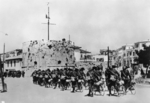
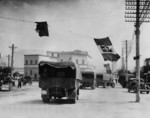
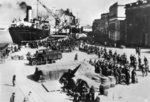
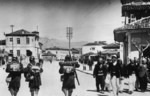
ww2dbaseDeciding that Adolf Hitler had been upstaging him, Benito Mussolini decided it was time to launch another invasion to put Italy in the news. Despite King Vittorio Emanuele III's objections, Mussolini used King Zog's oppression of fascists in Albania as an excuse for aggression. On 25 Mar 1939, Mussolini delivered an ultimatum to the Albanian capital of Tiranë, demanding Albanian to subject to Italian annexation. After King Zog's refusal, Italian warships bombarded the Albanian coast, followed by troop landings on 7 Apr 1939, Good Friday. The selection of the invasion date mirrored a strategy adopted by Hitler, who knew that British politicians were known to be unavailable on weekends and holidays, therefore making those days perfect for launching major initiatives; The British ruling class continued "to take its weekends in the country," criticized Winston Churchill, while "Hitler takes his countries in the weekends." Many of the initial Italian landers drowned in rough Albanian coastal waters, but Albanian resistance proved to be ineffective. King Zog and Queen Geraldine Apponyi, along with the infant Crown Prince Leka, fled to London via Greece. On 12 Apr, the Albanian parliament surrendered. Rather reluctantly, King Vittorio Emanuele III took the crown of Albania. "It was an infamous victory", wrote William Manchester. Mussolini installed Shefqet Verlaci as the head of the puppet government and absorbed the Albanian military under Italian leadership.
ww2dbaseAs a response, Winston Churchill of Britain recommended the occupation of several Greek islands, with the consent of the Greek government, to deter further Italian aggression in the Balkans. The recommendation, however, was largely ignored. "[E]ven a few British ships would confront Mussolini with beginning a war of aggression upon England", Churchill explained, noting that Mussolini would not dare challenging Britain directly. This recommendation was rash. Italian air forces possessed enough strength to ravage any British naval presence without the support of the British Royal Air Force, but Churchill knew Britain must do something in response. British Prime Minister Neville Chamberlain was enjoying the view of the 10 Downing Street garden from his study; bird food had just been strewn on a shelf outside. When he was informed of the news of invasion, he was initially annoyed with being disturbed on a holiday with such matters. When the work week came around, however, he condemned the invasion and surprisingly went as far as guaranteeing Greek borders with British military might, a commitment Italy did not expect the pacifist politician to make. Chamberlain, however, did not heed to Churchill's advice to dispatch a strong Royal Navy presence to Greece. Additionally, this invasion also marked Chamberlain's loss of trust for Mussolini, for that Italy had previously promised Chamberlain that the sovereignty of the Balkans nations would not be violated. "Such faith as I ever had in the assurances of dictators is rapidly being whittled away", Chamberlain later said.
ww2dbaseSources: the Last Lion, Wikipedia.
Last Major Update: Jul 2006
Photographs
 |  |  |  |
Invasion of Albania Timeline
| 7 Apr 1939 | Italy invaded Albania. |
| 3 Feb 1941 | Mussolini sent Fascist Party leaders to the Albanian front to bolster morale. |
| 11 Apr 1941 | Italian forces redoubled their efforts to link up with units in Albania. In northern Greece, German troops captured Vevi. In the evening, British, Australian, and New Zealand troops engaged German troops in Greece for the first time just south of Vevi, stopping the advance of Leibstandarte SS Adolf Hitler Regiment at Klidi Pass. |
Please consider supporting us on Patreon. Even $1 per month will go a long way! Thank you. Please help us spread the word: Stay updated with WW2DB: |


» Iachino, Angelo
Location:
» Albania
Document:
» Statement by Cordell Hull on Albania
- » 1,182 biographies
- » 337 events
- » 45,119 timeline entries
- » 1,248 ships
- » 350 aircraft models
- » 207 vehicle models
- » 376 weapon models
- » 123 historical documents
- » 261 facilities
- » 470 book reviews
- » 28,409 photos
- » 365 maps
Winston Churchill, 1935

Please consider supporting us on Patreon. Even $1 a month will go a long way. Thank you!

Or, please support us by purchasing some WW2DB merchandise at TeeSpring, Thank you!