


Battle of Denmark Strait
Contributor: C. Peter Chen
ww2dbaseOn 18 May, German Grand Admiral Erich Raeder called for more surface units to raid British shipping. The battleship Bismarck and heavy cruiser Prinz Eugen, both newly commissioned and on their first combat mission, were sent from the Baltic Sea toward the Denmark Strait. The action was code named Operation Rheinübung and was commanded by Admiral Günther Lütjens. Originally, additional ships were dispatched from Brest to join Bismarck and Prinz Eugen, but British bombing of the French port prevented German ships from departing Brest. With the operation launched with only two warships, Lütjens opted to sail through the Denmark Strait, a body of water between Iceland and Greenland, to break into the Atlantic Ocean.
ww2dbaseThe German fleet was spotted by a Swedish cruiser and by a Royal Air Force Spitfire aircraft. Admiral Lancelot Holland's group centered around battlecruiser Hood and battleship Prince of Wales was in the region and was immediately notified to intercept. Admiral John Tovey boarded the battleship King George V and set sail for the region alongside of carrier Victorious.
ww2dbaseIn the evening of 23 May, heavy cruisers Norfolk and Suffolk under the command of Rear Admiral Wake-Walker began to shadow the German ships by Suffolk's newly installed radar. The Germans soon detected the presence of the British ships, and Bismarck fired her guns at Norfolk, but missed.
ww2dbaseThe Battle
ww2dbaseAt 0537 on 24 May, Holland's group made contact with the German ships in the Denmark Strait. German sailors identified Prince of Wales as King George V, as they did not believe Prince of Wales had been deployed to sea yet. The mis-identification was understandable. Prince of Wales was rushed to action without proper shakedown and training; in fact, while underway to intercept the two German ships, shipyard workers traveled aboard the battleship to frantically work on mechanical problems with her main armament. At 0552, Hood opened fire first at a distance of approximately 26,500 yards or about 13 nautical miles, then Prince of Wales followed suit. They first fired on the lead ship, which Holland had incorrectly assumed to be Bismarck. The mistake was detected and the order amended, but Hood, for whatever reason, continued to fire on the lead ship Prinz Eugen for some time longer. Both British ships continued to close in on their German counterparts.
ww2dbasePrince of Wales drew blood against Bismarck first. The first hit took out the commander's boat and the seaplane catapult, the second passed through the bow, and the third struck the hull underwater. While the two final hits only caused minor damage and flooding, the second hit severed access to the forward fuel tanks, decreasing her range and forcing her to leave a trail of oil slick from that point on.
ww2dbaseBeginning at 0555, the German ships fired on Hood. A shell started a fire in Hood's ready-use 4-inch ammunition store, but caused relatively little damage. At 0600, while the British ships executed a turn to port, Bismarck hit Hood with at least one shell at a distance of 9 miles. A pillar of flame was reported by men of Prince of Wales to have shot up from Hood's mainmast area, followed by an explosion that destroyed a large portion of the ship from amidships clear to the rear of "Y" turret. She then broke up into two parts. The stern broke away and sank, while the bow floated for a while before following suit after about three minutes. The sinking of Hood killed 1,415 men, including Holland. Only 3 survived to be rescued two hours later by destroyer Electra. Later studies concluded the first explosion was caused by the fire in the ready-use 4-inch ammunition store, while the second explosion was caused by Bismarck's shell penetrating Hood's magazines.
ww2dbaseFinding herself steering towards the wreckage of Hood, Captain John C. Leach of Prince of Wales ordered an emergency maneuver to avoid collision. This maneuver put her at a position where she was most vulnerable to German gunfire, which resulted in four hits by Bismarck and three hits by Prinz Eugen. One of them passed through her superstructure, killing several men in the compass platform and air defense platform. Shrapnel from another shell killed several men in the radar room. Soon after, a 203-mm shell from Prinz Eugen and a 380-mm shell from Bismarck hit her, both penetrating her outer armor, but luckily for Prince of Wales, none of them detonated. The hits, however, placed most of the main guns out of action and killed 13 men. She made smoke and retreated at 0604 while her rear turret fired under local control as deterrent to any German pursuit. Though the rear turret shells fell short of their targets, she successfully disengaged from combat at about 0610.
ww2dbaseBetween 0619 and 0625, Suffolk fired six salvoes at the direction of Bismarck. These shells fell well short of battleship due to Suffolk having miscalculated the range. Bismarck was actually much further away than the guns' effective range. The British ships continued to shadow the German ships, but the German ships eventually escaped detection. Although only suffering slight listing to port and a small reduction to her speed, Bismarck was leaving an oil slick trail behind her. She began turning for Saint-Nazaire, France for repairs while Prinz Eugen headed south to successfully meet an oil tanker for refueling. After experiencing some engine trouble, she headed for Brest to end her patrol.
ww2dbaseEpilogue
ww2dbaseHunting down the Bismarck to avenge for Hood became an obsession for the British. The Admiralty dispatched every available warship to hunt down Bismarck. On the night of 24 May, British carrier planes hit the Bismarck. This strike did not sink her, but further reduced her speed. Bismarck's maneuvers caused the British to lose track of the German battleship once again. Two days later, on 26 May, a Catalina flying boat found her again 700 miles west of Brest. Carrier Ark Royal launched Swordfish torpedo bombers led by Lieutenant Goode to attack her, damaging her steering mechanism with one of the two torpedo hits. Bismarck was now unable to maintain course toward France, and she had not yet entered Luftwaffe operating range. In the morning of 27 May, Tovey's King George V was joined by battleship Rodney and the cruisers Dorsetshire and Norfolk, and the collective force engaged Bismarck from the west at 0900, with Bismarck profiled clearly in front of the rising sun. Bismarck returned fire, but her inability to steer and the list to port affected the effectiveness of her guns, while her slow speed of seven knots made her an easy target for British guns. One salvo destroyed Bismarck's forward control post, killing most of the senior officers. Within the next 30 minutes, she was visibly taking in a lot of water, and her guns went silent one by one. Rodney closed in to within 3-kilometers from Bismarck, firing at near point blank range. When Bismarck was apparently defeated, the ships were sent home while Dorsetshire remained to fire three 21-inch torpedoes to finish Bismarck. Bismarck rolled over at 1039, probably due to German sailors scuttling the ship, though the actual fate of Bismarck remain somewhat controversial. What is known for sure is that only 115 of her crew were saved. British ships Dorsetshire and Maori saved 110, but had to abandon the rest due to German submarine alarm. The next morning, German submarine U-74 and weather ship Sachsenwald picked up 5 more survivors. The total loss of Bismarck's sinking amounted to almost 2,100.
ww2dbaseUnable to communicate with German naval command in her final condition, the Germans had no idea that she had been sunk and continued to issue her orders for hours. The Germans' suspicion that she had gone down was not confirmed until they had picked up Reuters news from Britain. After the battle, Tovey said that "Bismarck had put up a most gallant fight against impossible odds worthy of the old days of the Imperial German Navy, and she went down with her colors flying." Later, moves were made to court-martial Leach and Wake-Walker, but after Tovey's protest, the notions were dropped.
ww2dbaseSources:
US Navy Naval History and Heritage Command
Wikipedia
Last Major Update: Aug 2007
Battle of Denmark Strait Interactive Map
Photographs
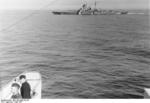 | 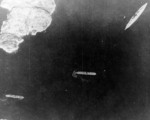 | 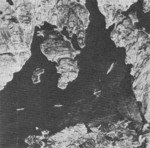 | 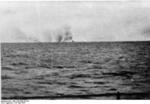 |
Battle of Denmark Strait Timeline
| 18 May 1941 | After sundown, German battleship Bismarck and cruiser Prinz Eugen departed Gotenhafen (Gdynia), occupied Poland for the North Atlantic. The fleet was commanded by Admiral Günther Lütjens aboard Bismarck. |
| 20 May 1941 | Swedish seaplane-cruiser Gotland spotted German warships Bismark and Prinz Eugen in the Kattegat between Denmark and Sweden. This information was passed on to the British naval attaché in Stockhlom, Sweden Henry Denham, who in turn passed it to the British Admiralty. |
| 21 May 1941 | German battleship Bismarck and cruiser Prinz Eugen stopped in Grimstadfjord, Norway to refuel Prinz Eugen. At 1315 hours, RAF Flying Officer Michael Suckling, flying a Spitfire fighter, spotted the warships. British Home Fleet commander Admiral John Tovey dispatched all available warships to prevent the Germans from breaking out to the North Atlantic. The German ships completed refueling at 1900 hours and began moving westwards. After dark, British bombers attacked the empty Grimstadfjord. |
| 22 May 1941 | British aerial reconnaissance confirmed the German battleship Bismarck and cruiser Prinz Eugen had left Grimstadfjord, Norway. The German aerial reconnaissance to Scapa Flow, Scotland, United Kingdom, seeing dummy warships, reported that the British fleet was still in port. |
| 23 May 1941 | German battleship Bismarck and cruiser Prinz Eugen were spotted by British cruisers HMS Suffolk and HMS Norfolk in the Denmark Strait at 1922 hours. Bismarck forced the British cruisers to back off with her guns, but the cruisers would follow at a safer distance to report the German position. |
| 24 May 1941 | British battlecruiser HMS Hood and battleship HMS Prince of Wales engaged German battleship Bismarck and cruiser Prinz Eugen at 0552 hours at the distance of 24 kilometers. At 0600, a 15 inch shells from Bismarck penetrated Hood's thin deck armor, detonating a magazine and sinking her with almost all killed. Prince of Wales broke off from the battle at 0604 hours after being hit 7 times. Bismarck was hit 3 times and began to sail south for repairs. At 2350 hours, 8 British Swordfish torpedo bombers from aircraft carrier HMS Victorious attacked Bismarck and scored one torpedo hit. |
| 25 May 1941 | British cruisers HMS Suffolk and HMS Norfolk lost radar contact with German battleship Bismarck at 0306 hours as the German ship unexpectedly turned west. Several hours later, the British learned of Bismarck's general area after intercepting a radio message sent by Admiral Lütjens. All British attempts to locate Bismarck on this date, however, failed. |
Please consider supporting us on Patreon. Even $1 per month will go a long way! Thank you. Please help us spread the word: Stay updated with WW2DB: |


Visitor Submitted Comments
20 Apr 2007 01:20:45 PM
Now...was the German Bismarck the largest battleship of the war, or was the Japanese Yamato? Ironic how both these huge ships never really achieved anything, with Bismarck being scuttled and Yamato running from a bunch of American tin cans in the Battle off Samar...
6 May 2007 11:35:53 AM
The Yamato was the largest battleship ever built.
21 May 2007 10:24:21 PM
Thats what I thought but I wasnt sure.
10 Jan 2010 02:28:59 AM
Please put down many choosen language. Malay for example.
23 Apr 2012 02:37:03 PM
Bismark was 41500 tons standard, the Musashi and Yamato were 68000 tons standard, All were deadly 15 inch guns on the Bismark and 18.1 on the two Yamato class battleships. The interesting thing is the ending of the battleship as the major agressive ship today
31 May 2016 12:03:22 PM
My great uncle was a Captain in the Royal Marines who was stationed aboard the Suffolk during the hunt for and destruction of the Bismarck.
Sadly, he died on D-Day a 24 year-old Major.
28 Dec 2019 11:03:50 AM
It could be the events of the evening and night of the 23/24th that contributed considerably to the Hood disaster. Some have criticised the Hood's approach by Admiral Holland because it closed slowly and exposed Hood to descending gunfire for longer. But Holland was likely planning the previous evening to cut sharply across Bismarck's bow, giving a high closing rate and crossing her T, in which case the result might have been very different. What may have fouled that up was Lutjens' attempt to break contact with the shadowing cruisers by turning from southwest to south. He didn't succeed, but the temporary loss of enemy reports from Suffolk caused Holland to hang on northward for longer to avoid risking a failed interception. Holland probably did the best he could have with the ships and information he had.
2 May 2023 05:38:38 AM
The first sentence of the final paragraph has a notable error. It reads "Able to communicate with German naval command, the Germans had no idea that she had been sunk and continued to issue her orders for hours." Clearly, the first word "Able" should instead be "Unable."
 C. Peter Chen says:
2 May 2023 06:44:47 AM
Thank you to Anonymous of 2 May 2023; the mistake has been corrected.
All visitor submitted comments are opinions of those making the submissions and do not reflect views of WW2DB.

» Somerville, James
» Vian, Philip
Location:
» Atlantic Ocean
Ship Participants:
» Ark Royal
» Bismarck
» Cossack
» Dorsetshire
» F6
» Hood
» King George V
» London
» Prince of Wales
» Prinz Eugen
» Rodney
» Victorious
Notable Aircraft:
» Swordfish
- » 1,177 biographies
- » 337 events
- » 44,933 timeline entries
- » 1,245 ships
- » 350 aircraft models
- » 207 vehicle models
- » 376 weapon models
- » 123 historical documents
- » 261 facilities
- » 470 book reviews
- » 28,474 photos
- » 365 maps
Thomas Dodd, late 1945

Please consider supporting us on Patreon. Even $1 a month will go a long way. Thank you!

Or, please support us by purchasing some WW2DB merchandise at TeeSpring, Thank you!
18 Apr 2007 09:28:53 PM
That sure was a sore blow to the British, the sinking of HMS Hood, the symbol of British naval power.