


Scuttling of the French Fleet
Contributor: C. Peter Chen
ww2dbaseOn 19 Nov 1942, German leaders in Berlin set Operation Lila in motion, with the objective of capturing the French port city of Toulon, along with the French fleet in its harbor. German forces were to attack from both east and west. From the east, the plan was to capture Fort Lamalgue, headquarters of Admiral André Marquis, and the Mourillon arsenal; from the west, the plan called for the capture of the main arsenal and the coastal defenses. German naval forces were cruising off the harbor to engage any ships attempting to flee, and naval mines were laid.
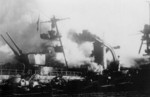
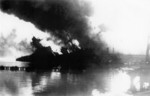
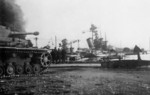
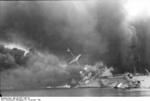
ww2dbaseAt dawn on 27 Nov, the execution of the operation began. At 0425 hours, German tanks arrived at Fort Lamalgue on the east side of the port, capturing Marquis by surprise, but failing to prevent his chief of staff Rear Admiral Robin from contacting Rear Admiral Dornon at the arsenal, who sent the recommendation to scuttle the fleet to Admiral Jean de Laborde aboard flagship Strasbourg. At 0520 hours, the Germans broke through the Mourillon gate (Porte Nord); five minutes after, Castigneau gate to the northwest was penetrated. While the Germans took the following 20 to 30 minutes to advance to the moorings, French sailors worked diligently in deploying explosives, smashing machinery, and opening valves. At about 0550 hours, the Germans finally reached the moorings; it was around this time that Admiral Laborde officially ordered the scuttling to begin via radio, visual signals, and dispatch boat. Shortly after, fighting broke out near battleship Strasbourg and cruiser Foch. A German tank fired on battleship Strasbourg (hitting a secondary turret, killing officer and wounding six men) while various machine guns fired on submarines. At 0620 hours, the demolition charges went off aboard Strasbourg, destroying her armament, machinery, and fuel stores. A few minutes later, cruisers Colbert, Algérie, and Marseillaise were destroyed in similar manners. Cruiser Dupleix was boarded by force by German troops, but they failed to prevent Captain Moreau from setting the demolition charges, which detonated the magazine at 0830 hours, destroying the ship. In the port's drydock, demolitions set up aboard cruiser Jean de Vienne were disarmed in time by German troops, but the open sea valves brought her to the bottom, blocking the drydock. Shortly after, in another drydock, battleship Dunkerque was destroyed by demolition charges, then cruiser La Galissonnière was scuttled to block that drydock.
ww2dbaseAgainst orders, several submarine captains refused to scuttle their boats, and chose to defect to the Free French instead. Submarines Casabianca and Marsouin reached Algiers, Le Glorieux reached Oran, and Iris reached Barcelona to reach that end. Submarine Vénus failed to leave the harbor, and was scuttled at the entrance to Toulon harbor instead.
ww2dbaseOne surface ship, Leonor Fresnel, managed to escape and reach Algiers. Destroyers Panthère, Tigre, and Trombe survived as they were under maintenance; they would later be pressed into Italian service.
ww2dbaseDuring the scuttling operation, the French destroyed 3 battleships, 7 cruisers, 15 destroyers, 13 torpedo boats, 6 sloops, 12 submarines, 9 patrol boats, 19 auxiliary ships, 1 school ship, 28 tugs, and 4 cranes. 12 French naval personnel were killed and 78,888 were captured (although they would be speedily freed after the French pledged full cooperation in the salvage efforts). In the end, the Germans were only able to capture three disarmed destroyers, four damaged submarines, three civilian ships, two obsolete battleships of little military value, and 27 other small vessels, some of which were damaged. The only prize of value was the 40,000 tons of fuel oil found on storage tanks. Toulon harbor burned for several days, and oil pollution was so bad that it took two years before the harbor water cleared.
ww2dbaseThe destruction of the French fleet at Toulon symbolically ended the Vichy government's military importance.
ww2dbaseSources:
John Jordan, Warship 2013
Wikipedia
Last Major Update: Sep 2007
Scuttling of the French Fleet Interactive Map
Photographs
 |  |  |  |
Scuttling of the French Fleet Timeline
| 12 Jun 1940 | French Admiral François Darlan, Commander-in-Chief of the French Navy, assured British Prime Minister Winston Churchill that there would be no question of surrendering the French naval ships. He further asserted that orders would be given to scuttle the ships if such a danger were to exist. |
| 9 Nov 1942 | Adolf Hitler informed Italy, via Galeazzo Ciano, that he intended to occupy Vichy France soon. |
| 10 Nov 1942 | As Pierre Laval visited Adolf Hitler in Germany, Hitler told the French Prime Minister that Germany intended on moving its forces into Vichy France and Tunisia; Hitler did not share the timetable and gave no indication that it was to happen soon. Laval did not protest. At 2030 hours, Hitler gave the order to launch the occupation on the following day. |
| 11 Nov 1942 | Vichy France became occupied by German and Italian troops in order to defend against a potential Allied invasion. The American embassy in Vichy was seized by German troops by force. |
| 13 Nov 1942 | Adolf Hitler promised France that Germany would leave the French fleet at Toulon, France alone. |
| 25 Nov 1942 | Adolf Hitler ordered the seizure of the French fleet at Toulon, France. |
| 27 Nov 1942 | Germans occupied naval base at Toulon; French Navy scuttled warships to avoid German capture. |
Did you enjoy this article or find this article helpful? If so, please consider supporting us on Patreon. Even $1 per month will go a long way! Thank you. Share this article with your friends: Stay updated with WW2DB: |


Visitor Submitted Comments
27 Nov 2013 02:23:28 PM
The French need to hold their heads in shame at this. By messing around they ended up helping the axis powers. I love it! They were angry at us (UK) sinking their ships when they Should have handed them over to join us. How did they think we were going to react, Just Scuttle away like they did? How did they think the Nazis were going to get out of France? Or is that not what they wanted. One word, Collaboration!
7 Mar 2021 12:23:27 AM
It is always necessary for British readers to understand the true mentality & ethos of "Vichy France". It came to power by a discreet take over of power mzasked by a venir of legality. France even more Petain was torn apart between left & right, very xenophobic and antisemitic with a strong dose of historic anti-British sentiment (note Dunkirk & the return of hostile French troops to certain POW status as just two examples). By Nov 1942 sentiments in France were changing slowly to the allied cause (Stalingrad !). Effectively, although still very closely tied to Germany & Italy they decided after the N. African Torch landing to "hedge their bets" by scuttling their fleet at Toulon to show some "good faith" to the allies already in their African department Algeria! Darlan strangely had just turned up there and was probably an emissary of Petain hoping to arrange after "Victory" his regime would remain in power.
All visitor submitted comments are opinions of those making the submissions and do not reflect views of WW2DB.
» de Laborde, Jean
» Marquis, André
» Meynier, Robert
Location:
» France
Ship Participants:
» Algérie
» Casabianca
» Dunkerque
» Dupleix
» Foch
» Jean de Vienne
» Marseillaise
» Provence
» Strasbourg
Document:
» Führer Directive 19
Related Book:
» Warship 2013
- » 1,150 biographies
- » 337 events
- » 44,024 timeline entries
- » 1,242 ships
- » 350 aircraft models
- » 207 vehicle models
- » 375 weapon models
- » 123 historical documents
- » 260 facilities
- » 470 book reviews
- » 28,623 photos
- » 431 maps
General Douglas MacArthur at Leyte, 17 Oct 1944

Please consider supporting us on Patreon. Even $1 a month will go a long way. Thank you!

Or, please support us by purchasing some WW2DB merchandise at TeeSpring, Thank you!
19 May 2010 02:39:56 PM
It's amazing that despite numerous attempts by the Brits to convince the French navy to sail their ships to a Free French port, to America, or to Britain the French admirals preferred to sit in a Vichy port until they had no choice but to scuttle or be captured.
What a waste of a fine naval task force.