


Doolittle Raid
Contributor: C. Peter Chen
ww2dbaseAfter the embarrassment at Pearl Harbor, at the Philippine Islands, at Java Sea, and at just about every engagement in the early chapters of the Pacific War, overall long term goals aside, the American leaders wanted a quick victory to be advertised as a revenge for the purpose of raising public morale. At the same time, they wanted to do exactly the opposite against the Japanese, and striking urban centers could achieve just that. US Navy Admiral Ernest King named Tokyo, Japan as the target as he was bombarded by the American public with the question "where is the Navy? Why don't they do something?" Barely a month into the war with Japan, King had already summoned Captain Donald B. Duncan, his air operations officer, to discuss possibilities for such a revenge operation. Americans had no bases within bomber operating range of Tokyo, and planes typically used with carriers did not carry enough payload to cause enough damage for such an operation. Duncan used some creativity to draw up a plan to borrow US Army Mitchell B-25 bombers (General Henry H. "Hap" Arnold of the Army did not know why they loaned out the bombers when they did) and train pilots to fly them off of carrier flight decks. It was a bold plan, and a bold admiral was chosen to bring the bombers there: Vice Admiral William Halsey.
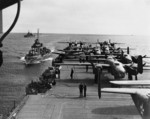
ww2dbaseLieutenant Colonel James H. Doolittle had always been a maverick of sorts in his career. He liked to be daring, thinking of military maneuvers that no one had yet done before. It was not surprising to see him taking on the task of lightening up B-25 bombers in order to allow them to take off from carriers. Beyond targeting the strategic manufacturing centers, he, like those in Washington D.C., wanted to hurt the Japanese morale, too. Doolittle's call for volunteers was met with ample calls. In Eglin Field, Florida, United States, Doolittle installed catapults in shortened airstrips, training the pilots to take off using as little space as possible. Landing was not practiced, as the plan was for the bombers to fly into friendly Chinese territory, where Chiang Kaishek's Nationalist troops would welcome them at airfields 1,100 miles from Tokyo. The pilots were not told of their targets, only that it was a dangerous mission which the rewards reflected the hazards. The pilots' only hint was that they were taught navy etiquette by US Navy Lieutenant Henry L. Miller; from this clue the pilots concluded they were going to hit a target in the Pacific. Most guessed wrongly at the Philippines, while Doolittle told them simply not to venture any guesses and keep their mouths shut, lest any spies began to piece things together. Interestingly, their B-25 bombers were parked atop atop USS Hornet, which was to bring them toward Japan, without any covering.
ww2dbaseOn 2 Apr 1942, USS Hornet set sail into the Pacific Ocean. On 13 Apr, the carrier met with Admiral Halsey's fleet, which escorted her for the rest of its journey toward Japan. It was not until this time the US Army pilots learned that their target: "Our destination is Tokyo," Doolittle said, "we're going to bomb Tokyo, Yokohama, Osaka, Kobe, and Nagoya." The Army pilots cheered, while the Navy pilots were generally envious of the opportunity. "It's going to be a pretty tight squeeze", he continued. "But it's all been worked out the best possible way." Because he had brought reserve airmen along, Doolittle asked if any of the men wished to back out of the mission now that they targets had been revealed; none did. Some of the reserve airmen tried to offer as much as $150 to switch places with the primary crewmen, but they were not persuasive enough. On 17 Apr, the task force refueled one thousand miles away from Tokyo. Most of the bombers were each loaded with 1,140 gallons of fuel and four 500-pound bombs, while four others (including Doolittle's) were loaded with incendiary bombs. A few officers who were decorated in Japan during peace time appeared to tie their medals to the bomb; Halsey tied his to one of the big 500-pound bombs, saying "[b]oys, return these medals with interest." Unbeknownst to Doolittle, the proposed landing fields were not ready. The Chinese were not told of the nature of the mission, so when bad weather struck, they decided to maintain radio silence to prepare for a Japanese advance under the cover of weather.
ww2dbaseAt the dawn of 18 Apr, the fleet was discovered by Japanese picket ship Nitto Maru. She was quickly destroyed by the cruiser USS Nashville, but not before enough time elapsed which Nitto Maru could have radioed her findings back to Japan. To prevent losing the element of surprise, despite it being hours before the original planned takeoff time, Halsey ordered Doolittle to take off, launching 800 miles from Japan instead of the planned 400 to 650 miles. The timing of the attack was also completely changed. Original plans called for a night time raid, but due to the early launch, the bombers would arrive during daylight. Fuel was now a major issue. Captain Ted Lawson, pilot of the B-25 bomber "Ruptured Duck" that participated in the Tokyo attack, remembered his anxiety as he checked on his suddenly non-functional rear turret before taking off.
ww2dbaseCommander Mott of the USS Enterprise remembered that day after the bombers launched:
ww2dbaseAll 16 bombers took off the short carrier deck successfully, and they did not need to worry about bearing as the wind allowed USS Hornet to point straight at Tokyo as the bombers took off. It was good flying weather, as Lawson recalled, and all aircraft reached their targets successfully. Despite earlier worries about the Nitto Maru providing early warning, the raiders encountered little defense. In total, the bombers encountered about 20 enemy interceptors (and a few were shot down by the bombers' turrets) and met sporadic anti-aircraft fire, but all bombers carried out their mission without suffering much damage. Doolittle's bomber was the first to reach Tokyo. Like the other raiders, he flew so low that the plane was in danger of coming in contact with power lines; he observed that he flew so low that he even broke up a baseball game in the Tokyo suburbs. When he neared the city, his bomber pulled up to about 1,500 feet and dropped his bombs at his target, then diving low to make his escape in the southward direction to prevent the Japanese from figuring out immediately where he came from or where he was going. On the way south he flew across a field of red and silver training aircraft, and, according to his navigator Lieutenant Henry Potter, Doolittle cursed over the noise of the engines because he had no more bombs to attack these planes.
ww2dbaseImmediately after the attack, the Japanese attempted to control morale by announcing distorted figures. According to the official Japanese announcement, nine of the raiders were shot down after they caused a few minor fires, though in fact only seven bombers attacked Tokyo and some of the damages such as the large explosions at the oil refineries caused significant damage. Regardless of the attempts to hide the extent of damage, it caused loss of face among the leaders of Japan; the officer in charge of Tokyo's air defenses committed ritual suicide because he felt dishonored and ashamed that he was not able to protect his country from the American attack. Argentinian commercial attaché to Tokyo Ramon Muniz Lavelle witnessed and documented the outcome of the raid, debunking the propaganda by the Japanese government to control the morale:
ww2dbaseWhen the raid was finally officially announced by the United States government a few weeks later, it gave the American military the boost in morale that it needed at this stage of the war. Because of the early launch, none of the bombers reached Chinese airfields (the Chinese airfields were not ready even if they had). Most crashed on the Chinese coast or in waters immediately off the coast, with some unfortunately landing in Japanese-held territory. The only bomber that did not crash during the emergency landing found its way to an airfield in Vladivostok, Russia; that aircraft was confiscated by the Soviets and the crew was interned (this crew was transferred to the Soviet border with Iran, and in 1943 the NKVD secretly helped this crew escape across the border without the knowledge of the US airmen; this was done in secret because the USSR wished to maintain its friendly relations with Japan). The few captured by the Japanese were put on trial for bombing civilian targets. Three were executed in Shanghai, China, on 15 Oct 1942; five became prisoners of war, enduring terrible conditions, with one dying in captivity. "It was with a feeling of deepest horror, which I know will be shared by all civilized peoples, that I have to announce the barbarous execution by the Japanese Government of some of the members of this country's armed forces who fell into Japanese as an incident of warfare", said US President Franklin Roosevelt, denouncing the kangaroo court and the rushed executions of the captured airmen. In addition to the executions, a Japanese effort to seek out the remaining American airmen who crash-landed in China resulted in 25,000 civilian deaths in the process.
ww2dbaseThose who crashed landed in friendly territory recalled the selfless attitude of the Chinese civilians who put themselves in danger to save the foreigners whose language they could not even comprehend. Many injured American airmen were transported by sedan chairs, diesel trucks, junks, or whatever mode of transportation the local Chinese could find to move the Americans westward toward the Chinese war-time capital Chongqing. Lawson, especially after learning of the Japanese retribution on the Chinese civilians, said that there was no word to describe the gratitude he had for the Chinese who helped him and no word to describe the agony he felt knowing there was nothing he could do to return the favor, even though he found that the Chinese who helped him wished nothing in return for the assistance.
ww2dbaseAfter the Doolittle Raid, many among the top Japanese leadership focused on eliminating the chance for a repeat of such an attack, which led to the Midway-Aleutian Islands invasion that would prove to be a pivotal point of the war.
ww2dbaseDoolittle won a Medal of Honor for the successful execution of this raid.
ww2dbaseSources:
Ted Lawson, Thirty Seconds Over Tokyo
Craig Nelson, The First Heroes
Dan van der Vat, The Pacific Campaign
Wikipedia
Last Major Update: Oct 2005
Doolittle Raid Interactive Map
Photographs
 |  |  |  |
Maps
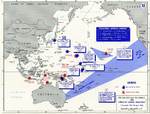 | 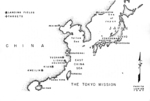 | 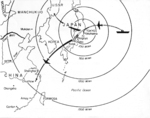 |
Doolittle Raid Timeline
| 2 Jan 1942 | James Doolittle was promoted to the rank of lieutenant colonel in the US Army for the task of planning an air raid against Japan. |
| 1 Apr 1942 | Under strict security sixteen modified B-25 bombers were lifted onto the USS Hornet and lashed to the flight deck at Naval Air Station Alameda, California, United States. |
| 2 Apr 1942 | USS Hornet departed Naval Air Station Alameda near San Francisco, California with James Doolittle and his 16 US Army B-25 bombers on board. |
| 11 Apr 1942 | American submarine USS Thresher provided a weather report on Tokyo, Japan for the Doolittle Raiders. |
| 13 Apr 1942 | Task Force 16 (USS Enterprise) made rendezvous with Task Force 18 (USS Hornet) north of Midway and pressed on westward toward the launch point for the Doolittle Raid. Later on the same day, they crossed the 180th meridian. |
| 16 Apr 1942 | Submarine USS Thresher departed her patrol area off the coast of Japan bound for Pearl Harbor, Hawaiʻi. During this patrol, Thresher had transmitted vital weather intelligence needed by Admiral Halsey and the Doolittle Raid. |
| 17 Apr 1942 | The task force carrying the Doolittle Raiders refueled at about 1,000 miles away from Tokyo, Japan. |
| 18 Apr 1942 | 16 US Army Air Force B-25 bombers launched from USS Hornet attacked Tokyo, Yokohama, Yokosuka, Kobe, Osaka, Nagoya, and other targets in the Japanese home islands at about 1200 hours. Most of the bombers would fly on to crash land in or bail out over China, while one landed in Russia and the crew were interned by the Soviets, who had a non-aggression treaty in place with Japan. |
| 18 Apr 1942 | As part of the covering force for the Doolittle Raid, cruiser USS Nashville was ordered to destroy two Japanese patrol boats, No.23 Nitto Maru and the Nagato Maru. Discovery of these boats prompted the early launch of the Doolittle bombers. |
| 21 Apr 1942 | Large number of Japanese warships were dispatched in search for the carriers that launched the Doolittle Raiders. |
| 25 Apr 1942 | Troops of the Japanese 22nd Infantry Division began to conduct a search in Zhejiang and Jiangxi Provinces on the Chinese coast, burning down and massacring entire villages suspected of assisting the Doolittle Raiders. |
| 21 Apr 1943 | US President Franklin Roosevelt made the official announcement regarding the Japanese execution of downed American airmen who had participated in the Doolittle Raid. |
Please consider supporting us on Patreon. Even $1 per month will go a long way! Thank you. Please help us spread the word: Stay updated with WW2DB: |


Visitor Submitted Comments
19 Apr 2007 08:23:19 AM
Anonymous #1 is full of beans. Everyone is entitled to their own opinion. Nobody is entitled to their own facts. This article contains mere facts. Dont try to change history by you whining.
19 Apr 2007 12:40:47 PM
True...this is about what happened, not what everyone thought of it.
3 Jun 2007 10:58:57 PM
To the first post: if you dont like the way this is done, start your own *** website and dont bitch about this one.
26 Aug 2007 06:35:05 PM
Truism? As in altrusim? You lost me there, ace.
1 Mar 2009 07:21:14 PM
i don't like all these anonymous names this is stupid we all have our own ideas on the raid and there should be at least some links to other webs with different views
17 Mar 2009 10:56:09 AM
I think this website is a reliable source. I got an A on my project
31 Dec 2009 03:06:17 PM
Good article. One thing I find amusing that wasn't mentioned is that the timing for the raid and landing in China is that the planners failed to take into account of crossing the international dateline. In the end it didn't matter because of the early launch.
23 Feb 2012 06:08:35 PM
this is helpful to me
21 Dec 2012 07:04:46 AM
America sucks
17 Apr 2013 05:36:13 PM
It is April 17th where I am now (New England, USA), but it is April 18th where Col. Doolittle launched his attack. He and his brave fliers may have past into history, but let us NOT forget the COURAGE it took to under take this mission. I speak for myself , but I can not fathom the depth of guts it took to fly this mission! Thanks to those who flew this mission and prayers to those who fell in enemy hands and suffered and died. Your sacrifice to freedom was not in vain! Despite the events that took place in my birth place Boston, MA two days ago yours is a shining example of love of country and freedom that we in the world we live in today shouls draw strength from. Done with my rant. Final word: I really am in awe of those who answer the call of their country in it's hour of need! You have my unquestioned thanks and praise!!
 Alan Chanter says:
3 May 2013 01:22:05 AM
Doolittle picked Twenty-four 'Volunteer' crews from the 17th Bombardment Group (Medium) for training at Elgin Field. This Group had been conducting routine maritime patrols along the West Coast ever since Pearl Harbor and there would most certainly have been no shortage of keen young aircrew looking for a bit of action.
The sixteen twin-engined B-25 Mitchell bombers selected for the operation were heavily modified for the long range mission. Three auxiliary fuel tanks, ten 5-gallon tins, and a 360-gallon capacity collapsible rubber bag were added to the normal fuel load to provide the bombers with a sufficient 'attack and escape' range. The bomb load was small, but the three 500-pound bombs and single incendary cluster could still do a significant amount of damage if dropped on the right target. For security reasons the (secret) Norden bombsights were removed and replaced with a very effective substitute, called the 'Mark Twain', especially designed by Captain C.F. Greening, USAAF, for low altitude bombing. For 'protection' from astern two fake wooden .50 machine guns were installed in the stingless rear turret.
19 Apr 2014 03:35:15 AM
What did this raid achieve? Not massive damage to Japan on the day, but it caused a change in Japans meticulous plans that had seen all swept before it. The Japanese attitude was so hurt by the raid that they went from cool and calculating to white hot rage. They removed carriers from their invasion of Port Moresby and Australia if all went well. These would have seen the Allies overwhelmed in The Battle of the Coral Sea. Japan then sent a task force with the extra carriers to sink the Island of Midway assuming that was where the bombers had come from and not off a carrier. Japans codes had been broken and the battle for Midway had begun. With out the Doolittle raid Japan would have executed their original plans and caused possibly millions more to die on all sides. Remember them all on this day, this raid achieved much more than was expected or even dreamed.
24 Apr 2015 12:21:37 PM
GUYS this is very reliable and also today there are only two of the men still alive im doing my research paper on this and one of the people alive his name is Richard e cole we better repay our respect and not just do this for a grade
28 Nov 2016 04:35:37 AM
they same,because the ships crossed the International Date Line,the Raid has been done one day sooner? why? it must be one day later,right?
All visitor submitted comments are opinions of those making the submissions and do not reflect views of WW2DB.

» Birch, John
» Doolittle, James
» Halsey, William
» Jurika, Stephen
» Mitscher, Marc
» Murray, George
Location:
» Japan
Ship Participants:
» Ellet
» Enterprise
» Grayson
» Hornet (Yorktown-class)
» Nashville
» Northampton
» Salt Lake City
» Thresher
» Vincennes
Notable Aircraft:
» B-25 Mitchell
Related Books:
» Lucky's Life
» The First Heroes
» Thirty Seconds Over Tokyo
Affiliated Link:
» Thirty Seconds Over Tokyo
- » 1,178 biographies
- » 337 events
- » 45,089 timeline entries
- » 1,245 ships
- » 350 aircraft models
- » 207 vehicle models
- » 376 weapon models
- » 123 historical documents
- » 261 facilities
- » 470 book reviews
- » 28,488 photos
- » 365 maps
James Forrestal, Secretary of the Navy, 23 Feb 1945

Please consider supporting us on Patreon. Even $1 a month will go a long way. Thank you!

Or, please support us by purchasing some WW2DB merchandise at TeeSpring, Thank you!
9 Jul 2005 12:58:17 PM
Your views on this page are very bias and should include stories and points of view from all the countries involved in WWII. Since this is not included, it makes this webpage an unreliable resource. Also, it helps to put sources for more truism, without it, the information on this page is considered unreliable.