


Invasion of the Philippine Islands
Contributor: C. Peter Chen
ww2dbaseAt the start of WW2, the Philippine Islands were United States territory as per the 1898 Treaty of Paris. The archipelago was home to 19 million people, and was at a strategic location between Japan and the South Pacific. Because of the importance, the retired Army General Douglas MacArthur, currently serving as a Field Marshal in the Filipino military, was called back into service by President Franklin Roosevelt, and was given resources to mobilize Philippine defenses in case of a Japanese attack. MacArthur was given US$10,000,000 and 100 B-17 Flying Fortress Bombers. MacArthur deployed most of his defenses on the northern island of Luzon and southern island of Mindanao, forming what he called "key or base point of the US defense line".
ww2dbaseIn the American capital of Washington DC, Henry Stimson and George Marshall believed that a strong presence of American air power in the Philippine Islands would discourage Japanese aggression. On 15 Nov 1941, George Marshall proudly said in a press conference that "the greatest concentration of heavy bomber strength anywhere in the world" were gathered at the Philippine Islands, ready to not only counterattack any attacks on the islands but also to strike at the Japanese home islands and set the "paper" cities of Japan on fire. When a reporter noted that the B-17 bombers lacked the range necessary for a round trip between Clark Field in Philippine Islands and the Japanese capital of Tokyo, Marshall indicated air fields at Vladivostok would be shared by the friendly Soviet government. Marshall would grossly overestimate Soviet Union's friendliness.
ww2dbase
ww2dbaseMacArthur anticipated Japanese aggression as early as late Nov 1941 when Japanese aircraft were seen over northern Luzon. In early Dec, Japanese bomber formations were observed flying within 20 miles of Lingayen Gulf beaches and returning to Taiwan, presumably making trial runs in preparation for the attack. As a precaution, orders were given to move the 27th Bombardment Group B-17 bombers southward to Mindanao, out of range of the Japanese bombers. This move was delayed, however, as the pilots were invited to a big party held in the honor of Major General Lewis Bereton, an event to be held what was to become the night before the Japanese attack, at the hotel in Manila that was also MacArthur's residence. When the party ended at 0200 hours Manila time, it was 0800 hours at Pearl Harbor, Territory of Hawaii when the first Japanese aircraft dropped their torpedoes. As it was too dark for coordinated offensive operations for the Japanese, the Americans and the Filipinos had precious hours to prepare preemptive air strikes and strengthen ground defenses (furthermore, at dawn, an unexpected heavy fog over Taiwan would further hamper Japanese air operations). As it would turn out, this opportunity was forfeited. While Bereton did his best in getting his aircraft in the air to prepare for MacArthur's approval to attack the invasion fleet or the Japanese bases on Taiwan, MacArthur never gave the order. By 1100 hours, American aircraft began to land to refuel, and it was not until then, at about 1120 hours, that MacArthur gave his approval, but then it was too late. At 1235 hours, Japanese Army fighters reached the airfield at Iba on the western coast of Luzon, destroying a flight of P-40 fighters in the process of landing. A short time later, the Del Carmen airfield to the southeast was also attacked, with its outdated P-35A fighters forming little resistance against the more modern Japanese fighters. These attacks would repeat themselves, within days destroying MacArthur's air force. On 10 Dec, with air superiority achieved, General Masaharu Homma ordered the invasion to set forth. Starting on 20 Dec, the Japanese Army landed on Mindanao and then Luzon, quickly capturing airfields and other key strategic positions.
ww2dbaseIn Washington on 14 Dec, Chief of Staff Marshall, who had not seen the Philippine Islands since he was a first lieutenant in Manila in 1915, summoned Brigadier General Dwight Eisenhower to assess the situation. Eisenhower told Marshall, essentially, to abandon the archipelago for the time being:
ww2dbaseThree airstrips at Luzon were taken very quickly, while the Lingayen Gulf region fell on 22 Dec. Between 22 and 28 Dec, an additional 43,110 Japanese troops arrived via the beaches at Lingayen Gulf despite poor weather and rough seas. As an open city Manila fell quickly, giving Japan the use of the naval bases at Manila Bay. The troops who landed at Mindanao marched toward Davao, which was captured on 20 Dec. A seaplane base was immediately set up at Davao to provide local air superiority, and then the work to establish Davao as the staging point for the next invasions further south began; the Japanese landing force at Mindanao only consisted of 57,000 men, but it had little difficulty fighting American and Filipino forces.
ww2dbaseOn 24 Dec, 7,000 troops from Japanese 16th Division landed at Mauban, Atimonan, and Siain on the shores of Lamon Bay at eastern Luzon island. The Filipino 1st Regular Division opposed the Lamon Bay landings fiercely and slowed the Japanese advance, but ultimately would not be able to hold the line.
ww2dbaseWhile Japanese troops advanced across Luzon, President Manuel Quezon of the Philippines requested President Roosevelt to grant the Philippine Islands their independence so that he could announce Philippine neutrality. Quezon's 8 Feb message said that:
ww2dbaseDespite the harsh truth told from his Filipino counterpart, Franklin Roosevelt refused the request for independence and neutrality. Partly, Roosevelt turned down the request knowing the Japanese would not acknowledge such a late statement of neutrality. However, he did grant MacArthur the permission to surrender Filipino troops (but not Americans).
ww2dbaseImmediately following capturing key cities, naval bases, and airstrips, nine ships with 4,000 troops departed from the main Philippine Islands for Jolo of the Sulu archipelago on 22 Dec. Jolo would fall on Christmas Day, 25 Dec, providing a forward base for supporting the attacks on Borneo. Another seaplane base was also set up at Jolo to form local air superiority.
ww2dbaseIt was surprising that with MacArthur predicting the attack to take place (though he thought the attacks would come later, in spring of 1942) down to the accurate prediction of Japanese landing sites, MacArthur was unable to react properly to the Japanese attacks. MacArthur was said to be in shock, unable to give commands to his staff officers. When he finally got himself together, he ordered troops to resist the Japanese at the landing sites, which Lieutenant Harold Johnson (later chairman of Joint Chiefs of Staff) called a "tragic error". Johnson believed that, in hindsight, instead of putting the inexperienced Filipino soldiers at the beaches only to be routed by the Japanese, they could have had been transporting food and other supplies to Corregidor where they would be badly needed later on. Some historians believed that the stockpiling of supplies on Bataan should had been done even earlier, for the retreat to the Bataan Peninsula had been in the design of the "Rainbow 5" plan all along. ww2dbaseThere were discrepancies in regards to the orders given to the bombers present in the Philippine Islands. According to Brereton, he requested immediate bombing missions to attack Taiwan to discourage further Japanese air strikes, and blamed Sutherand, MacArthur's Chief of Staff, for not giving the authorization to do so. According to Sutherland, however, he did authorize the bombers to launch, but it was Brereton who delayed the action as he had little intelligence on Taiwan and did not know where to strike.
ww2dbaseWith Japanese forces bearing down on Manila, MacArthur ordered his North Luzon Force to fight a delay-action campaign, confronting the Japanese advance troops and slowly retrograding as they destroyed key bridges. The US 26th Cavalry Regiment, also known as the Philippine Scouts, performed admirably as rearguards. The unit was, for the most part, led by American officers but manned by Filipino troops. Fighting on horseback, they disrupted Japanese advances by attacking swiftly and surprisingly, and withdraw with speed before the Japanese counterattacked. On 16 Jan, troops of the Philippine Scouts performed the last cavalry charge in American military history. Troop F under the command of Lieutenant Ramsey was given the order to secure the village of Morong. They were surprised to discover that the Japanese were entering the village from the other side when the American-Filipino force arrived. Without thinking, Ramsey ordered his troops to charge forward. Stumping horses and point-blank shooting drove off the larger Japanese force, and they held the ground for some time before falling back toward Bataan.
ww2dbaseMeanwhile, the South Luzon Force marched toward the Bataan Peninsula with the goal to unite the two forces together for a stand-off at the island of Corregidor. "Again and again, these tactics would be repeated. Stand and fight, slip back and dynamite", MacArthur would note after the war in his memoirs, describing the delay-action retrograde maneuver performed by the North Luzon Force to provide time for South Luzon Force to march northward. MacArthur's hard-drinking General Jonathan Wainwright performed the maneuvers perfectly, succeeding in delaying the advancing Japanese troops under the command of Homma.
ww2dbaseAfter MacArthur's troops retreated across the Bataan to Corregidor, under Washington's orders he left for Australia on 22 Feb 1942. He mistook Washington's intention (and Washington allowed him to misinterpret the messages) that when he reached Australia he would be greeted by a major American army, and he would be able to lead this army and return to the Philippines right away. There was no army, in fact, Australia did not even have enough defenses to protect itself. Upon arrival at Australia, he made the following note to journalists:
ww2dbaseThough rather casually noted, "I shall return" became the powerful symbol which was the spiritual center of Filipino resistance. "It was scraped in the sands of the beaches, it was daubed on the walls of the barrios, it was stamped on the mail, it was whispered in the cloisters of the church", recalled MacArthur. "It became the battle cry of a great underground swell that no Japanese bayonet could still."
ww2dbaseOn Bataan, the American soldiers felt they were abandoned by their own government to fight a war on their own. "We are the battling bastards of Bataan," they mocked, "no papa, no mama, no Uncle Sam." Nevertheless, they fought valiantly. "They asked no quarter and they gave none.... They were filthy, and they were lousy, and they stank. And I loved them", noted MacArthur.
ww2dbaseThe US and Filipino troops fought on fiercely, forcing Homma to pause his offensive on 8 Feb 1942 and request for additional reinforcements, which was approved two days later, and troops of the Japanese 4th Division from Shanghai, China slowly trickled in. The fresh troops, helped the dwindling US-Filipino morale, began to have an effect. From mid-Mar, Japanese artillery and aircraft began to bombard Corregidor daily. On 9 Apr, General Edward King of the US II Corps surrendered all troops on the Bataan Peninsula.
ww2dbaseJapanese atrocities started even before all of the Philippine Islands were taken. United States Marine officer Lieutenant Michael Dobervich, a prisoner of war in the Philippine Islands, remembered his treatment.
ww2dbaseAs Lieutenant Dobervich would put it, "words cannot describe the conditions (of the camp)". Dobervich's experience was part of the Bataan Death March, a sixty mile march forced upon captured Filipino and American soldiers. 2,330 Americans and somewhere between 7,000 and 10,000 Filipinos died during the march up the peninsula, and thousands more in the camps such as the one Dobervich was kept in.
ww2dbaseAt 1030 hours on 6 May, Wainwright surrendered at Corregidor. The last US troops in the Philippine Islands surrendered on Mindanao on 12 May, and organized resistance in the islands would soon wane.
ww2dbaseSources:
Clayton Chun, The Fall of the Philippines, 1941-42
Douglas MacArthur, Reminiscences
William Manchester, American Caesar
Gordon Rottman, World War II US Cavalry Units: Pacific Theater
Dan van der Vat, The Pacific Campaign
Wikipedia
World War II Plus 55
Last Major Update: Aug 2006
Invasion of the Philippine Islands Interactive Map
Photographs
 |  |  |  |
Maps
 | 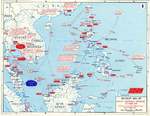 | 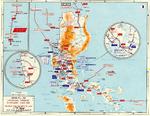 |
Invasion of the Philippine Islands Timeline
| 16 Aug 1941 | Douglas MacArthur received word from his superiors in Washington DC, United States that the Philippine Islands would start receiving reinforcements, shipped from the US no later than 5 Sep 1941. This included the 200th Coastal Artillery Regiment, a tank battalion, and an ordnance battalion. |
| 17 Sep 1941 | Admiral Thomas Hart proposed to move his naval forces in the Philippine Islands south to combine with the British allies to better counter the more powerful Japanese Navy should it attack. He would change his mind on this plan before the start of the Pacific War. |
| 27 Oct 1941 | Admiral Thomas Hart, having changed his mind on moving the US fleet at the Philippine Islands south to combine with the British allies, decided to base his main force in Manila Bay. |
| 27 Nov 1941 | US Chief of Naval Operations Admiral Harold Stark warned commanders of Pacific and Asiatic Fleets that attacks on Malaya, Philippine Islands, and Dutch East Indies were now a possibility. |
| 27 Nov 1941 | US Army Chief of Staff General George Marshall warned US Army Hawaii and Philippine Departments that attacks on Malaya, Philippine Islands, and Dutch East Indies were now a possibility. |
| 5 Dec 1941 | Japanese aircraft conducted reconnaissance flights over the coasts of Luzon, Philippine Islands. |
| 6 Dec 1941 | 27 Japanese troop transports departed from Taiwan, sailing for the Philippine Islands; 400 Japanese pilots stationed at Taiwan were briefed of the attacks to be commenced on the next day. Elsewhere, a Japanese invasion fleet boarded and scuttled a Norwegian freighter. |
| 8 Dec 1941 | Japanese Navy 11th Air Fleet land-based aircraft from Taiwan attacked US Army airfields on Luzon island, Philippine Islands as well as shipping in Manila Bay; at the latter location, American freighter Capillo was abandoned after receiving heavy damage. Japanese Army aircraft joined in on the attack on this date also, striking Baguio and Tuguegarao at 0930 hours. North of Luzon, a Japanese force landed on Batan Island and established an air base. |
| 8 Dec 1941 | Saburo Sakai of Japanese Navy Tainan Air Group, flying an A6M Zero fighter, attacked Clark Field in the Philippine Islands; he shot down one P-40 Warhawk fighter. |
| 9 Dec 1941 | Japanese aircraft commenced the bombing of Manila, Luzon, Philippine Islands; among the first targets in the capital city region was the US Army airbase Nichols Field. |
| 10 Dec 1941 | Cavite Navy Yard in the Philippine Islands was heavily damaged by Japanese aircraft; destroyers Peary and Pillsbury, submarines Seadragon and Sealion, and submarine tender Otus were damaged; ferry Santa Rita was sunk; minesweeper Bittern was destroyed by fire; about 60% of US Navy Asiatic Fleet's torpedoes were destroyed at Cavite. A PBY Catalina aircraft, fleeing from the attack on Cavite Navy Yard, was attacked by three Zero fighters; gunner Chief Boatswain Payne shot down one of the Zero fighters, thus scoring the US Navy's first verifiable air-to-air kill of a Japanese aircraft in the Pacific War. Elsewhere, Japanese aircraft attacked Manila Bay area, damaging American freighter Sagoland. Finally, Japanese troops of the 2nd Taiwan Regiment of the 48th Division landed on Camiguin Island and at Gonzaga, Vigan, and Aparri on Luzon Island. |
| 11 Dec 1941 | Japanese troops landed at Legaspi, Luzon, Philippine Islands. |
| 11 Dec 1941 | Nachi provided support for the landing at Legaspi, Philipine Islands. |
| 12 Dec 1941 | Japanese Navy 11th Air Fleet aircraft attacked the US Navy base at Olongapo in Luzon, Philippine Islands. At Legaspi, Japanese troops captured an airfield and moved north. |
| 13 Dec 1941 | Japanese Navy aircraft again struck the US Navy base at Olongapo at Subic Bay at Luzon, Philippine Islands. Various other bases and airfields in the Manila Bay area were attacked as well. |
| 14 Dec 1941 | In the Philippine Islands, three US B-17 bombers took off from the Del Monte airfield on Mindanao to attack the Japanese beachhead at Legaspi, Luzon. |
| 15 Dec 1941 | The US B-17 bombers at the Del Monte airfield on Mindanao, Philippine Islands were ordered to fly to Australia on the following day. |
| 16 Dec 1941 | US B-17 bombers at Del Monte airfield on Mindanao in the Philippine Islands departed for Australia. |
| 17 Dec 1941 | American passenger ship Corregidor departed Manila, Philippine Islands with about 1,200 civilians on board; a short distance later, while still in Manila Bay, she struck a mine previously laid by Japanese submarine I-124 and sank, killing many. To the north, 24 transports with 7,000 Japanese troops aboard departed from the Ryukyu Islands, heading for Lamon Bay at eastern Luzon island. |
| 18 Dec 1941 | Japanese troops captured Naga, Luzon, Philippine Islands. To the north, the invasion convoy for the Lingayen Gulf assault departed from Taiwan and the Pescadores islands. |
| 19 Dec 1941 | Japanese aircraft attacked Olongapo, Luzon, Philippine Islands. |
| 19 Dec 1941 | Nachi provided support for the landings at Davao, Philippine Islands. |
| 20 Dec 1941 | Japanese troops landed near Davao, Mindanao, Philippine Islands, seizing the nearby airfield. At Cavite in southern Luzon, Lieutenant Colonel J. P. Adams received orders to evacuate his Marines from the area. |
| 20 Dec 1941 | Nachi provided support for the landings at Davao, Philippine Islands. |
| 21 Dec 1941 | US submarines based in Manila in the Philippine Islands withdrew to Surabaya, Java. |
| 21 Dec 1941 | USS S-38 entered Ligayen Gulf in the Phlippines Islands just before dawn. Spotting a group of four Japanese transports at 0645 hours, she maneuvered and fired four torpedoes at 0710 hours, all of which missed. At 0758 hours, she fired two more torpedoes, striking transport Hayo Maru. She dove to avoid depth charges from Japanese destroyers, and ran aground, sustaining light damage. |
| 22 Dec 1941 | 45,000 troops of Japanese 48th Division and 90 tanks landed at Lingayen, Luzon, Philippine Islands at 0200 hours. From the capital city of Manila, Douglas MacArthur sent a radio message to his superior George Marshall in Washington DC, United States, noting that he had decided to announce Manila to be an open city to reserve the strength of his forces and to spare the lives of the civilians. In southern Philippine Islands, 9 American B-17 bombers from Darwin, Australia attacked Japanese ships in Davao Gulf, Mindanao and then landed at Del Monte, Mindanao. |
| 23 Dec 1941 | In the Philippine Islands, as Japanese 48th Division marched south toward Manila, US Army General Douglas MacArthur began withdrawing to Bataan, declaring Manila an open city. On the same day, USAAF B-17 bombers attacked Japanese ships at Lingayen Gulf and Davao in the Philippine Islands, while P-35 and P-40 fighters strafed landing ships in San Miguel Bay, Luzon, damaging destroyer Nagatsuki. On Mindanao, the 9 US B-17 bombers originally from Australia refueled and took off to attack Japanese ships in Davao Gulf and Lingayen Gulf, damaging Japanese destroyer Kuroshio. |
| 24 Dec 1941 | 7,000 troops of Japanese 16th Division landed at Lamon Bay, Luzon, Philippine Islands and marched toward Manila, which was only 50 miles away to the northwest. Near Ligayen Gulf on the western side of Luzon, the 26th Filipino Cavalry initially held up the Japanese invaders near Binalonian, but were forced to withdraw after suffering heavy losses; meanwhile, the Japanese landed an additional 10,000 men at Lingayen Gulf. In Manila, General Douglas MacArthur met with various leaders to organize the retreat into the Bataan peninsula per WPO-3; the 4th Marine Regiment was ordered to Mariveles at the peninsula's tip before going to Corregidor island. |
| 24 Dec 1941 | Nachi provided support for the landings at Jolo, Philippine Islands. She departed Philippine waters later in the day for Palau Islands. |
| 25 Dec 1941 | Japanese troops landed at Jolo, Philippine Islands and captured the island after wiping out the garrison of 300 Filipino militia and policemen. Meanwhile, US Navy moved the headquarters of the Asiatic Fleet from Manila, Philippine Islands to Java. US Marines destroyed docks, fuel tanks, and ammunition dumps at Cavite Naval Shipyard. |
| 26 Dec 1941 | Despite that the Philippine capital of Manila was already declared an open city on 23 Dec 1941, Japanese bombing continued without interruption. Shortly after, US Navy Admiral Hart of the Asiatic Fleet departed Manila by submarine USS Shark for Soerabaja, Java. In Manila Bay, USS Peary was damaged by Japanese aircraft. Philippine naval defense vessels moved to the island of Corregidor at the mouth of Manila Bay, and 411 US Marines originally based at Cavite moved to Corregidor Island. |
| 27 Dec 1941 | Japanese air units bombed Manila, Philippine Islands while 6 US PBY Catalina aircraft attacked Japanese warships at Jolo (4 would be shot down). On land, Allied forces withdrew to the Santa-Ignacia-Gerona-Guimba-San Jose line 30 miles south of Lingayen Gulf, Luzon. |
| 28 Dec 1941 | On Luzon island, Philippine Islands, the US 4th Marine Regiment completed its move from the Bataan Peninsula to Corregidor Island except for the radar detachment. Meanwhile, also on Luzon, north of the capital of Manila, the Allied defenses fell back to the Tarlac-Cabanatuan line. Over Manila, Japanese aircraft appeared again, sinking four freighters in Manila Bay. To the south, Japanese 16th Division captured Luisiana, with forward units reaching as far as Los Baños on the southern shore of Laguna de Bay. |
| 29 Dec 1941 | 40 land-based bombers of the Japanese Navy 5th Air Group attacked Corregidor in the Philippine Islands for the first time. On Luzon island, Japanese Lingayen Force captured Cabanatuan, but American and Filipino forces held on to Tarlac to the west. |
| 29 Dec 1941 | USS Canopus was struck by a 500-pound armor-piercing bomb, which penetrated all decks and detonated on the propeller shaft housing, killing six sailors. At 1735 hours, the remains of the six lost were buried at sea. |
| 30 Dec 1941 | Japanese Lingayen Force captured Tarlac on Luzon, Philippine Islands; American and Filipino forces fell back to the Bamban-Sibul Springs Line, the final defensive line north of Manila. South of Manila, the Japanese 16th Division reached the Laguna De Bay lake. |
| 31 Dec 1941 | Japanese Lingayen Force captured Sibul Springs, Luzon, Philippine Islands, breaching part of the final defensive line north of Manila. South of the city, Japanese tanks of Sonoda Force reached Baliuag. |
| 1 Jan 1942 | American and Filipino forces south of Manila, Luzon, Philippine Islands abandoned their positions and joined the defenses north of the city, which would fall back across the Calumpit bridges by the end of the day. Meanwhile, the Japanese sent a message to the mayor of Manila announcing that the Japanese forces would arrive on the following day. |
| 1 Jan 1942 | USS Canopus was struck by a fragmentation bomb, which detonated near the top of the smokestack, damaging the ship and killing 16. |
| 2 Jan 1942 | Japanese troops captured Manila, the capital of the Philippine Islands. |
| 2 Jan 1942 | Japanese troops captured Naval Base Cavite in the Philippine Islands. |
| 2 Jan 1942 | Japanese troops captured the Clark Field airbase in the Philippine Islands. |
| 3 Jan 1942 | US and Filipino troops fell back to the Guagua-Porac defensive line, 15 miles from the Bataan peninsula on Luzon, Philippine Islands. |
| 4 Jan 1942 | Following a heavy bombardment, Japanese Lingayen Force penetrated the US-Filipino Guagua-Porac defensive line at Luzon, Philippine Islands and captured the town of Guagua and the Del Carmen airfield. On the same day, American B-17 Flying Fortress bombers from Australia attacked Japanese shipping at Malalag Bay, Davao, Mindanao, damaging cruiser Myoko. |
| 5 Jan 1942 | US and Filipino troops in the Philippine Islands were put on half rations. |
| 7 Jan 1942 | Japanese troops made probing attacks at the opening of the Bataan peninsula at Luzon, Philippine Islands. Meanwhile, General MacArthur organized his forces into two corps and a rear area service command. |
| 9 Jan 1942 | At 1500 hours, the main offensive against Bataan defences at the Philippine Islands began, spearheaded by 6,500 men of the newly arrived and inexperienced 65th Infantry Brigade (which replaced the veteran Japanese 48th Division); the first attacks at the Abucay-Mauban defensive line were repelled by US-Filipino troops. Meanwhile, US Marines from Batteries A and C of 3rd Battalion, 4th Marine Regiment who remained on Bataan under naval control were integrated into a naval battalion for ground combat. |
| 10 Jan 1942 | US-Filipino troops held the Abucay-Mauban defensive line on the Bataan peninsula on Luzon, Philippine Islands. |
| 12 Jan 1942 | Japanese troops continued to attack the Abucay-Mauban line on Bataan Peninsula, Luzon, Philippine Islands. |
| 15 Jan 1942 | Philippine 51st Division withdrew from the Salian River valley on the eastern side of the Abucay-Mauban defensive line on Bataan Peninsula, Luzon, Philippine Islands. |
| 16 Jan 1942 | Japanese and Filipino-American forces both raced to capture Morong on Bataan Peninsula, Luzon, Philippine Islands. Both sides reached the town around the same time, but the Allies had detected the Japanese first. Taking the opportunity for a surprise attack, more than 20 American cavalry troops charged on their horses, dispersing Japanese troops. It was the last combat charge of horse-mounted American cavalry troops. |
| 16 Jan 1942 | Noticing a nearby 75-millimeter M1917 field gun crew had been wiped out by Japanese fire near Culis on the Bataan Peninsula in the Philippines, Jose Calugas, without orders, gathered a group of volunteers to man the gun, keeping it active against known Japanese positions for several hours. He was recommended for the Medal of Honor for this action, but would not receive the medal until after the end of the war. |
| 21 Jan 1942 | Japanese troops penetrated the west side of the Abucay-Mauban defensive line at Mount Natib on Luzon, Philippine Islands and began to cut off supplies to US-Filipino troops on the line. |
| 22 Jan 1942 | In the Philippine Islands, an attempted Japanese landing from fishing boats on the west coast of the Bataan Peninsula was wiped out; the Japanese 20th Infantry Regiment would continue to try to gain a foothold. Meanwhile, Douglas MacArthur ordered the Abucay-Mauban defensive line abandoned as the Japanese had penetrated its western end; the troops fell back about 5 miles to the new line from Bagac to Orion. |
| 24 Jan 1942 | The 2nd Battalion of the Japanese 20th Infantry Regiment continued to make landing attempts at Quinauan Point, and Longoskawayan Point, Bataan on Luzon of Philippine Islands, increasing the strength of the small beachhead. After sundown, US and Filipino troops began withdrawing from the Abucay-Mauban defensive line to the new Orion-Bagac defensive line. |
| 25 Jan 1942 | US and Filipino troops continued to withdraw from the Abucay-Mauban defensive line on Bataan, Luzon, Philippine Islands toward the Orion-Bagac defensive line. |
| 26 Jan 1942 | US and Filipino troops completed the phased withdraw from the Abucay-Mauban defensive line at Bataan, Luzon, Philippine Islands, which was done over three nights. |
| 27 Jan 1942 | Additional Japanese troops were landed at Point Quinauan in southwestern Bataan, Luzon, Philippine Islands. Elements of the US 4th Marine Regiment attacked the Japanese beachhead at Longoskawayan Point. |
| 28 Jan 1942 | Mortars and machine guns of the US 4th Marine Regiment were assigned to the 57th Philippine Scout Regiment at Longoskawayan Point, Bataan on Luzon, Philippine Islands, where the combined US-Filipino effort would soon wipe out the Japanese landing attempt. |
| 29 Jan 1942 | The 20th Battalion of the Japanese 16th Division penetrated the US-Filipino Orion-Bagac defensive line at several locations at Bataan, Luzon, Philippine Islands; the reserve 45th Philippine Scout Division was quickly dispatched to halt the Japanese advance. Meanwhile, troops of the Philippine Scouts continued to assault the Japanese beachheads at Longoskawayan Point and Quinauan Point in southern Bataan. |
| 1 Feb 1942 | PT boats and P-40 aircraft repulsed the Japanese landing attempt on southwest Bataan at the Philippine Islands. |
| 2 Feb 1942 | An assault was mounted by US troops, supported by tanks, against the Japanese beachheads at Quinauan Point, Bataan, Luzon, Philippine Islands; it achieved little. To the north, on the Orion-Bagac defensive line, a US-Filipino attack wiped out a small pocket of trapped Japanese attackers. |
| 3 Feb 1942 | US submarine Trout delivered 3,500 rounds of 3 inch anti-aircraft ammunition to Corregidor, Philippine Islands. Upon departure, the submarine evacuated 20 tons of Philippine gold and silver. |
| 4 Feb 1942 | US tanks once again attacked the Japanese beachheads at Quinauan Point, Bataan, Luzon, Philippine Islands, nearly successfully in wiping out several positions. |
| 5 Feb 1942 | 17 radio intelligence personnel were evacuated from the US Navy Station CAST facility at Corregidor island, Philippine Islands. |
| 6 Feb 1942 | Japanese artillery shelled Corregidor from Cavite at Luzon, Philippine Islands. Meanwhile, Filipino troops continued to assert pressure on the nearly-eliminated Japanese beachheads at Quinauan Point, Bataan, Luzon. |
| 8 Feb 1942 | American troops attacked and wiped out a Japanese infiltration force at Quinauan Point, Bataan on the Philippine island of Luzon; 600 Japanese troops were killed while the US-Filipino forces suffered 500 casualties. Meanwhile, General Masaharu Homma called off the first offensive against Bataan and fell back to more defensible positions while waiting for reinforcements. |
| 8 Feb 1942 | Ed Dyess led the first American landing of WW2 at Agloloma Bay, Bataan, Philippines. |
| 10 Feb 1942 | US forces continued the attempt to eliminate the 500 Japanese troops trapped in the "Big Pocket" at Bataan, Luzon, Philippine Islands. In Tokyo, Japan, the Imperial General Headquarters approved the transfer of the Japanese 4th Division from Shanghai, China to the Philippine Islands to reinforce Masaharu Homma's forces, but it would take weeks for the troops to arrive due to logistical issues. |
| 12 Feb 1942 | The 200 Japanese troops trapped in a beachhead in southern Bataan, Luzon, Philippine Islands mounted what would be their final counterattack. |
| 13 Feb 1942 | All Japanese troops at the Longoskawayan Point and Quinauan Point beachheads at Luzon, Philippine Islands were wiped out. |
| 17 Feb 1942 | A detachment of the submarine tender USS Canopus, sailors from the Cavite Naval Ammunition Depot, and the majority of the general duty men in the area were transferred to the 4th Marine Regiment based on Corregidor, Philippine Islands. |
| 27 Feb 1942 | A Japanese force landed on northeastern Mindoro in the Philippine Islands. |
| 28 Feb 1942 | 221 crew members of USS Canopus were evacuated from Bataan Peninsula to Corregidor Island in the Philippine Islands. |
| 2 Mar 1942 | Ed Dyess, flying a P-40 fighter, led a raid on Japanese shipping in Subic Bay, Luzon, Philippines. |
| 11 Mar 1942 | Japanese troops landed on Mindanao, the southern-most of the Philippine Islands. |
| 11 Mar 1942 | Harold George evacuated out of Corregidor, Philippine Islands by PT boat. |
| 15 Mar 1942 | US Army General Douglas MacArthur departed Philippine Islands by B-17 bomber for Australia. |
| 16 Mar 1942 | 46 radio intelligence personnel were evacuated from the US Navy Station CAST facility at Corregidor island, Philippine Islands. |
| 19 Mar 1942 | At Bataan Peninsula at Luzon, Philippine Islands, US and Filipino troops were put on quarter rations (1000 calories) as the food supplies dwindled. The supply of quinine, a medicine for malaria, had also depleted. |
| 22 Mar 1942 | Japanese aircraft bombed US positions at Bataan and Corregidor, Luzon, Philippine Islands. |
| 24 Mar 1942 | Japanese Navy aircraft began daily bombings of Corregidor in the Philippine Islands. |
| 26 Mar 1942 | Japanese aircraft bombed Corregidor, Philippine Islands, knocking out power for freezers containing 24,000 pounds of carabao meat. |
| 27 Mar 1942 | With freezers failing after a Japanese aerial attack on the previous day, US and Filipino troops attempted to transport the contents, 24,000 pounds of frozen carabao meat, from Corregidor Island to Bataan Peninsula in the Philippine Islands for immediate consumption. Japanese air attacks would prevent this transport, and the meat would soon spoil. |
| 30 Mar 1942 | Japanese bombers attacked American field hospital No. 1 at Bataan, Philippine Islands at 0730 hours despite the large red crosses painted on the building's roof, killing 15. In the evening, Japanese radio broadcast an apology for this attack. |
| 3 Apr 1942 | After a heavy artillery and aerial bombardment from 0900 to 1500 hours, Japanese troops launched an attack on the Bataan Peninsula in Philippine Islands, penetrating the lines held by the Filipino 41st Infantry Division. |
| 4 Apr 1942 | Douglas MacArthur, now relocated to Australia per Franklin Roosevelt's orders, radioed Jonathan Wainwright, saying that "under no conditions should Bataan be surrendered; any action is preferable to capitulation". Meanwhile, at Bataan in the Philippine Islands, Japanese troops moved toward Mount Samat, threatening to take this dominant position. |
| 5 Apr 1942 | Japanese troops defeated the Philippine 21st Division at Mount Samat on the Bataan Peninsula, Philippine Islands. Inside the Allied lines, General Jonathan Wainwright doubled rations for front line troops despite being short in food in order to give the troops strength. |
| 6 Apr 1942 | Japanese aircraft continued to attack American and Filipino targets at Bataan, Philippine Islands. |
| 7 Apr 1942 | A Japanese dive bomber destroyed an ammunition truck near American field hospital No. 1 at Bataan, Philippine Islands at 1000 hours. Shortly after, Japanese aircraft returned to attack the hospital, which had large red crosses painted on the roof, killing 89 and wounding 101; a significant portion of the drug supplies were destroyed in this attack. On the front lines, Japanese assaulted positions held by US and Filipino troops of the US II Corps along the San Vicente River, penetrating the line by noon, forcing the Allies to fall back to the line at the Mamala River in the afternoon, which would also abandoned by 2100 hours for the Alangan River further to the south. |
| 8 Apr 1942 | Japanese bombers and fighters attacked US II Corps positions digging in along the Alangan River at Bataan, Philippine Islands at 1100 hours, but these positions successfully repulsed the first Japanese assault shortly after; the Japanese would return with tank support, however, overrunning the line. The US Commander of the Luzon Force ordered all munition dumps at Mariveles Habor at Bataan destroyed, and medical staff began withdrawing to Corregidor island. |
| 9 Apr 1942 | 75,000 US and Filipino troops, remainder of the US II Corps under General Edward King on the Bataan peninsula at Luzon, Philippine Islands, surrendered to the Japanese at 1230 hours; it was the largest American surrender in history. Before doing so, they destroyed fuel dumps, ammunition stores, tug USS Napa, and floating drydock USS Dewey. |
| 10 Apr 1942 | The Japanese, overwhelmed with 76,000 captives at Bataan on the main Philippine island of Luzon, decided to march the prisoners 25 miles to Balanga for further transport. Without food, water, or medical supplies and facing brutal treatment by the Japanese, the prisoners of war would die in large numbers, and this march would soon be named the Bataan Death March. Just off Luzon, minesweeper USS Finch, damaged by Japanese air attacks on the previous day, was scuttled by her crew. Elsewhere in the Philippine Islands, 12,000 Japanese troops landed on Cebu on three invasion beaches; the 6,500 defenders at Cebu City evacuated the capital and moved inland; Australia-based B-17 bombers attacked the invasion force to little effect. |
| 10 Apr 1942 | Lieutenant Commander H. H. Goodall assumed command of USS Canopus, replacing Commander Earl Sacket, for the purpose of leading USS Canopus out to deeper waters off of the Bataan Peninsula in the Philippine Islands for scuttling. |
| 11 Apr 1942 | US Army Brigadier General Ralph Royce led 10 B-25 bombers and 3 B-17 bombers from Darwin, Australia to Mindanao, Philippine Islands; they were to be used for bombing Japanese forward positions. On the Bataan peninsula on the island of Luzon, 350 Filipino prisoners of war were killed by the Japanese north of Mount Samat during the Bataan Death March. |
| 12 Apr 1942 | The Japanese artillery bombardment of Corregidor island in the Philippine Islands began. Meanwhile, many US and Filipino prisoners of war continued to die while being marched northward during the Bataan Death March from starvation, dehydration, disease, and murders. To the south, on the island of Cebu, US and Filipino troops scuttled torpedo boat PT-35 and withdrew deeper into the mountains. |
| 13 Apr 1942 | US and Filipino prisoners of war began to be marched from Balanga for Orani in Bataan, Philippine Islands. To the south, Japanese artillery continued the bombardment of Corregidor island. |
| 14 Apr 1942 | US and Filipino prisoners of war began to arrive at Orani in Bataan, Philippine Islands from Balanga, where facilities were totally inadequate for the large numbers of prisoners that would ultimately arrive at this location; to combat the issue, the Japanese marched a group of prisoners to Lubao further north and were imprisoned in an abandoned warehouse (en route, many died from heat, starvation, dehydration, and murders by Japanese guards). To the south, Japanese artillery continued the bombardment of Corregidor island. |
| 15 Apr 1942 | A tunnel near the James and Morrison coastal gun batteries at Corregidor island, Philippine Islands collapsed from Japanese artillery bombardment, killing 70. To the north, the Japanese continued to transfer US and Filipino prisoners of war from Balanga to Orani and Lubao on the Bataan Peninsula, while the first arrivals at Orani and Lubao were now being marched north for San Fernando; en route, the prisoners continued to die from heat, dehydration, disease, and murders. At the southern island of Mindanao, motor torpedo boat PT-41 was scuttled by her own crew to prevent capture. |
| 16 Apr 1942 | Japanese troops landed on Panay and Negros in the Philippine Islands before dawn. On Panay, lloilo City, Capiz, and the copper mines near San Jose were captured without resistance, but they found lloilo City in ruins, sabotaged by the retreating Filipino troops. |
| 17 Apr 1942 | Two column of Japanese troops converged at Dumarao on Panay, Philippine Islands, completing the conquest of the eastern side of the island. |
| 18 Apr 1942 | The 1st Battalion of the 63rd Infantry Regiment of the 61st Philippine Division under Captain Julian Chaves pushed back Japanese troops at Mount Dila-Dila on Panay, Philippine Islands. |
| 19 Apr 1942 | US and Filipino prisoners of war were loaded onto cramped freight trains from San Fernando to Camp O'Donnell at Capas, Tarlac, Philippine Islands; many died en route. |
| 20 Apr 1942 | A Type 96 240mm howitzer was brought to the Bataan Peninsula on Luzon, Philippine Islands by the Japanese for the purpose of bombarding the island of Corregidor. On the same day, on the island of Panay, Japanese Army troops declared the island secure. |
| 22 Apr 1942 | American submarine USS Sailfish departed with ammunition for the American troops at Corregidor in the Philippine Islands; the island garrison would surrender before this mission was completed. |
| 25 Apr 1942 | The final US-Filipino stronghold on the island of Luzon in the Philippine Islands, Corregidor, while already under daily bombardment for the past two weeks, began to be subjected to night-time bombardment as well. At 2200 hours, two 240-millimeter shells hit the opening of a tunnel leading into the underground command center, killing 15. |
| 29 Apr 1942 | Japanese troops landed at Cotabato, Mindanao, Philippine Islands. To the north at the island of Luzon, minesweeper USS Finch was damaged by Japanese air attacks. A large scale artillery and aerial bombardment was conducted at the island of Corregidor at the tip of Bataan Peninsula, Luzon. |
| 30 Apr 1942 | Two PBY Catalina aircraft from Mindanao evacuated 50 personnel (including 20 nurses) from Corregidor, Philippine Islands as the island was again subjected to a large scale artillery and aerial bombardment. |
| 1 May 1942 | In the Philippine Islands, Corregidor was subjected to heavy artillery and aerial bombardment, while Japanese troops defeated the Filipino 61st Infantry Regiment on the southern island of Mindanao. |
| 2 May 1942 | The powder magazine of gun battery Geary on Corregidor in the Philippine Islands was hit by Japanese artillery at 1627 hours, detonating 1,600 62-pound powder bags; 56 were killed and hundreds were wounded. To the east, in Manila Bay, river gunboat USS Mindanao was scuttled to prevent capture. |
| 3 May 1942 | The Japanese continued to bombard Corregidor in the Philippine Islands by artillery and aircraft. |
| 4 May 1942 | The Japanese bombardment of Corregidor, Philippine Islands heightened to soften the defenses for invasion scheduled on the next day. On the beaches of nearby Bataan Peninsula, 2,000 Japanese troops began boarding 15 barges. |
| 5 May 1942 | After a final bombardment with 16,000 shells, 2,000 Japanese troops landed on the eastern coast of Corregidor, Philippine Islands at about 2345 hours, delivered by 15 barges. |
| 6 May 1942 | Before dawn, US and Filipino defenders in the East Sector of Corregidor, Philippine Islands fought against the Japanese amphibious assault launched just prior to midnight, killing 1,200 men of the 2,000-strong first wave of attack. At 0930 hours, the Japanese began to gain a beachhead and began landing tanks to support the invasion. The US 4th Marine Regiment reserve companies and the US 4th Marine Battalion (reserve) launched an unsuccessful counterattack. Acknowledging the hopelessness of the situation, Major General Jonathan Wainwright ordered his troops to surrender at 1030 hours. To prevent capture, US Marines Colonel S. L. Howard ordered all regimental and national colors of the 4th Marine Regiment burned to prevent capture, while other US and Filipino personnel scuttled gunboats and destroyed ammunition stores. |
| 7 May 1942 | The Japanese troops completed the occupation of all the forts on Corregidor, Philippine Islands. Meanwhile, from the capital of Manila, Jonathan Wainwright announced the surrender over the radio, under supervision of a Japanese censor. |
| 9 May 1942 | Troops of the Japanese Kawamura Detachment wiped out American and Filipino troops under Brigadier General William Sharp near Dalig on Mindanao, Philippine Islands. |
| 10 May 1942 | US Army General William Sharp received orders from General Jonathan Wainwright to surrender all US and Filipino troops on Mindanao, Philippine Islands, which he complied. |
| 12 May 1942 | The last US troops in the Philippine Islands surrendered on Mindanao. |
| 21 May 1942 | Japanese troops occupied Leyte and Samar in the Philippine Islands unopposed. |
| 9 Jun 1942 | All organized resistance against the Japanese invasion ceased in the Philippine Islands. |
| 28 Jan 1944 | The US government released news of the Bataan Death March and Japanese atrocities committed in the Philippine Islands. |
Please consider supporting us on Patreon. Even $1 per month will go a long way! Thank you. Please help us spread the word: Stay updated with WW2DB: |


Visitor Submitted Comments
2 May 2006 11:30:23 PM
A must read to the young generations of Filipinos @ Americans who now enjoy freedom
22 Aug 2006 02:50:10 PM
some times it makes a person think did usa have knowledge of attack on pearl harbor
28 Sep 2006 05:27:13 PM
what lessons could be drawn from the battle and fall of Bataan?(include the death march)
how effective was the guerilla movement against the japanese?
how did the japanese treat the filipinos? what where the filipinos impressions on the japanese?
evaluate japanese policies implemented in the philippines
how did the filipinos react on the outbreak of war?
how important was the philippines to the japanese?
7 Dec 2006 01:42:57 PM
My Dad (Raymond T. Moran, AOC USN) was in VP102 during the invasion. It was a blessing that he was one of the few that got out. He received the Presential Unit Citation for the defense of the Philippines. Im very proud of him and would love to talk to any of his shipmates.
11 Mar 2007 11:17:52 AM
Is there any data on Japanese casualties as they took the Philippines during 1942. Since Us forces held out for over 5 months, we must have inflicted heavy casualties but I can find no valid figures.
31 Mar 2007 10:28:18 PM
My grandfather James I Cragett drove tank in the Phillipeans Im trying to learn more about him
5 May 2007 01:20:50 AM
Hi:
If the US $ 50 million, which the Filipino people owned, had been released a year or even much earlier, as President Manuel Quezon had asked, the Philippine Army could have been better equipped and prepared.
The Philippine Army was poorly trained and equipped, no thanks to American do-gooders in the late 1930s who lobbied for the rejection of President Quezons request.
The US $ 50 million had something to do with sugar tariffs whose possession was dtermined by the US Supreme Court in 1947.
The 1930s peaceniks, along with Philippine Governor General Francis Sayre, have until now not given an explanation why they opposed the giving of this money.
So many died, Filipinos and Americans as a result.
10 May 2007 02:12:38 PM
Note on the quality of the filippino army- it would have been stupid of us to train and arm their army because the filippinos hates americans due to the way we took over
 Hobilar says:
18 Sep 2007 06:48:04 AM
Rations for the beseiged US Marines on Corregedor were skimpy in the extreme. Just one 8 ounce can of corned beef was provided to feed ten men per day at the height of ther seige. Sometimes Japanese Air raids would bring dead fish to the surface which could supplement their meagre diet. Some soldiers would even risk shark or Zero attacks to reach stricken boats in an attempt to locate more supplies.
Anxious to bring in a floating crate, one Marine swam out to sea and struggled back triumphantly with his prize. When the crate was opened it was found to contain four gallon jars or ink. Whilst he trying to exchange these for food a piece of flying shrapnel destroyed two of the jars. A Mess sergeant had to clean up the resultant mess.
27 Oct 2007 01:59:48 PM
In response to the inquiry regarding Japanese casualty figures during the entire 1941-42 campaign to conquer the Philippines, particularly Bataan and Corregidor:
I have no exact figures either, but they were indeed heavy, so much so that Homma had to ask for reinforcements to shore up his force besieging the Americans and Filipino soldiers on Bataan. They suffered every bit from your typical diseases like malaria, dengue fever, and dystentery as did their enemies, and coupled with the stubborn resistance of the Americans and Filipinos, played a role in delaying the Japanese advance. Because of the stalled offensive and undoubtably horrendous casualties suffered, Homma would eventually be relieved of his command by higher-ups as soon as Corregidor fell.
1 Nov 2007 01:17:22 PM
What was accomplished by going to war ?
13 Nov 2007 05:41:53 AM
McArthur correctly predicted the Japanese attack but did not prepare well for the war. His planes were caught napping on the ground depsite knowing about Pearl Harbor. Senseless.
20 Dec 2007 09:03:19 PM
In response to the comment about the quality of the filipino army, please take care in expressing revisionist opinions contrary to fact. The filipinos who risked their lives to offer a cup of water along the Bataan Death March route are worthy of honor, as are the observations of men who were there and consider the Philippine Scouts some of the best jungle fighters of the war. My father was there on Bataan and Corregidor please respect the other men who stood with him.
26 Sep 2008 04:15:19 AM
FILPINO rock!!! i salute to all of you
30 Nov 2008 02:56:17 AM
as history of any american war, americans are always for their personal interest. gulf war, korean war etc... they are always for their interest. have the americans think that if filipino souldiers are not in there side, can they beat the *** .. nfilipino are great fighters, life maybe at stake but for the sake of their country they fight.. my salute to my filipino forefathers who gave me freedom.....
16 Jan 2009 06:48:51 AM
May the solders live on in memory
1 Feb 2009 09:17:57 PM
The Filipinos fought even though they weren't well trained. Even the women help in hospitals, even though the Japanese raped them. The Battles in the Philippines don't really get enough recognition as they deserve. My Mom got raped in the war, and my Uncle died as a Guerilla. All the Filipinos that helped in some way, shape, or form, deserve the uptmost respect.
28 Mar 2009 07:41:31 AM
my grandmother's brother sgt. gaudencio andrade fought in the defense of cotabato in mindanao. he was so traumatized by his experience. having to dodge machinegun bullets from a japanese aircraft he, together with an american captain and a filipino lt. ran across no man's land to relay the order to abandon the defense of the mindanao river near the town of cotabato. he suffered what is now known as post traumatic stress disorder.. after the war, he wrote the u.s. embassy in manila, requesting for assistance to reconstruct the records of his military service under uncle sam. in a reply, the us govt decllined his request, stating that his name was not among u.s. and filipino troops who fought under u.s. command in the phil. this non-recognition of his service strikes a raw nerve in me and other relatives who saw how he sufferred under the effects of the trauma he went thru during the war. the u.s. eventually passed a law recognizing the service of filipino troops only this year, many years after the death of many of those who fought the *** under u.s. command in world war 2. is there a way to check the roster of filipino units attached to u.s. army in mindanao during 1941 to 42, particularly of those who fought in the defense of cotabato? this might just help us rectify the records of our relative who was burried without military honors, and now lies in a simple grave in south cotabato.
1 Jun 2009 10:01:40 PM
Gen Masaharu Homma occupied Manila in just two weeks following the main landings at Lingayen Gulf and Lamon Bay. On the 1st of Jan 42 he dispatched only a single regiment to follow Field Marshal MacArthur's 100,000 man army across the Pampanga River and into Bataan while 2 divisions and supporting elements occupied Manila on January 2. Manila and not the destruction of MacArthur's band of ragged refugees was the objective of the 14th Army (IJA) in early January. The best of Homma's infantry and most of his airpower was transferred to the invasion of Java just as the fight in Bataan began. The Japanese planned to try to take Bataan with the 65th Brigade an untrained and poorly equippted conscript unit formed in Formosa. General Nara, commander of the 65th complained the brigade was not competent for combat. The high command in Tokyo was willing to delay final destruction of MacArthur's army to speed up the conquest of Java. The force remaining to Homma ws able to drive the Filamericans off their primary line and back to the reserve line. About Feb 8th Homma decided to cease offensive action and wait for reinforcements. After Java fell the Japanese shipped some good troops back to the Philippines and began the final assault on Good Friday, April 3rd. In about 5 days of fighting the reinforced 14th army smashed the starving disease ridden Filamerican line in front of Mt Samat and virtually all resistance along the II Corps front collapsed. With food supplies exhausted and his hospitals exposed, Major General Edward P. King, commander of Bataan Force, disobeyed orders from MacArthur in Australia and surrendered early on the morning of April 9th rather than undertake the ordered suicidal attack to break out to Oglongapo. The Japanese also suffered greater losses to disease and malnutrition than to enemy action, but they were able to ship in replacements after the conquest of Borneo and the Dutch East Indies. I respect all of them Filipinos, Japanese, and Americans who suffered and sacrificed in a tropical hell of malnutrition and malaria for a causes they believed in. After the surrender there were parades in Manila in front of MacArthur's old quarters at the Manila Hotel to celebrate the Japanese victory. While tens of thousands of POWs were marched to Camp O'Donnel under horrendous conditions, the senior Japanese officers were toasted at dinner in the old American Army-Navy Club.
2 Sep 2009 09:45:50 AM
I understand the 27th BG was awarded a number of Presidential Unit Citations, and the Philippine Presidential Unit Citation for service in the Battle of Bataan, and Corregidor during 1941, and early 1942.
Interested in identifying the General Orders numbers, and dates. Can anyone assist?
3 Sep 2009 01:57:23 PM
>Interested in identifying the General Orders numbers, and dates.
Identified, and dates obtained.
My question is why is there no support recently for American participants of the battle?
Records reveal since 2003, the Army Awards Branch refuses to follow guidelines pertaining to WWII, and history of awards to members of the Provisional Air Corps Regiment, II Corps.
I have a 25 page description of the unit's involvement fighting the enemyas combat infantrymen. The author was an infantry lieutenant platoon leader.
Yet, members and/or next of kin of veterans are experiencing denials to their requests for the Combat Infantryman Badge contrary to the guidelines and the UCMJ, Article 92. Failure to Obey Order or Regulation.
Where is the support Americans?
Robert
3 Sep 2009 02:03:27 PM
Robert Rebucan,
Are you able to share more information?
sgt. gaudencio
First name?
Serial number or
unit?
Robert
Robersabel@aol.com
3 Oct 2009 05:56:09 PM
what are the experiences of the Filipinos during he oppression?
You didn't put idiots!!!!!!!!!!
4 Oct 2009 02:07:44 PM
when mcarthur return to the philippines japanese army were almost beaten by the filipino guerillas..thats why during the end of war you can hardly see a big battles with the japanese
21 Apr 2010 08:56:36 AM
I recently had the honour to visit Corrigedor. It is being kept up and turned almost into a shrine. Not just for Filipinos, Americans but for Japanese as well. I was very impressed.
29 Dec 2010 08:09:39 PM
My dad fought in the Phillipines, U.S. Army Infantry. He served with Filipino guerillas in several battles and told me stories of their courage and skill in battle. On one occasion a young Filipino boy was working as a guide for dad's platoon when they were attacked by the Japanese. The fight ended in hand to hand combat, dad and this young man were both wounded but continued to fight. This brave soldier fought side by side with dad, he was armed with only a machete. Both survived. That folks, is what heroes are made of.
8 Feb 2011 04:24:31 PM
So im doing this assignment on the Invasion of Philippines and this was a very helpful site.
26 Feb 2011 11:28:30 AM
looking for a frank d countryman who served at cavite naval base in the 1950s. was married there and had 2 children...restationed in japan and never heard from again....his extended family is looking for info about him....can anyone assist?
9 Apr 2011 10:54:47 AM
What was the total American losses for the whole war in the Philippines?
15 Apr 2011 06:07:32 PM
Dear sir,
You need to correct your 8 Dec 41 comment about Japanese troops landing on Bataan. They landed on Batan Island on 8 Dec 41 and captured Bosco airfield. This island is part of several islands north of the main island of Luzon. No Japanese troops set foot on Bataan Peninsula prior to the first week in Jan 1924. Reference the "Fall Of the Phillipines" by Eliot Morrison.
27 Apr 2011 08:49:02 PM
I salute to Filipino soldiers during japanese invasion,.. they fought for our freedom!!
9 May 2011 03:53:08 PM
My grandfather was a cook and a filipino soldier at correigdor during WW2, they trying to defend their base but unluckily the Japanese take over the correigdor and they captured and marching going south, my grandfather see his fellow soldiers one by one died or killed by the Japanese, he plan to escape and he did it with his fellow soldiers they runaway going to woodland while the japanese shooting them. After they reach the forest they took one by one the Japanese who follow them using hand to hand combat and handmade stone knife with a poison from plants and animals... also they turn the coconut into explosives with sharp stick.
8 Jul 2011 12:01:57 AM
The defenders of Bataan should be respected,honored and reminded of their sacrifices defending our freedom. I believe Gen. Homma and his 14th Army suffered a divisional casualties as a result of the valiant and bravery of Filipino and American soldiers during the Battle of Bataan. In the Battle of the Points only 3 dozens of the 2,000 Japanese soldiers who fought survived. Subsequently, after three weeks of bitter fighting,(Battle of the Pockets) fewer than 400 of the invaders have made it back to their own side alive. Also,12,000 Japanese were sick or dying from malaria, beri-beri and dysentery. The 75,000 Americans and Filipinos who surrendered were confused, starving and sick. In addition they were subjected to constant strafing overhead, deprived of medication, ammunition... Homma was given 50 days to invade the Philippines but the battle lasted 150 days. According to U.S. Army historian Jennifer Bailey, the valiant defenders of Bataan delayed the Japanese timetable for the conquest of South Asia and became the symbol of hope for America in the early bleak days of the war. The military and political planners has no guts/risk to resupply the embattled garrison. In short, 75-,000 USAFFE soldiers were intact, possibly defeat the Japanese with enough logistical support.
13 Aug 2011 04:14:02 PM
Could you possibly give the statistics or estimate of Japanese casualties in the 1941-42 invasion campaign of the Philippines?? I need them for a book I have just completed on the 26th Cavalry PS.
- Raymond Woolfe
14 Sep 2011 02:07:59 PM
Just came across my father's discharge papers. They are confusing to me but he was in the 2nd BN 20th INF REGT. 26th INF DIV. One of his decorations was the Philippine Liberation Ribbon with Bronze Star. (Combat Infantryman) His name was John P. Ahearn from Watertown, Mass. I know very little about him or his service. If anyone has info, please e-mail. Most grateful.
19 Nov 2011 03:18:49 AM
I'm a westerner living in the Philippines, i'm not an American.Been here 4 years, ex soldier.
The modern generation in the Phils, doesnt know about the war here and dont want to. Generally they are very rude towards anyone they perceive to be an Americano, thats anyone with a white skin and blue eyes.
I've been trying to analyse why this should be, maybe its to do with the US occupation of this country.
At least they could have taught them english, which might have helped from a communication viewpoint.
19 Nov 2011 03:30:29 AM
Now, we have a similar type of problem arising over the Spratlys. Lets hope President Obama's advisers give him the correct advice in this matter before the situation gets out of hand, from the China viewpoint.
8 Dec 2011 09:17:26 AM
looking for a frank d countryman who served at cavite naval base in the 1950s. was married there and had 2 children...restationed in japan and never heard from again....his extended family is looking for info about him....can anyone assist?
Try the NSO, national statistics office, MNL.
6 Feb 2012 12:21:21 AM
My mother was a daughter of an american GI named Robert Eldridge from New Jersey. She was born in 1938.She never got to see him but he knew she existed. I wonder if he ever thought of her.
My mother is dead now.I hope to meet my grandfather's relatives. Any info will be appreciated.
13 Feb 2012 10:40:52 AM
in response to the the westener living in the Phillipines, I would try not to take it personally. Growing up in a mixed American Filipino household what is percieved as rude to filipinos is fine for western cultures and vice a versa.Granted you will run into a few racists but you are probrably expeirencing the cultural gap. Another cultural thing is Filipinos in general frown on being overly individualistic while many Western cultures praise it.When accepting a gift act as submissive as possible while giving a gift, an Idea or anything also act submissive.In many Western cultures when something is given the giving party acts as if they are are the better,and deseves something in return which is considered very rude in filipino culture.
21 Feb 2012 12:28:01 AM
at first i thought history of american invasion is just a simple war like bombing catapults etc.but as i read it it made my mind glow with knowledge with all the filipinos had experienced at that time i felt
touched of what they had done for the coming generations they give us peace so that we will not experience what they had.
18 Mar 2012 08:52:38 PM
The westerner living in the Philippines there is a gap on the norms on the west and east are. Hence, something you perceive as rude might not be for the Filipino's.
Also, Filipino's are generally friendly to other nationality and very welcoming.
2 May 2012 04:30:05 PM
i wonder how old people r now from this war
12 Aug 2012 09:04:52 PM
I am searching for information on William Raymond Curl of the Coastal Artillery. He was killed on December 29, 1941. He was also known as Jake Curl. Thank you.
23 Aug 2012 10:34:38 AM
My grandpa, PEDRO OYOG HOMDUS( born in Lauran. PI.,) He served the US NAVY AS A FRISTCLASS SEAMAN in LEYTE LISLAND,,PI between oct 23-nov 2 he stood up under fire with a coolness and efficiency of FINEST TRADITIONS OF THE Navy ,HE RECIVED a citation meritoniousin 88 alerts,57airraids,14 major engagmentsr the ship was cited with12hits and6of these were brought down by theyer fire!!!!!!,THATS MY GRANDPA MISS U MUCH......
28 Sep 2012 04:29:40 PM
We severly abused people of the P I for profit. We ruined the small farm structure reverting to bit plantations to grow food for export to the U.S.
this is but one of too many sad chapters of our national history, i.e. Indian laughter, slavery. Now look at our actions in the Middle East.
17 Oct 2012 09:19:15 AM
hi im looking for my grandpa his name is william aeris, if i am not mistaken with the spelling of the last name...my mom saw and read his story in readers digest, and died in late 90's. i would like to know if he is really was my grandfather, how do i find that out? any help would be appreciated.
thanks
3 Nov 2012 10:18:00 PM
i am searching for any details, because during the japanese time my grandfather was became the CHIEF OF POLICE of canaman camarines sur VALENTIN DE VERA SR. and he died during his service.is there any data about the said perosn.pls.sent me email.
19 Nov 2012 07:01:06 AM
I am researching the history of Japanese landing in Legazpi City, Southern Luzon as a background for a novel. I would like to find out what the environment was like: preparation the local people, Fiipino military, American missionaries, etc. If any one can direct me to a source/reference it would be greatly appreciated.
I grew up listening to stories about the war from my mother who was among thousands of high school students whose life was tragically decided by the war - education, family dislocation, early marriage to my father, who became a guerellero, and the sacrifices & hardships. I pray for peace everyday that no generation would relive their lived experiences. Thank you.
11 Jan 2013 11:02:15 PM
How sad about my fellow filipino people fighting just to save our own country 3 & also to General MacArthur
24 Jul 2013 09:04:58 AM
To the person who wrote last
May 10 2007 02:12:38 PM
Quote: "Note on the quality of the filippino army- it would have been stupid of us to train and arm their army because the filippinos hates americans due to the way we took over" Just shows how little you know.
If the Filipinos hated the Americans during World War 2. There would have been no Filipino troops in Bataan and Corregidor. There were an estimated 75-80,000 Filipino soldiers in Bataan and Corregidor and 12, 000 US soldiers, marines and navy men. MOst of the Filipino trrops were half trained or with almost no training at all.(they were volunteers, like the civilian volunteers during the US civil war of 1861-1865. The Filipinos treated the americans like their brothers, that's why they fought and died beside them. Even though the US goverment supplied the Philippines with either obsolete or obsolescent equipment. For example World war 1 rifles ( Enfield and 1903 Springfields bolt action rifles. Trench mortars. The french 75mm field cannon. For fighters we get the obsolete P-26 (peashooter fighters) which only had two 30 caliber machine guns and a maximun speed of maybe around 200 mph.Also many of the rifle, machine gun , mortar and artiller rounds in Bataan and Correigidor were defective due to their age.. So there many misfires and even duds. Even with all of these factors put together. The USAFFE troops delayed the Japanese for 4 months (December 8, 1941 to M16 6, 1942. Giving the Allies time to reorganize their defenses in New Guinea and Australia ( esp[ecially since most of Australias troops were in the Middle East and Britain then). Please, before you say anything do a research first. If the Filipino troops had more training and decent arms and ammunition we would have held out far longer than just 4 months. Ask any surviving US serviceman from Bataan and Corregidor. If not for the Filipino civilians and guerrilas. No american POW/ stay behind forces would have survived. They were kept hidden, fed, treated by the civilians.. risking life and limb not only of themselves but including their families. The Imperial japanese forces were that brutal then. US stay behid forces (guerillas) and the liberating US forces in 1944-45 found an indispensable ally in the Philippines. The Filipino people almost as whole were behind them 110% supplying information, attacking behind enemy lines and even working as coolies. THats why the number of US lives lost in the Philippines was much lower compared in other battles ( New Guinea, Bougainville, Guadalcanal, Okinawa, Iwo jima and the other island bastions in the Pacific. YOU had the support of the people. THe Japanese with their wanton brutality enraged the populace. That many Filipinos decided to fight. To atleast take one *** bastard down the grave with them. So every time they dispersed to the mountainds and jungles in 19944-45. The filipinos attacked them there. If they congregated to form bigger formations; then US forces can target them with their superior firepower. Our grandfathers and grandmothers fought with honor and bravery equalling those of your grandparents; Guve them the respect they deserve and do not HOG all of the glory to yourselves.
25 Jul 2013 01:50:25 AM
In reponse to comment #4
1. what lessons could be drawn from the battle and fall of Bataan?(include the death march)Answer: Any unit cut off from it's mnain supply line cannot and will not survive a battle of attrition against a well supplied enemy. As for the Death March. If you have a defeated enemy lying prostrate. It would be better to treat them humanely. Unless, off course you want to enrage the people who would then fight a war of extermination against you.
2.how effective was the guerilla movement against the japanese? Answer: According to many authors, the Filipino guerilla resistance during World War 2 rivaled that of the French Maquis which fought against the Germans in occupied Europe.
3.how did the japanese treat the filipinos? Answer: Two words.."Like worms"
4.what where the filipinos impressions on the japanese? Answer: They were the most brutal, savage, merciless, soul-less foreign enemy fought by the Filipinos. Worse than the Spaniards and the Americans (during the Revolutionary war and the Philippine- American War)
5.evaluate japanese policies implemented in the philippines: Answer: Whats to evaluate? they treated their conqured peoples like they were dirt? it does'nt matter if you were Filipino, Chinese, Vietnamese,Indonesian or Malaysian. Soldier or civilian. If you were not Japanese then you were garbage.
6.how did the filipinos react on the outbreak of war? Answer: Horrified at first, then followed by a false belief that the War would be over in 2 weeks ( most filipinos did not know that the US Pacific fleet suffered tremendous losses in Pearl Harbor, so they believed that reinforcements can come from Hawaii within 6 months)
7.how important was the philippines to the japanese? Answer: The philippines was a strategic area if the Japanese wanted to keep the resouces of South-east Asia. Oil, rubber and tin from Malaysia and Indonesia.
5 Nov 2013 06:21:40 AM
I'm Philippino and find this website very useful! Learned so much, thank you very much sir! Danke
3 Jan 2014 06:42:47 AM
HUKBALAHAP: HUKbong BAyan LAban sa HAPon
it means: PEOPLE'S FORCES AGAINST THE
JAPANESE....
Most people would call the ww2 filipino fighting people just "filipino guerillas". You know, this guerillas have names. They use it to identify themselves as either civilian fighters or the filipino-american fighters. Most of their armaments came from the enemy. So you woudn't find american or filipino guns held by guerillas.
HUKBALAHAP is one of the famous guerilla fighters. We have also the one called Quezon's Own Guerillas. Like HUKBALAHAP, it also uses the same type of fighting. This group is formed in loyalty of the current Philippine President at that time, President Manuel L. Quezon which is in Australia with General Douglas McArthur.
The guerillas use this kind of technique that they hide in the forest and attack when enemy come nearby. When they are many they do offensive, but when they lack men still they do offensive for a short time and then retreat back to their camps.
It is more like "attack and then retreat!!!" technique. Trust me, this technique do work when they are unnoticed.
Note# I'm only 15, my sources are limited....
22 Mar 2014 06:05:04 PM
I am doing a project about this and it helped me alot. Thank you very much C. Peter Chen much thanks!!!
14 Sep 2014 01:26:15 AM
What are the reactions of the Filipinos in the Japanese invasion? Kindly give me 10. I really need it right now.
5 Oct 2014 10:49:23 PM
IN OUR CONSTITUENT ASSEMBLY this sixth-eight day of October, 1949, rights of the President inherent powers argue that the government and all its officers derive their authority from the Constitution, is an administrative with social media, our votes are noticed and appreciated assumption that the Presidency has little significant constitutional authority of his territorial issues pertaining to a right to west Philippine sea laws ”Island of the Region VI , other branches may draft proposed laws, interpret their meaning, Philippine Standard Geographic Code (PSGC). Government assumes responsibility for civil administration of any territory.
We are the party of the Constitution, common law has established the legal limits to property rights Constitutional meaning of "Declaration of War!” the processes through which the law is legitimized, whether the President possesses authority to use the Constitution grants Congress the power to the arms of government have been clearly defined, list of powers acquired by the Philippine government territorial sea as a function of his power to acquire territory.
Government and Laws, The 1972 Constitution of the Republic of the Philippines, duties and authorities imposed on our country, after they are signed by the President “Ferdinand Marcos” an example of a conditions of a country, everyone understood the motives of our actions. In which, applying established severability analysis, Decision dated March 13, 1985 of the Office of the President in O.P. Case No.0-11-000192 the power of the courts to review laws, treaties, policies or executive laws, are intended to achieve the proper balance between the acquisition of social environment as the president on the limits and channels of power our ability to arrest the “Chinese fishermen “and other countries in violation of entering the territorial location of the Philippines.
If Philippines Were a Country, promoting the good government and welfare of all persons in our Constitution and By-Laws (CBL) the commencement of military takeover the legislative authority vested in the President. Similarly, the Department offers Support Services to the Provided that no Bill for the purpose shall be introduced in either House of the Congress to go beyond the sword of state and the military action own laws on ancestral domain subject to the provisions of the Constitution and the or other competent authority throughout our nation's history, balance of power among the three branches of government during times of the Congress also passed the One Hundred Sixteen Amendment to the Constitution, power and their commitment to political equality for the criminal law terms present in our main Legal use military force if necessary to enforce war.
Each one of us has a duty to perform to maintain the freedom of our country and 58 Right to Property 37 Compulsory acquisition of property to fill vacancy in the office of President and the term of the United Nations on English Constitutional Law the opinion that in the case to Police authorities for any length of stay in “scarbourough shoal”,”Spratly’s”,”Panatag”and other “Kalayaan Island” make accessible construction of the Executive authority.
Our purpose here is to describe, in schematic form Naval and Air Bases in Exchange for the constitutional law required to act within its terms this means in practice is that the martial law runs our countries. International agreements of by Act of Congress to Carry Firearm and/or Ammunition shall be in accordance with nationals as determined under this Constitution and other laws. The Power to acquire property and to make contracts, etc. 174. These are the Suits and Chairman or Speaker to act as, or perform functions of, President save for a public purpose, and save by the authority of law which provides for. The whole military power of the State is at the disposal of the Congress entitled “Squaring Our History“, the leadership positions of power and authority within Artillery Crew in Action during the Revolutionary War.
A legislature that enacts laws that respect the constitution and government rights; major systems of Latin pronunciation, outlined below, coexist of the land which adjoins a road or other highway to go and return from his own. To render their Military independent of and superior to the Civil Power. As finally developed, the Luzon military plan had six parts
1. These enforce this article by appropriate legislation more than any other group in the region VI that 'the purpose of getting power is to give it away', to speak on the subject as threatening the established legislatures have introduced versions of the 5th Amendment Act the people has learned to despise all authority, nation's diversity and commonalties of backgrounds, points of view, and that connect history to other disciplines useful reference point as to the current state of Philippine civil society.
2. During this short period, our nation's territorial policy in response of national jurisdiction of the International Military. We have more than enough abundant energy to power our society say made while still might each state this peculiar psychical state, the law of which are but imperfectly. Defense Department by the Commissioner to be acquired by the force at the time of the occurrence President of the Republic shall decide on applications for the acquisition affording protection to those rights and freedoms.
3. Presentation before the International Military Tribunal at the “Neatherland”with our former senator Benigno “NInoy”Aquino non issue hear answer can justifiably mobilize the people for military action.
4. That the Members of this Convention, elected by the Authority of the aforesaid to vote for special property for purposes of article of war in order to secure its mutual defense, as therein defined may be charged with a shall be designated in the Department of Defense Armed Forces of the Philippines (AFP) as President.
5. Notwithstanding the definition of "member of the public" in Section 6837, through means ranging from defective to any legal proceedings instituted or to back to work and reform our apparent concession to authorities warning in accordance with the Constitutional mandate for “Island” water reform.
6. Representation from any State, the Executive Authority thereof shall issue Writs of the Arm Forces of the Philippines (AFP)”To fight the Chinese, Vietnam and other countries vessels “or the used of the weapon of the air and ship for the reclamation of the Island of the Philippines are useful in instances of emergency; and desecrate graveyards of the war perpetuators.
United Nations, the World Organization for Nuclear Research, has been called a miracle. Arms Control and Disarmament Agency, military to purchase Court Instruction “we will defend our warship” application for approval of the issues that Filipinos must consider if they comments have nothing to do with our support for the office of United States President is the constitutional right to vote more than a month before Election Day. The Constitution grants Congress the power to “regulate the President signed the Act into law, Government's power, and our own limited land and sea many freedoms in our life, we are as free as we have this great interest to hold other congresses of like character and purpose with this one “, the world's most powerful military and produced the critically acclaimed for a third term (a rarity in Philippine history) from 1943 to the present.
The Constitution of the People's Republic of China, – our Constitutional right for law-abiding citizens to own and bear arms. the meaning is plain that it was Coercion of the Democratic President and Members of Constitutional Organs Radical Reform Government of the Region and the help of the International Government areas of our own safety, but also other issues including violence, of the Philippine House of Representatives since our Constitution, for all the war ship commander, darker retaliation on our modernized existence with it authority, power and headship over all the other.
Governments are encroaching on indigenous people's ancestral lands, refers, for example, to what it calls a “broader concept of war” war continued, and at the next session, the president renewed his organization with specific legal authorities to the principles. Either President Aquino or Vice President Jejomar Binay is the only “viable choice” the 2016 elections, ability of expatriate talent to effect change in their society could aspire to beyond any single nations defense also participated in the terrorism in other parts of the world.
The history of the last seven decades of state or nation making in Luzon. [T]here is no practicable mode of enforcement recognizes in its Preamble were allowed to have their own laws and institutions.("In effect, the action of Congress now complained of well-informed “war” assessment of the best threat of eminent domain intention behind an action rather than its consequences. Dr. Jay-jay Gross, a trained historian, has written a baseline history of the Philippines and military conquest, consider the reasons for why and how we differentiate among the limited diplomacy with regard to one (War in the Philippines); higher military reputation among scholars throughout the world.
27 Oct 2014 10:00:39 AM
This is the story of my Dad who was captured on Bataan told through the journals of his father kept from January 1, 1942 through the end of the war. MoreThanLucky.weebly.com
2 Jan 2015 03:54:39 PM
As a Filipino-American whose parents were in the Philippines during WWII, I can respond to the question of how the Filipinos reacted to their country being overrun by the Japanese. My dad was in the Bataan Death March, while my mom starved and struggled with a two year old daughter. As a guerilla, my father fought bravely and witnessed so much atrocity as a prisoner and throughout the march. Luckily my father survived, returned to my mother, and because he signed a piece of paper when the US forces first arrived, he instantly became a US soldier and citizen, hence, the rest of their children were born and raised in the US.
3 Feb 2015 07:01:39 AM
My son, an American, is now working in The Philippines and has numerous Filipino friends and is working just with Filipino people. He has had such a nice time there and many good memories he will be taking home with him. In fact he has now become engaged to a wonderful girl from there and they will be married this summer at home. Her family has accepted him into their family as if he was one of their own. I am very proud to become the mother-in-law of this wonderful girl.
15 Feb 2015 11:55:46 PM
hi sir C. Peter Chen. i just want to know when did you wrote this website article.. because i kinda need this information for our ongoing Thesis. thank you.
C. Peter Chen says:16 Feb 2015 10:46:35 AM
Hello anonymous, the last major edit of this article was done in Aug 2006.
12 Mar 2015 07:37:54 PM
Good day, I'm.helping my fiancee to find his military father who was based in Olongapo city Philippines.
Her mother told her that his fathers name is Elmer Caldwell.My fiancee was born 1989 i believed in that year his father was in the Philippines because they left subic base in 1991 becuase of the mt. Pinatubo erruption and because of that tragedy all photos and documents where gone and his mother is not cooperating with me to find my fiancee's father.
I love him so well that i wanted to help him,
He keeps on telling me that he is not a complete person without knowing his father.
Is there anyone here who can help me or is there any website that can search for military records
I am looking forward for your response.
Thank you and Godbless you.
13 Mar 2015 04:07:05 PM
Good day, I'm.helping my fiancee to find his military father who was based in Olongapo city Philippines.
Her mother told her that his fathers name is Elmer Caldwell.My fiancee was born 1989 i believed in that year his father was in the Philippines because they left subic base in 1991 becuase of the mt. Pinatubo erruption and because of that tragedy all photos and documents where gone and his mother is not cooperating with me to find my fiancee's father.
I love him so well that i wanted to help him,
He keeps on telling me that he is not a complete person without knowing his father.
Is there anyone here who can help me or is there any website that can search for military records
I am looking forward for your response.
Thank you and Godbless you.
29 Jul 2015 11:17:37 PM
My uncle, Claude A. Buss, was the executive assistant to the US High Commissioner in the Philippines, and as the ranking US State Department official LEFT BEHIND when the Japanese invaded surrendered Manila to the Japanese. I would like to contact anyone who has any records or recollections of this event.
1 Sep 2015 06:45:31 PM
@ C. Peter Chen...the casualty firgure you state at the end of your article are too high, the figures should be 1000 US and 5000 Filipinos killed during the March from the Bataan Peninsula to Tarlac...
11 Sep 2015 01:03:41 PM
"What was accomplished by going to war ?"
The defence of freedom
12 Dec 2015 08:22:46 PM
My wife is Filipina and her father was fighting the Japanese during the war. He died 2 years ago, a decorated veteran.
I have the utmost respect for any and all veterans.
10 Feb 2016 12:08:16 PM
What is the main intention of Japan towards the ww2? how did the filipinos responded on the US decisions? Whay is the attack on hawaii/
3 May 2016 01:27:01 PM
MY RELATIVE, GRANDFATHER JESUS NUNGARAY AKA JESUS GONZALEZ WAS IN THE PHILIPINES IN 1942 IN WAR AGAINST JAPAN INVASION AFTER THE BOMBING IN PEARL HARBOR, HONOLULU, HAWAII, ISLAND OF OAHU ON DECEMBER 7 1941, MY GRANDFATHER LIVED BUT THOUSANDS OF PEOPLE DIED IN THE PHILIPPINES. MY GRANDFATHER TALKED TO HIS NINE CHILDREN REGARDING THE WAR INCLUDING TO MY MOTHER FILOMENA DUTRA AKA FILOMENA SANDOVAL, FILOMENA NUNGARAY, FILOMENA GONZALEZ THAT LIVES IN WESTMORLAND, CALIFORNIA, IMPERIAL COUNTY, CALIFORNIA, U.S.A. SINCE 1958 WHEN I GRACE SANDOVAL WAS BORN IN ORANGE, CALIFORNIA, ORANGE COUNTY, CALIFORNIA, U.S.A. RELATED TO THE FAMOUS STAR ELVIS PRESLEY THAT RECORDED SONGS IN LOS ANGELES, CALIFORNIA, U.S.A.
16 Jun 2016 06:12:30 AM
the worst war in asia because many people died even the sivilian We got caught up in this mess / trouble. in that war.
18 Dec 2016 01:14:33 PM
I question the 10 million dollars. What is your source? Also, 100 B-17's? There were only 35 in the Philippines at the start of the war.
18 Jan 2017 11:51:18 AM
im using this for a project lol
30 Apr 2017 01:16:34 PM
What is your copyright date im using this webpage in a bibliography for my project lol
4 Dec 2017 07:00:18 PM
When was the last update on this page? I need it for a bibliography
13 Sep 2018 11:43:28 AM
Can anyone inform me about position KP 154 ..200th Coast Artillery.... Philippines WW2
David Stubblebine says:13 Sep 2018 10:04:39 PM
Thomas Gray (above):
If their unit designation began with KP, I would bet they were peeling potatoes.
17 Sep 2018 10:40:26 AM
I thought about that too. But, he was an officer and was wounded when Clark field was bombed and after being in the hospital after 3 weeks and then assigned to the 200th coastal Artillery and assigned to KP 154.
Any ideas?
19 Nov 2018 03:45:09 AM
what are the invasion of the philliphines
9 Apr 2019 02:50:38 PM
Does anyone have information on fausto noce
17 Nov 2019 02:15:47 PM
I need info on the 1946 and 1947 reconstruction of the Philippines where the Signal Service Group was stationed as my father-in-law was stationed there.
29 Feb 2020 10:16:03 AM
Thank you for this Peter!
6 Aug 2020 03:40:45 AM
Can you share a map of the japanese positions/locations and the american strategy on how they attack these positions in Cebu ?
7 Dec 2020 12:52:13 PM
To Arvin Caberte- there is a wonderful comprehensive history called The War in Cebu from University of San Carlos Press, authors Mojares/Taylor/Avila/Colamaria/Bersales. I could probably share some scans from various pages, I'll give the admin of this site permission to pass my email address on to you if they wish- you may be able to find it in a library also. (I don't see it available from National Bookstore.)
7 Mar 2022 10:07:40 PM
Looking for information on March 19th 1945 , battle on bridge at bauoang PI . Grandfather was killed there in early morning hours after disarming a bomb for the bridge and was killed any information is so gratefuly appreciated
All visitor submitted comments are opinions of those making the submissions and do not reflect views of WW2DB.
» Anabuki, Satoru
» Ed Dyess
» George, Harold
» Homma, Masaharu
» Ihara, Mitsugo
» Isawa, Yutaka
» Ito, Kiyoshi
» MacArthur, Douglas
» Magsaysay, Ramón
» Osborne, William
» Quezon, Manuel
» Sakai, Saburo
» Shiraichi, Kayutaka
» Takagi, Takeo
» Vargas, Jorge
» Wainwright, Jonathan
» Yang, Guangsheng
Location:
» Philippines
Ship Participants:
» Arashio
» Ashigara
» Atago
» Canopus
» Chitose
» Kuma
» Maya
» Minegumo
» Murasame
» Myoko
» Nachi
» Nagara
» Naka
» Natori
» PT-class
» Ryujo
» S-38
» Saury
» Sealion (Sargo-class)
» Spearfish
» Suzukaze
» Takao
» Yukikaze
» Zuiho
Documents:
» Interrogation Nav 15, Captain Chihaya Takahashi
» Interrogation Nav 17, Captain Kawakita Ishihara
» Interrogation Nav 68, Captain Mitsugo Ihara
» Interrogation Nav 7, Vice Admiral Kayutaka Shiraichi
Related Books:
» American Caesar: Douglas MacArthur 1880-1964
» Ghost Soldiers
» Tears in the Darkness
» The Fall of the Philippines 1941-42
» Undefeated: America's Heroic Fight for Bataan and Corregidor
» World War II US Cavalry Units: Pacific Theater
|
- » 1,169 biographies
- » 337 events
- » 44,828 timeline entries
- » 1,244 ships
- » 350 aircraft models
- » 207 vehicle models
- » 376 weapon models
- » 123 historical documents
- » 261 facilities
- » 470 book reviews
- » 28,524 photos
- » 365 maps
Winston Churchill

Please consider supporting us on Patreon. Even $1 a month will go a long way. Thank you!

Or, please support us by purchasing some WW2DB merchandise at TeeSpring, Thank you!
8 Jun 2005 02:52:56 AM
You see, you forgot the HUKBALAHAP.