


Cairo Conference
Contributor: C. Peter Chen
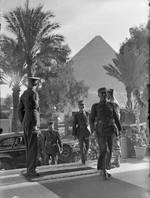
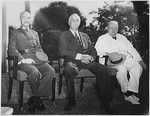
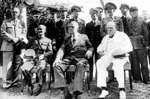
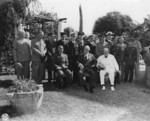
ww2dbaseThe Cairo Conference was attended by "The Big Three": President Franklin Roosevelt of the United States, Prime Minister Winston Churchill of the United Kingdom, and Chairman Chiang Kaishek of the Republic of China.
ww2dbaseBefore the conference took place, intelligence leaked somewhere in Washington or London, and German field agents were assumed to be knowledgeable of the travel plans of Roosevelt and Churchill. Cairo was outside the jurisdiction of Dwight Eisenhower's control, but since Roosevelt would have to travel great distances through his sector, his recommendations were sought upon in this situation. Eisenhower recommended that the location to remain the same, for that a sudden change in meeting location (alternate locations include Malta, Khartoum, among others) would not give the military nor Secret Service enough time to prepare security details, and might become riskier. Roosevelt and Churchill agreed with Eisenhower, and the conference remained at the original location of Cairo.
ww2dbaseBefore the conference, Churchill made a stop at Malta where they met with Eisenhower. Eisenhower commented that "Mr. Churchill, as always, was entertaining and interesting. I have never met anyone else so capable at keeping a dinner gather on its toes. His comments on events and personalities were pointed and pungent, often most amusing." Churchill focused much on his continued believe that the Mediterranean was the soft underbelly that was the weak point of the Axis, and from which location the Allies were most likely to move into Germany. He also again expressed his uncertainty regarding the risk of a cross-Channel invasion that Eisenhower had been lobbying for. Eisenhower felt that Churchill's views were influenced by the Prime Minister's wish for an Anglo-American-friendly Balkans, which Eisenhower understood but could not agree with as a soldier. At Malta, Churchill also presented two unique medals, awarded by King George VI, to Eisenhower and Alexander.
ww2dbaseAfter the meeting with Churchill, Eisenhower traveled to Tunisia for a meeting with Roosevelt, en route to Cairo. The two discussed everything from Eisenhower's experiences working with the French leaders in North Africa and Roosevelt's relationship with Churchill ("No one could have a better or sturdier ally than that old Tory!" Roosevelt said at the meeting despite saying that he had some differences in opinion with the Prime Minister). They also discussed Roosevelt's wish to push for an American to lead the cross-Channel invasion. When Roosevelt was leaving for Cairo, he decided to take Eisenhower along, not so much as a military advisor but rather to give the hard-working general a short vacation, a small break from the Supreme Commander's stressful routine.
ww2dbaseDuring the Cairo Conference, Churchill displayed a rather apathetic attitude toward the development in China, leaving Chiang and Roosevelt to tend to those affairs, with Churchill's lieutenants such as Louis Mountbatten to tend to the details. During the meetings, the Anglo-Americans were frustrated doubly with Chiang. The proceedings were excruciatingly slow, as everything Chiang said was translated not only once (by the official interpreter) but twice (also by his wife, Song Meiling, who insisted her translation was truer to her husband's true intentions). The many small episodes such as the two above signified a serious failure in terms of east-west relations, where Chiang got the impression that the Anglo-Americans were treating China as an unimportant theater, while Roosevelt began to be frustrated by Chiang's political intrigues. To the world, however, the conference was publicized as a success, where the three leaders established directions for post-war Asia in which Chinese territories occupied by Japan were to be returned to the Republic of China and occupied Korea was to become independent.
ww2dbaseThe text of the Cairo Declaration was as follows:
"The several military missions have agreed upon future military operations against Japan. The three great Allies expressed their resolve to bring unrelenting pressure against their brutal enemies by sea, land and air. This pressure is already rising.
"The three great Allies are fighting this war to restrain and punish the aggression of Japan. They covet no gain for themselves and have no thought of territorial expansions. It is their purpose that Japan shall be stripped of all the islands in the Pacific which she has seized or occupied since the beginning of the first World War in 1914, and that all the territories Japan has stolen from the Chinese, such as Manchuria, Formosa [Taiwan], and the Pescadores, shall be restored to the Republic of China. Japan will also be expelled from all other territories which she has taken by violence and greed. The aforesaid three great powers, mindful of the enslavement of the people of Korea, are determined that in due course Korea shall become free and independent.
"With these objects in view, the three Allies, in harmony with those of the United Nations at war with Japan, will continue to preservere in the serious and prolonged operations necessary to procure the unconditional surrender of Japan."
ww2dbaseUpon completion of this conference, Roosevelt and Churchill left for Tehran immediately to attend the Tehran Conference with Joseph Stalin.
ww2dbaseSources:
Dwight Eisenhower, Crusade in Europe
Frank McLynn, The Burma Campaign
John van der Vat, The Pacific Campaign
Wikipedia
Last Major Update: May 2006
Cairo Conference Interactive Map
Photographs
 |  |  |  |
Cairo Conference Timeline
| 22 Nov 1943 | Franklin Roosevelt, Winston Churchill, and Chiang Kaishek met at Cairo, Egypt. In the evening, Anglo-American leaders including Churchill, Roosevelt, Harry Hopkins, Louis Mountbatten, Joseph Stilwell, and Claire Chennault dined together. |
| 23 Nov 1943 | In a meeting between Chinese and American leadership in Cairo, Egypt, Chiang Kaishek demanded American supplies for the Chinese war effort; believing that the demands were unreasonable and observing that Chiang would not budge, George Marshall simply stormed out of the meeting. |
| 25 Nov 1943 | At Cairo, Egypt, Chiang Kaishek decided to pull his support for a Chinese invasion of northern Burma due to his perception that the British and the Americans were not putting in their full effort in the theater. |
| 26 Nov 1943 | The Cairo Conference ended with Franklin Roosevelt, Winston Churchill, and Chiang Kaishek agreeing that Japanese-occupied northeastern China (Manchuria), Taiwan, and the Pescadores islands were to be returned to the Republic of China. The Anglo-Americans were, however, unable to persuade Chiang to re-instate his pledge to send Chinese troops in an invasion into northern Burma. |
Please consider supporting us on Patreon. Even $1 per month will go a long way! Thank you. Please help us spread the word: Stay updated with WW2DB: |


» Brooke, Alan
» Chennault, Claire
» Chiang, Kaishek
» Churchill, Winston
» Dill, John
» Douglas, Sholto
» Marshall, George
» Merrill, Frank
» Mountbatten, Louis
» Portal, Charles
» Roosevelt, Franklin
» Song, Meiling
» Stilwell, Joseph
Location:
» Egypt
Document:
» Cairo Conference Agreement
Related Book:
» The Burma Campaign: Disaster into Triumph 1942-45
- » 1,167 biographies
- » 337 events
- » 44,606 timeline entries
- » 1,243 ships
- » 350 aircraft models
- » 207 vehicle models
- » 376 weapon models
- » 123 historical documents
- » 261 facilities
- » 470 book reviews
- » 28,498 photos
- » 365 maps
General Douglas MacArthur at Leyte, 17 Oct 1944

Please consider supporting us on Patreon. Even $1 a month will go a long way. Thank you!

Or, please support us by purchasing some WW2DB merchandise at TeeSpring, Thank you!