


Marshall Islands Campaign
Contributor: C. Peter Chen
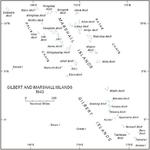
ww2dbaseAbout 4,000 kilometers southwest of the Hawaii Islands, the Marshall Islands represented part of the perimeter of the Japanese Pacific empire. The former German colony was given to Japan after the closure of WW1, and had since been an important part of both offensive and defensive plans of the Japanese Navy. By the end of 1943, Admiral Mineichi Koga of the Japanese Combined Fleet knew the Americans were eyeing the islands, but he could not figure out where they would strike. His difficulties were further complicated by the lack of carrier aircraft, as they were taken away from him in an attempt to reinforce land-based squadrons. With his hands tied, all Koga could do was to send his submarines out as forward observers and order the regional commander in Truk Admiral Masashi Kobayashi to reinforce the island garrisons that were most exposed to American attacks. Kobayashi shifted men to the outer islands of Jaluit, Mili, Wotje, and Maloelap. In total, Kobayashi had 28,000 troops available to him in the Marshall Islands. For a garrison that size ground fortifications were sub-par, but that was rather by design at this stage of the war, for that Tokyo had since decided that the Marshall Islands were to serve only as a part of a delay action campaign. The new defensive perimeter was to be established much closer to the home islands.
ww2dbaseAmerican intelligence decoded Japanese messages and detected movements for the outer islands, and decided to change the invasion plans. Unbeknownst to the Japanese, the Americans were now bypassing the reinforced outer islands; they were now directly attacking Kwajalein and Eniwetok.
ww2dbasePrelude
Nov-Dec 1943
ww2dbaseRear Admiral J. H. Hoover's land-based B-24 Liberator bombers and other attack aircraft of the 7th Air Force from Ellice and Gilbert Islands attacked Mille and Maloelap as early as Nov 1943. ON 3 Dec, Rear Admiral Charles Pownall's Task Force 50 launched a carrier strike against Kwajalein with planes from four fleet carriers and two light carriers. The strike destroyed four transports and fifty Japanese aircraft, though the damage achieved little strategic importance. Upon recovery of the planes, Pownall cancelled a planned second strike against the Wotje Atoll in fear of a Japanese counterattack. The counterattack came in the form of night bombing attacks, which the Americans had no means of defense from the air since the American pilots had no night flight training. Lexington took a torpedo hit in one of the night strikes, but the entire task force would eventually return to Pearl Harbor.
ww2dbaseMajuro atoll was named to be a forward base in preparation of the invasion. Rear Admiral Harry Hill landed the Reconnaissance Company of the V Amphibious Corps of the United States Marine Corps and the 2nd Battalion of the 106th Infantry of the US Army's 7th Infantry Division, taking the lightly defended atoll on 31 Jan without any casualties.
ww2dbaseBattle of Kwajalein Atoll
29 Jan-3 Feb 1944
ww2dbaseLogistical problems caused the invasion plans against the Marshall Islands to become delayed for one month, but as soon as Chester Nimitz could gather all the troop transports he needed, he launched Operation Flintlock against the Kwajalein atoll in the south. Rear Admiral Richmond Turner commanded the forces against Kwajalein Island, with Major General Charles Corlett's 7th Infantry Division of the US Army on board. Rear Admiral Richard Connolly, with Major General Harry Schmidt's 4th Marine Division, sailed the Roi-Namur Islands in the north. Rear Admiral Harry Hill's task force was designated the reserve force ready to assist any of the two invasion forces after securing Majuro. The entire operation was covered in the sky by Vice Admiral Marc Mitscher's planes from six fleet carriers and six light carriers, which was escorted by eight battleships and a full compliment of cruisers and destroyers.
ww2dbaseOverall The Japanese garrison at the Kwajalein atoll consisted of 8,000 men, but only half of them were combat capable. The other half consisted of conscripts, laborers (many of whom were Koreans), and the Navy's aircraft support personnel. Rear Admiral Monzo Akiyama, located on Kwajalein Island, knew he lacked strong fortifications but his capability to coordinate a damaging aerial counterattack potentially could make up for his shortfalls.
ww2dbaseThe opening chapter of the invasion destroyed On 29 Jan 1944, American carrier aircraft attacked Roi-Namur, destroying 92 of the 110 Japanese aircraft that survived the pre-invasion strikes over the previous two months. Akiyama had just lost his ability to mount an effective aerial counterstrike.
ww2dbaseThe Roi-Namur invasion started smoothly on 31 Jan on five nearby small islands, but weather and inexperience in amphibious operations caused major confusion and delays during the actual landing on Roi-Namur on the next day. Nevertheless, luck stood with the Americans as Japanese resistance was much lighter than expected after the successful pre-invasion aerial and naval bombardment. The landers only faced a garrison of 300 Japanese. Roi-Namur was secured with only 51 Japanese survived out of the garrison of 3,000 men.
ww2dbaseAfter a similar first phase of capturing smaller outlying islands in the atoll on 31 Jan, the 1 Feb southern Kwajalein landings went much more smoothly. The 7th Infantry Division's men, vehicles, and equipment were unloaded with order and efficiency. Part of the reason was because most of the Japanese defenses were established on the ocean side of the island instead of the reef siding; when the defenses were constructed, the Americans had not yet achieved the ability to traverse over coral reefs. Another reason was an effective pre-landing bombardment. Commander Anthony Kimmins of the British Royal Navy observed the American landings at Kwajalein, and was amazed at the effectiveness of the pre-invasion bombardment. He said
ww2dbaseHe commented that the bombardment was "the most brilliant success" he ever witnessed.
ww2dbaseAkiyama countered the Americans with a series of fierce infantry charges backed by strong bunkers and pillboxes when the Americans advanced. By the start of 2 Feb, only 1,500 out of the original 5,000 garrison were still alive. Much like Roi-Namur, by the time the island was secured, only 265 men survived as captured prisoners; all the rest perished. The Americans lost one for every 100 killed.
ww2dbaseBattle of Eniwetok Atoll
17-21 Feb 1944
ww2dbaseEniwetok was an atoll with a series of small islands and islets offering little more than two square miles of land, but the location was strategic, for that they could provide airfields for the subsequent invasion of the Marianas. Major General Yoshimi Nishida bolstered the defenses of the main island some time before Jan 1944, but the small size of the island meant that defense in depth was nearly impossible. Any American attempt to invade the island must be stopped at the beaches, otherwise the main island of Eniwetok would be lost. The main island was guarded by 4,000 men, of which about half were of the Japanese Army and the other half various naval personnel.
ww2dbaseThe invasion, Operation Catchpole, began with a naval bombardment on 17 Feb, while 8,000 Marines and 2,000 Army infantry waited aboard transports. On the same day, the 22nd Marine Regiment commanded by Colonel John Walker on Engebi Island in the northern side of the atoll. The Engebi landing was a logistical nightmare that embarrassed Marine Corps Brigadier General Watson who oversaw the operation, though he made up his initial mistakes by securing the island at a casualty count of only 85. On 19 Feb, the 106th Infantry Regiment landed on the main island of Eniwetok after only a brief bombardment. The brief bombardment proved to be ineffective. With automatic fire cris-crossing the landing beaches, American men and equipment soon formed a congested mess, repeating the same logistical nightmare that haunted the invaders. Nevertheless, the island was secured by 21 Feb at the loss of 37 Americans; similarly, nearly the entire 800-strong Japanese garrison died. Next, Watson led his Marines (leaving the Army to occupy Eniwetok Island) to Parry Island. The landers faced similar defenses on Parry, but the logistical problems were averted by a thorough naval bombardment led by battleships Tennessee and Pennsylvania, delivering over 900 tons of explosives on the Japanese defenses before the 22nd Marine Regiment made their landing. Parry Island was secured the next day.
ww2dbaseWith the Marshall Islands under American control ten weeks ahead of schedule, Allied engineers started to construct the islands as forward bases for the next phase of the island hopping campaign toward the Japanese home islands.
ww2dbaseSources: The Pacific Campaign, Wikipedia
Last Major Update: Sep 2006
Marshall Islands Campaign Interactive Map
Photographs
 | 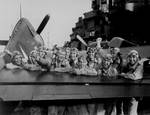 | 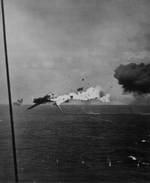 | 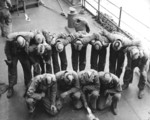 |
Maps
 | 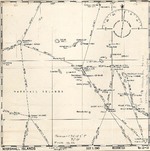 | 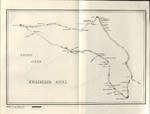 | 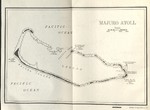 |
Marshall Islands Campaign Timeline
| 20 Aug 1943 | Admiral Chester Nimitz submitted a general plan for the invasion of the Marshall Islands. |
| 19 Nov 1943 | USS Nicholas screened carriers USS Yorktown, USS Lexington (both Essex-class), and USS Cowpens as they launched air strikes against Japanese positions on Makin, Mili, and Jaluit Atolls over 6 consecutive days. |
| 4 Dec 1943 | USS Portland and USS New Orleans (New Orleans-class), among other ships, screened carrier Lexington (Essex-class) in strikes against Kwajalein Atoll, Marshall Islands. Lexington received a torpedo hit that crippled her steering. New Orleans escorted Lexington to Pearl Harbor. |
| 29 Jan 1944 | USS Yorktown (Essex-class) and Task Group 58.1 arrived at its launching point early in the morning and its carriers (Yorktown, Lexington, and Cowpens) began air strikes on Taroa airfield on Maloelap Atoll, Marshall Islands. Throughout the day, aircraft hit Maloelap in preparation for the assaults on Majuro and Kwajalein scheduled for the 31 Jan 1944. |
| 30 Jan 1944 | USS Yorktown (Essex-class) struck targets on Kwajalein, Marshall Islands to begin softening up the island for the landings set for the next day. |
| 30 Jan 1944 | USS Bailey screened the bombardment group during the landings on Kwajalein, Marshall Islands. |
| 31 Jan 1944 | USS Yorktown (Essex-class) aviators continued their strikes on Kwajalein, Marshall Islands in support of the troops landing on that atoll. The Yorktown air group conducted similar strikes the first three days in February. |
| 31 Jan 1944 | Americans landed on Kwajalein and Majuro atolls in the Marshall Islands. |
| 31 Jan 1944 | USS New Mexico shelled Japanese positions on Kwajalein Island, Kwajalein Atoll, Marshall Islands. |
| 31 Jan 1944 | USS Portland bombarded Djarrit Island, Majuro Atoll, Marshall Islands for 30 minutes before receiving word that there were no Japanese on the island. |
| 1 Feb 1944 | USS New Mexico shelled Japanese positions on Ebeye Island, Kwajalein Atoll, Marshall Islands. |
| 7 Feb 1944 | American troops completed the conquest of Kwajalein and Majuro Atolls in the Marshall Islands. |
| 17 Feb 1944 | US Marines landed on Eniwetok Atoll in the Marshall Islands. USS Hoel fired her main guns in anger for the first time on when she fired on Japanese troops seen moving about Parry Island. |
| 17 Feb 1944 | Portland bombarded Parry Island, Eniwetok Atoll, Marshall Islands as part of the Battle of Eniwetok |
| 20 Feb 1944 | American troops captured Eniwetok in the Marshall Islands. |
| 21 Feb 1944 | USS New Mexico shelled Japanese positions on Wotje, Marshall Islands. |
| 22 Feb 1944 | Japanese aircraft attacked US Naval Task Force 58 approaching the Mariana Islands but suffered heavy losses. Meanwhile, another Allied forces operating around Rabaul and Kavieng encountered no Japanese aircraft, hinting that Japanese resources were now becoming scarce. |
Please consider supporting us on Patreon. Even $1 per month will go a long way! Thank you. Please help us spread the word: Stay updated with WW2DB: |


Visitor Submitted Comments
22 Oct 2006 12:18:47 PM
I am still hoping to hear from someone familiar with this situation. Wylene
15 Feb 2007 10:05:59 AM
Does anyone have any info on PLT SGT Charles Lada KIA Roi-Namur in operation flintlock He was my uncle and I never met him although I am named after him
28 Feb 2007 06:02:54 PM
my father in law fought in this battle, as well as others in this campaign. we have photos of the aftermath.
16 Sep 2007 06:53:26 AM
My dad fought in this battle...he was in the 4th Marine div. he left the US and sailed directly to the island...This was the first for him and seven more invasions follow...And they cry because they have to extend thier tour in Iraq????
24 Sep 2007 02:53:45 PM
The USS Competent swept two mines at Arno Atoll in the Mashalls.They were said to be the first *** mines swept in the pacific
11 Nov 2007 10:14:11 AM
My dad, Sam Petkovich, fought in this invasion and was wounded. He was taken to Pearl Harbor to recover. Dad passed away just three years (2004) but I have photos and a certificate Domain of Neptunus Rex ( a pirate document of sorts) that the marines signed giving the name of the ship and the date, January 25th, 1944.
11 Mar 2008 01:43:37 PM
My father, P. Mims Rogers, was a Major with the 7th Infantry and fought in this battle under General Corlett, and I have a picture of them together. I would love any information about this battle.
25 Nov 2008 10:43:30 AM
If anyone has information on PLTSGT Herbie "Frenchy" LeClair please call. Unit was VAC 5th Amphib Corps Recon Company with LT Harvey Weeks when they captured the *** Warrent Officer on Majuro. My uncle transported him back to the ship USS Kane. 320-629-3212
9 Apr 2010 03:08:25 AM
I have a photograph of my father, Captain Maguire, MD, with Mag. Gen Corlett on Kwajalein.
The number in the bottom tight corner is W-CPA-44-106-AV.
Can anyone translate that and how is it possible to look up in Army Archives?
Thanks,
Tom
22 Apr 2010 04:07:01 AM
My father told me he fought in Marshell Island in 1944?, he recieved the bronze star what I dont know. I have a picture of him and a buddy in their MP unifrom taken in
South Pacific. He was in Army infantry, thats all I know would love to know more.
His name Roy Patton.
24 Apr 2010 09:06:11 AM
My dad Tommy Oran Wheeless was in the army 1939-45. he passed in 1994. he recieved 3 purple hearts, i believe he fought on the marshall islands.
4 May 2010 12:02:41 AM
After a long effort, I finally obtained my father's USMC records of his service in WWII--or what's left of them or available. There's a big gaping hole instead of details for the period between Feb. 25, 1944 and August, 1945 and then again until 1946 when he was sent to San Diego. This "hole" begins with him being sent "into the field" on Feb. 25, 1944 via "Cape Victory" (a troop ship made by Consolidated Steel, Wilmington DE. He was in the Provisional Signal Corps, Service Battalion, 5th Amphib.. He verbally told me and my brother that he'd been at Peleliu, Saipan, Iwo Jima and Okinawa. He told my brother he was captured on Okinawa and escaped on his second try. After the first try the Japanese skinned his best friend alive and made him watch. We believe he had been promoted at one point from Cpl. to Sgt, sometime in 1944 and busted back to Cpl after what he did to the Japanese who killed his friend. However, we have only a few verbal bits from my late father. The most he ever talked about his experiences was about 10-15 minutes and only about four times that any of us can remember. He was still having occasional "bad dreams" etc. that he wouldn't discuss but sent him at last to a psychologist in the last couple of years before he died in 2005. I wish the VA had provided that service when he spent the first six years of my life avoiding the contiguous 48 states, cities, noise, etc.--and his family, or when he finally "came home" he had such anger management issues that he nearly killed me twice--before I was 8 years old. If anyone recognizes the name John George Fabos, out of the Signal Corp for the Service Battalions in the 5th Amphib. Corps, please let me know, especially if you know anything about what all he did, when and where. We have nothing in the "declassified" record we were given. He did have several medals, etc. and all were stolen in a burglary of his late parents' house when it had passed to a cousin, while she was in a nursing home, after a traffic accident. I didn't even receive a record of his medals from the National Archives. As I said, there is this big hole in his records.
Cecilia L. Fabos-Becker, San Jose, CA
celia.lfsbecker@sbcglobal.net
4 May 2010 03:30:26 AM
Amazing Flintlock operation.
My question why the boss of landing force in Kwajalein (south) is Army General ? Not Marine General ?
Thanks
Sola
8 Jul 2010 11:24:30 AM
I hope anonymous of item #6 will email me I was there and would like to talk to him
8 Jul 2010 08:25:15 PM
Looking for any of the crew of the Competent who were at the Palau Islands September 1944
27 Aug 2010 11:07:38 PM
My father, Donald Edward Stafford, was shot down and crashed into the lagoon. His plane was a B-26. He was rescued by natives. He spent the next year in Hawaii recovering from his wounds and was headed to Guam aboard ship when the war ended.
This is all I know.
I would like to know what unit he would have been with during the Marshall islands campaign and any other info that some one could provide.
Thank You
29 Nov 2010 05:49:26 AM
My grandfather by the name, Terruo Tsuwano, if i'm correct, was captured by the american after the world war 2 on Aerok, Ailinglaplap, Marshall Islands, and haven't been heard from sinced.
I am hoping to find information about on him, and hopefully to reconnect with any relatives, if any.
Please feel free to contact me at the e-mail above, if any info on this man.
He left a son behind my grandmother passed away 4 years ago.
21 Feb 2011 07:16:58 PM
as a Marshallese, it hurts my feeling while looking at the pictures of the war in the Marshall Islands.....it reminds me about my great grandparents who were there during the war...
19 Jul 2011 09:45:01 PM
My uncle was a Private in the 184th Infantry Regiment, 7th Infantry Division, and he was killed in action at Kwajalein on Feb 2, 1944. He was awarded a Bronze Star and Purple Heart, but that's all the information I've ever been able to get. His name was Frederick J Gulik, but he went by Fred or maybe Fritz. My dad--his brother--was stationed in Hawaii at the time, and he said his captain told him that Fred was shot while coming off an LST...
12 Dec 2011 07:04:02 PM
My father who was in the toke the troops onshore in the Marshal Islands. The only thing he told me about the invasion that after the invasion was over him and one other person was in charge of burring the bodies of the Japanese. He brought back with him a bayonet,rifle, and some Japanese money. He also said while on the island Japanese aircraft flew over but had no bombs.
16 Jan 2012 07:17:43 PM
I had a Uncle who serviced in the 4th Marine Division He died on Feb. 2 1944 in the first invasion in the Marshall Islands.
8 Feb 2012 03:08:45 PM
I have so many family members who were kill on world warII on,kwajelin, Marshall Islands. My mom was 2 years that time. I am a Marshallese and I am Very Proud of The U.S Army and soilder who were die for My country ." I joseph,boas ,promoise to do my best,to do my duty to God and my Country and to obey the people from United state of America."
18 Apr 2012 08:18:10 AM
I understand that both the Japanese and the Americans tried to warn the Marshallese people away from where the worst killing would be, leading up to and during the Feb 1944 WWII battles in the Marshalls. I guess there were people, sailor fishermen, perhaps, who would hear and pass the warnings. For example, I see in Morison's Volume-7 p.226-227, on the unopposed taking of Majuro, "Blessed with fair weather, Admiral Hill prepared to assault the atoll --- which photographic interpretation of the buildings had informed him, might be defended by three to four hundred Japanese. This intelligence was confirmed by natives on the channel islets, where a scout party of Marines, Lieutenant Harvey W. Weeks USMC, had made a landing the previous evening.... Before D-day dawned they had overrun Dalap and Uliga, found nary a *** and heard from natives that there were none on Darrit. Captain Jones was unable to convey this information to Admiral Hill in time to stop his scheduled bombardment of Darrit. At 0655, after the shoot had been going on for 18 minutes, he managed to get the word through. The Admiral then ordered his guns to stop talking .... Fortunately nothing was seriously damaged during the 18 minute bombardment...." Any stories would be appreciated as to the underground between the Marshalese, Americans and Japanese." I would appreciate hearing from anyone who has any information or stories as to how it actually worked in reality for the Japanese and Americans trying to get the Marshallese people our of the impending harm's way. Thank you. Phil Pyle PPyle@Comcast.Net
18 Apr 2012 08:36:55 AM
PS. I missed an important footnote in Morison. "The natives meant that the Japanese had formerly been on the atoll, but the Marines' Gilbertese translator, who did not know Marshallese very well, slipped up. (Conversation with Capt. Jones 24 April 1944. He is brother to Maj. William K. Jones USMC of the Betio battle." PPyle
6 May 2012 11:25:30 AM
My grandfather served in the Marshall islands as a Sgt. in the Army Air Corps. we have photos of him with a PFC. Charles Lubic. if anybody knew about the units that were stationed there, or airbases plz contact me via email.
27 Jun 2012 11:54:33 AM
MY FATHER, PFC FRANK H. ERNST FOUGHT IN THE
MARSHALL ISLANDS DURING WWII! THANKS DAD FOR
YOUR EFFORTS. IT WILL NEVER BE FORGOTTEN.
16 Nov 2012 01:12:26 PM
seriously interesting helps with my project for history
6 Mar 2013 06:26:09 AM
If any of your fathers or uncles were with the 7th Infantry Division, during the battle for Kwajalein, please do get back with me as i have info that i can share with you. My father was in Co B 17th Regiment 7th Division.
James LaVerdure
josie56@sbcglobal.net
27 May 2013 02:51:21 PM
my father leland skinner was in the marshall islands where he got shot in june 1944.He was in camp Roberts California in march25 - june 23,1943.I have alot of pictures of him & his buddies there would like to share with anyone who father has been there too.He also was in 7 infantry division in Okinawa, Ryukyu Islands.
14 Oct 2013 12:29:52 PM
My Uncle, PFC Merle V Davis was killed on Eniwetok, Feb 1944. Any info from anyone on this site would be sincerely appreciated.
my em studduck999@yahoo.com
10 Nov 2013 01:37:05 PM
iso info on Douglas Ralph Byers who served in Australia and New Gineau in WWII.
20 Jan 2014 06:42:16 PM
there is family leave in Ailinglaplap half japanese half marshallese Tsuwano.
18 Feb 2014 01:29:15 PM
GULIK, FREDERICK J
PVT US ARMY
WORLD WAR II
DATE OF BIRTH: 01/15/1922
DATE OF DEATH: 02/02/1944
BURIED AT: SECTION N SITE 907 Click to view the cemetery map
NATIONAL MEMORIAL CEMETERY OF THE PACIFIC
2177 PUOWAINA DRIVE HONOLULU, HI 96813
(808) 532-3720
22 Jun 2014 10:50:47 AM
My uncle was on Kwajalein with the Army Air Corps, right after the battle. Does anyone know the Air Corps unit numbers at that time?
5 Jul 2014 11:55:25 PM
I would be so proud if U.S military could remember the Marshallese men and also list their names who served as scout for the U.S military during the WW2 in the Marshall Islands and send their names to RMI government.
23 Aug 2014 05:20:21 PM
To Charles Aucoin. Your uncle Charles Lada is memorialized on a plaque on Roi-Namur Island that was put in place in February of this year in commemoration of the 70th Anniversary of the battle of Roi-Namur.
23 Aug 2014 05:22:34 PM
To Anonymous Lucky Lady. there are currently several efforts underway to memorialize the efforts of the Marshallese Scouts during World War II. I believe these effects include one by the U.S. Army and one on behalf of the U.S. Ambassador to the Marshall Islands.
24 Nov 2014 10:22:29 PM
My uncle, whom I was named after, was killed on Roi Island on February 12 1944 during the battle of Kwajalein. He was a Leutenant jg in the USNR. The Japanese bombed an amunition dump which resulted in a huge explosion and inferno. If anyone has any information about this incident or about my uncle please contact my.
24 May 2015 08:30:14 PM
Thinking of my father, in the 7th infantry in the battle of Kwajalein on this Memorial Day 2015.
He received a bronze star for his leadership. Was later a Captain.
25 May 2015 01:04:21 PM
My father Dell Goss,served with 7th infantry, 184th California division company M.
He received bronze star with oak leaf clusters along with purple harts.
I still have some of his leggings and other "souvenirs"
12 Jul 2015 12:59:36 AM
My grandfather was a scout during battle Marshall island. He was a messasenger during the war
5 Aug 2015 04:45:22 PM
My uncle, who I never met, was killed in the battle of Kwajeline. I was born in 1945. I believe he was a sniper. I was looking for a list of casualties, but have never found one. Nobody left in the family has much information. His name was Charles Swan.
30 Sep 2015 02:15:26 AM
My Uncle S Sgt William Dixie Morris from Arkansas was killed February 4, 1944 on Kwajalien Island. He was awarded Silver Star postumously. Trying to find out more information. Ichf.roy@gmail.com
7 Dec 2015 12:29:52 AM
My Dad fought on the Marshall Islands in 1944 with the 7th Cav, and was awarded the purple heart . my mother has waited for 5 years since his death to get his heart and never did and I am his son and feel I deserve his Purple Heart . My Dad was Richard D. Ettinger 7th Cav .
28 Mar 2016 04:03:38 PM
I was based on Kwajalein from 1945 to '46. I wrote a book, "Spam Cans, Rice Balls and Pearls" which has considerable information about Kwaj as I knew it at that time. I knew some of the natives and often wondered how many casualties they suffered during our invasion.
1 May 2016 12:05:58 PM
My father, John J. O'CONNELL , served with the 100th Seabee battalion in the Marshal Islands. He went ashore with a Marine Division on Roi. Don't know much more as dad wouldn't talk about it. Was also on Majuro. Was a hard hat diver. Any more info to fill in the blanks?
7 Aug 2016 09:48:59 PM
My Dad (Burt Norris Groves) served on the USS Pennsylvania, he was a gunners mate 3 class. He died when I was young, it was not untale about 10 years ago that I looked up his ship. I was amazed at what I found out, I knew very little about what the Pennsylvania was about, or just what took place. Please send me all you can about Mr Groves and the mighty JSS Pennsylvania.
6 Nov 2016 06:21:45 AM
First, I want to thank the providers of this web page for making it possible for me to be able to contribute my experiences in the battle (invasion) of Kwajalein , Jan. 31-Feb3rd 1944.
Yes, I was there, this is a first hand actual account of the invasion through the eyes of an 18 year old kid from Oklahoma. I was, at that time , a very excited young man , about to make his first run to the beach as the coxswain of a Higgins Landing Craft loaded with troops .
I had watched the terrific high altitude bombing of the island, then the battle ship shelling , and finally the dive bombers . And once the air power bombings & ships' cannons had pulverized the island, the actual invasion began . Our boats, loaded with troops , swarmed in the lagoon waters . A GREY HAZE HUNG OVER THE ISLAND. Sounds of small caliper weapons and occasional explosive could be heard as we neared our respective landing targets.
Boats faltered, for a moment . An unexpected traffic jam of landing craft had temporarily blocked the passage of our boats to the beach , but out of no where jumps this older guy , he's standing on a coral rock, he's waving his hands, yelling at us, and pointing the way to go! He yelled at us, "go this way..." and with a traffic cops' signals he direct us to a safe passage way.
I drop my ramp, the troops wade ashore , I go back to the ship , load up again , again and again . keeping this up until we are all finished bringing in what's needed .
From out of no where I'm selected/ordered to stay ashore on the atoll . I am to live in a pub tent, eat with the Army. My assignment , was to provide the Army via my boat , transportation of all their needs, supplies and etc. from the cargo ships in the lagoon/harbor.
That I did, but I also was conscripted to help bury the
bodies of the Japanese Imperial Marines. Which I did ! And in that capacity I witnessed first hand the ugliness of war.
While my Unit 34 shipmates went back on board their ship, I stayed on Kwajalein .
This sounds morbid, but it was a beautiful sight to have witnessed the U S A's military might .
10 Jan 2018 10:57:46 AM
Looking any information for Marshall W. Lyons (born 7-15-1921) USNR Polit , WWII Pacific Theather, Crashed on a Island near or around Marshall Islands, marooned over a month before resuced (Information needed for family member who is my VFW Post)
Like
Show more reactions
Comment
3 3
Comments
Eileen Flaherty Whitmire
Eileen Flaherty Whitmire Don Bechtel - I'm finding the birth year to be 1923 - Marshall Willard Lyons
in the U.S. WWII Draft Cards Young Men, 1940-1947
View Original Image on Fold3.
Name:
Marshall Willard Lyons
Gender:
Male
Race:
White
Age:
18
Relationship to Draftee:
Self (Head)
Birth Place:
Primrose, Nebraska, USA
Birth Date:
15 Jul 1923
Residence Place:
Kansas City, Missouri, USA
Registration Date:
30 Jun 1942
Occupation:
Sear Roebuck And Co
Weight:
170
Complexion:
Light
Eye Color:
Blue
Hair Color:
Brown
Height:
6
Next of Kin:
G L Hansen
Household Members:
Name
Relationship
Marshall Willard Lyons
Self (Head)
Manage
LikeShow more reactions · Reply · 1h
Eileen Flaherty Whitmire
Eileen Flaherty Whitmire Don Bechtel - Marshall W Lyons
in the U.S., Select Military Registers, 1862-1985
View
Name:
Marshall W Lyons
Birth Date:
1923
Military Date:
1 Jan 1946
Publication Date:
1 Apr 1951
Title:
Commissioned and Warrant Officers of the United States Naval and Reserve
Manage
LikeShow more reactions · Reply · 1h
Eileen Flaherty Whitmire
Eileen Flaherty Whitmire Don Bechtel - Missouri, Marriage Records, 1805-2002
Does the Marshall W Lyons in this record match the person in your tree?
Yes No Maybe
Name:
Marshall W Lyons
Marriage Date:
1 Sep 1946
Marriage Place:
Jackson, Kansas City, Missouri
Registration Place:
Jackson, Missouri, USA
Spouse:
Madonna E Bargold
Manage
LikeShow more reactions · Reply · 58m
Eileen Flaherty Whitmire
Eileen Flaherty Whitmire Don Bechtel - U.S., Social Security Death Index, 1935-2014
Name
Marshall W. Lyons
Last Residence
Shreveport, 71118, Caddo, Louisiana
Born
15 Jul 1923
Died
2 May 2008
State (Year) SSN issued
Arkansas - Before 1951
14 Mar 2018 12:17:10 PM
Did anyone know Stanley Lukowski? He was in the 106th Infantry Regiment, 27th Infantry Division and died on February 20, 1944. He was my great uncle. Thank you!
13 Aug 2018 01:36:21 PM
My Father-In-Law (a Marine) lost his life in the Marshall Island waters during WWII. His body was never identified. What steps will we need to take to investigate if his remains were ever found?
 David Stubblebine says:
13 Aug 2018 08:52:37 PM
Tom (above):
Visit the “Defense POW/MIA Accounting Agency” website at http://www.dpaa.mil/. They have a list of still missing men from World War II separated by state (place of enlistment, probably). Your question speaks to exactly what this agency does all the time.
1 Oct 2018 02:58:05 PM
I have recently uncovered a journal kept by my father Deward Harrison while stationed aboard the Uss cleaveland during the Marshall Island attacks Describes many of the battles and air raids contains orders and messages from rear admiral Shepard. Also details airfield attack, other significant battles task force 36 references etc The Colorado other shios
28 Jan 2019 08:15:53 AM
My dad was in the navy. And in the raid Roi,Kwajalien Atoll, by the Japanese. February 1944. In his belongs I found dogtags which I assume were a friend of his. Name is Robert Wallace Rush T .12-42 USN B. I do not know how to find to who his family members might be. My dad died after the war in 1963. So I could never ask him , I was 13. And didn't know of the dog tags. Would like to return them, but don't know who or how. if any one knows? you can contact me.
25 Apr 2019 08:15:22 AM
I am only reading this for a project
20 May 2019 04:06:14 PM
My father, CPL Hamilton Wm Wright, Marine 1st Defense Battalion was seriously injured during the invasion of Kwajalein in 1944. He spent 6 months on a hospital ship before being returned to the Navy Hospital in Corona, CA. Prior to the invasion he was stationed for 2 years on Palmiera Island with the 1st Defense Battalion. Would appreciate any information relative to his injury or battalion during the action period.
7 Jul 2019 07:36:49 AM
John HWright I am doing a project documenting the burial spots of ww2 navy personnel if you sendthe Info on the tags I may be able to locate family from burial info
14 Dec 2019 06:53:52 AM
Great Piece ! Now...read my comments , which , as a participant in the invasion , will give the readers , a thrill of pride in their Country, the USA ! First, as an eighteen year old "kid" from Oklahoma , I wasn't prepared , to witness , the exactness of the pre-pared plans of the fleet , the Air Force , Army and the Marines . It was like a movie ! Our Commander, the night before the invasion , called us all aft of the LSD Lindenwold, to pray ! Early the next morning, we pulled into the lagoon ! WOW! Every kind of war ship one could imagine, was position for action ! The VERY SIGHT of such a massive armada gave me chills of pride in America . I knew then ! On that early morning, that America HAD ARRIVED , AND NO FEAR FOR THE OUTCOME OF THE BATTLE ! The folks , at home , who had sacrificed and made possible this vast fleet of ships , would have been PROUD as well ! I will not take any more of your time and space , by giving you details of the battle , for that has been covered quite well by the hosts of this site. Just remember, please ....America is GREAT !
16 Nov 2024 05:58:05 PM
My father was at Marshall Island but I never see the name of his ship Belluwood. My father was a pilot during or around the Marshall Islands.
All visitor submitted comments are opinions of those making the submissions and do not reflect views of WW2DB.

» Browning, Miles
» Erskine, Graves
» Evans, Ernest
» Feller, Robert
» Gonsalves, Harold
» Smith, Holland
» Tokuno, Hiroshi
» Turner, Richmond
Location:
» Marshall Islands
Ship Participants:
» Alabama
» Anzio
» Bailey
» Bell
» Belleau Wood
» Chester
» Colorado
» Cotten
» Cowpens
» Cummings
» Ellet
» Essex
» Hoel
» Hull
» Indiana
» Indianapolis
» Intrepid
» Iowa
» Isuzu
» Johnston
» Lexington (Essex-class)
» Manila Bay
» Massachusetts
» Minneapolis
» Mugford
» New Mexico
» New Orleans
» Nicholas
» North Carolina
» Pennsylvania
» Portland
» Princeton
» Salt Lake City
» San Diego
» San Francisco
» San Juan
» Saratoga
» South Dakota
» Washington
» Yorktown (Essex-class)
Documents:
» Interrogation Nav 18, Lieutenant Commander Hiroshi Tokuno
» Interrogation Nav 30, Commander Goro Matsura
» Interrogation Nav 34, Commander Chikataka Nakajima
» Interrogation Nav 38, Captain Toshikazu Ohmae
» Interrogation Nav 96, Rear Admiral Shunsaku Nabeshima
Related Book:
» A Shanghai American
- » 1,181 biographies
- » 337 events
- » 45,115 timeline entries
- » 1,248 ships
- » 350 aircraft models
- » 207 vehicle models
- » 376 weapon models
- » 123 historical documents
- » 261 facilities
- » 470 book reviews
- » 28,412 photos
- » 365 maps
Chiang Kaishek, 31 Jul 1937

Please consider supporting us on Patreon. Even $1 a month will go a long way. Thank you!
Or, please support us by purchasing some WW2DB merchandise at TeeSpring, Thank you!
2 Aug 2006 01:08:33 PM
An article appeared in the Atlanta Georgia paper,saying that a Georgia marine and a N.Y. marine had captured the first prisioners on the Island The Georgia boy was my brother Henry Durwood Howard. This must have been Jan. of 1944. I was a child of 4 at the time and many years have passed since my brother was killed just a few days later. In June I went to the burial site in ohau,and it has kindled an interest that I didnt even know still existed. I have tried in the last few years to locate the other man who was envolved in my brothers heroism. It would be so great to talk to someone about all of this. Thanks to whomever, Wylene Howard Brown Quitman Georgia