


Annexation of Austria
Contributor: C. Peter Chen
ww2dbaseAustria was Adolf Hitler's birth country, and she was the first nation to be annexed by Hitler's Nazi Germany. The idea of a unification of all German-speaking people under one flag, Anschluß (frequently Anglicized as Anschluss), had been an idea that had existed since the end of the Holy Roman Empire in 1806. It briefly gained momentum immediately after WW1, but by the 1930s most Austrians were happy with the arrangement of having their own independent nation. Hitler, however, was among those who held on to the idea, and considered it his personal mission, as shown in Mein Kampf.
ww2dbaseTo reach that goal, the first course of action was to spread the influence of the Nazi Party into Austria, secretly funding the Austrian Nazi organization through the German Foreign Office. By Jul 1934, the Nazi Party was so influential that Chancellor Engelbert Dollfuß of Austria banned all political parties except for the ruling Christian Social Party. Near the end of the very same month, a failed coup d'état by Austrian Nazi Party members saw the murder of Dollfuß. Kurt Schuschnigg succeeded as the next Chancellor, and continued to strike at Nazi Party leaders.
ww2dbaseOn 12 Feb 1938, Hitler invited Schuschnigg to his home, Berghof, in Bavaria, Germany for a secret discussion. Schuschnigg politely addressed Hitler as "Herr Reichskanzler" (Mr. Reich Chancellor) as per diplomatic courtesy, but immediately Hitler put on an unfriendly face, addressing Schuschnigg by his name rather than his title. Hitler threatened and insulted Schuschnigg; "I have only to give an order," Hitler screamed, "and your ridiculous defenses will be blown to bits!" Hitler continued to remind Schuschnigg that top German leaders were present in Berghof at the very moment, but according to Wilhelm Keitel after the war, it was only a bluff, and Hitler had not been ready to actually use force. Hitler left Schuschnigg for several hours, and called Schuschnigg back into his office. He gave Austria until 15 Feb; by that time, he wanted Schuschnigg to be replaced by Austrian Nazi Party member Arthur Seyß-Inquart. Before he departed Berghof, he signed a two-page agreement drafted by Joachim von Ribbentrop which lifted the ban on the Austrian Nazi Party, released jailed Austrian Nazi Party members, and appointed Nazi Party members Arthur Seyß-Inquart and Edmund Glaise-Horstenau ministers in his government.
ww2dbaseOnce Schuschnigg returned to Austria, though initially timid, he began to work against German violations against his country's sovereignty. He immediately contacted Italy, which had been Austria's protector since the country's formation; although Benito Mussolini had previously voiced support for Austrian independence, he remained curiously quiet this time. Details of the German demands were also published abroad to gather international support. On 9 Mar 1938, he announced that a nation-wide plebiscite was to be held, believing that the voice of Austrians against any form of German aggression, political or otherwise, would cause the Germans to risk an international incident; should the Austrian people show less resolve than Schuschnigg had hoped for, his single-party ruling system could resort to ballot-fixing if necessary. Hitler became furious when he heard the news of the plebiscite; on 11 Mar, Hitler ordered his top military leaders to convert Case Otto, a wargaming scenario for a war against Austria, into a military operation that would be ready by the next day in order to strike prior to the planned plebiscite date of 13 Mar. At the same time, various Nazi Party organizations fabricated false news of riots and general breakdown of society in Austria; this was to create false incidents to lay the ground for Seyß-Inquart, once he gained power, to send a request to Germany for German troops to help quell the civil disobedience (ultimately, Seyß-Inquart would refuse to send such a request, and the Germans would resort to filing a falsified request in the German Foreign Office). German leader Hermann Göring played an important role during this time as well, coordinating communications between Austria and Germany as well as ensuring inaction on the part of Czechoslovakia in the matter.
ww2dbaseIn the early hours of 12 Mar, troops of the German 8th Army marched into Austria. Schuschnigg was arrested, and Seyß-Inquart proclaimed to wield the power of both the President's and the Chancellor's offices, despite the fact that President Wilhelm Miklas had refused to resign. Adolf Hitler crossed the border shortly after, welcomed by thunderous crowds, some of which were genuine while some others staged. He visited his birthplace of Braunau, touring his former school and home, and was reported to have gotten emotional.
ww2dbaseBenito Mussolini of Italy, having received a hand-written letter on this topic shortly before, personally telephoned Hitler to let Hitler know that Austria was "immaterial" to Italy, suggesting Italy's approval for this annexation. The enthusiastic Hitler told a messenger to bring Mussolini the message "I will never forget him for this.... Never, never, never, no matter what happens!"
ww2dbaseAt the city of Linz, Hitler gave a speech at the city hall; Wilhelm Keitel recorded the crowd reaction as "electric and excited beyond belief". To establish legality for the annexation, it was announced that a plebiscite was to be held in both Germany and Austria, both of which were to be held on 10 Apr. Hitler immediately engaged on a trip all cross Germany and Austria to garner support. Photographs of enthusiastic Austrian crowds waving the Nazi Party flag were circulated throughout Germany and Austria, while those depicting refugees fleeing out of Austria, both Jewish and otherwise, were suppressed. The result of the plebiscite showed overwhelming, ie. 99%, support for the annexation in both countries, but this revealed little of real German and Austrian sentiments as coercion most likely played a role in the voting. According to Winston Churchill's own intelligence network, the most generous estimate did not exceed 35% approval rate. "[T]he majority in the country is in favor of an independent Austria," said Georg Franckenstein, an Austrian diplomat in London, England, United Kingdom who was secretly acting as one of Churchill's informants.
ww2dbaseMeanwhile, the western powers of the United Kingdom and France failed to act. British Prime Minister Neville Chamberlain protested by stating that "our Ambassador in Berlin registered a protest in strong terms with the German Government against such use of coercion, backed by force, against an independent State in order to create a situation incompatible with its national independence", but failed to commit any action to back up his words. On 17 Mar 1938, the Soviet Union attempted to organize a multi-power discussion to curtail German expansionism; Chamberlain, among other leading world politicians, denied the request.
ww2dbaseNazi anti-Semitic policies were implemented shortly after the occupation. An Austrian who was able to flee to Britain described after the war how his countrymen were demeaned by the German occupiers:
ww2dbaseOn 7 Oct 1938, British Lord Halifax sent Berlin a letter questioning the reports of ill-treatment; he requested a statement from Berlin "to combat such assertions, the spreading of which might in fact hamper the advocates of Anglo-German relations in the realization of their aspirations." Hitler's responded that anyone who stood in his way would be vanquished. Two days later at a speaking engagement at Saarbrücken in Germany, Hitler added that Germany "cannot tolerate any longer the tutelage of governesses. Inquiries of British politicians concerning the fate of Germans within the frontiers of the Reich, or of lands belonging to the Reich, are none of their concern." Even after such responses to foreign inquiries, however, pacifists in Britain and France continued to believe Hitler could be appeased.
ww2dbaseFrom a military perspective, the annexation of Austria immediately provided the German military five incomplete divisions (two infantry, two mountain, and one armored). Additionally, Czechoslovakia was now surrounded by Germany on three sides, with its borders nearly indefensible to a German invasion.
ww2dbaseSources:
William Manchester, The Last Lion
Wilhelm Keitel, In the Service of the Reich
William Shirer, The Rise and Fall of the Third Reich
Wikipedia
Last Major Update: Dec 2011
Annexation of Austria Interactive Map
Photographs
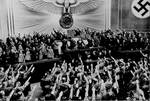 | 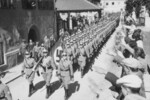 |  | 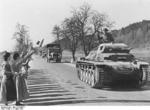 |
Annexation of Austria Timeline
| 11 Jul 1936 | Germany and Austria signed an agreement in which Germany promised to respect Austria's sovereignty and Austria agrees to be considered a state of the German people. In a secret clause of this agreement, Austria was to permit the Nazi Party. |
| 15 Jan 1937 | Hermann Göring met Benito Mussolini; when Göring brought up the topic of the German wish to annex Austria, Mussolini showed disapproval. |
| 11 Feb 1938 | Austrian Chancellor Kurt Schuschnigg secretly went to Salzburg, Austria by car for a meeting with German leaders. |
| 12 Feb 1938 | Austrian Chancellor Kurt Schuschnigg crossed into Germany and was welcomed by Franz von Papen. Taken to Adolf Hitler's residence in Obersalzberg, München-Oberbayern, Germany, he was threatened with a ultimatum and was given three days to answer. |
| 15 Feb 1938 | Austrian Chancellor Kurt Schuschnigg sent a message to Franz von Papen noting his acceptance to Adolf Hitler's demands given three days prior and probed Germany for any intention of maintaining Austrian sovereignty. |
| 20 Feb 1938 | Adolf Hitler assured the Deputies in the Reichstag that no problems existed between the National Socialist State and the German Armed Forces, while spoke about the German destiny to annex Austria. |
| 24 Feb 1938 | Austrian Chancellor Kurt Schuschnigg made the "Red-white-red until we're dead" ("Rot-weiß-rot bis in den Tod") speech at the Austrian Bundestag in protest of German threat. In the country, protests both for and against Germany appeared; meanwhile, there was a run on the banks and tourists began to leave the country. |
| 4 Mar 1938 | Members of the Austrian Social Democratic Party offered help against German threat if the Austrian government would lift the ban on their party activities. Chancellor Kurt Schuschnigg granted the request, but it was largely too late to make a difference. |
| 9 Mar 1938 | Austrian Chancellor Kurt Schuschnigg announced that a plebiscite was to take place on 13 Mar 1938 to decide Austria's fate regarding the German threat. Upon learning the news, Adolf Hitler became furious. |
| 10 Mar 1938 | Adolf Hitler ordered his military leaders to review Case Otto for the invasion against Austria. |
| 11 Mar 1938 | Adolf Hitler formally issued a directive for the invasion of Austria, to be taken place on the following day. |
| 12 Mar 1938 | Germany declared, then affected by marching troops across the frontier, Anschluß with Austria. Hours later, Adolf Hitler visited Linz in the recently annexed Austria region of Germany; he met with the German-installed Austrian Chancellor Arthur Seyß-Inquart at this city to discuss details of the occupation. Ousted Austrian Chancellor Kurt Schuschnigg was placed under house arrest. |
| 13 Mar 1938 | Austrian Chancellor Arthur Seyß-Inquart claimed that Austrian President Wilhelm Miklas had resigned his post and consolidated the power of the president in the position of the chancellor; in actuality, Miklas had refused to resign. Meanwhile, Kurt Schuschnigg's small Fatherland's Front, a Fascist political party created in 1934 from the Christian Social Party, which had advocated Austrian independence along Italian Fascist lines, was disbanded; the Party leaders were either arrested by the Nazis or fled into exile. Later on this date, Hitler visited his parents' grave, then visited his hometown of Braunau and then returned to Linz to give a speech. |
| 14 Mar 1938 | Adolf Hitler arrived in Vienna in the recently annexed Austria region of Germany. The visit to Vienna, the Austrian capital, was intended to be for the first day of the occupation, but it was delayed until this date because Heinrich Himmler's organization could not complete the rounding up of all suspected elements in the city, and that many Heinz Guderian's tanks had broken down since crossing the German-Austrian border that slowed the progress of the military occupation of the region. In Britain, Prime Minister Neville Chamberlain noted that little could have been done in the previous few days to alter Hiter's intended course regarding Austria. |
| 15 Mar 1938 | At a speech in the Heldenplatz in Vienna, Adolf Hitler formally announced the "re-unificatrion" of Austria with the rest of Germany. |
| 16 Mar 1938 | Benito Mussolini, previously a proponent of Austrian independence, stated his support for the recently affected German occupation of Austria. |
| 25 Mar 1938 | Adolf Hitler gave a speech at Königsberg, Germany; the approval of the annexation of Austria was his main concern. |
| 6 Apr 1938 | The United States recognized the German occupation of Austria. |
| 9 Apr 1938 | Adolf Hitler arrived in Vienna in the recently annexed Austria region of Germany to gather support for the plebiscite of the following day. |
| 10 Apr 1938 | At the Reichstag elections a single ballot paper also required voters to approve the union with Austria. There was much vote rigging by local Party officials to ensure Hitler got the result he wanted. |
Did you enjoy this article or find this article helpful? If so, please consider supporting us on Patreon. Even $1 per month will go a long way! Thank you. Share this article with your friends: Stay updated with WW2DB: |


Visitor Submitted Comments
19 Oct 2008 07:14:29 PM
HELP ME
SO LONGG
9 Feb 2009 03:47:46 AM
:O much text :P
4 Sep 2009 10:24:09 PM
Too long? Do you think history isn't worthy of such long paragraphs? If you don't enjoy it, then why read it? It is YOUR history too, you know!
17 Nov 2009 04:10:11 PM
Oh my god....the Allies lying about their evil history again.
Austria was not "annexed" LOL
The Austrians ARE Germans! They wanted the unification, or why do you think Austrian soldiers crossed teh German borders with FLOWERS in their rifles?
Likewise for teh SUDETENLAND - it was not annexed, it RETURNED to Germany! It was GERMAN LAND. Why do you Allies lie about your evil past?
The Sudetenland is a good example for Angloamerican "Demococracy": After promising the Germans "right to self-determination" in their 14 points, the Angloamericans gave the Sudetenland to thze CZECHS, against the people's will! They declared in the democratic Vienna parliament their will to remain Austrian resp. German citizens , and they declared their free will also in peacefull demonstrations in all their cities. Czech troops and tanks moved in, and opened fire on unarmed peaceful demonstrators. In the city of KAADEN only, hundreds were wounded and killed, even children and young women were anmong the victims of the aggression of the Versailles-criminals Britain + USA. Sudetenland was taken by FORCE, against people's will, and DEMOCRATIC VOTES were forbidden by Britain and the USA. In 1938, Britain corrected their crime, and gave the Sudetengermans freedom again (read the Lord-Runciman report). However,this insight came to late.
To think you British and American people are not ashamed for all your lies about history? Pathetic!
Thank god i am not British!!! I would be ashamed to stem from a country that LIES about her history.
20 May 2010 11:56:02 AM
Peter - Obviously you don't know much about history. No... I mean the REAL history of WWII. Not the propaganda you've been reading on Nazi websites.
The Austrians never asked to be re-united with Germany. That was Hitlers' plan. The vast majority of the Austrians' wanted to remain FREE!
Where do you get off revising history? You say these lands were "returned" to Germany.
Ok.. Tell us. When were they taken FROM Germany? And by who?
18 Oct 2010 01:03:52 PM
this is a very accurate website
25 Oct 2010 06:36:45 PM
which countries were involved in the annexation
24 Nov 2010 08:27:58 AM
Peter, I can only hope what you're commenting is in fact a very bad joke.
I think that you'll find in any case you can define what happened after a 1938 in either of two ways an invasion,annexation.
I would also like to point out that Presdent Wilson's 14 points were never accepted by Britain or France and Germany merely assumed that the Treaty of Versailles will be based on these ideals. Of course when you look at the 14 points they are more about deconstructing imperial empires namely that of the Britishthen creating lasting peace in Europe. God bless Woodrow Wilson he was an outsider trying to understand European politics it's a shame he didn't realise that we hate each other.
on the topic of the Sudetenland I think you'll find the land originally formed the outlying regions of the Kingdom of Bohemia and therefore was taken by the Germans in one way or another.
lastly I am British we have a long history some of which we should not be proud of some of which we should be very proud of and the same is true for all countries. And when you consider that history changes to suit the political climate of the time I'm very certain that if you back in your history some facts have been glossed over.
Out of curiosity where I getting your information from I would love to have a read of it.
4 Jan 2011 08:38:56 PM
Austrians are actually Germans, Peter is correct - the only reason Austria never joined Germany is because Otto forbidded it under Treaty Of Versailles so instead it was Prussian-led not Austrian-led, in 1918 Austria changed its name to German Austria and 98% wanted union with Germany to make Greater Germany, when Hitler did Anschluss it was NOT invasion or annexed it was a join up and seen as the unification of the German people. Few quick points.
Austria in German means "Eastern Reich for Germans"
Austria was part of the holy roman empire of the german nation, part of the german confederation and even vienna sat as capital it is only because of late 19th politics that Austria never became what we know as "Germany" Hitlers nationality was Austrian but he was ethnically German.
5 Mar 2012 03:21:00 PM
Anonymous, Whether Austrians are ethnically German or not, the plebiscite that was issued in April of 1938 was rigged. Where in any point in history have we ever seen a 99% agreement among the people? Never. Because as humans it is probably implausible that we would ever agree even half of the way, let alone 99%. And if for some reason the vote was in 99% agreement, it is impossible to ignore the fact that the Germans annexed, invavded, joined up with, whatever verb you chose to use, simply to exterminate the Jewish population, which is a horrific and undeniable fact.
19 Jun 2012 03:46:48 AM
I can't believe the murder of the Chancellor of Austria by the Nazi's in 1934 was not considered in the timeline of events. Indeed it was a violent invasion of Austria. After the take over by the Nazis, they showed their true character by the inhumane treatment of the Jews. The refugees left their belongings and fled through fear for their lives. One famous case in point the Von Trapp family. Nazi Germany caused so many horrific deaths and heartache in the 30's and 40's it is inconceivable how Hitler was admired.
24 Nov 2012 08:19:57 AM
There were many Austrians, such as my mother and her family, who did not identify themselves as German. My family, who lived in Vienna, risked their own lives to hide a Jewish family from the Nazis. My mother would break down crying each time she recalled the day when the young Jewish girl's baby, whom they were hiding died due to the harsh conditions. Please don't paint everyone with a wide brush, Austrians were not all for the annexation.
15 Feb 2013 06:47:18 PM
peter is a fool
13 Sep 2013 10:11:10 AM
That I think Germany should not be allowed to annex Austria and Sudetenland
9 Feb 2016 10:39:56 AM
Any country or state should be able to choose who they are appart of
16 Feb 2016 04:30:52 PM
Ughh this is like reading the *** constitution 17 times
29 Mar 2016 02:46:45 AM
you people only think of the atrocities of hitler you dont remember what the white people did to africans but whenHiler tried to do the same to you , you say this is bad, and the jews even if hitler mistreated you, you have no rights at all to annex arabs land and kills innocent palestine children... Hitler did the same in europe and failed in the hands of the same people whom he considered inferior.. you too your turn will come.. repent now before its too late.. this world has no chance for war mongering people like you.
All visitor submitted comments are opinions of those making the submissions and do not reflect views of WW2DB.
» Blaskowitz, Johannes
» Blomberg, Werner
» Göring, Hermann
» Hitler, Adolf
» Jodl, Alfred
» Le Suire, Karl
» Reichenau, Walther
» Seyß-Inquart, Arthur
» Skorzeny, Otto
» Sperrle, Hugo
Location:
» Austria
Related Book:
» The Rise and Fall of the Third Reich
- » 1,150 biographies
- » 337 events
- » 44,024 timeline entries
- » 1,242 ships
- » 350 aircraft models
- » 207 vehicle models
- » 375 weapon models
- » 123 historical documents
- » 260 facilities
- » 470 book reviews
- » 28,627 photos
- » 431 maps
Winston Churchill

Please consider supporting us on Patreon. Even $1 a month will go a long way. Thank you!

Or, please support us by purchasing some WW2DB merchandise at TeeSpring, Thank you!
25 Jul 2006 03:14:41 PM
problem with this is that the paragraphs are appalling long... @.@