


Invasion of Denmark and Norway
Contributor: C. Peter Chen
ww2dbaseThe WW2-era German economy relied on over 11 million tons of iron ore imported from Sweden every year. During the warm months, there was little concern regarding the transportation of the ore into Germany, as the north-south railways were clear of snow, the Swedish Baltic ports free of ice, and the narrow entrance to the Baltic Sea sealed off to British warships. In the winter, however, the Swedish ore destined for Germany was forced to take a westward overland route into Norway, where it would board sea-going freighters for a southward coast-hugging voyage. This arrangement worked for as long as Norway stayed out of the war, which the Norwegian government desperately attempted to do. The Altmark incident on 16 Feb 1940, in which Norwegian gunboats stood by and allowed a British destroyer to board a German transport, however, changed the German viewpoint. The Norwegian lack of response in this particular incident meant, in Adolf Hitler's mind, that a meek Norway could easily fall prey to an Allied invasion, which in turn would close of this important iron ore supply route. Furthermore, should the Allies embark on an invasion of Norway, it was difficult to predict whether Sweden would be included in the invasion plans as well. Hitler, therefore, decided that Germany must act first.
ww2dbaseThe Western Allies had indeed been eyeing Norway for a long time, aiming to cut this very supply route. In addition, they also wished to open a land route so that Allied troops could possibly march in to aid Finland in its war against the Soviets. Winston Churchill, the British Lord of the Admiralty, proposed a preemptive strike at Norway before Germany could do the same, but he failed to fully convince his colleagues. Instead, all Churchill achieved by 8 Apr 1940 was the mining of Norwegian coastal waters to deter German transports. Such a mining operation was a gross violation of Norwegian sovereignty, but Churchill justified it to the British people by noting it would hurt Germany far greater than it would Norway.
ww2dbaseThe 8 Apr 1940 announcement of the naval mining gave Hitler the perfect excuse to launch an invasion, responding to Britain's first strike. The German plan would include both Denmark and Norway, and the invasion would begin on the very following day, 9 Apr 1940. This seemingly impossible rate of reaction was, of course, not so impossible, as Germany had long since planned for such an invasion and occupation.
ww2dbaseFor decades, Friedrich Krupp AG, a German munitions firm, had been the weapons suppliers of many nations. Norway and Denmark were no different. Two months before the invasion, Krupp agents at Oslo and Copenhagen had already sent information back to Berlin regarding the weaponry of their respective nations. The agents at Oslo, however, would make one mistake: they had forgotten the ancient 28-cm Krupp cannon at the fortress at Oscarborg. Despite the old age, the cannon was still in remarkably good condition, and this oversight was to have consequences during the invasion.
ww2dbaseOn 9 Apr 1940, German armor and men poured across the Danish border. A few dozen defenders were killed before the Danish government surrendered a few hours later.
ww2dbaseControl of the Skagerrak Channel by warships usually secured the control of the entire Baltic Sea in previous wars. The introduction of aviation meant machines costing a fraction of ships-of-the-line could perform the same function. By a swift takeover of Danish airfields, German aircraft now controlled both the channel and the sea. William Manchester noted that
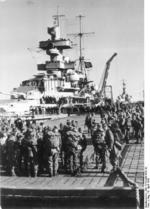
ww2dbaseEven before Denmark was fully occupied, German transports set sail for Oslo, Norway. En route, engagements with the Norwegian Navy spelled the end of the small Norwegian vessel Pol III by naval gunfire. The German Navy was not left without scars, however. As the German fleet approached Oslo, the ancient 28-mm Krupp cannon at Oscarborg opened up, surprising the Germans. The cruiser Lützow was damaged, and the cruiser Blücher was sunk, taking 1,600 men with her. Oskar Kumetz, the admiral commanding the fleet who had broken his flag aboard Blücher, had to swim ashore to save his own life. King Haakon VII of Norway, with the delay achieved at Oscarborg, announced his intention to fight the German invasion, and retreated away from Oslo with the royal family and members of the government. Meanwhile, German paratroopers took control of airports and airfields in the Oslo region, including the seizure of Aalborg airfield on 9 Apr 1940. Together with the airborne operation at Masnedø, Denmark, the German campaign against Denmark and Norway was the first to fully utilize an organized airborne assault in history. Before long, German naval forces landed troops at or near Bergen, Stavanger, Egersund, Kristiansand, Arendal, Horten, Trondheim, and Narvik.
ww2dbaseAt Narvik, a naval engagement on 10 Apr between British and German naval forces saw two German destroyers sunk and five seriously damaged at the cost of two British destroyers; three days later, British Vice Admiral William Whitworth led the battleship HMS Warspite and aircraft carrier HMS Furious, supported by British and Polish destroyers, in the destruction of the remainder of the German fleet at Narvik. Although 2,000 German troops had a secure footing on land near Narvik, the unexpected naval losses brought Adolf Hitler into an uncontrollable panic, knowing that Germany had just lost half of her destroyer strength. "The hysteria is frightful", recalled Alfred Jodl who witnessed Hitler's reaction to the news. The German leader was only able to regain composure after Jodl's reassurance that the losses were trivial in the grand war plan. This would be one of the events that would lead to Hitler's later pattern for his total personal control of the battlefields; "even in seemingly trivial matters", recalled Wilhelm Keitel. Although the Allied forces eventually recaptured Narvik on 28 May 1940, Allied inefficiencies and inexperience consistently gave the German forces an upper hand. American foreign correspondent Leland Stowe observed the British troops in Norway and reported sadly that they were untrained, poorly equipped, and without adequate leadership; British newspaper journalists agreed. The best British troops were in France, first sitting idle, then overwhelmed by the German invasion of France and the Low Countries.
ww2dbaseInitially, the political leaders in London focused on denying the Germans the use of Norwegian ports and on disrupting German supplies from sailing up and down the coast. However, after King Haakon VII urged Britain to retake Trondheim, Norway's historical and cultural capital, the prior focused strategy began to waver. Although Britain was without a force strong enough to retake Norway, Lord Halifax and others committed to the royal request. Winston Churchill fought fervently against it, but he met little success. On 13 Apr, British troop transports originally bound for Narvik were redirected to Trondheim. Beyond the fact that Norwegian and British intelligence failed to acquire a good estimate of the strength of German forces at Trondheim (the British would send too small a force, the decision having been based on intelligence reports with underestimated German strength), the battlefield tacticians also committed grave errors. Avoiding a frontal attack, they decided to deploy a pincer around Trondheim. The northern pincer landed in Namsos, but this force was slowed by heavy snow, unable to move toward Trondheim at the planned rate of advance. The southern pincer landed at Andalsnes. Instead of moving toward Trondheim, it was diverted to reinforce Lillehammer, eighty miles away in the opposite direction. When the Germans captured Lillehammer, British formations became separated and became lost in the vast fields of snow. A group found themselves two days later at the town of Nykirke, 200 miles from Trondheim. German troops pushed both pincers all the way back to the ports where they had originally disembarked. The cost of this failed operation came in the form of 1,559 casualties. Not a meter of ground was won.
ww2dbaseOn the European continent, France was about to fall, which factored in the British leadership's decision to withdraw from Norway by 9 Jun 1940. King Haakon VII departed Norway for Britain aboard British cruiser HMS Devonshire on 7 Jun 1940; three days later, Norway officially capitulated. A German-sponsored puppet government was established in Norway to ensure German access to Swedish iron ore, but armed Norwegian resistance would continue for the remainder of the war. In addition to gaining safer passage for transports between Norway and Germany, a German-controlled Norway also provided the German Navy control of the North Sea, disrupting Allied supply convoys bound for the Soviet Union in the later years of the war. For the remainder of the war, Britain would conduct occasional commando raids in Norway against German occupation forces, forcing Germany to commit troops in Norway that could otherwise be deployed on the continent.
ww2dbaseSources:
Wilhelm Keitel, In the Service of the Reich
William Manchester, The Arms of Krupp
William Manchester, The Last Lion
Anthony Read and David Fisher, The Fall of Berlin
William Shirer, The Rise and Fall of the Third Reich
Wikipedia
Last Major Update: Jul 2008
Invasion of Denmark and Norway Interactive Map
Photographs
 |  |  |  |
Invasion of Denmark and Norway Timeline
| 10 Oct 1939 | Erich Raeder informed Adolf Hitler the strategic importance of Norway to the German Navy. |
| 13 Jan 1940 | The German Navy Operations Division reported that while Norway presented strategic importance, Germany should not invade the neutral country if there was little risk of a British violation of Norwegian neutrality. |
| 27 Jan 1940 | Adolf Hitler ordered Wilhelm Keitel to continue with the planning of an invasion of Norway. |
| 19 Feb 1940 | Adolf Hitler, alarmed by the Altmark Incident of 16 Feb 1940, ordered to hasten the planning of the invasion of Norway. |
| 21 Feb 1940 | Adolf Hitler authorized the Operation Weserübung, the invasion of Norway. Lieutenant General Falkenhorst was ordered to submit his final invasion plan by 1700 hours on the same day. Having no clue he was to be assigned this commanding role prior to the meeting and given little time to prepare, Falkenhorst purchased a traveler's guide to Norway and used it to design a general invasion plan; the general plan he would devise in his hotel room in the next few hours would generally agree with the plan the OKW had come up with thus far. |
| 29 Feb 1940 | Adolf Hitler approved Nikolaus von Falkenhorst's invasion plan for Norway. |
| 1 Mar 1940 | Adolf Hitler issued a formal war directive for Weserübung, the invasion of Norway and Denmark. |
| 2 Mar 1940 | The United Kingdom and France once again requested Sweden and Norway to allow passage of Allied troops through their borders in order to aid Finland, should Finland formally requested such aid from the Allies. |
| 3 Mar 1940 | Adolf Hitler decided that the invasion of Norway would take place prior to the invasion of France. |
| 7 Mar 1940 | Adolf Hitler allocated 8 divisions for the invasion of Norway and Denmark. |
| 14 Mar 1940 | According to Alfred Jodl's diary entry for this date, Adolf Hitler was actively searching for excuses that would justify the planned invasion of Norway. |
| 1 Apr 1940 | Hitler set the date of the Denmark and Norway invasion to be 9 Apr 1940. 2 divisions were allocated for Denmark and 6 division for Norway, while a bulk of the German Navy was to support the overall operation. Coordinated support in the air from the Luftwaffe was also planned. |
| 2 Apr 1940 | In the afternoon, Adolf Hitler issued the directive for the invasion of Denmark and Norway, with the planned launch date to be 9 Apr 1940. Foreign Minister Joachim von Ribbentrop was made aware of the invasion for the first time so that his office could help develop excuses for the invasion. Meanwhile, Dutch border guards were placed on full alert due to the detected German deployments. |
| 3 Apr 1940 | German supply ships began departing Hamburg, Germany for the invasion of Norway; in all 7 freighters of 28,693 tons would set sail. The British cabinet was warned of this action and the German concentration of troops within hours. |
| 5 Apr 1940 | The United Kingdom informed Norway and Sweden of its intent to mine Norwegian waters; British warships departed Scapa Flow at 1830 hours for this operation. Force WB consisting of two minelaying destroyers sailed for the Norwegian coast between the towns of Bud and Kristiansund. Force WS, consisting of minelayer Teviot Bank and destroyers Inglefield, Ilex, Imogen and Isis sailed for waters off Stadtlandet, but this force would be recalled before laying any mines. Force WV consisting of minelaying destroyers Esk, Icarius, Impulsive and Ivanhoe, escorted by the 2nd Destroyer Flotilla of 4 destroyers, set sail for waters near Bodö. The operation had a covering force under Vice-Admiral William Whitworth on battlecruiser Renown and destroyers Hyperion, Hero, Greyhound and Glowworm. Glowworm turned back in heavy weather to recover a rating that was washed overboard. |
| 5 Apr 1940 | Norwegian ambassador in Berlin warned Danish and Norwegian capitals of a possible invasion, as did British intelligence. |
| 6 Apr 1940 | RAF aircraft conducted a photo reconnaissance mission over Kiel, Germany to monitor preparations for the German invasion of Norway. German Kriegsmarine's Marine Gruppe 1 departed Cuxhaven, Germany for Narvik, Norway with 2,000 soldiers on 10 destroyers escorted by battlecruisers Scharnhorst and Gneisenau. Marine Gruppe 2 departed Wesermünde, Germany for Trondheim, Norway with 1,700 soldiers on 4 destroyers escorted by cruiser Admiral Hipper. Both departures were made after nightfall to escape British detection. |
| 7 Apr 1940 | In the morning, the first German naval forces set sail for Operation Weserbüng. The huge Frorce was split into 10 groups under overall command of Admiral Rolf Carls. In the force were the old battleship Schleswig-Holstein, the heavy cruisers Hipper, Blücher and Lützow, with light cruisers Köln, Königsberg and Karlsruhe. There were also over 20 destroyers, mineseepers and torpedo boats, as well as tenders and transports. Admiral Karl Dönitz made up 9 submarine groups to accompany the surface vessels, 31 submarines in all; the U-boat operations would end as a total failure: despite good conditions the torpedoes showed defects in the depth-keeping mechanisms and the magnetic fuses failed, ending in only 6 Allied sinkings at the cost of 4 submarines. At 1325 hours, Hudson reconnaissance aircraft of No. 220 Squadron RAF spotted a part of German Marine Gruppe 1 and reported the presence of 1 cruiser and 6 destroyers at 1325 hours, sailing in a northward direction; 12 Blenheim and 24 Wellington bombers were dispatched to attack this group but the attack was not successful. The British Admiralty, receiving reports of major German naval movements, incorrectly assumed the Germans were launching a major attack into the Atlantic Ocean. The Home Fleet departed from Scapa Flow at 2115 hours, while the 1st Cruiser Squadron disembarked the troops already on board in order to prepare for a battle on the open seas. Nevertheless, British submarines continued to patrol the European coast for German activity rather than going out to the open seas; HMS Shark and HMS Seawolf departed Harwich naval base to patrol off Dutch coast, while HMS Clyde and HMS Thistle departed Scapa Flow to patrol the coast of Norway. |
| 8 Apr 1940 | Albatros attempted to hunt down British submarine HMS Triton, which had tried to attack the German force off the Norwegian coast; Triton escaped unharmed. Later that day, as the German force approached the Norwegian coast, Norwegian patrol boat Pol III rammed Albatros. Albatros fired upon Pol III, thus gaining the honor of having fired the opening salvos of the German-Norwegian war. |
| 8 Apr 1940 | British destroyer HMS Glowworm discovered German Navy Marine Gruppe 1 at 0800 hours and was fired upon by cruiser Admiral Hipper at close range. Outgunned, Glowworm's captain decided to ram the German cruiser, which caused heavy damage for Admiral Hipper but it also led to her sinking, which killed 118, including commanding officer Lieutenant Commander Gerard Broadmead Roope, who received a posthumous Victoria Cross, the first of the war; captain Hellmuth Heye of Admiral Hipper spoke highly of Roope's courage. Off Narvik, British destroyers Esk, Icarus, Impulsive, and Ivanhoe mined Vestfjord at 0500 hours in preparation for landings by British and French forces at Namsos, Narvik, and Andalsnes; Norway was informed of this action at 0600 hours. Meanwhile, German Navy Marine Gruppe 3 departed Wilhelmshaven, Germany for Bergen, Norway (1,900 troops aboard 2 cruisers, 1 transport, 1 minelayer, and 5 torpedo boats), Marine Gruppe 4 and Marine Gruppe 6 departed Cuxhaven, Germany for southern Norway (1,250 troops), and Marine Gruppe 5 departed Swinemünde, Germany for Oslo, Norway (2,000 troops aboard 3 cruisers, 8 minesweepers, and 3 torpedo boats). In Britain, Vice Admiral Max Horton dispatched 6 more submarines to intercept these additional German invasion fleets; many of his peers were against this decision, believe there would not be any additional fleets being dispatched by the Germans. Among the 6 newly dispatched British submarines included HMS Ursula, HMS Triad, and HMS Sterlet, which departed to patrol the Skagerrak between Denmark and Norway. |
| 9 Apr 1940 | German troops crossed into Denmark at 0500 hours, with landings near Copenhagen unopposed; the Danish government surrendered within the same day, and Germany completed the conquest Denmark with only 20 casualties. To the north in Norway, German troops attacked four locations. At Narvik, German destroyers sank Norwegian coastal cruisers Eidsvold and Norge, killing 276. At Trondheim, German warships pretended to be British ships and sailed by the coastal batteries without being hassled, thus the city was captured with relative ease. At Bergen, the coastal batteries at Fort Kvarven damaged German cruiser Königsberg and minelayer Bremse. Off Bergen, German Ju 88 and He 111 aircraft attacked British battleship HMS Rodney and destroyer HMS Gurkha at 1400 hours; Rodney was hit by a dud 500-kg bomb, and Gurkha sank at 1600 hours, killing 15; only four German Ju 88 aircraft were lost in this attack. Finally, at Oslo, the batteries at Oscarborg sank German cruiser Blücher in the Oslofjord, killing 830. Out at sea, British battlecruiser HMS Renown intercepted German battleships Scharnhorst and Gneisenau after they had successfully escorted Marine Gruppe 1 to Narvik; Renown fired first, hitting Gneisenau three times, but received two hits before the German ships disengaged from the battle. Given the dire situation, the Norwegian royal family, the government, and the country's gold reserves (with over 48 tons of gold) departed from Oslo at 0830 hours. |
| 9 Apr 1940 | Emden transferred 350 of her 600 carried troops onto Räumboote minesweepers, which would act as landing ships for the Oslo, Norway invasion operation. At 1555 hours, Emden began firing on the Oscarborg fortress. |
| 9 Apr 1940 | Seeadler arrived off Kristiansand, Agder, Norway, assisted in the capture of the fortress in the morning, and departed for Kiel, Germany at 1800 hours. |
| 9 Apr 1940 | Albatros was hit by a shell from Norwegian minelayer Olav Tryggvason at Karljohansvern, Horten, Norway, killing two and wounding two. |
| 9 Apr 1940 | German merchant steamer Seattle was lost off Kristiansand, Norway when she was mistaken for a German Navy supply ship and was fatally damaged by Norwegian 15-millimeter guns of the Odderøya forgress. The surviving crew were taken as prisoners of war for about one day until their civilian identities were confirmed. The wreck of Seattle burned for several days before finally sinking. |
| 10 Apr 1940 | At the First Battle of Narvik, 10 German destroyers were attacked in the Ofot fjord by 5 British destroyers. 2 German destroyers, 11 merchant ships, and 1 supply ship were sunk. 2 British destroyers were lost. Both commanding officers, British Captain Bernard Warburton-Lee and German Commodore Friedrich Bonte, were killed in the action. Warburton-Lee was posthumously awarded the Victoria Cross and Bonte the Knight's Cross of the Iron Cross. |
| 10 Apr 1940 | Albatros escorted merchant ship Curityba as she unloaded troops on the Norwegian island of Rauøy. Upon completion of the escort mission, Albatros sailed southeast and struck the Gyren shoal southwest of Frederikstad, Norway at the speed of 20 knots. She was lost, and the survivors were taken aboard auxiliary ship V707 Arthur Dunker. |
| 11 Apr 1940 | In Norway, the German 196th Division moved north from Oslo up the Gudbrandsdal and Østerdal valleys in an attempt to link up with the German forces in Trondheim. In an attempt to halt the German advances, RAF attacked the Stavanger airfield in southern Norway. Norwegian Army General Kristian Laake was relieved of command for his failures in the opening chapters of the German invasion; General Otto Ruge took over as his successor. Meanwhile, German collaborator Vidkun Quisling sent a message to King Haakon VII of Norway, asking him to return to Oslo; seeing through his plot to use him as a puppet, the king chose to ignore the request. Seeing a lack of response from the king and his government, German bombers attacked the village where they were hiding in a failed attempt to wipe out Norwegian leadership. In Britain, Winston Churchill spoke at the House of Commons and used Norway as an example to urge other smaller neutral European countries to join the Allies before Germany violated their neutrality as well. |
| 11 Apr 1940 | Battleship Warspite and aircraft carrier furious joined the Home Fleet which continued unsuccessfully to find the German force west of Norway. Light cruisers and some destroyers were detached for re-fuelling. A sortie was made by battleships Rodney, Valiant and Warspite, the carrier Furious and the heavy cruisers Berwick, Devonshire and York under command of Admiral Charles Forbes. An unsuccessful attack was undertaken against three German destroyers after the cruiser Hipper set out undetected and heads south with the destroyer Friedrich Eckoldt. |
| 12 Apr 1940 | Corporal Jack H. Langridge of the Royal New Zealand Air Force, assigned to a Wellington bomber of No. 149 Squadron RAF, became the first of 1,670 New Zealanders to be killed while serving with RAF Bomber Command during the war. The aircraft took off from RAF Mildenhall in Suffolk, England, United Kingdom, attacked Stavanger Airfield in Norway during daylight, and was shot down around 1610 hours by a Bf 110 fighter just off of the coast southwest of Stavanger. |
| 12 Apr 1940 | Norwegian artillery Major Hans Holtermann and 250 volunteers began reactivating the old fort at Ingstadkleiva near Trondheim, Norway, which would become known as Hegra Fortress for defense against the Germans. |
| 13 Apr 1940 | At Narvik, Norway, a British naval force consisted of battleship HMS Warspite and 9 destroyers under the command of Vice Admiral William Whitworth entered Ofotfjord; in the Second Battle of Narvik, Warspite's Swordfish torpedo bomber sank German submarine U-64 with bombs, while surface vessels sank 3 destroyers, with another 5 German ships scuttled by their own crews after suffering extensive damage; three British ships were damaged in the battle; without their ships, 2,600 German sailors went on land and served as infantrymen; Whitworth radioed London, noting that German forces at Narvik were now stranded, and a single brigade could defeat them. Meanwhile, off Trondheim, Norwegian cruiser-minelayer Frøya was damaged by German warships while defending the Agdenes fortress; German submarine U-34 scuttled Frøya to prevent salvage. |
| 14 Apr 1940 | 350 British Royal Marines landed at Namsos, Norway to prepare for the arrival of the 146th Territorial Brigade; these Marines were the first British forces to land in Norway. German paratroopers of the 7th Flieger Division were paradropped into Dombås, Norway; after heavy casualties incurred largely due to the fact that they landed right into Norwegian 11th Infantry Regiment's camp, they successfully damage the nearby railways and occupied farmhouses, thus able to hamper with Norwegian transportation efforts for several days. Out at sea, British submarine HMS Sterlet damaged the German gunnery training ship and minelayer Brummer in the Skagerrak between Norway and Sweden with torpedoes; Brummer would remain afloat until the next day. |
| 15 Apr 1940 | British troops landed in the Lofoten Islands in northern Norway in response to German invasion; their original objective was to secure the rail line to Swedish iron ore fields. Also in northern Norway, instead of making a landing directly at Narvik against an unknown number of German defenders, British Major General Pierse Mackesy decided to land his troops north of the city at an undefended location; due to the large amounts of snow on the ground, his troops would have to wait before making a major advance at Narvik. Further south, the British 146th Territorial Brigade landed at Namsos and was immediately ordered to march south toward Trondheim, which saw attacks by RAF Blenheim bombers based in the United Kingdom; it was the first time the Bomber Command sent aircraft based in the UK against targets overseas. |
| 16 Apr 1940 | The ill-equipped British 24th Brigade landed at Harstat, Norway 37 miles north of Narvik. Meanwhile, at Namsos, the reserve unit 148th Territorial Brigade boarded cruisers HMS Carlisle and HMS Curacoa for Trondheim, without their anti-aircraft weapons due to lack of space. |
| 17 Apr 1940 | Before dawn, British cruiser HMS Suffolk shelled the German-controlled airfield of Sola at Stavanger, Norway. Suffolk's Walrus seaplane, used to drop flares over the airfield, was shot down early in the bombardment, thus the shelling was largely inaccurate and destroyed only 4 aircraft. After sunrise, Suffolk was repeated attacked by German aircraft. She was hit twice and heavily damaged, and was placed out of action until Feb 1941. Meanwhile, in the United Kingdom, the British War Cabinet approved direct troop landings at Trondheim, Norway (rather than the landing done at Narvik in which troops were dropped off at undefended beaches far away). The landing was to be supported by simultaneous landings at Namsos in the north and Åndalsnes in the south. |
| 18 Apr 1940 | The Norwegian government declared war on Germany after several days of fighting. On the same day, German troops advanced past Oslo, but were held up by Norwegian forces north of the city in the village of Bagn. The British 148th Brigade arrived in Åndalsnes overnight; commanding officer Brigadier Morgan was given conflicting orders, one ordering him to march north to Trondheim, while the other ordered him to march south to support Norwegian troops in the Gudbrandsdal and Østerdal valleys north of Oslo. Meanwhile, troops of the German 181st Infantry Division began to arrive at Trondheim as reinforcements via aircraft, transport ships, and submarines. |
| 19 Apr 1940 | The first engagement between British and German troops in Norway took place at Verdal, north of Trondheim, when the British 146th Brigade and Norwegian troops clashed with troops of the German 138th Gebirgsjäger Regiment; later on the same day, 45 German paratroopers surrendered to the Norwegian forces at Dombås. Norwegian General Ruge convinced British Brigadier Morgan to lead the British 148th Brigade in an effort to block the German advance from Oslo. Overnight, 3 battalions of French mountain troops arrived at Namsos, Norway, but without their skis, mules, and anti-aircraft weapons. |
| 20 Apr 1940 | The British 148th Brigade arrived at Lillehammer, Norway by train at 0250 hours and began to march south toward the front lines held by Norwegian troops on both sides of Lake Mjøsa. At Namsos, Norway, German aircraft destroyed large quantities of British supplies and equipment piled near the docks; the British could do little to fight back as they were short on anti-aircraft weapons; in an attempt to remedy this, the 263 Squadron RAF dispatched 18 Gladiator biplanes to Scapa Flow, where they would be ferried to Norway by HMS Glorious. In the United Kingdom, the British War Cabinet canceled the plans for direct landings at Trondheim, Norway (Operation Hammer) in fear of heavy casualties; a failure in communications meant that the British 146th Brigade remained in precarious positions near Trondheim. |
| 21 Apr 1940 | German troops landed at Verdal and Kirknessvag, Norway, causing the British 146th Brigade near Trondheim to withdraw to Vist. Around Lake Mjøsa, British 148th Brigade reinforced Norwegian positions, but on the same day German forces broke through the line, causing the entire Norwegian-British force to withdraw north toward Lillehammer. Out at sea, German submarine U-26 sank British merchant vessel Cedarbank of convoy AP-1 50 miles northwest of Ålesund, killing 15; destroyer HMS Javelin rescued 30 men, but the vehicles, anti-aircraft weapons, ammunition, and food destined for the British 148th Brigade near Lillehammer were all lost. |
| 22 Apr 1940 | The anti-aircraft sloop HMS Pelican, on her way to the Romsdal Fjord carrying the personnel of the Naval Base party for Molde, Norway, was crippled by a dive-bomber and suffered heavy casualties. |
| 22 Apr 1940 | British 146th Brigade began to retreat toward Namsos, Norway as German troops began to surround their positions. British 148th Brigade defended against German attacks north of Lillehammer, Norway and were flanked by mountain troops. The British troops fell back 20 miles to the north overnight and formed a new line at Tretten Gorge. Out at sea, British sloop Auckland, still carrying some troops after a snowstorm prevented her from disembarking all of her passengers, made rendezvous with French transport Ville d'Alger, British destroyer Maori, British cruiser HMS Birmingham, British anti-aircraft cruiser HMS Calcutta, and French destroyers Bison and Foudroyant. |
| 23 Apr 1940 | British 146th Brigade retreated to Namsos, Norway; the brigade had thus far suffered 19 dead, 42 wounded, and 96 missing. British 148th Brigade's defense line at Tretten Gorge in Norway suffered a heavy artillery barrage in the morning, an attack by light tanks in the early afternoon, and a surprise mountain troops attack from behind the lines; they began to retreat northward at 1900 hours, strafed by German aircraft in the process; the 148th Brigade had thus far suffered 705 killed, wounded, or missing. Near Oslo, British aircraft conducted a raid on German-controlled airfields. |
| 23 Apr 1940 | A brief action took place between the French 8th Destoyer Division under Captain E. G. M. Barthes. The heavy destroyers L'Imdomptable, Le Malin and Le Triomphant engaged the German 7th Patrol Boat Flotillacommanded by Lieutenant Commander G. Schultze. The German called in bombers but their attack scored no hits and the French forces returned to the North Sea. |
| 24 Apr 1940 | During an air raid near Molde, Norway, the British trawlers HMT Bradman and HMT Hammond were both sunk by German aircraft. Hammond was salvaged by the German Navy in 1941 and commissioned as the Salier. In 1942 she was renamed NT-04, and after various other names she was broken up in 1971. |
| 24 Apr 1940 | In Norway, 18 Gladiator biplanes of the 263 Squadron RAF arrived at the frozen Lake Lesjaskogsvatnet in Norway, which was to become their base of operations; the field had no anti-aircraft defense. Troops of the British 15th Brigade landed at Åndalsnes after a 9-day journey by sea from France; they immediately marched south toward Lillehammer, Norway. Troops of the Norwegian 6th Brigade attacked German positions north of Narvik, Norway; Gratangsbotn was briefly re-captured by Norwegian troops. German troops repelled a British attack near Trondheim. |
| 24 Apr 1940 | The 6,503-ton merchant steamer Afrika, a German cargo ship previously captured by Norwegian torpedo boat Stegg, was scuttled by Norwegian troops during the Germans attempt at recapture at Ulvik, Norway. |
| 24 Apr 1940 | HMS Glorious arrived off off the Norwegian and transferred Gladiator aircraft to airfields on land. |
| 24 Apr 1940 | British trawler HMT Larwood, requisitioned in Aug 1939 and used as an anti-submarine vessel, was sunk in a German air raid on the coast of Norway. She was later raised by the German Navy and was used under the names Franke (1940), V-6110 (1941), V-6111 (1942), and V-6305 (1944). |
| 25 Apr 1940 | HMS Glorious transferred Gladiator aircraft to airfields on land in Norway. |
| 25 Apr 1940 | 3,000 troops of the British 15th Brigade were engaged by 8,500 troops of the German 196th Division at the village of Kvam in Norway, 55 kilometers south of Dombås; despite German numerical advantage and being supported by dive bombers, the British troops held ground and stopped the German advance. Elsewhere, a group of RAF Gladiator aircraft operating on the frozen Lake Lesjaskogsvatnet in Norway was discovered by the Germans. German aircraft bombed the rough airfield on and off for eight hours, destroying 13 aircraft on the ground. Three German He 111 bombers were shot down by RAF aircraft. By the end of the day, Squadron Leader Donaldson ordered the position to be abandoned; the 5 surviving Gladiator aircraft were to be withdrawn to Stetnesmoen. |
| 26 Apr 1940 | Gladiator biplanes based out of Stetnesmoen, Norway intercepted a group of German He 111 bombers, downing one of them; this RAF unit would run out of fuel and ammunition by the end of this engagement, however. Adolf Hitler, unhappy that the British 15th Brigade was able to land in Norway without German interference, ordered Åndalsnes, Norway to be bombed the entire day; part of the British 15th Brigade's supplies were destroyed by the bombing while they continued to hold their line against attacks by the German 196th Division at Kvam, 172 kilometers from Åndalsnes. In the evening, the British 15th Brigade fell back 3 kilometers to form a new line at Kjorem. |
| 27 Apr 1940 | A British attempt to deliver much-needed anti-aircraft weapons by ground to Åndalsnes, Norway was turned back by a three-hour German aerial bombardment. At Kjorem, after holding the line against attacks by the German 196th Division throughout the day, the British 15th Brigade withdrew 17 kilometers to the north to form a new line at Otta. Meanwhile, the German 196th Division captured the Østerdal valley in Norway. |
| 28 Apr 1940 | The British War Cabinet ordered the withdraw of British troops at Trondheim, Norway to the dismay of Norwegian leaders. Meanwhile, troops of the British 15th Brigade held their line against attacks by the German 196th Division at Otta throughout the day before they fell back 25 miles to the north to Dombås overnight. |
| 29 Apr 1940 | British destroyers HMS Kelly, HMS Maori, and HMS Imperial and French destroyer Bison departed Scapa Flow, Scotland, United Kingdom to evacuate British troops at Namsos, Norway; they were escorted by cruisers and other destroyers. |
| 29 Apr 1940 | Troops of the German 196th Division marched out of the Gudbrandsdal Valley in Norway and linked up with German troops near Trondheim, threatening to surround the British 15th Brigade. |
| 30 Apr 1940 | HMS Glorious provided air cover for troops fighting on land in Norway. |
| 30 Apr 1940 | The German 196th Division arrived at Dombås, Norway on foot as their vehicles had been rendered useless after encountering blown bridges; their initial attacks were held off by the British 15th Brigade; despite causing heavy casualties to the Germans, the British withdrew their defensive line at dusk by train toward Åndalsnes. Near Oslo, RAF bombers conducted attacks on German-controlled airfields in Stavanger and Fornebu, escorted by naval fighters launched by HMS Ark Royal and HMS Glorious; Germans detected the location of the British carriers and successfully launched a fighter attack that drove off the carriers. Off Namsos, Norway, German Ju 87 aircraft attacked British anti-submarine sloop HMS Bittern, hitting her with a bomb and starting a fire on the stern that killed 20; destroyer HMS Janus rescued the survivors and scuttled HMS Bittern to prevent capture. Off Trondheim, Norway, German aircraft sank British trawler HMS Warwickshire; her wreck was later raised by the Germans and put into service. In the United Kingdom, a British fleet consisted of cruisers HMS Manchester and HMS Birmingham and destroyers HMS Inglefield, HMS Diana, and HMS Delight, under the command of Vice Admiral Layton, departed Scapa Flow, Scotland for Norway; its mission was to evacuate the British 148th and 15th Brigades from Åndalsnes and Molde. |
| 1 May 1940 | Norwegian troops in Lillehammer surrendered. En route to Åndalsnes, Norway for evacuation, the train carrying troops of the British 15th Brigade crashed into a bomb crater at 0115 hours, killing 8 and wounding 30; the surviving troops marched 17 miles through deep snow, arriving at Åndalsnes at 0900 hours. British Vice Admiral Layton's task force consisted of cruisers Manchester and Birmingham and destroyers Inglefield, Diana, and Delight arrived at Åndalsnes, Norway to evacuate the British 148th and 15th Brigades; they embarked 5,084 men overnight and departed at 0200 hours on the next day. Joining the British evacuation was Norwegian General Ruge, who departed Åndalsnes aboard British destroyer HMS Diana to join the Norwegian government at Tromsø. Four British destroyers arrived at Namsos to evacuate the British 146th Brigade and other Allied troops in the area; heavy fog delayed the operation, and only 850 French troops were embarked overnight. In the Kattegat, British submarine HMS Narwhal fired six torpedoes at a German merchant convoy carrying parts of 2nd Gebirgsjager Division to Norway; German steamer Buenos Aires was hit by one of the torpedoes and sank, killing 62 men and 240 horses; another transport, Bahia Castillo, was hit but did not sink, killing 10 men and 26 horses. |
| 2 May 1940 | German forces reached Aandalesnes, Norway. In southern Norway, British troops began to withdraw, but continued to fight in the north to interrupt the flow of iron to Germany. British Vice Admiral John Cunningham arrived in Namsos, Norway with 3 cruisers, 5 destroyers, and 3 transports to aid with the evacuation of the British 146th Brigade; German aircraft attempted to interfere, damaging HMS Maori with a near miss, killing 5 and wounding 18; through the end of the night, 5,350 men were embarked. |
| 3 May 1940 | Norwegian troops south of Trondheim surrendered to the Germans. The Allies completed the evacuation at Namsos, Norway. The British destroyer HMS Afridi, left behind to shell British vehicles on the dock that could not be evacuated, departed at 0445 hours. German aircraft found part of the evacuation fleet and attacked the convoy at 0945 hours, sinking French destroyer Bison at 1010 hours, killing 103. HMS Afridi was bombed at 1400 hours and sank 45 minutes later, killing 49 men of the crew, 13 men of 146th Brigade, and 30 rescued men of Bison. |
| 4 May 1940 | 30,000 Allied troops were present near Narvik, Norway, including units of the French Foreign Legion, French mountain troops, Polish troops, the British 24th Brigade, and Norwegian troops, aiming to take Narvik from the Germans. Meanwhile, German 2nd Gebirgsjäger Division's mountain troops began marching 350 miles north from Trondheim, Norway to relieve the German 139th Gebirgsjäger Regiment in Narvik; detecting this, the Allies deployed 300 to 500 men each at Mosjöen, Mo, and Bodö in an attempt to stop this movement. |
| 5 May 1940 | After a 25-day battle, the Norwegian fortress of Hegra surrendered at 0525 hours. The 190 men were the last Norwegian troops actively resisting German invasion in southern Norway. Civilian nurse Anne Margrethe Bang was also captured. They would all be released within the next two months by the order of Adolf Hitler in recognition of their bravery during the defense. |
| 6 May 1940 | German mountain troops of the 2nd Gebirgsjäger Division continued their slow march north from Trondheim, Norway to Narvik, where South Wales Borderers of the British 24th Brigade, French Chasseurs Alpins mountain infantry, and French colonial artillery troops continued to assert pressure on the German troops. Off Narvik, British cruiser HMS Enterprise was slightly damaged by a near miss by an aerial bomb, killing one Royal Marine. Meanwhile, the Norwegian gold reserves arrived in London, England, United Kingdom. |
| 7 May 1940 | German Luftwaffe aircraft attacked British cruiser HMS Aurora off Narvik, Norway at 1641 hours, putting A and B turrets out of action and killing 7 Royal Marines. |
| 9 May 1940 | Four Polish battalions arrived at Narvik, Norway. |
| 13 May 1940 | At midnight, which was light due to the latitude, British cruiser HMS Aurora, cruiser HMS Effingham, and battleship HMS Resolution bombarded Narvik, Norway in preparation of the 0100-hour amphibious operation at Bjerkvik, which was the first of the European War. French Foreign Legion and light tanks came ashore at Bjerkvik in landing craft, suffering 36 casualties, then reached and captured Øyjord unopposed. Many Norwegian civilians died during the attack. |
| 21 May 1940 | British Royal Air Force 263 Squadron and 46 Squadron arrived in Narvik, Norway with 18 Gladiator and 18 Hurricane aircraft to provide additional, but still not adequate, protection for Allied warships in the area. |
| 24 May 1940 | The British War Cabinet issued the order to withdraw the British troops in Norway in light of the situation in France. |
| 26 May 1940 | German Ju 88 aircraft attacked and sank British anti-aircraft cruiser HMS Curlew off Narvik, Norway, killing 9. HMS Curlew was equipped with the only early warning radar set. |
| 27 May 1940 | German Luftwaffe aircraft attacked Bodø, Norway, rendering 3,500 of the town's 6,000 residents homeless. 2 British servicemen and 13 Norwegian civilians were killed. |
| 28 May 1940 | Allied forces consisted of British, French, Norwegian, and Polish troops attacked Narvik, Norway across the Rombaksfjord and by land starting at 0015 hours. German aircraft did not arrived until 0430 hours, but they were able to force the Allied fleet to withdraw after damaging cruiser HMS Cairo (killing 10 and wounding 7). At 1200 hours, Allied troops captured the city. German troops withdrew to nearby hills. |
| 30 May 1940 | Allied troops began pushing German troops from the Narvik, Norway region back toward the Swedish border. |
| 31 May 1940 | HMS Acasta, HMS Ardent, HMS Acheron, HMS Highlander, and HMS Diana escorted aircraft carriers HMS Ark Royal and HMS Glorious from the Clyde in Scotland, United Kingdom to the Norwegian coast to carry out air operations in support of the evacuation of Allied forces from Norway during Operation Alphabet. |
| 1 Jun 1940 | British troops at Narvik, Norway began evacuating to reinforce Britain itself from a potential invasion. British ambassador to Norway Sir Cecil Dormer informed Norwegian King Haakon VII of the news and recommended the royal family and the government to evacuate as well. |
| 2 Jun 1940 | HMS Glorious provided escort for British RAF bombers attacking German airfields in Norway. |
| 2 Jun 1940 | The Allies dispatched Polish and French troops to push German troops eastward from Narvik, Norway, while evacuated British troops. Carriers HMS Ark Royal and HMS Glorious provided air cover for the evacuation of 26,000 British troops. |
| 3 Jun 1940 | After nightfall, the Allies began to evacuate Narvik, Norway. Through the night and the following day's daybreak, British destroyers and Norwegian fishing boats ferried Allied personnel to six troops transports in various fjords nearby. |
| 4 Jun 1940 | German Admiral Wilhelm Marschall launched Operation Juno, sending Scharnhorst, Gneisenau, Admiral Hipper, and several destroyers from Kiel for Norway, aiming at disrupting the Allied supply lines to Narvik. |
| 5 Jun 1940 | 4,900 Allied troops boarded transport ships at Narvik, Norway during the evacuation operation. |
| 6 Jun 1940 | 5,100 Allied personnel were transported to troop transports hiding in fjords near Narvik, Norway over the previous night. They then departed the area with about 15,000 troops aboard, escorted by destroyer HMS Arrow and sloop HMS Stork for the first phase of their trip back to Britain. |
| 7 Jun 1940 | British pilots without proper carrier landing training safely landed 10 Gladiator and 8 Hurricane aircraft aboard HMS Glorious, completing the evacuation of 46 and 263 Squadrons RAF from Norway. |
| 7 Jun 1940 | The troop transports of British Group II arrived at Narvik, Norway and embarked 5,200 men overnight. Out at sea, troop transports of Group I which had departed Narvik on the previous day were spotted by German aircraft, but they were mis-identified as empty supply ships heading back to Britain, thus spared from attack. |
| 8 Jun 1940 | During Operation Juno, Scharnhorst and Gneisenau opened fired on British carrier HMS Glorious and her escorts HMS Acasta, HMS Ardent, HMS Acheron, HMS Highlander, and HMS Diana about 170 miles west of Narvik, Norway at 1627 hours. British destroyers made smoke, but did not prevent the Germans from hitting the carrier, causing her to list. In an attempt to save Glorious, destroyer HMS Acasta charged at the German ships, firing two salvos of torpedoes while being struck by German gunfire. One torpedo in the second salvo struck Scharnhorst, tearing a 12-meter (39-foot) hole, at 1734 hours, disabling her starboard engine room. Shortly after, commanding officer Commander C. E. Glasfurd gave the order to abandon ship. Acasta sank stern first at about 1820 hours. Meanwhile, HMS Ardent sank at 1720 hours (killing 151). As for the HMS Glorious, the main German target, Captain Guy D'Oyly Huges of HMS Glorious was blamed for the attack being a surprise, for that he had failed to launch scouting aircraft ahead of the task force. As the flight deck became damaged during the battle, the carrier could not launch any of her aircraft to participate in the engagement. She was ultimately sunk at 1910 hours; 1,474 naval officers and ratings and 41 RAF personnel were killed, 43 survived. Scharnhorst suffered one torpedo hit by HMS Ardent. |
| 8 Jun 1940 | French and Polish troops left dummies on the front lines to trick their German foes and fell back into Narvik, Norway for evacuation. British Group II troop transports took on the final 4,600 Allied troops and departed Narvik, escorted by carrier HMS Ark Royal, cruisers HMS Southampton and HMS Coventry, and 11 destroyers. German aircraft conducted nearly continuous attacks on the convoy, while German troops on land quickly realized the situation and moved into Narvik. |
| 9 Jun 1940 | The Norwegian 6th Division, essentially the last Norwegian unit still actively fighting the German invasion, surrendered to the Germans. An armistice was to take effect at midnight. |
| 10 Jun 1940 | Norway surrendered to Germany. |
| 13 Jun 1940 | At dawn, 0243 hours, 15 British Fleet Air Arm Skua aircraft from HMS Ark Royal dive bombed German battleships Scharnhorst and Gneisenau at Trondheim, Norway. Scharnhorst was hit by a 500-pound bomb, but it failed to explode. 8 Skua aircraft were shot down; 6 airmen were killed and 10 were taken prisoner. The remaining 7 aircraft returned to Ark Royal at 0345 hours. Nearby, Ark Royal's escorting destroyers HMS Antelope and HMS Electra collided in fog; both sustained damage that would take them out of action until Aug 1940. |
Please consider supporting us on Patreon. Even $1 per month will go a long way! Thank you. Please help us spread the word: Stay updated with WW2DB: |


Visitor Submitted Comments
11 Dec 2006 09:00:42 PM
Germanys successful invasion of Norway! How little difference there often is between defeat and victory. If ARK ROYAL had been available to attack the Kreigsmarine during their most vulnerable moment, traveling to the invasion site. If Hitler had not countermanded his own order to Deitl to withdraw into Sweden better internment than capture. Norway should have been Germanys first major defeat.
11 Dec 2006 09:03:37 PM
I should also say however that Norways resistance shattered Germany s claim that the occupation was a peaceful one, welcomed by the Norwegians. And I wish I could have been there to see the BLUCHER done in by the 11 guns at that fortress.
19 Mar 2007 05:18:55 PM
ohhhhhhhh
20 Jan 2010 04:42:44 AM
wow this is good information doin a book about hitlers canary a book report and this has useful information
28 Feb 2011 06:17:45 PM
I feel bad for the Jews and it was sad.You shuold read number the stars
9 Jun 2011 06:24:04 PM
The guns were a 280 mm and NOT a 28 mm. Three guns Krupp 11" or 280mm or 28cm), Aaron, Moses and Joshua. See the article Battle of Drøbak Sound (http://en.wikipedia.org/wiki/Battle_of_Dr%C3%B8bak_Sound) in Wikipedia.
8 Jan 2012 11:40:41 AM
Take a look at www.Rexvita.com.
It may be of interest to you.
4 Apr 2012 07:50:20 AM
British commando raids forced German to commit troops?? I'd give far more credit to the Norwegian resistance movement. I realize that you mention the resistance elsewhere in your final paragraph, but you later imply (incorrectly, in my opinion) that it was the British, not the Norwegian resistance, that kept German forces pinned in Norway.
18 Jan 2016 12:25:01 PM
I would say that this article wasn't very well researched due to the lack of information about the importance of the German victory of invading Norway and Denmark
20 Aug 2016 09:46:20 AM
This page is badly in need of proofreading and text editing.
22 May 2020 05:00:38 PM
Does anyone know what this items definition means or anything about it? Its a steele eagle looks like a military item pendant medallion of some sort
All visitor submitted comments are opinions of those making the submissions and do not reflect views of WW2DB.

» Auchinleck, Claude
» Bismarck, Georg
» Bohusz-Szyszko, Zygmunt
» Crutchley, Victor
» Cunningham, John
» Dietl, Eduard
» Falkenhorst, Nikolaus
» Greim, Robert
» Milch, Erhard
» Quisling, Vidkun
» Vian, Philip
» Vogelsang, Ernst
Locations:
» Denmark
» Norway
Ship Participants:
» Acasta
» Admiral Hipper
» Albatros
» Ark Royal
» Błyskawica
» Blücher
» Bremse
» Cossack
» Deutschland
» Devonshire
» Dithmarschen
» Effingham
» Emden
» Émile Bertin
» Furious
» Glorious
» Gneisenau
» Grom
» Jaguar
» Karlsruhe
» Kelly
» Köln
» Königsberg
» Nordmark
» Orzel
» Rodney
» Scharnhorst
» Schleswig-Holstein
» Seeadler
» Togo / Coronel
» Valiant
» Warspite
» Wilhelm Gustloff
» York
|
- » 1,182 biographies
- » 337 events
- » 45,119 timeline entries
- » 1,248 ships
- » 350 aircraft models
- » 207 vehicle models
- » 376 weapon models
- » 123 historical documents
- » 261 facilities
- » 470 book reviews
- » 28,409 photos
- » 365 maps
Winston Churchill, on the RAF

Please consider supporting us on Patreon. Even $1 a month will go a long way. Thank you!

Or, please support us by purchasing some WW2DB merchandise at TeeSpring, Thank you!
8 Dec 2006 05:14:55 AM
I am sorry, but the paratroopers at the Norwegian airport were not the first airborne assault in history! Before that the Germans had used paratroopers at Masnedø Fort in Denmark. (And before that the Russian had used paratroopers against the Finns)