


Line Crossing Ceremony
Contributor: C. Peter Chen
 The open seas had been a subject of myths and legends since the beginning of seafaring. Mariners of the ancient times made animal sacrifices to Neptune to please him, asking for protection from the monsters and storms. Meanwhile 15th Century explorers pondered what lay beyond Northwest Africa, at the same time both looking for something to ease their fear of falling off the edge of the world as well as tokens to display their maritime achievements. Somewhere along the line, the line crossing ceremony was born. When a sailor crossed the equator for the first time, sailors who had previously crossed the equator tested them for their capability to endure the long voyages, and at the end of the ceremony inducted them into a fraternity of seasoned sailors. Since then, other similar ceremonies were conducted when other lines such as the Arctic Circle or the International Date Line were crossed by sailors for the first time.
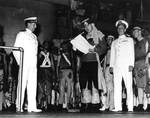
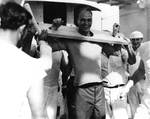
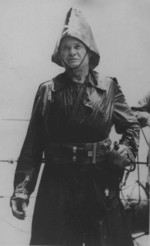
The tradition of the line crossing ceremony lived on into the WW2 era, and for many navies in the world at the time, it constituted a rite of passage for sailors. In the British Royal Navy and the United States Navy, for example, Pollywogs who had not yet crossed the line transformed into Shellbacks with the ceremony, entering a brotherhood of trusty sailors. The ceremony traditionally was presided over by a Shellback dressed as King Neptune, ruler of the high seas; other Shellbacks might dress as the king's court. As popularly known, the ceremony involved the embarrassment of Pollywogs for the entertainment of Shellbacks. Pollywogs often had to run through a gauntlet of various obstacles, then swear loyalty to King Neptune by kissing his signet ring and/or his bare foot.
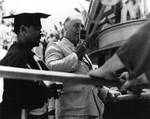
 In late Nov 1936, when American cruiser USS Indianapolis crossed the Equator with President Franklin Roosevelt aboard, even the leader of a nation was not subject to exemption. Roosevelt was made to plead his case before a seasoned sailor who dressed up as King Neptune, and had to go through some degree of embarrassment before he was granted the status of a Shellback. Like most sailors who went through this rite of passage, Roosevelt was given a certificate to show his status as a trusty Shellback.
Men who crossed the equator and completed the ceremony often received a certificate to commemorate the event. Decorated by drawings of mermaids and sea serpents, Roosevelt's certificate read:
The Royal High Court of the Raging Main
BE IT KNOWN, That we hereby summon and command you
FRANKLIN DELANO ROOSEVELT
Now the Commander in Chief of the Army and Navy, to appear before the Royal High Court and our August Presence on the aforesaid date at such time as may best suit OUR pleasure under penalty of eternal pickling.
You will accept most heartily and with good grace the pains and penalties of the awful torture that will be inflicted upon you to determine your fitness to be one of our Trusty Shellbacks and answer to the following charges:
CHARGE 1. Disregard of the traditions of the sea.
Specification: In that Franklin D. Roosevelt, having, for many years sailed the high seas and bounding main, entirely through kindly assistance, toleration and consideration of his Majesty Neptunus Rex, has, for lo these many years, failed to appear in person to show allegiance to his Royal Highness, thereby masquerading as a man of the sea, and by this utter disregard added insult to other previous crimes.
CHARGE 2. Taking liberties with the piscatorial subjects of His Majesty Neptunus Rex.
Specification: In that, Franklin D. Roosevelt, having taken liberties with the denizens of the Realm of Neptunus Rex, by maliciously removing them from the depths of their recognized habitat, has permitted these acts to be publicized by print, town crier, and all other means of shameless publication; and, furthermore, has exaggerated this crime by the public humiliation of the greatest of these creatures of the sea, by stuffing them full of sawdust, and placing them in a position of eternal disgrace in a national museum where the eyes of all mortals may regard their pitiful and ignoble plight.
Disobey this summons under pain of Our Swift and Terrible displeasure
Our Vigilance is ever wakeful, Our Vengeance is Just and Sure
NEPTUNUS REX
Ruler of the Raging Main
DAVY JONES
Clerk
Modeled after the British Navy, the Japanese Navy had its version of the equator crossing ceremony as well. On 20 Jan 1942, the Japanese Army South Seas Force crossed the equator at 0500, the first group of Japanese Army soldiers to cross the line in the nation's history. Toshio Miyake, a newspaper correspondent traveling with the troops, later described:
Such events were open to controversies, however. Line crossing ceremonies were sometimes known to become brutal hazing events, where the uninitiated often were beaten with wet ropes or fire hoses. During WW2, United States Navy ship logs often recorded additional visits to sickbays immediately after the particular ship had crossed the line. One such example was when aircraft carrier USS Franklin crossed the equator in the Pacific Ocean on 20 Sep 1944. "[A]ll hell broke loose", recalled Electrician's Mate 2nd Class Bob St. Peters. "The shellbacks grabbed pollywogs and started beating them. Actually beating them." He was one of the victims as well by members of his station, who gave him electric shocks with a hand-cranked generator as part of his initiation. Seaman 2nd Class George Sippel remembered beatings, hair shavings, tarring, painting, humiliation, and other forms of hazing, but he explained it as a rite of passage that, when all was said and done, all sailors enjoyed. He said
In 1995, the line crossing ceremony aboard an Australian submarine was deemed as sexual assault upon the uninitiated, and the news came before public scrutiny. Navies of the world began curtailing or banning the ceremony in the 1980s.
There were other similar ceremonies. For instance, the Dragon Ball sometimes took place on the return trip across the Equator. When sailors cross other major lines or landmarks, such as the Arctic Circle, International Date Line, or the Panama Canal, similar ceremonies were sometimes held. For many veterans of different navies, their recollections of the line crossing ceremony remain one of the most memorable experiences in their careers.
Sources: Inferno, United States Navy Naval Historical Center, Wikipedia.
Last Major Update: Feb 2007
Line Crossing Ceremony Timeline
| 20 May 1936 | USS Portland crossed the equator while on maneuvers with the rest of the Pacific Fleet, prompting Crossing the Line ceremonies on at least 102 ships. |
| 14 Jan 1942 | USS Yorktown, Louisville, and St. Louis and convoy crossed the equator while transiting from San Diego, California to Pago Pago, Samoa. |
| 18 Jan 1942 | Submarine USS Saury crossed the equator for the first time while patrolling the Makassar Strait east of Borneo. |
| 30 Jan 1942 | USS Yorktown, Louisville, and St. Louis and task group crossed the 180th meridian while transiting from Pago Pago, Samoa to the Gilbert Islands. |
| 13 Apr 1942 | Task Force 16 (USS Enterprise) made rendezvous with Task Force 18 (USS Hornet) north of Midway and pressed on westward toward the launch point for the Doolittle Raid. Later on the same day, they crossed the 180th meridian. |
| 18 Jun 1942 | Destroyers USS Castor, Ralph Talbot, and Blue crossed the equator bound from Pearl Harbor, Hawaii to Pago Pago, Samoa. |
| 1 Jul 1942 | Destroyers USS Castor, Ralph Talbot, and Blue crossed the 180th Meridian bound from Pago Pago, Samoa to Auckland, New Zealand. |
| 1 Sep 1942 | USS Washington, with USS Nicholas as an escort, crossed the equator. |
| 16 Sep 1942 | USS Nicholas crossed the 180th meridian and was detached from the USS Washington task group to proceed independently to Nouméa, New Caledonia. |
| 20 Oct 1942 | Destroyer USS Shaw crossed the equator en route from Pearl Harbor, Hawaii to the Solomons. |
| 21 Oct 1942 | Destroyer USS Shaw crossed the 180th meridian en route from Pearl Harbor, Hawaii to the Solomons. |
| 17 Nov 1942 | Battleship USS Indiana, cruiser USS Columbia, and destroyers USS Saufley, and USS DeHaven crossed the equator bound for Tonga in the South Pacific. |
| 30 Nov 1942 | Battleship USS Indiana, cruiser USS Columbia, and destroyers USS Saufley, and USS DeHaven departed Tongatabu Harbor, Tonga bound for Nouméa, New Caledonia. The task group crossed the 180th Meridian that evening. |
| 20 Dec 1942 | USS Nashville crossed the equator for the first time and escort USS Ralph Talbot crossed for the second time heading from north to south while escorting USAT Funston from Pearl Harbor, Hawaii to Viti Levu in the Fiji Islands. |
| 26 May 1943 | Gato-class submarine USS Silversides crossed the equator southbound. |
| 11 Sep 1943 | During her approach to Nauru Island, submarine USS Narwhal crossed the equator for the first time. On arrival off Nauru Island, Narwhal torpedoed and sank the 5,000-ton transport ship Hokusho Maru. Narwhal then endured a lengthy and rattling depth charge attack; after which, the commanding officer announced that the torture of the depth charge attack would count as the crew's Crossing the Line ceremony. Narwhal then departed Nauru bound for Kwajalein. |
| 19 Oct 1943 | USS Bailey crossed the equator for the first time while en route from Pearl Harbor, Hawaii to Suva, Fiji. |
| 22 Oct 1943 | USS Bailey crossed the 180th meridian while en route from Pearl Harbor, Hawaii to Suva, Fiji. |
| 6 Dec 1943 | Bound for Darwin, Australia, submarine USS Tinosa crossed the equator for the first time. |
| 15 Mar 1944 | USS Nicholas crossed the equator. |
| 16 Mar 1944 | Destroyer USS Hoel crossed the equator for the first time. Her log recorded, “The ship teemed with low marine life. Polywogs in particular were in abundance. These were brought before the royal court of Neptunus Rex and duly initiated.” |
| 18 Mar 1944 | USS Nicholas crossed the 180th meridian. |
| 27 Mar 1944 | Gato-class submarine USS Silversides shifted areas to waters off northern New Guinea. Upon crossing the equator, Silversides "Dove to obtain bathythermograph observations and properly indoctrinate 24 polywogs." |
| 10 Jul 1944 | Casablanca-class escort carrier USS Sargent Bay crossed the 180th Meridian for the first time. |
| 30 Aug 1944 | Casablanca-class escort carrier USS Sargent Bay crossed the equator for the first time. |
| 19 Sep 1944 | While transiting the Makassar Strait, submarine USS Growler noted in her war diary that the sub “crossed the Equator. Davey Jones, Neptunus Rex and his Royal Party boarded the ship through No. 2 Torpedo Tube and duly initiated 38 Pollywogs into the Ancient Order of the Deep. No casualties.” |
| 8 May 1945 | USS Nashville crossed the equator southbound while transiting from Pearl Harbor, Hawaii to Seeadler Harbor on Manus Island. Due to the large turnover in personnel, 500 slimy pollywogs were initiated into the Ancient Order of the Deep. |
| 4 Jul 1945 | Fleet oiler USS Tamalpais crossed the International Date Line on her way from San Pedro, California to Eniwetok, Marshall Islands with her load of fresh water. |
| 12 Jul 1945 | USS Tamalpais crossed the equator on her way from Eniwetok in the Marshall Islands to Manus in the Admiralty Islands. |
| 18 Jul 1945 | Escort carrier USS Bogue crossed the 180th meridian from west to east. |
| 13 Oct 1945 | USS Nicholas crossed the 180th meridian bound for the United States. |
Photographs
 |  |  |  |
Line Crossing Ceremony Interactive Map
Please consider supporting us on Patreon. Even $1 per month will go a long way! Thank you. Please help us spread the word: Stay updated with WW2DB: |


Visitor Submitted Comments
10 May 2010 06:02:47 AM
From a journal of one of the LST 740's radioman, Earl L. Roper -USNR-
July 5 - Crossed equator. Us pollywogs (the one’s that had not been across the equator before) got initiated into the order of the shellbacks by King Neptune and Davey Jones and his band. We flew the Jolly Roger all the time we were being initiated. First we had to strip to our shorts and then they sprayed us with sea water and we went and knelt down before King Neptune and they blindfolded us and gave us so many licks with a paddle and then they took us in another partition and gave us castor oil and painted us every color you could think of and cut our hair every which a way. We were sure funny looking sights. We had a lot of fun though after getting initiated watching others get it.
18 May 2010 10:01:13 PM
After my dad died, we found his Domain of Neptunus Rex card among his belongings - it is dated: 22nd day of August 1944 (aboard the U.S.S. Leon).
8 Jun 2010 05:51:35 PM
Earl L. Roper
I was also on the LST 740 and crossed the equator with Earl Roper.
I'm very interested in hearing from Earl. I have a lot of pictures on a CD that I would be happy to share. Please let me know where I can send them.
Clark E. Parks,
Ex Signalman on LST 740
21 Jun 2010 05:17:57 PM
Wesley Higgins,
I would like to hear from Earl Roper. As stated above, I was a shipmate of Earl.
Clark
22 Jun 2010 09:20:57 AM
Please contact by e-mail,(cep1207@aol.com) if you are or know of any shipmates of LST 740.
Clark E. Parks
4 Jul 2010 06:36:08 AM
Mr. Chen
I was a signalman onboard the LST 740 in the Pacific during WW 2. I have been working on a website for a long time and just got it up and running. www.usslst740.com Please take a look at it and hopefully you will link it to your site for others to see. Clark E. Parks
11 Aug 2010 05:39:01 PM
My dad talks about crossing the equator on the USS Newberry on his 18th birthday, 1945. One of the rituals he endured was: he was put into a barbers chair, his head was shaved, and he was tipped back into a tub of drain oil. At 84 years young, he laughs about it.
16 Nov 2010 09:10:49 AM
I found a certificate for my grandpa's crossing from WWII. Wish he were still alive so I can ask him about it.
28 Feb 2011 05:39:04 PM
looking for anyone who knows when the USS Baltimore may have crossed the equator in "44". I found a certificate among his belongings.
9 Apr 2011 03:28:56 PM
I recently found my fathers certificate from the USSLST-688. It is dated August 23, 1944. I would appreciate any information anyone has. His name was Robert Thompson.
13 Jul 2011 07:27:10 PM
we recently got my grandfathers from usns "general Callan" from the 15th day of november 1957, we got this document and we had no idea what it was for, so if anyone has any more info about this ship or the time frame please let me know i would appreciate anything you have
8 Nov 2011 10:21:25 AM
To Kelly Lantz
Your father on the USSLST-688 was in some of the same operations we were on the LST 740.
Leyte and Luzon.
You might enjoy my web site that tells about these operations.
www.usslst740.com
Clark E. Parks, Ex SM 1/c LST 740
13 Feb 2012 02:06:51 PM
I have found a Neptunus Rex form for my step-father Thomas Norman Bromfield. Its dated 12th April 1943 on the HMS Striker bound for Balboa. I am totally confused as I can't seem to find any verification of this. Does anyone remember him as he was in the Russian Convoy. Some autographs have comments on calling him Stripes or Stripes the rum rat. Any info would be much appreciated.
20 Feb 2012 09:33:17 AM
I have my dad's certificate from crossing on January 17, 1944 on the USS Azalea City bound south on a secret mission of war.
25 Jul 2012 02:30:39 PM
My Dad was on the USS Erie. He is very proud of his Navy years. I had his certificate and then gave it to my nephew. He is 92 and doing fine.
19 Nov 2012 09:06:57 PM
I have my fathers certificate Domain of Neptunes Rex Dated Aug 30 1943, any information would be appreciated.
27 Feb 2013 06:23:41 PM
I have a flag that my dad got when he crossed the international date line I don't know his boat history or when he got it
I knowHe was on a let first then some kind of missile ship
His name is LaVerne briesch born in 1924 anyone have history for me? Character24@msn.com. Or where can I get records thanks
19 May 2013 01:52:48 PM
We purchased some old photographs at an auction. In a USN cruise albulm we found wonderful pictures of James Melton Henry (killed June 20, 1948) and Clifford Neal Gilham (killed May 28, 1945), along with all of their Navy buddies. We would love to return these to the family. If anyone has any information please let me know. The albulm was made by someone named "Peg".
8 Sep 2013 07:41:57 PM
I have my Dad's Neptune Certificate from Oct, 1944. He was on the Thetis Bay in the South Pacific.
21 Dec 2013 09:20:25 PM
I have my dad's "Ruler of the Raging Main" dated July 13th, 1944 from the S.S. Howell....I used to love to hear his stories of the war. He was awarded the Silver Star among other medals. He was in the Phillipines. He was such a proud man who fought for his country. He was in the same time with his 2 other brothers...Colonel Adam and bomber pilot Charlie. My dad's name was Andrew Zalonka
9 Oct 2014 04:26:17 PM
Crossed the line on November 30,1966. USS Eugene A. Greene (DD-711).Initiated, and injured leg crawling on non-skid. Spent 5 days in rack ,on back filled with anti-biotics until healed.
24 Nov 2014 11:56:17 AM
I have two wallet sized cards that belonged to my uncle who served in the USMC during WWII. The first is Neptunus Rex... dated 1-22-44 on the USS Robert C Harper... longitude 175-05w. The second was Domain Of The Golden Dragon for crossing the 180th Meridian into the "Far East" by air on a CENCATS flight... latitude was "secret", presumably not to identify CENCATS routes should the card be captured. That card is dated 2-8-44.
24 Jan 2015 04:42:11 PM
My father crossed over April 23, 1942 the U.S.S McCawley at Longitude 95-40W. I'm trying to figure out how to spot this on Google Earth. My father was Richard C. Payne, USMC, 1st Marine Division. This would have been on his way a Dauntless Dive Bomber at Guadalcanal. Any help is apprecicated.
 David Stubblebine says:
24 Jan 2015 07:20:08 PM
George:
In the Google Earth search window, type: 0N, 95 40W [no dash], click Search and you will fly to the spot. This spot is in the Pacific just west of the Galapagos.
27 Apr 2015 10:45:56 AM
Domain of Neptunus Rex month of Sept.1944 in latitude 0000 there appeared in Our Royal Domain the S.S.MATSONIA.Be it known by all Sailors Marines,Landlubbers and others that :Tec 5 Donald M.Hensel was found worthy to be numbered as One of Our Trusty Shellbacks.
27 Apr 2015 04:08:53 PM
Was the Azelea City mentioned in line 15 the second Azealea City.
5 May 2015 07:04:33 PM
On Line 27 I see someone is talking about the second Azalea City. Was there 2 of them?
David Stubblebine says:5 May 2015 11:41:01 PM
There were indeed two ships named Azalea City in WWII. Both were merchant ships, not Navy ships, so 'SS Azalea City' would be more proper than 'USS Azalea City.' The first was a freighter sunk Feb 1942 by U-432 off the US east coast. The second was a troop ship that carried troops to Guadalcanal in Jan 1944.
22 Sep 2015 10:54:43 PM
My grandfather william b.norman who is 95 and still kicking was on the USS Washington Battleship when he crossed the equator on July 13, 1943. Awesome stories he tells especially me being a former Marine
14 Oct 2015 09:50:34 PM
Hi, I wrote 1st here about my father in 2009. He has since died but just yesterday I found his Shellback Certificate. My grandmother placed it behind an old print. I was looking behind old prints and found it . September 14, 1944 bound for SW for south west and WAR ZONE . The LONGITUDE says only 1 word SECRET !! I was so shocked to find this. It was in a garage I plan to have demolished and rebuilt. So its like gold to me . A final gift from my father and grandmother to show they do care. But if anyone onows of this crossing I am momtina8888@yahoo.com . I am so glad to hear your stories of people we all loved andd who gave so much . It warms my heart THANK YOU ALL !!!
David Stubblebine says:14 Oct 2015 11:18:00 PM
Tina:
The War Diaries for USS General M.L. Hersey are not very clear. Lat/Longs were not listed, as did most War Diaries, so the Longitude of the line crossing is not included. Interestingly, the War Diary skips the date of 16 Sep 1944 and moves from time zone plus-10.5 to minus-13 [sic] which means they were crossing the International Date Line – the Domain of the Golden Dragon. If your Shellback Certificate is dated 14 Sep 1944, then they narrowly missed the chance to cross both lines at once which would have bestowed upon them the very rare title of Golden Shellback.
4 Nov 2015 10:47:52 AM
I wrote here 1st in Oct 28, 2009 now Nov 4, 2015 a lot has changed. My father passed. His SHELLBACK certificate that has been missing for 70 years has been found by me !! My grandmother was born 1899 and Grandma Mary had folded the top and bottom edges and placed the certificate behind an old print . Grandma had gone to a nursing home and years later died. Her house was cleared out . My Dad had many things in his garage stored for close to 20 years. When he died my sister was power of attorney. The property was inherited by me but my sister , neice and family took a lot. They went all threw the garage took every thing they wanted 2 years ago. Well I have to rebuild garage and staarted to look and all of a sudden I remembered my grandma hid many things. I looked behind each picture and WOW I found the Shellback certificate !! says WAR ZONE and Longitude SECRET !! it's in beautiful shape I know know it will be next to my son Jon Whitehairs Shellback certificate. My grandmother and father and mom show me in all sorts of ways I am LOVED each day. Oh we won't mention the gold ;) thats another story . See it pays to be good and just be there for parents as they get old. Dad when he had his stroke only could remember my phone number because of all his 4 girls in nursing (Resp therapy, LPN and RN) . It was me the little Nurse Aid who called each day. When his phone was off the hook my husband and I went 20 miles to make sure he was fine . I hope to hear more threads from you all on good things you learn. I will say a prayer for each of the military both living and lost . BUT ALWAYS in OUR HEARTS !!
4 Nov 2015 11:08:16 AM
This doesn't show Golden Shellback BUT it's heaven to me ho matter what. And the fact it ended up with just the right daughter after everyone else took all they wanted just makes it so much sweeter. My son Jon was Navy number 2 Instructor of the Year in 2010 . He was Sailor of the Year 2008 , Sailor of the Quarter many times as a STEG Sonar Tech. the only grandchild to go Navy. So you see it's special my son will have this and he and Dad became great friends as well :). It is so COOL Dad was so close to a Golden Shellback he was just 18 and turned 19 on the Island Dec 26. He built many bases in Plesington but his boot camp was as a Carpenters Mate building SAMPSON Base in our home state of NY. dDad was NOT A CB !! But a real Carpenters Mate . Sampson has photos in the museum and online of the 1st winter. MY DAD WAS THERE !!! There were no boot camp photos and no boats at the camp yet. Dad was in the building by the lake on the left side of camp. befor going to Great Lakes. He had meny adventures. Like learning to drive on the islands and Lake Sentani neat Hollandia the Air Force fixed there planes and took sailors up on test flights . Dad said Japanese planes were all over the trees where they crashed. He was there after the war and a lot got dumped in the waters off the coast befor going home on the Uss Half Moon. When he got ther he always remembered Melody Bay but it was Milne Bay so he was very close in remembering . THANK YOU FOR ALL YOUR HELP !!!I want to help others over there and family in some way :) .
24 Jan 2016 08:27:33 PM
After loosing my father, I found his Neptunus Rex and Golden Dragon certificates. Both are dated April, 1945 with the Golden Dragon showing April 17th. Both were from the USS S.D. Sturgis.
The Dragon was signed by John Barr and the Rex by Clark, D.A. (USN). Does anyone have any information they can share with me. My father died at 87 years old and never spoke about his time in the service. He was with the Tropic Lightning Division, specifically the Wolfhounds and landed at Luzon. After that campaign he was shipped to Yokohama. Anything and everything would be appreciated.
6 Mar 2016 02:43:48 PM
My dad, Conrad Nagengast, entered the Navy on January 7, 1936. In November of that year he was on the USS Indianapolis for President Roosevelt's Good Neighbor tour to South America. We still have my dad's Neptune certificate signed by Roosevelt as his shellback initiation. My dad remained on the Indy for at least the next 6 years. The ship was 4 days out of Pear Harbor when it was bombed. He has told us what it felt like to return to that devastation a few days after the bombing. His second Neptune certificate, also while stationed on the Indy, is dated February 1942 only 2 months later. Fortunately as a seasoned sailor, needed for the new ships for the war in the Pacific, my dad was transferred to a different ship, survived WWI and Korea and retired in 1956 after 20 years of service.
7 Mar 2016 10:26:21 AM
Typo in my comment #32: my dad survived WWII. The Indy returned to Pearl a few days after Pearl was bombed. He had transferred off of the Indy by the time she was torpedoed and sank.
9 Mar 2016 08:31:56 AM
Gosh! I really seem to be "typo challenged". Comment # 37 should have referred to comment #36
22 Nov 2016 06:32:08 AM
I just picked up a certificate from an estate sale dated March 6th 1945 from the USS Major. My son is a recent shellback so I thought he might like the history of it. If anyone has any more information it would be great. I know the major witnessed the Japanese surrender on Sept. 2, 1945.
5 Dec 2016 03:28:42 AM
I just came across a document/scroll entitled Domain of Neptunis Rex. Signed by Davi Jones and another person,dated 1918! if anyone has any information about this document it would be greatly appreciated
10 Jan 2018 09:37:58 AM
My question is: Are the certificates standardized? If not, where are they designed and printed? Is there a way to tell which ship the initiates were on?
4 Jun 2018 03:55:09 PM
My Uncle passed 10 years ago. He gage me a framed document of 'Rulers of the Raging Man. on the back were the signatures of approximately 80 service members with their (then) addresses. Dater January 28, 1944... any interest out there.
25 Jun 2018 11:28:34 AM
I have a Subpoena and Summons Extraordinary, The Trusty Shellbacks Versus Cartwright, D., PhM2c, U.S.N.R., Royal High Court of the Raging Main, Region of the South Seas, Domain of Neptune Rex, dated August 21, 1943. This was among my Dad's possessions when he passed away in 2004. He obviously valued it and kept it. It is reasonably good condition. Can anyone tell me more about it? Thanks, Gayle L. Cartwright, *** lecart@yahoo.com
21 Jan 2019 09:59:11 AM
Just found out my grandfather was given 2 certificate and would love to find out is there records kept? Thank
11 Jul 2019 05:37:54 PM
I have a certificate from my dad, who was in the Army in WW2, and recurved one of these documents when he crossed over the dateline, it is very old and was just wondering how mayfrom that era was around
20 Oct 2019 04:05:54 PM
I still have my “ Golden Shellback” certificate proudly displayed on the wall of my office. In 1989 I crossed the equator and the international date line at the same time so Two Ceremonies , Crossing the Line, aka Shellback and The Golden Dragon , are combined . I was an airman aviation machinists mate onboard the USS RANGER CV-61. It was a Forrestal Class Aircraft Carrier with roughly 5000 + Sailors onboard. Half of which were slimy polywogs including an East coast officer with the rank of Captain who was our new XO
( Executive Officer). I value that certificate probably more than all of the diplomas, licenses, and the like that also occupy my office wall. In fact I unconsciously ( but not accidentally) put it at the very top of that wall. Why was it so important you ask? Because I went through a month of Shellback created , pre ceremony, dread leading up to “ The Day” I watched and spied on the Shellbacks as they labeled a giant spittoon, already 1/2 full of tobacco spit, “ Wog Brew” “ What is that for “, I asked. My second class petty officer said “ First of all you offend us , slimy polywog, you may not speak unless directed to and may not cast your slimy eyes upon our excellence.” He smiled evilly and said , “ If ye must know, it’s a brew us respectable sailors be brewin for yer enjoyment come Wog Day. ! “ He and the other Trusty Shellbacks with him were delirious with laughter . On Wog day , they kept their word. Our jaws were pryed then held open as a cup of that crap was poured down our throats. This was the start of the most grueling 12 hours of my life. Let me say that I’ve read that the US Navy was cracking down on the Hazing and Beatings starting in the 80s but even my XO will attest to that being horsecrap. When I say beatings I mean with Shelaighles. The Ship put out regulations on these. Had to be made from burlap firehouse with the rubber liner removed. Excluding the length of the handle, the swatting length was limited to a foot. Swatting was to be on the buttocks and Nowhere Else. So the shelaghles started at around two feet , rubber liner removed then lashed around one end of firehouse for about 6”. On the opposite end, 6” of hose was detasseled into narrow rows then knots were tied to form cat o nine tails,; leaving one foot to be brushed with fiberglass shellac to sadistic perfection. Did the Trusty Shellbacks limit their lashings to Buttocks only you ask? Let’s just say that pretty much all the Shellbacks had very poor aim. “Wog Dogs” were definitely a big item during our initiation and I rarely hear other stories about the ceremony mention them. Let me say that your T-shirt must be inside out and backwards as well as your dungarees(jeans) with your tidywhitey underwear over them. Only Shellbacks can walk on two legs, Wogs are on their hands and knees the entire day. That day is roughly the entire 12 hour Dayshift( I was night shift so no sleep prior) just crawling on your hands and knees on a steel deck coated with a no skid surface bloodies the hands and knees. In the center of my ship( the Hangar Bay) we were whipped in the direction of Wog Breakfast where our faces were shoved into troughs of rotten sourkraut and rotten eggs and whatever else had been kept unrefrigerated for a week getting whipped from all directions. Tempers of the wogs flared but Shellbacks and there “ Wog Dogs “ would yell at you and warn you not to rise up or suffer the consequences . Wog Dogs ( big dudes but polywogs) were pitted against each other to wrestle each other on the nonskid decks until one was pinned; the victor was directed to hump the loser until the Shellbacks were satisfied that both Wog Dogs had sufficient shaming. The Gauntlet, Wog Beauty Contest, and the Royal Court all took place on the Flight Deck. That part took about three of last hours of my day . We had to eat a maraschino cherry out of the bellybutton of the fattest Shellback on the ship, “King Neptune’s Baby” they would pour a fresh helping of Maple Syrup on his belly and he would grab your hair or neck and rub your face all over his belly before ordering you to dislodge the tightly packed maraschino from an immensely deep “ Iny”.
When it’s all over, I stood up and took a look around at the flight deck . It resembled a landfill after a torrential downpour. Flying from the top of the Control Tower in place of the United States Flag , was the “Jolly Roger “black flag with skull and crossbones . It was not new and had probably been used since the Vietnam War. At that point I realized that Every Shellback in the Navy took this Initiation dead serious. It had been in place for centuries for the same purpose ; to separate the men from the boys, the salty from the sweet, the seaworthy from the sea stricken, and I had made it! All the Shellbacks embraced us as members of the crew now and we had their respect. The Hangar Bay was just as filthy as the Flight Deck as I walked the length to my Berthing to take a long, painful, and detailed shower. About an hour and a half later I walked down to the galley and the dinner was steak and lobster . The entire ship was again spotless ! I couldn’t believe it! I learned later during Desert Shield when I was on the Administering end of the initiation that we Shellbacks put fire hoses to a better use and clean up the ship with them and mops and squeegees. I hear that the ceremony is pretty much gone and that new Shellbacks are just handed the certificate. Which isn’t surprising seeing as though the millennium generation has grown up in a world where participation trophies are the norm and political correctness is the directive . Every Shellback certificate that wasn’t earned are nothing compared to mine and I’ll wager most are lost or tossed
1 Dec 2021 12:00:03 PM
R.R. Smith card says he joined the ancient order on Feb 1944 but we cannot make out the name of the ship. He also has MoMac after his name. The ship looks like M. S. Japan but cannot find any info about it.
19 Feb 2022 07:15:57 PM
My first cousin sent me our grandfather Ray Edward Cole's certificate of his crossing on the 23rd of July 1934. The strange thing is the certificate is covered with 5 kisses in red lipstick. Very interesting to see it and it has a notery stamp. We lost our grandfather on Spet 11, 1943 aboard the USS Rowan DD 405 that was torpedoed by the German's off the cost of Italy after an escort.
1 Jun 2022 10:41:08 AM
I have a ring stamped domain of neptunus Rex shellback USN
Sterling and gold mens signet ring. Anyone know how old and value?
16 Aug 2022 07:32:16 AM
I was stationed aboard the aircraft carrier USS Constellation (cv-64) from Sept of 2000 to its decommissioning in Sept of 2003. I earned my Golden Shellback crossing the equator and the international dateline simultaneously on Mar 28 2001. It was a great day. Lots of hazing but it was all in fun. We crossed the equator again in 2003 coming back from the Persian Gulf having initiated Operation Iraqi Freedom and Operation Enduring freedom in Afghanistan. I slept in and wasn't interested in hazing new wogs. Now the US Navy has done away with the tradition. Today's youth are too soft to carry out the old seafaring traditions. Its sad
7 Mar 2024 03:51:06 PM
This was one of the best times I ever had in the Navy Will never forget my initiation aboard the Green DD711 crossing the equator 6768 your time also enjoyed going back across the equator with the midshipman and we sure had a lot of fun that day
All visitor submitted comments are opinions of those making the submissions and do not reflect views of WW2DB.

- » Wreck of Teruzuki Found (27 Jul 2025)
- » USS Orlean's Bow Found (22 Jul 2025)
- » The Emperor of Japan Planned to Honor WW2-era Japanese POWs in Mongolia (4 Jul 2025)
- » US State Lawmaker John Winter Caught Using Racial Slur "Jap" and Apologized (11 Jun 2025)
- » US Government Plans to Purge WW2 Information (17 Mar 2025)
- » See all news
- » 1,181 biographies
- » 337 events
- » 45,132 timeline entries
- » 1,249 ships
- » 350 aircraft models
- » 207 vehicle models
- » 376 weapon models
- » 123 historical documents
- » 261 facilities
- » 470 book reviews
- » 28,426 photos
- » 365 maps
Fleet Admiral Chester W. Nimitz, 16 Mar 1945

Please consider supporting us on Patreon. Even $1 a month will go a long way. Thank you!

Or, please support us by purchasing some WW2DB merchandise at TeeSpring, Thank you!
28 Oct 2009 11:23:08 PM
USS G. M. L. Hersey crossing the line in 1944 Going to the islands to drop sailors off to build Hollandia New Guinea. Also building Mandus and Los Negros . WHAT date is the line crossing. No ship books open to people to see. Shellback cards not given to all. When were the crossing dates to the islands at war time 1944 to 1946 ?