


Japanese Midget Submarine Warfare in World War II
Contributor: David Stubblebine
 By definition, a midget submarine is less than 150 tons, has a crew of no more than eight, has no on-board living accommodation, and operates in conjunction with a mother ship to provide the living accommodations and other support. The Japanese Navy built at least 800 midgets in 7 classes, but only a fraction had any noticeable impact on the war. Their intended purpose initially was to be deployed in front of enemy fleets, but their actual use would be in harbor attacks and coastal defense.
The Japanese kept no comprehensive shipbuilding records for their midget submarines. What is known about these crafts was pieced together from a variety of sources, and some authors still do not agree over some details.
Midget subs were not named but were numbered with "Ha" numbers (e.g., Ha-19). These numbers were not displayed on the exterior and operationally the midgets were referred to according to the numbers of their mother ships. Thus, when I-24 launched Ha-19, the midget was known as "I-24tou" (designated "M24" in some texts). The "Ha" numbers were not unique either; some Type D's were numbered Ha-101 through Ha-109 and SS-Type medium submarines used the same numbers.
Midget Submarine Types
Ko-hyoteki Ko Gata Type A
Ko-hyoteki Ko Gata Type A midget submarines were 78.5 feet long, displaced 46 tons, were armed with two muzzle-loaded torpedoes, and had a crew of two. Normally, they were transported to and from their target areas on the decks of larger Type C1 submarines. About 60 Type A's were built and were the first midgets to be deployed.
Ko-hyoteki Otsu Gata Type B
Just one Ko-hyoteki Otsu Gata Type B Midget prototype was built in 1942 to test improvements to the Type A. Some sources suggest that a few Type A's were retrofitted into Type B's, but sources conflict.
Ko-hyoteki Hei Gata Type C
15 Ko-hyoteki Hei Gata Type C Midgets were made and none were used operationally, according to most sources. These were also improved versions of the Type A with a crew of 3, diesel generator, and an increased radius. Some sources say as many as 47 boats were built with 15 being deployed. Given that one Type C wreck was recovered from the waters around Guam, some manner of deployment seems apparent.
Koryu Tei Gata Type D
In mid-1944, with coastal defense requirements becoming urgent, the Japanese Navy developed the Koryu Tei Gata Type D. More than just another improved version of the Type A, this was a new design. They were the largest of Japan's midgets, displacing about 60 tons, 86 feet in length, with a five-man crew, featuring a more powerful diesel engine, and had improved operating endurance. Koryu's had the same armament as the Ko-hyoteki's: two muzzle-loaded 17.7-inch torpedoes. As with the earlier types, individual boats had alpha-numeric names in the "Ha" series beginning with Ha-101. Some 115 units had been completed when Japan capitulated in August 1945. Nearly 500 more were under construction. Some of these submarines intended for training pilots for Kaiten type manned torpedoes, had an enlarged conning tower and two periscopes.
Kairyu
The small Kairyu type midget submarines displaced somewhat over 19 tons. Their length varied, with the largest being about 57 feet long. Hull diameter was 4.5 feet, creating a tight fit for the two-man crew. They were intended to defend the entrance Tokyo Bay and for local defense against the prospective invasion that confronted Japan in 1945. The design, which featured diving planes mounted on the hull amidships, was tested in 1943-44 with production beginning in early 1945. Over 760 of these submarines were planned, but about 200 were delivered by war's end in August 1945. Though originally designed to carry two 17.7-inch torpedoes externally, a torpedo shortage caused most, if not all, to be fitted with a 1300-pound internal warhead for employment on suicide missions. Some units used for training had a second periscope mounted at the rear of their streamlined conning tower. Due to Japan's surrender in August 1945, none of these submarines ever saw action.
Kaiten
The Kaiten were truly human guided torpedoes. Many authors do not include the Kaiten as a midget submarine since it is more of a person going on a torpedo ride; but they were machines whose design included transporting a person under the water and they fit the midget sub definition otherwise, the Kaiten is included here.
Kaitens were the first Japanese "Special Attack" weapons, vehicles whose use involved the certain death of the crew, though their first successful use followed the Kamikaze aircraft by about a month. Proposals for human torpedoes were made in 1943 and were approved in early 1944, initially with provision for the survival of the operator. However, the extreme peril facing Japan after the loss of the Marianas in June 1944 led to acceptance of the pilot's death as an inevitable consequence of Kaiten use.
The initial Kaiten Type 1 was converted from a 24-inch Type 93 torpedo. A new 39-inch forward section containing the warhead, additional fuel, oxygen tanks, and the pilot's compartment was grafted to the torpedo's middle and after sections, producing an overall length of just over 48 feet. Speed could be varied from 12 knots, giving a range of some 85,000 yards, to 30 knots and a range of about 25,000 yards. For guidance, the pilot had a short periscope. The Kaiten's immense 3400-pound explosive warhead, more than three times the size of the Type 93 torpedo's original warhead, was capable of producing catastrophic damage in the target ship. Over 300 Type 1 Kaitens were produced in 1944-45; but only two are known to have been used to successfully sink enemy vessels.
Larger Kaiten Type 2 and Type 4 had hulls about 4.5 feet in diameter and 55 feet long. The warhead was as large or larger than that of the Type 1 and performance was better. The Type 2 was not built in any quantity but some 50 of the less-ambitious Type 4's were reportedly built in 1945. There was also an experimental Type 3 of similar size to the Types 2 & 4 and a Type 10. Only the Type 1 was deployed operationally, however.
Operational Uses
Pearl Harbor - 7-Dec-1941
Author's Comment:
In the 1990s, the possibility was first published suggesting a midget submarine may have fired torpedoes at Pearl Harbor's Battleship Row during the air attack. This suggestion has been repeated in documentary television productions that appeared on NOVA, the History Channel, the Military Channel and others. Many, many things are still unknown about the mini-subs at Pearl Harbor so a huge range of possibilities may be correct. The reader is cautioned that when all the evidence is weighed, the question of whether a submarine fired any torpedoes at Battleship Row remains inconclusive. A full discussion of this possibility would require its own page, if not its own book, and will remain something outside the scope of this summary page. Suffice it to say, this author believes the body of available evidence does not support the proposition that any submarine launched torpedoes at Battleship Row.
Readers are encouraged to consider the evidence for themselves and come to their own conclusions.
During the early morning hours of December 7, 1941 (local time) five Ko-hyoteki Type A submarines armed with Type 97 torpedoes were launched from Type C1 fleet mother-submarines about ten miles off the Pearl Harbor channel opening. Their orders were to attack any ships that attempted to leave the harbor.
The Japanese did not name or even number their midget submarines; they were referred to according to the mother-submarine they launched from. Translating this system into English has resulted in a few different ways to refer to these submarines. The system that appears to be emerging as the preferred convention is to use the suffix "tou" (boat). Thus, the Type A launched from Fleet Submarine I-18 would be denoted "I-18tou." This sub is also called M-18 by some authors ("M" for Mother Sub).
One of the five midget submarines launched against Pearl Harbor, I-18tou, was depth-charged in Keehi Lagoon outside Pearl Harbor between the harbor entrance and Honolulu, now under the extended runways of Honolulu International Airport. US Navy divers recovered the wreck in June 1960 with both torpedoes still aboard. The torpedoes were neutralized and the rest of the wreck was returned to Japan.
I-20tou was spotted as it was entering the harbor and was sunk by gunfire from USS Ward when still outside the harbor. NOAA's Hawaii Undersea Research Laboratory [HURL] located the wreck offshore in August 2002 with both torpedoes still aboard. The wreck has not been recovered.
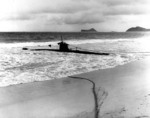
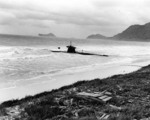
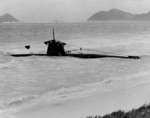
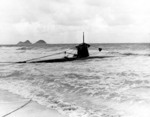
I-24tou (Ha-19) lost her way due to a malfunctioning gyrocompass. It ran up on reefs twice, drawing fire from patrol vessels. It finally grounded herself on Waimanalo Beach on Oahu's east shore, over 25 sea miles from the Pearl Harbor entrance. The sub was captured with both torpedoes still in its tubes and its commanding officer became the first Japanese POW captured by US forces in the war. [This sub is known as "Ha-19" in most US sources because the Americans found that number on what looked like a number plate inside the sub; these "Ha" numbers were construction numbers that the Japanese Navy did not use or keep records of.]
I-22tou entered Pearl Harbor and fired both torpedoes in the North Channel, on the opposite side of Ford Island from Battleship Row, just after the air attack started. One torpedo was fired toward USS Curtiss and the other toward USS Monaghan but both missed. Monaghan rammed and then depth-charged this sub. The wreck was recovered shortly after the attack and later was used as fill during an expansion of the Pearl Harbor Submarine Base. The hulk was dug up in 1952 but reburied almost immediately. The remains of the two crewmen remain aboard.
I-16tou remains the most mysterious of the Pearl Harbor midgets, and the most intriguing. I-16tou sent a radio report during the night of December 7th with the code words indicating the attacks had been successful but was never picked up by any of the mother-subs. The submarine's actions that day and her subsequent whereabouts remained a complete mystery for many years. Photographic analysis conducted by independent researchers and published by the United States Naval Institute in 1999 suggested a Type A may have successfully fired torpedoes at USS West Virginia and USS Oklahoma during the air attack; but this continues to be controversial. If this is true, this could only have been I-16tou. Pieces of the broken sub were first observed by HURL researchers in 1992 on the ocean floor just south of Oahu, but their significance was not fully understood for ten more years. I-16tou appears to have been recovered during the war in two pieces, the larger of the two pieces was disassembled by the salvors into two more manageably sized pieces, and then all three pieces were dumped at sea. The sub's scuttling charge appears to have been detonated prior to the wartime recovery. This much of the story was deduced after the pieces were found in 2002 but some of it is still uncertain since no record of the sub's recovery has been located. When the sub's bow section was found in 2001, both torpedo tubes were empty. At least one author asserts there is evidence that both torpedoes were fired from their tubes rather than being removed by the salvors, but this remains speculative.
So, five Type A submarines carrying a total of ten Type 97 torpedoes were launched against Pearl Harbor. Six torpedoes are known to have never left their tubes; two were fired in the North Channel but hit no ships; which leaves just the two torpedoes from I-16tou that are not completely accounted for.
Light Cruiser USS St. Louis reported being fired upon by a midget submarine as she broke out of Pearl Harbor at about 0930-1000 but the "two torpedoes" exploded against a submerged reef before reaching the ship. Destroyers pounded the area of the sub with depth charges as St. Louis continued on her sortie. The written reports from St. Louis are very detailed, very clear, and the captain repeated his account several times; claiming with complete certainty that two torpedoes were fired at his ship and that he could see the midget submarine broaching the surface during the attack. The captain later saw the captured I-24tou and confirmed it was the same type of craft that fired at him on Dec 7th. Nevertheless, information learned since the war has punched some holes in the St. Louis account. In the end, it is very doubtful that St. Louis was fired upon by one of the five midgets, despite Captain Rood's certainty.
The photo analysis suggesting a midget might have fired on Battleship Row was first printed in 1999, years before the wrecks of I-20tou or I-16tou were discovered. At the time of publication, four torpedoes had not yet been accounted for; enough for St. Louis to have been fired upon and also Battleship Row. With the discovery of I-20tou in 2002 with both torpedoes still aboard, the question was reduced to which account is more credible: the attack on Battleship Row, the attack on St. Louis, or something else altogether. The proposition that a submarine fired on Battleship Row has been repeated in several forums, but it has, as yet, not gained universal acceptance.
On the side of the Battleship Row theory, perhaps the most exhaustive online examination of I-16tou and her fate appears at the truly excellent I-16tou.com website.
Sydney Harbor - 31-May-1942
At 0300 on 30 May 1942 one of five large Japanese submarines launched a reconnaissance aircraft northeast of Sydney, Australia. After circling the harbor, the plane returned reporting "battleships and cruisers" in the harbor. In reality, the largest ship present was the heavy cruiser USS Chicago. The flotilla's commander decided to attack the harbor with midget submarines the next night. The next day the five submarines approached Sydney Heads and released three Type A midget submarines at about 0430 to begin their approach to Sydney Harbor.
The outer-harbor defenses detected the entry of the first midget submarine at about 2000 hours, but it was not identified until it became entangled in an anti-torpedo net that was suspended between George's Head and Green Point. Before HMAS Yarroma was able to open fire, the submarine's two crew members destroyed their vessel with demolition charges and killed themselves.
The second submarine entered the harbor at about 2148 and headed west towards the Harbor Bridge, causing a general alarm to be issued by the Naval Officer in Charge, Sydney. About 200 yards from Garden Island the submarine was fired on by the cruiser Chicago. The submarine then fired its two torpedoes at the cruiser. One torpedo ran ashore on Garden Island but failed to explode. The other passed under the Dutch submarine K9 and struck the harbor bed beneath the depot ship HMAS Kuttabul where it exploded, killing 21 sailors: 19 Royal Australian Navy and 2 Royal Navy. Its mission complete, the submarine then slipped out of the harbor and disappeared (her wreck was located in November 2006 about 20 miles north of the harbor; it is now protected as a war grave).
The third submarine was sighted by HMAS Yandra at the entrance to the harbor and was depth-charged. Some four hours later, having recovered, it entered the harbor but it was subsequently attacked with depth charges and sunk in Taylor Bay by vessels of the Royal Australian Navy. Both members of the submarine's crew committed suicide.
The two submarines that were recovered from inside the harbor were identical. Their remains were used to reconstruct one complete submarine that toured Australia for a year before being delivered to the Australian War Memorial in Canberra in 1943, where it still remains on display.
Diego Suarez, Madagascar - 30-May-1942
Japanese submarines I-10, I-16 and I-20 arrived off Madagascar 29 May 1942. I-10's scout plane spotted the 31,000 ton battleship HMS Ramillies at anchor in Diego Suarez harbor but the aircraft was spotted and Ramillies changed her berth. On 30-May-1942 I-20 and I-16 launched two Type A midget submarines, one of which managed to enter the harbor and fire two torpedoes while under depth charge attack from two corvettes. One torpedo seriously damaged Ramillies, while the second sank an oil tanker British Loyalty (later refloated). Ramillies was later repaired in Durban, South Africa and Plymouth, England before sailing with distinction in the Normandy Invasion.
One of the submarines was beached at Nosy Antalikely and the crew moved inland towards their pick-up point near Cape Amber. When they bought food at a village, they were informed upon and they were both were killed by Royal Marines a few days later. The second midget submarine was lost at sea and the body of one its crew washed ashore a day later.
Other Operations
Type A and Type D boats also were employed off Guadalcanal and the Solomon Islands in 1942-43, where they achieved modest success against U.S. shipping. They were deployed around Midway, the Aleutians, the Bismarck Islands, the Philippines, the Marianas, and Okinawa as shore-based defensive units, but their overall effectiveness was negligible at best.
On 20 November 1944, five submarine-launched Kaitens penetrated the US anchorage at Ulithi in the Caroline Islands. Only one had any success, however, sinking the fleet oiler USS Mississinewa amidst pillars of thick black smoke that could be seen throughout the fleet. Eight months later on 24 July 1945, east of the Philippines, another Kaiten sunk the Buckley-class destroyer escort USS Underhill. These two incidents are the only confirmed successful Kaiten attacks, although some Japanese sources list higher numbers.
For more information:
Type A-classType B-class
Type C-class
Type D-class
Kairyu-class
Kaiten
Sources:
Wikipedia
CincPac Pearl Harbor Report of 15 Feb 1942
Hewitt Congressional Inquiry
Naval History & Heritage Command
Combined Fleet
Japan-101
US Naval Institute
Aerospaceweb.org
DANFS (CL-49)
JBarche
HURL
Parks Stephenson's I-16tou.com
Burl Burlingame (Advance Force Pearl Harbor)
Last Major Update: Feb 2009
Japanese Midget Submarine Warfare in World War II Timeline
| 7 Dec 1941 | Five Japanese Type A Ko-hyoteki-class midget submarines are launched south of Oahu, Hawaii from mother submarines I-16, I-18, I-20, I-22, and I-24 as part of the overall Japanese attack on Pearl Harbor. All five were lost. |
| 30 May 1942 | Before dawn, the floatplane of Japanese submarine I-10 conducted a reconnaissance mission over Diego-Suárez harbor, Madagascar, spotting British battleship HMS Ramillies, a tanker, a freighter, and an ammunition ship. At 1740 hours, I-16 and I-20 launched midget submarines M-16b and M-20b 10 miles from Diego-Suárez. M-20b fired her torpedo at 2025 hours, damaging HMS Ramillies and putting her out of action for a year. At 2120 hours, corvettes HMS Genista and HMS Thyme counterattacked with depth charges but failed to hit the Japanese midget submarines. Shortly after, M-20b fired her second torpedo, sinking British tanker British Loyalty. |
| 31 May 1942 | Japanese submarines I-22, I-24, and I-27 launched three midget submarines 7 miles off of Sydney, Australia. At 2235 hours, one was caught in torpedo nets and was scuttled by her own crew of two (both were killed in the process). The two others continued into Sydney Harbor. |
| 31 May 1942 | Japanese submarine I-10 launched her floatplane for a reconnaissance mission over Diego-Suárez harbor, Madagascar to evaluate damage caused by the midget submarine attack that had taken place during the previous night. |
| 5 Jan 1945 | While escorting the Lingayen Gulf invasion force into the Sulu Sea, destroyers USS Taylor and USS Nicholas attacked a Japanese midget submarine that had fired two torpedoes at the ships. Both ships dropped depth charges and Taylor rammed the submarine causing it to break apart. |
Photographs
 |  |  |  |
Japanese Midget Submarine Warfare in World War II Interactive Map
Please consider supporting us on Patreon. Even $1 per month will go a long way! Thank you. Please help us spread the word: Stay updated with WW2DB: |


Visitor Submitted Comments
1 Apr 2010 02:23:52 PM
These midget subs have always been particularly interesting to me, my Grandfather was involved with removing them from the harbour and some 40 years later, as an apprentice at cockatoo island I was involved with the restoration- Thanks for the article.
29 Sep 2011 08:09:13 PM
i have a genuine piece of japanese midget sub sunk in australia world war two and signed declaration of the countries that helped. please email me if anyone is interested in this genuine article left to me by my grandfather
12 Oct 2011 07:49:17 AM
good vary good live this page and love to read the stuff onit
22 Oct 2011 07:12:58 PM
i have a genuine piece of the midget sub sunk in Sydney harbor 1942 it is a genuine and want to have it valued or if there is any collector or museum interested in viewing this pls email
22 Jan 2013 02:13:13 PM
The link you've provided to "objective research" also references the 1999-2001 discovery by the Hawaii Undersea Research Lab (HURL) of what appears to be the fifth Pearl Harbor midget sub (I-16tou). The sub was found divided into three sections with both torpedo tubes empty (see http://i-16tou.com/). A strong case is made for identification of the sub as being I-16tou and for it having fired upon the Arizona (perhaps unsuccessfully) and the Oklahoma. Whether or not these vessels were indeed its targets may never be definitively ascertained; however, the evidence cited for identification of the wreck as being I-16tou seems to be compelling.
 David Stubblebine says:
3 Aug 2013 09:46:58 PM
Original Comment: 22 Jan 2013; 10:16:14 PM – Edited Comment:
John: I had not seen the “i-16tou.com” site before; the page linked in the article has been updated only recently with the addition of the I-16tou information. I thank you for steering me toward this site and I encourage all interested readers to look at it. I agree that those authors make a strong case for having found the fifth sub but I am not sure yet that they made as strong a case for this sub firing torpedoes at Battleship Row. With questions popping up much more quickly than the answers, this topic is sure to be the source of fascinating debate for some time to come. Stay tuned.
9 Apr 2017 07:32:19 PM
one was seen at Sand Lake , Oregon -1942 ?
All visitor submitted comments are opinions of those making the submissions and do not reflect views of WW2DB.
- » US Government Plans to Purge WW2 Information (17 Mar 2025)
- » WW2DB's 20th Anniversary (29 Dec 2024)
- » Wreck of USS Edsall Found (14 Nov 2024)
- » See all news
|
- » 1,160 biographies
- » 337 events
- » 44,601 timeline entries
- » 1,243 ships
- » 350 aircraft models
- » 207 vehicle models
- » 376 weapon models
- » 123 historical documents
- » 261 facilities
- » 470 book reviews
- » 28,636 photos
- » 429 maps
General Douglas MacArthur at Leyte, 17 Oct 1944

Please consider supporting us on Patreon. Even $1 a month will go a long way. Thank you!

Or, please support us by purchasing some WW2DB merchandise at TeeSpring, Thank you!
1 Nov 2009 06:55:12 PM
i think they should put a few written letters, or any other written source on this. it will help many people about the feelings people were going through at the time