


Robert Oppenheimer
| Surname | Oppenheimer |
| Given Name | Julius |
| Born | 22 Apr 1904 |
| Died | 18 Feb 1967 |
| Country | United States |
| Category | Science-Engineering |
| Gender | Male |
Contributor: C. Peter Chen
ww2dbaseJulius Robert Oppenheimer was born in New York, New York, United States to textile merchant Julius Oppenheimer and painter Ella Friedman. He was educated at the Ethical Culture Society School founded upon Jewish morals. He attended Harvard University and completed his undergraduate degree in chemistry in three years. He performed postgraduate work in experimental physics at Ernest Rutherford's famed Cavendish Laboratory in Cambridge and studied theoretical physics at the University of Göttingen in Germany under Max Born. He received his Doctor of Philosophy degree at the age of 22. He published several papers, including the Born-Oppenheimer approximation, while at Göttingen. In Sep 1927, he returned to Harvard, and in 1928 studied at the California Institute of Technology. He became a professor at the University of California at Berkeley. In that same year, he traveled to Europe to lecture in the Netherlands and studied with Wolfgang Pauli in Zurich, Switzerland. His significant contributions in this period include advances in theoretical astrophysics, nuclear physics, spectroscopy, and quantum field theory. In particular to nuclear physics, his Oppenheimer-Phillips process directly contributed to the atomic weapon research during WW2. In the late 1930s, he was among first to suggest the existence of black holes. Beyond physics, he also studied Eastern philosophy and various languages. Not all colleagues valued his diverse interests, however. Isidor Rabi commented that "Oppenheimer was overeducated in those fields which lie outside the scientific tradition... which resulted in a feeling of mystery of the universe that surrounded him like a fog."
ww2dbase"I need physics more than friends", said Oppenheimer to a friend, epitomizing his tendency to place more importance in his studies than himself during this period of his life. He was known to go long periods without social contact outside of his professional colleagues, and at times even long periods without food or rest. He regularly smoked several packs of cigarettes each day, which would lead to fatal health issues later in life. His psychological health also dipped at certain points in his life; once on a trip to Paris, France, while explaining his frustrations with experimental physicals to his friend Francis Ferguson, he attacked Ferguson by strangling him for no apparent motive. Like Ferguson, other friends of Oppenheimer's also expressed similar deep concerns for Oppenheimer's mental health.
ww2dbaseIn the 1930s, the previously apolitical Oppenheimer became a stern supporter of left-wing political movements. A part of his large hesitance received in 1937 after the death of his father went to fund raising efforts for the Republicans of the Spanish Civil War and Communist movements in the United States. He had never joined the Communist Party, but he had close associations with Communist Party members (including his wife, Katherine "Kitty" Puening Harrison, whom he married in Nov 1940) and was suspected of having authored Communist brochures.
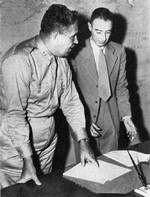
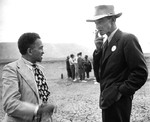
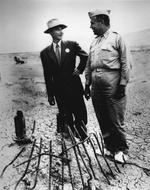
ww2dbaseWhen WW2 started, Oppenheimer renounced left-wing movements and pledged his support for the American war effort. Already involved in atomic weapon research, he was appointed by General Leslie Groves as the scientific director of the Manhattan Project. At first the research was spread out at various laboratories and universities around the country, but due to security concerns Groves and Oppenheimer centralized the weapon research to New Mexico, not far from where Oppenheimer maintained a ranch that satisfied his hobby of horseback riding. Top physicists such as Enrico Fermi, Richard Feynman, Robert R. Wilson, and Victor Weisskopf, among many others, were invited to live and work at the newly constructed Los Alamos laboratory. Oppenheimer naturally contributed much from the scientific perspective, but he was also known for being able to control the cultural conflicts between the scientists and the military; his effective style of management is still studied at organizational behavior and negotiations courses in business schools today. Groves had always suspected Oppenheimer for security reasons for his past Communist connections, but continued to support him as the scientific director for his brilliant mind and his leadership. The atomic weapon research came to fruition in mid-1945. On 17 Jul 1945, Operation Trinity succeeded in detonating a nuclear explosion near Alamogordo. "We knew the world would not be the same", he recalled years later. "A few people laughed, a few people cried, most people were silent. I remembered the line from the Hindu scripture, the Bhagavad-Gita. Vishnu is trying to persuade the Prince that he should do his duty and to impress him takes on his multi-armed form and says, 'I am become Death, the destroyer of worlds.' I suppose we all thought that one way or another." The quote from the Hindu scripture had since become one of Oppenheimer's most famous quotes.
ww2dbaseWith the war against Germany already over, the scientists and the military argued fervently on the future of this destructive technology. Some of the scientists, knowing the destructive potentials of the weapon, argued that a mere demonstration of the weapon would be enough to intimidate Japan to surrender. Oppenheimer, however, sided with the military, arguing that despite the potential harm that the weapon might cause to civilians, it must be used to quickly destroy Japan's capacity to continue the war. On 6 Aug, the uranium bomb "Little Boy" destroyed Hiroshima. Three days later, the plutonium bomb "Fat Man" was detonated over Nagasaki. Tens of thousands of civilians died along with the intended military targets. The mass destructed destroyed Japanese morale. At the face of the Russian declaration of war (which country Japan had always thought would help them mediate a peace with the Allies), Japan surrendered, ending WW2.
ww2dbaseAfter the war, Oppenheimer was distraught with the destruction the bombs had caused in Japan. "In some sort of crude sense which no vulgarity, no humor, no overstatement can quite extinguish," he later said, "the physicists have known sin; and this is a knowledge which they cannot lose." He unsuccessfully lobbied President Harry Truman to establish a "no first use" policy involving weapons of mass destruction. In an attempt to dissuade Truman from engaging in hydrogen bomb research, an effort he once again failed to achieve, he advocated the development of small atomic warheads that could be used tactically. He became the first chairman of the General Advisory Committee of the Atomic Energy Commission, then in 1947 became the director of the Institute for Advanced Study in Princeton, New Jersey, United States. When the first hydrogen bomb was created in 1951, Oppenheimer expressed awe for the technology; this moral inconsistency brought criticism from his colleagues.
ww2dbaseAfter being investigated by J. Edgar Hoover's Federal Bureau of Investigation for many years, Oppenheimer was accused in 1953 for being a security risk. President Dwight Eisenhower asked him to resign as a result of his accusation, and a hearing ensued. Oppenheimer's clearance was initially suspended and later revoked altogether. He was one of the first high-profile figures to be a victim to McCarthyism. Nevertheless, he continued to work in physics. He gave lectures world-wide without context to political implications. In 1963, he was awarded the Enrico Fermi Award by President John Kennedy as a sign of reconciliation between the United States government and the scientist.
ww2dbaseIn the final few years of his life, Oppenheimer once again felt the need for solitude. He often took months-long vacations on his Virgin Islands property and went sailing with his wife. He died of throat cancer in Princeton, New Jersey, United States; the disease was directly attributed to his regular smoking habit. After his death, he was commonly credited as the father of modern theoretical physics.
ww2dbaseSources:
Kai Bird and Martin J. Sherwin, American Prometheus
Wikipedia
Last Major Revision: Apr 2006
Famous Quote(s)
- "I become Death, the Destroyer of Worlds."
» 16 Jul 1945
Robert Oppenheimer Interactive Map
Photographs
 |  |  |  |
Videos
 |
Robert Oppenheimer Timeline
| 22 Apr 1904 | Robert Oppenheimer was born in New York, New York, United States. |
| 24 Jul 1942 | Oppenhheimer was selected to head the atomic bomb research efforts. |
| 16 Nov 1942 | Robert Oppenheimer, Leslie Groves, and others toured a prospective site for nuclear research in New Mexico, United States. The site would not be selected due to Oppenheimer's opinion that the surrounding high cliffs would cause claustrophobic and thus lower morale, while engineers were concerned with the possibility of flooding. |
| 28 Feb 1945 | Robert Christy finalized the Christy Gadget implosion device during a meeting in Robert Oppenheimer's office in New Mexico, United States. |
| 16 Jul 1945 | In Operation Trinity, the Americans successfully detonated an atomic bomb at Alamogordo Bombing Range in New Mexico, United States. The test blast created temperatures 10,000 times the surface temperature of the sun and was felt 200 miles away. The explosion was the equivalent of 20,000 tons of TNT and throws a column of fire and smoke 35,000 feet into the night sky. The authorities hid the blast by claiming that an ammunition dump had gone up. |
| 17 Aug 1945 | Robert Oppenheimer traveled to Washington DC, United States and personally delivered a letter to Secretary of War Henry Stimson, expressing his wish to see nuclear weapons banned. |
| 16 Oct 1945 | Robert Oppenheimer resigned as the director of the Los Alamos, New Mexico, United States facility of the Manhattan Project. |
| 7 Jun 1949 | Robert Oppenheimer testified before the House Un-American Activities Committee of the US Congress in Washington, United States that he had associations with the Communist Party USA in the 1930s. |
| 21 Dec 1953 | Robert Oppenheimer was informed by Chairman of the United States Atomic Energy Commission Lewis Strauss that Oppenheimer had temporarily lost his security clearance due to questions regarding Oppenheimer's loyalty to the United States. |
| 27 May 1954 | A three-member Personnel Security Board of the US Atomic Energy Commission revoked Robert Oppenheimer's security clearance due to their doubts on Oppenheimer's loyalty to the US. The board was consisted of President of the University of North Carolina Gordon Gray (voted for revocation), industrialist Thomas Alfred Morgan (voted for revocation), and Chairman of the chemistry department of Northwestern University Ward Evans (voted against revocation). |
| 3 May 1962 | Robert Oppenheimer was elected a Foreign Member of the Royal Society in Britain. |
| 15 Feb 1967 | Robert Oppenheimer fell into a coma in Princeton, New Jersey, United States. |
| 18 Feb 1967 | Robert Oppenheimer passed away after being in a three-day coma at his home in Princeton, New Jersey, United States. |
| 16 Dec 2022 | United States Secretary of Energy Jennifer Granholm vacated the 1954 revocation of Oppenheimer's security clearance. |
Did you enjoy this article or find this article helpful? If so, please consider supporting us on Patreon. Even $1 per month will go a long way! Thank you. Share this article with your friends: Stay updated with WW2DB: |


Visitor Submitted Comments
5 Feb 2009 04:29:36 PM
im looking on more research bu its still good!
 BILL says:
28 May 2009 04:36:20 PM
" I am become Death, the destroyer of worlds"
J. Robert Oppenheimer.
BILL says:10 Jun 2009 12:47:24 PM
It was a single projectile charged with all the power of the universe. An incandescent column of smoke and flame as bright as 10,000 suns rose in all its splendor.
It was as unknown weapon, a gigantic messenger of death, which reduced to ashes the entire race of the Vrishnis and the Adhakas...The corpses were so burned as to be unrecognizable, their hair and nails fell out, pottery broke without apparent cause and the birds turned white. After a few hours all foodstuffs were infected. To escape from this fire, the soldiers threw themselves in streams to wash themselves and all their equipment.
-From the Mahabharata,the epic poem of India not translated into English until 1840......
What does this remind you of, living in the late 20th and early 21st Centuries. For me it sounds like at sometime in the past, somebody set off a nuke, or had a good imagination, but remember Homer and the Trojan War.
Bill says:28 Oct 2009 11:25:44 AM
"If the radiance of a thousand suns were to
burst at once into the sky that would be like to the splender of the Mighty One...
I am become Death, the Shatterer of Worlds".
-J. Robert Oppenheimer, Quoting
"The Bhagavad Gita"
Alamogordo, New Mexico July 1945
Bill says:28 Oct 2009 11:29:27 AM
"The Atomic bomb made the prospect of future
war unendurable. It has led us up those last
few steps to the mountain pass, and beyond
there is a different world".
-J. Rpbert Oppenheimer-
Bill says:28 Oct 2009 11:38:07 AM
Nothing could have been more obvious to the
people of the late Twentieth Century, that
the rapidly with which war was becoming
impossible.
And as certainly they did not see it.
They did not see it, until the Atomic bomb
burst into their fumbling hands...
-H.G. Wells-
The World Set Free, 1914
Bill says:12 Nov 2009 06:32:17 PM
The word "Nuke"(verb) wasn't used until 1959
14 years, after it was used...
Bill says:15 Nov 2009 05:06:59 PM
"It worked" (Said after whitnessing the
the first Atomic detonation)
-J. Robert Oppenheimer-
28 Mar 2010 07:08:35 AM
Some say the world will end in fire,
Some say in ice.
From what I've tasted of desire
I hold with those who favor fire.
But if it had to perish twice,
I think I know enough of hate
To say that for destruction ice
Is also great
And would suffice.
~Robert Frost
15 Jun 2010 06:53:59 PM
...As one of our secrets in the end
now lowly man has become our friend
and as this world tends too cease
..may your body rest in peace.....
15 Jun 2010 06:57:07 PM
..and the world will decease
.....unless the warheads will all rust in peace
Bill says:5 Oct 2010 05:15:12 PM
Did you know...
H.G. Wells coined the term Atomic Bomb, years before it came to pass.
8 Mar 2011 06:14:41 AM
this site is AWESOME
All visitor submitted comments are opinions of those making the submissions and do not reflect views of WW2DB.
» Operation Trinity and Manhattan Project
Related Books:
» American Prometheus
» Bomb
» Countdown 1945
- » 1,150 biographies
- » 337 events
- » 44,024 timeline entries
- » 1,242 ships
- » 350 aircraft models
- » 207 vehicle models
- » 375 weapon models
- » 123 historical documents
- » 260 facilities
- » 470 book reviews
- » 28,623 photos
- » 431 maps
General Douglas MacArthur at Leyte, 17 Oct 1944

Please consider supporting us on Patreon. Even $1 a month will go a long way. Thank you!

Or, please support us by purchasing some WW2DB merchandise at TeeSpring, Thank you!
18 Nov 2007 08:55:50 AM
i have to tell you that i had to do a project on you and everthing i need is right here online.I just want to say thank you. Katie Crane