


Neville Chamberlain
| Surname | Chamberlain |
| Given Name | Neville |
| Born | 18 Mar 1869 |
| Died | 9 Nov 1940 |
| Country | United Kingdom |
| Category | Government |
| Gender | Male |
Contributor: C. Peter Chen
ww2dbaseArthur Neville Chamberlain was born to Joseph Chamberlain, Lord Mayor of Birmingham. He was educated at Rugby School; his classmates at Rugby remembered him as a shy boy. He then attended Mason Science College. After university education, he worked for an accounting firm. After some time as a failed plantation owner in the Bahamas, he returned to Britain and embarked on a successful career as a manager for several companies. In 1911, he entered politics at the Birmingham City Council, and in 1915 became the Lord Mayor. In 1916, he became the Director of National Service and managed the labor force in Britain during WW1, but he bumped heads with Prime Minister David Lloyd George; he resigned in 1917. He entered Parliament at the age of 49, where he refused a junior ministerial position and knighthood due to his protest of the Lloyd George government. In 1922, Andrew Bonar Law became the Prime Minister, and appointed Chamberlain as the Postmaster General, then later Minister of Health. In the latter position he introduced several programs that reformed housing laws. During Stanley Baldwin's term as Prime Minister, Chamberlain was promoted to the Chancellor of the Exchequer for one term; at the completion of the term he returned to the role of Minister of Health. In 1930, amidst infighting within the Conservative Party, Chamberlain took leadership of the party as its chairman, but Baldwin eventually retained true leadership.
ww2dbaseOn 24 Aug 1931, at the formation of a unified National Government, he returned as the Minister of Health, then within the same year the Chancellor of the Exchequer. In this second term as the Chancellor of the Exchequer, he promoted protective tariffs that would mold the British Empire, containing the United Kingdom, the Dominions, and lesser colonies, into one economic community that would be self-sufficient. He also worked to improve the debt situation, a legacy of WW1. His efforts to reduce debt, however, were attacked by the likes of Winston Churchill who accused him of undermining the defense expenditure at a time when Adolf Hitler's Germany was undoubtedly preparing for war. In 1937, Chamberlain introduced the National Defense Contribution that taxed excessive profits in the industrial realm, which gathered much opposition against him. Another contribution of Chamberlain during his second term as Chancellor of the Exchequer was the nationalization of certain old factories and mines that were devastated during the Great Depression. While he meant to protect these industries, the long term effect of the nationalization actually turned out to be one that gave Britain a greater capacity for manufacturing for WW2.
ww2dbaseOn 28 May 1937, Chamberlain became the Prime Minister, and a few days later the leader of the Conservative Party. He appointed his ministers from those whose visions closely matched his, and did not fear from selecting those from the business world with little political experience. In fact, he ruled like a businessman. Sir John Simon noted Chamberlain as one who would "listen in a business-like fashion to what one had to say, and then state his conclusions with the finality of a General Manager conducting his company's affairs." Domestically, he introduced the Factory Act in 1937 that protected the work force, the Housing Act in 1938 that provided relief in urban overcrowding, and many others that aimed to improve the lives of the commoners; his domestic programs were credited for setting the foundation for Britain's prosperity during the post-WW2 years. He maintained the difficult relation with Ireland, which was in the process of becoming an independent republic. Chamberlain and his government stated that the transformation was to be allowed, given Ireland's status within the British Commonwealth remain unchanged. Although agreements were reached on many aspects of the Irish independence, the creation of a British-controlled Northern Ireland remained troublesome for many years to come. On the international front, the creation of a Jewish state in Palestine and the handling of a progressively aggressive Germany were his focus. With the latter subject, he believed war should be avoided at all costs. This led to the appeasement policy that, together with a similar policy from France, actually fueled Hitler's expansionism. He commented that "the longer the war is put off the less likely it is to come at all as we go on perfecting our defences and building up the defenses of our allies". As a politician, Chamberlain was not entirely to blame of this, for he was only delivering what the British people wanted; the popular sentiment in Western Europe at the time credited Germany as the shield against the spread of communist revolutionary sentiment from Russia. Thus, on Chamberlain's watch, Germany acquired Austria, Sudetenland, and then later the rest of Czechoslovakia without British intervention. With his businessman mindset, he thought he and Hitler had a mutual respect. "Hitler definitely liked me," he noted in a personal correspondence to his sister, "and thought he could do business with me." Hitler, however, was no businessman; Hitler "dealt with [Chamberlain] because he believed him to be infinitely malleable." Chamberlain finally declared war on Germany after the invasion of Poland on Sep 1939, but the realization by then was already too late to prevent the conflict from growing into a major war. Returning from Munich after the agreement to deliver Sudetenland into German hands, he was quoted in saying "for the second time in our history, a British Prime Minister has returned from Germany bringing peace with honor", and he was not able to see that war was by now imminent despite of the appeasement efforts. His respectable passion to maintain peace, however noble, became his biggest flaw. During the Germany invasion of Poland in Sep 1939, Chamberlain promoted defensive measures such as stepping up the defense at radar stations along the coast, but he largely hoped for a diplomatic end to the conflict. His hope for peace did not die until the German invasion of the Low Countries and France. William Manchester noted that
ww2dbaseOn the evening of 10 May 1940, Chamberlain resigned. King George VI appointed Churchill as his successor. Chamberlain stayed in the Conservative Party and remained influential. Churchill wished to name Chamberlain the Chancellor of the Exchequer and Leader of the House of Commons, but political pressures on Churchill prevented this from happening. Instead, Chamberlain became the Lord President of the Council in Churchill's government. Chamberlain's support among Britain's politicians varied; some wanted him out of government altogether for his inability to prevent war, while others deeply believed he would undoubtedly return to the role of Prime Minister. In Jul 1940, however, his health deteriorated very quickly and had an operation for stomach cancer. In Sep 1940, he resigned from his office as well as the Conservative Party, though Churchill did allow him to continue to receive classified information about the war in order to keep him informed of the situation.
ww2dbaseChamberlain died of cancer in Highfield Park, Hampshire, at the age of 71 in Nov 1940.
ww2dbaseSources: the Last Lion, Wikipedia.
Last Major Revision: Aug 2006
Famous Quote(s)
- "In war, whichever side may call itself the victor, there are no winners, but all are losers."
» Speech at Kettering, Northamptonshire, England, United Kingdom, 3 Jul 1938 - "In the event of any action which clearly threatened Polish independence and which the Polish Government accordingly considered it vital to resist with their national forces, His Majesty's Government would feel themselves bound at once to lend the Polish Government all support in their power. They have given the Polish Government an assurance to this effect. I may add that the French Government have authorized me to make it plain that they stand in the same position in this matter."
» 31 Mar 1939 - "This morning the British Ambassador in Berlin handed the German Government a final note stating that unless we heard from them by eleven o'clock that they were prepared at once to withdraw their troops from Poland, a state of war would exist between us. I have to tell you that no such understanding has been received and that consequently this country is at war with Germany."
» 3 Sep 1939 - "This is a sad day for all of us, and to none is it sadder than to me. Everything that I have worked for, everything that I have believed in during my public life, has crashed into ruins. There is only one thing left for me to do: That is, to devote what strength and powers I have to forwarding the victory of the cause for which we have to sacrifice so much... I trust I may live to see the day when Hitlerism has been destroyed and a liberated Europe has been re-established."
» 3 Sep 1939 - "It is evil things that we will be fighting against—brute force, bad faith, injustice, oppression and persecution—and against them I am certain that the right will prevail."
» During a radio broadcast, 3 Sep 1939
Neville Chamberlain Interactive Map
Photographs
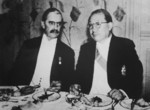 |  | 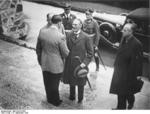 | 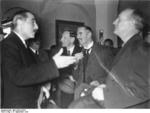 |
Neville Chamberlain Timeline
| 18 Mar 1869 | Neville Chamberlain was born in Birmingham, England, United Kingdom. |
| 28 May 1937 | Neville Chamberlain became the Prime Minister of the United Kingdom. |
| 24 Mar 1938 | British Prime Minister Neville Chamberlain rejected the Soviet request to form an international bloc to contain German aggression. |
| 30 Jul 1939 | British Prime Minister Chamberlain wrote in regards to the German oppression of Jews "[n]o doubt Jews aren't a lovable people, I don't care about them myself. But that is not sufficient to explain the pogram." |
| 3 Sep 1939 | At 1115 hours, British Prime Minsiter Neville Chamberlain announced over radio that because Germany had failed to withdraw troops from Poland by 1100 hours, a state of war now existed between the United Kingdom and Germany. |
| 9 Sep 1939 | British Prime Minister Neville Chamberlain's cabinet planned for a 3-year war. |
| 9 Oct 1939 | British Prime Minister Chamberlain announced a committee of ministers to coordinate the war time economy. |
| 12 Oct 1939 | British Prime Minister Neville Chamberlain rejected Adolf Hitler's proposal for a multi-power conference for peace made on 6 Oct 1939. |
| 1 Feb 1940 | In the British House of Commons, Prime Minister Neville Chamberlain declined to accept a suggestion by Herbert Morrison that a Minister of War Economy should be appointed on the grounds that such a post would do nothing which was not already being done. |
| 24 Feb 1940 | British Prime Minister Neville Chamberlain condemned Hitler's aggression but said that he was prepared to negotiate with an alternative German government. |
| 19 Mar 1940 | Members of the British House of Commons debated Britain's lack of action during the Winter War and criticized Prime Minister Chamberlain. Chamberlain noted that Finland never officially requested British military aid. |
| 31 Mar 1940 | British Prime Minister Chamberlain called off the mining of the Norwegian coast in protest of the French resistance to the mining of the Rhine River. |
| 5 Apr 1940 | British Prime Minister Neville Chamberlain announced that a German invasion of Western Europe would not be successful. |
| 7 May 1940 | Prime Minister of the United Kingdom Neville Chamberlain faced criticism during the Norway Debate. |
| 8 May 1940 | The opposition party in the United Kingdom, the Labour Party, called for a vote of no confidence for Prime Minister Chamberlain's government. Meanwhile, former Prime Minister David Lloyd George called for Chamberlain to step down for the good of the country. |
| 9 May 1940 | British Prime Minister Chamberlain offered to form a coalition government with the opposition Labour Party, but the attempt was unsuccessful. In the afternoon, Chamberlain began to discuss with Halifax and Churchill, the two leading contenders to be his successor, about the possibility of his resignation. |
| 3 Oct 1940 | British politician Neville Chamberlain resigned as Lord President of the Council for health reasons. |
| 9 Nov 1940 | Neville Chamberlain passed away of cancer. |
| 14 Nov 1940 | Neville Chamberlain's funeral was held at Collegiate Church of St Peter at Westminster, or Westminster Abbey, in London, England, United Kingdom. |
Please consider supporting us on Patreon. Even $1 per month will go a long way! Thank you. Please help us spread the word: Stay updated with WW2DB: |


Visitor Submitted Comments
6 Feb 2013 08:25:26 AM
He was a very important man in British history.
19 Apr 2014 06:47:57 AM
Neville chamberlain was my great grandmothers 1st cousin she was from Malvern and she was born on Christmas day her name was Christina she married Thomas Greenfield
25 Jan 2017 10:05:29 AM
I am doing a report on Neville Chamberlain. This does give a lot of information but I need to know about him in the world war 2.
 Alan Chanter says:
4 Oct 2018 05:52:31 AM
Neville Chamberlain was the only British prime minister until Margaret Thatcher to have a university education in science and the only university–educated twentieth-century prime minister to have studied entirely outside Oxbridge. Not showing much aptitude (though he had a lifetime passion for natural history), he trained as an accountant and went into business, starting with the growing of sisal in the Bahamas. Chamberlain’s industrial interests included Elliott’s Metal Company, which made brass, Birmingham Small Arms and the family-owned Hoskins & Co which made berths for ships’ cabins,
5 Apr 2019 09:52:45 AM
Neville Chamberlain was my Mom's cousin and therefore my 2nd cousin and a very much misjudged and maligned man he tried to see the best in people and was often fooled but he always did his best for his family, his country and his king. I for one am proud to be a family member .
28 Jan 2025 03:01:31 AM
i am proud to be a chamberlain. there are different opinions as to Nevillle and i read a book on him which i believed to be true as to others which degrade him
All visitor submitted comments are opinions of those making the submissions and do not reflect views of WW2DB.

» Munich Conference and the Annexation of Sudetenland
» Dismemberment of Czechoslovakia
Document(s):
» No. 105: Speech by Chamberlain to the House of Commons
» No. 116: Speech by Chamberlain to the House of Commons
» No. 11: Question and the Prime Minister's answer in the House of Commons
» No. 120: Speech by Chamberlain to the House of Commons
» No. 144: Chamberlain's Message to the German People
» No. 17: Statement by the Prime Minister in the House of Commons
» No. 35: Chamberlain's Speech at the House of Commons
» No. 56, 60, 68, 74, 78, & 89: Messages Between Chamberlain/UK Government and Hitler
» No. 64: Speech by the Prime Minister in the House of Commons
» No. 77: Speech by the Prime Minister in the House of Commons
» No. 9: Speech by the Prime Minister at Birmingham
» The Munich Pact
Related Books:
» Ministers at War: Winston Churchill and His War Cabinet
- » 1,176 biographies
- » 337 events
- » 44,933 timeline entries
- » 1,245 ships
- » 350 aircraft models
- » 207 vehicle models
- » 376 weapon models
- » 123 historical documents
- » 261 facilities
- » 470 book reviews
- » 28,471 photos
- » 365 maps
James Forrestal, Secretary of the Navy, 23 Feb 1945

Please consider supporting us on Patreon. Even $1 a month will go a long way. Thank you!

Or, please support us by purchasing some WW2DB merchandise at TeeSpring, Thank you!
29 Apr 2010 12:14:41 PM
He wanted to keep peace. Chamberlain was a British gentleman, Hitler a barbarian. Besides the Sudeten Germans were promised home rule after World War 1, but this was not granted in reality. So it was no problem for Chamberlain to sign the treaty of Munich 1938, in which the Sudetenland became part of the Third Reich