


Konstantin Rokossovsky
| Surname | Rokossovsky |
| Given Name | Konstantin |
| Born | 21 Dec 1896 |
| Died | 3 Aug 1968 |
| Country | Poland, Russia |
| Category | Military-Ground |
| Gender | Male |
Contributor: C. Peter Chen
ww2dbaseKonstantin Konstantinovich Rokossovsky was born in Velikie Luki in northern Russia to a Polish locomotive driver. After growing up in Warsaw, Poland, he was orphaned and became a stonemason during his teenage years. Tall and blonde, he was conscripted into the Russian Army in 1914, joining the 5th Kargopol Dragoons. In 1917 he joined the Bolshevik forces during the Russian Revolution and was twice honored with the Order of the Red Banner during the civil war. He studied at the Frunze Military Academy after WW1 and became a senior cavalry commander. In 1919 he joined the Communist Party. In the 1920s, he served in Mongolia and China, gaining experience as a tank commander. In 1939, he was removed from his post during Josef Stalin's Great Purge, accused of being a Polish spy and sentenced to death. He returned to the army in 1940, however, after being deemed rehabilitated, though it probably was because his leadership was needed for the war.
ww2dbaseIn Jul 1941, German troops poured into Russian territory during Operation Barbarossa. Rokossovsky became commander of the 4th Army at Smolensk. He distinguished himself leading the 16th Army during the defense of Moscow and Stalingrad. At Stalingrad, commanding the Don Front, his troops successfully counterattacked Friedrich Paulus' Sixth Army, marking a strategic victory by stopping the German southern advance. He also contributed much to the counterattack of the German forces at Kursk, again halting a major German offensive. For such feats he became the commander of the central front, directly overseeing the Russian offensive Operation Bagration. In mid-1944 he was given the title Marshal of the Soviet Union.
ww2dbaseMuch to Rokossovsky's dismay, however, all the victories he had achieved thus far in the war were fought under the banner of Georgi Zhukov. Despite being the same age, nearly equal tenure, and a similar track of promotions, he had always been kept under Zhukov. It was largely by design of Stalin, keeping the Russian generals competing with each other to gain Stalin's favor. Rokossovsky, however, on many occasions refused to play Stalin's games, arguing with the Russian leader on military strategy, upsetting Stalin despite Stalin's threats to send him back on death row.
ww2dbaseDespite being Polish, Rokossovsky stood by his orders to refuse aid to the Warsaw uprising against the German occupation troops in Aug-Oct 1944. Although recognizing that the uprising seriously damaged the German ability to hold the city of Warsaw, the leaders of the uprising sought an independent Poland, therefore did not spark much sympathy from Moscow. Rokossovsky's army stood on the banks of the Vistula and did not move into Warsaw until Jan 1945.
ww2dbaseAfter Warsaw, Rokossovsky commanded elements of the 2nd Byelorussian Front and defeated German troops in East Prussia and northern Poland. In Apr 1945 his troops linked up with those under the command of British Field Marshal Bernard Montgomery in northern Germany.
ww2dbaseAfter the war, a Russian-influenced Communist regime was established in Poland, and in Oct 1949 Rokossovsky was made the Polish Minister of Defense. In 1952 he became Deputy Chairman of the Council of Ministers of Poland. Although Polish, he was regarded as an agent of Moscow, and was pressured by politics to resign and return to Russia. In Jul 1957, Nikita Khrushchev appointed him the Deputy Minister of Defense and Commander of the Transcaucasian Military District, then chief inspector of the Ministry of Defense in 1958.
ww2dbaseRokossovsky passed away in 1968. He rests in peace in Red Square in Moscow.
ww2dbaseSources: the Fall of Berlin, Wikipedia.
Last Major Revision: Jan 2006
Konstantin Rokossovsky Interactive Map
Photographs
 |  |  |  |
Konstantin Rokossovsky Timeline
| 21 Dec 1896 | Konstantin Rokossovsky was born. |
| 4 Jun 1940 | Konstantin Rokossovsky was promoted to the rank of major general. |
| 11 Sep 1941 | Konstantin Rokossovsky was promoted to the rank of lieutenant general. |
| 15 Jan 1943 | Konstantin Rokossovsky was promoted to the rank of colonel general. |
| 28 Apr 1943 | Konstantin Rokossovsky was promoted to the rank of general. |
| 5 Aug 1943 | Konstantin Rokossovsky's Central Front liberated Orel, Russia and the Germans withdrew to the partly prepared Hagen line position at the base of the salient. |
| 29 Jun 1944 | Konstantin Rokossovsky was promoted to the rank of Marshal of the Soviet Union. |
| 29 May 1945 | Soviet 2nd Byelorussian Front was renamed Northern Group of Military Forces, or SGV. Konstantin Rokossovsky remained the commanding officer of the group. |
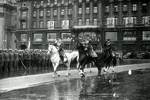
| 24 Jun 1945 | Konstantin Rokossovsky commanded a victory parade at the Red Square in Moscow, Russia. |
| 12 Jul 1945 | Bernard Montgomery awarded Konstantin Rokossovsky Knight Commander of the British Empire at the Brandenburg Gate, Berlin, Germany. |
| 2 Nov 1949 | Konstantin Rokossovsky was promoted to the rank of Marshal of Poland. |
| 3 Aug 1968 | Konstantin Rokossovsky passed away. |
Please consider supporting us on Patreon. Even $1 per month will go a long way! Thank you. Please help us spread the word: Stay updated with WW2DB: |


» Battle of Moscow
» Battle of Stalingrad
» Battle of Kursk
» Operation Bagration
» East Prussian Offensive
» East Pomeranian Offensive
- » 1,182 biographies
- » 337 events
- » 45,115 timeline entries
- » 1,248 ships
- » 350 aircraft models
- » 207 vehicle models
- » 376 weapon models
- » 123 historical documents
- » 261 facilities
- » 470 book reviews
- » 28,414 photos
- » 365 maps
James Forrestal, Secretary of the Navy, 23 Feb 1945

Please consider supporting us on Patreon. Even $1 a month will go a long way. Thank you!

Or, please support us by purchasing some WW2DB merchandise at TeeSpring, Thank you!