


Ivan Konev
| Surname | Konev |
| Given Name | Ivan |
| Born | 28 Dec 1897 |
| Died | 21 May 1973 |
| Country | Russia |
| Category | Military-Ground |
| Gender | Male |
Contributor: C. Peter Chen
ww2dbaseIvan Stepanovich Konev was born into a peasant family near Podosinovsky in central Russia. He worked as a lumberjack in 1916 when he was conscripted into the Russian Army. In 1919 he joined the Bolshevik Party and the Red Army as an artilleryman in the Russian Far Eastern Republic under Kliment Voroshilov. Unlike his fellow Field Marshals during WW2, his career path was slightly different; he became a political commissar, an officer that the Communist Party trusted to lead the Army. He studied at the Frunze Military Academy, emerging from the institution a regimental commander. His career in the Army benefited from his good working relationship with Voroshilov, who was in Josef Stalin's favor. In 1937 he became a Deputy of the Supreme Soviet and in 1939 a candidate member of the Party Central Committee. During the early phases of WW2 he commanded a Russian unit in the Far East against Japanese aggression into Mongolia. He was not able to impress Moscow with his performance, and was replaced by Georgi Zhukov. Zhukov, who succeeded in defeating the Japanese, became a target of jealousy and hatred for Konev.
ww2dbaseWhen Germany invaded Russia in Jun 1941 Konev commanded the 19th Army in defense of the German advance. He failed to hold the Germans in the Smolensk region and fell back to Moscow, but at Moscow he played a critical role in the eventual counterattack that pushed the Germans westward in the winter of 1941-42. For his contributions in the counteroffensive he was rewarded with a promotion to the rank of colonel general. Until the end of the war, he commanded men at the army size, including the First Ukrainian Front which famously stopped a major German offensive at the Battle of Kursk. Konev also played a role in the liberation of Belgorod, Odessa, Kharkov, and Kiev. In 1944 he was first given the title of Field Marshal then the title of Hero of the Soviet Union as his men successfully marched into Czechoslovakia. In Jan 1945 Konev's army launched a major offensive in western Poland, then in Apr 1945 toward Berlin alongside of Zhukov's army. Solely Zhukov was given the honor to capture the Reichstag; Konev and his men were sent to liberate Prague.
ww2dbaseAfter the war Konev headed Russian forces in East Germany and Allied forces in Austria. In 1946 he replaced Zhukov as First Deputy Minister of Defense of the Soviet Union, but was removed from power in 1950 due to Stalin's suspicion that he was gaining too much popularity. He regained the same position in 1953 under Nikita Khrushchev, then was promoted to become the Commander-in-Chief of the Armed Forces of the Warsaw Pact, a position he held from 1956 to 1960. He briefly commanded Russian forces in East Germany and then held a ceremonial post of Inspector-General of the Defense Ministry before he retired.
ww2dbaseKonev passed away in Moscow in 1973. He is remembered as a highly educated general of the Russian Army, always carrying books by classical authors and quoting the likes of Titus Livy and Aleksandr Pushkin. His ruthlessness has not been forgotten, either, illustrated by his part in the massacre of 20,000 surrounded and helpless German soldiers near Korsun, Ukraine in Feb 1944.
ww2dbaseSources: the Fall of Berlin, Wikipedia.
Last Major Revision: Feb 2006
Ivan Konev Interactive Map
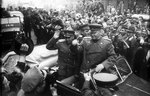
Photographs
 |
Videos
 |
Ivan Konev Timeline
| 28 Dec 1897 | Ivan Konev was born. |
| 1 Jun 1946 | Ivan Konev replaced Georgy Zhukov as the head of Soviet Ground Troops. |
| 21 May 1973 | Ivan Konev passed away. |
Did you enjoy this article or find this article helpful? If so, please consider supporting us on Patreon. Even $1 per month will go a long way! Thank you. Share this article with your friends: Stay updated with WW2DB: |


» Battle of Moscow
» Battle of Kursk
» Battle of Belgorod
» Fourth Battle of Kharkov
» Jassy-Kishinev Offensive and Romania's Surrender
» Vistula-Oder Offensive
» Silesian Offensive and the Siege of Breslau
» Battle of Berlin
» Prague Strategic Offensive
|
- » 1,150 biographies
- » 337 events
- » 44,024 timeline entries
- » 1,242 ships
- » 350 aircraft models
- » 207 vehicle models
- » 375 weapon models
- » 123 historical documents
- » 260 facilities
- » 470 book reviews
- » 28,623 photos
- » 431 maps
Winston Churchill, on the RAF

Please consider supporting us on Patreon. Even $1 a month will go a long way. Thank you!

Or, please support us by purchasing some WW2DB merchandise at TeeSpring, Thank you!