


Arthur Tedder
| Surname | Tedder |
| Given Name | Arthur |
| Born | 11 Jul 1890 |
| Died | 3 Jun 1967 |
| Country | United Kingdom |
| Category | Military-Air |
| Gender | Male |
Contributor: C. Peter Chen
ww2dbaseArthur William Tedder was born in Glenguin, Stirling, Scotland, Britain to Commissioner of the Board of Customs Sir Arthur John Tedder and Emily Charlotte Bryson. He joined the Dorsetshire Regiment in 1913 and was transferred to the Royal Flying Corps in 1916. During WW1, he served in France between 1915 and 1917 and then in Egypt until 1919. After the war, he was transferred to the newly formed Royal Air Force as a squadron leader. He was promoted to the rank of group captain in 1931, and served as Director of Training from 1934 to 1936. Immediately before the outbreak of the European War, he was the commander of the RAF Eastern Forces and was director general for research in the Air Ministry.
ww2dbaseAfter Britain entered WW2, Tedder served as the head of the RAF Middle East Command, which also covered the battlefields in the Mediterranean Sea and in North Africa. While the forces under his command experienced both victories and defeats, his reputation as an effective air commander grew. He was increasingly known for the deployment of "Tedder Carpet" tactic, which involves multiple bombers committing a rolling barrage with high explosive and napalm bombs ahead of advancing friendly forces. He was knighted in 1942 and was promoted to the rank of air marshal by the end of the Desert War. He was heavily involved in the planning of the invasion of Sicily and then Normandy. He was named Deputy Supreme Commander in the latter campaign, though he at times found himself without resources because commander of the Allied Air Expeditionary Force Trafford Leigh-Mallory at times deployed forces for objectives that were tactically different than that of Tedder's for the campaign in Normandy. In the last year of the war, he was sent to Russia seeking greater coordination between Russia and the Western Allies, particularly during the Ardennes offensive in the winter of 1944 to 1945. In May 1945, he signed the German surrender instrument on behalf of General Dwight Eisenhower.
ww2dbaseTedder lost two family members during the war. His son Richard Tedder died in combat in France during the German invasion. His first wife Rosalinde Maclardy, who was beside him during the Desert War, died in an air crash in Egypt in 1943.
ww2dbaseAfter the war, Tedder gained peerage as First Baron Tedder. He served as the Chief of the Air Staff between 1946 and 1950. In 1950, he served as the British representative on the military committee of North Atlantic Treaty Organization (NATO) in Washington, DC, United States. On the civilian side of his life, he was the chancellor of Cambridge University between 1950 and 1967, served some time on the board of the British Broadcasting Corporation (BBC), and authored his memoirs and a historical study of the Royal Navy.
ww2dbaseAfter several years of struggle with Parkinson's Disease, Tedder passed away in Surrey, England, at the age of 76.
ww2dbaseSource: Wikipedia.
Last Major Revision: May 2007
Arthur Tedder Interactive Map
Photographs
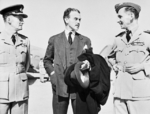 | 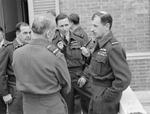 |  | 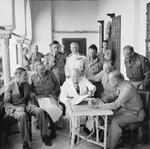 |
Arthur Tedder Timeline
| 11 Jul 1890 | Arthur Tedder was born in Glenguin, Stirling, Scotland, United Kingdom. |
| 30 Mar 1941 | An aircraft carrying British Air Marshal Arthur Tedder crash-landed in the Western Sahara; Tedder was not injured. |
| 17 Feb 1943 | Air Chief Marshal Sir Arthur Tedder became AOC-in-C Mediterranean Air Command with responsibility for all air operations. |
| 27 Dec 1943 | Air Chief Marshal Sir Arthur Tedder was appointed Deputy Supreme Commander under General Dwight Eisenhower. |
| 3 Jun 1967 | Arthur Tedder passed away. |
Did you enjoy this article or find this article helpful? If so, please consider supporting us on Patreon. Even $1 per month will go a long way! Thank you. Share this article with your friends: Stay updated with WW2DB: |


Visitor Submitted Comments
All visitor submitted comments are opinions of those making the submissions and do not reflect views of WW2DB.
» Conclusion of the Desert War
» Germany's Surrender
- » 1,150 biographies
- » 337 events
- » 44,024 timeline entries
- » 1,242 ships
- » 350 aircraft models
- » 207 vehicle models
- » 375 weapon models
- » 123 historical documents
- » 260 facilities
- » 470 book reviews
- » 28,623 photos
- » 431 maps
General Douglas MacArthur at Leyte, 17 Oct 1944

Please consider supporting us on Patreon. Even $1 a month will go a long way. Thank you!

Or, please support us by purchasing some WW2DB merchandise at TeeSpring, Thank you!
27 Dec 2018 09:20:42 AM
In May 1945, he he did not sign the German surrender instrument on behalf of General Dwight Eisenhower. Tedder signed May 8, 1945 in Berlin-Karlshorst the ratification of the Act of Military Surrender, May 7, 1945 at Reims.