


Vernon Baker
| Surname | Baker |
| Given Name | Vernon |
| Born | 17 Dec 1919 |
| Died | 13 Jul 2010 |
| Country | United States |
| Category | Military-Ground |
| Gender | Male |
Contributor: C. Peter Chen
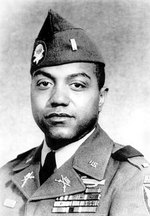
ww2dbaseVernon Baker was born in Cheyenne, Wyoming, United States. He enlisted in the United States Army on 26 Jun 1941, six month prior to the American direct involvement in WW2. On 11 Jan 1943, after completing officer candidate school, he was commissioned as a second lieutenant. On 5 and 6 Apr 1945, while fighting in near Castle Aghinolfi, Italy, he led a group of 25 men of the 370th Infantry Regiment, US 92nd Infantry Division deep into German lines, taking out six machine gun nests, two observer posts, and four dugouts, killing 26 German soldiers in the process. Baker alone was credited with the greater half of the enemy defensive structures destroyed and nine kills, achieved with his rifle and hand grenades. He was awarded the Distinguished Service Cross for his bravery at Castle Aghinolfi. During WW2, he also earned the Purple Heart and the Bronze Star. He remained in active service until Aug 1965, retiring at the rank of first lieutenant.
ww2dbaseIn 1993, a study commissioned by the US Army described systematic racial discrimination during the WW2-era. After review, Baker's Distinguished Service Cross was upgraded to the Medal of Honor, which was awarded to him by President William J. "Bill" Clinton on 13 Jan 1997. "[African Americans] helped America to become more worthy of them and more true to its ideals," Clinton said at the White House ceremony. The Medal of Honor citation reads as follows:
ww2dbaseFor conspicuous gallantry and intrepidity at the risk of his own life above and beyond the call of duty in action on 5 and 6 April 1945, Lieutenant Baker advanced at the head of his weapons platoon, along with Company C's three rifle platoons, toward their objective; Castle Aghinolfi—a German mountain strong point on the high ground just east of the coastal highway and about two miles from the 370th Infantry Regiment’s line of departure.
ww2dbaseMoving more rapidly than the rest of the company, Lieutenant Baker and about 25 men reached the south side of a draw some 250 yards from the castle within two hours. In reconnoitering for a suitable position to set up a machine gun, Lieutenant Baker observed two cylindrical objects pointing out of a slit in a mount at the edge of a hill. Crawling up and under the opening, he stuck his M-1 into the slit and emptied the clip, killing the observation post’s two occupants. Moving to another position in the same area, Lieutenant Baker stumbled upon a well-camouflaged machine gun nest, the crew of which was eating breakfast. He shot and killed both enemy soldiers.
ww2dbaseAfter Captain John F. Runyon, Company C's Commander, joined the group, a German soldier appeared from the draw and hurled a grenade which failed to explode. Lieutenant Baker shot the enemy soldier twice as he tried to flee. Lieutenant Baker then went down into the draw alone. There he blasted open the concealed entrance to another dugout with a hand grenade, shot one German soldier who emerged after the explosion, tossed another grenade into the dugout and entered firing his submachine gun, killing two more Germans. As Lieutenant Baker climbed back out of the draw, enemy machine gun and mortar fire began to inflict heavy casualties among the group of 25 soldiers, killing or wounding about two-thirds of them.
ww2dbaseWhen expected reinforcements did not arrive, Capt. Runyon ordered a withdrawal in two groups. Lieutenant Baker volunteered to cover the withdrawal of the first group, which consisted of mostly walking wounded, and to remain to assist in the evacuation of the more seriously wounded. During the second group's withdrawal, Lieutenant Baker, supported by covering fire from one of his platoon members, destroyed two machine gun positions (previously bypassed during the assault) with hand grenades. In all, Lieutenant Baker accounted for nine dead enemy soldiers, elimination of three machine gun positions, an observation post, and a dugout. On the following night, Lieutenant Baker voluntarily led a battalion advance through enemy mine fields and heavy fire toward the division objective. Lieutenant Baker's fighting spirit and daring leadership were an inspiration to his men and exemplify the highest traditions of the military service.
ww2dbase"No, I still don't feel like a hero", Baker said after receiving the honor from Clinton. "I just feel I was a soldier and I did my job, and I think I was rewarded for it". He also said that, during the ceremony, he thought of the other African American men in his unit who died on the front lines without ever receiving any recognition. "This day will vindicate those men and make things right", he said during an interview with the television news network CNN.
ww2dbaseBaker came close to death in 2004 from brain cancer, recovered, but cancer would ultimately take him in 2010 at his home in St. Maries, Idaho, United States. He was buried in the Arlington National Cemetery in Virginia, United States.
ww2dbaseSource: Wikipedia.
Last Major Revision: Aug 2007
Vernon Baker Interactive Map
Photographs
 |
Vernon Baker Timeline
| 17 Dec 1919 | Vernon Baker was born in Cheyenne, Wyoming, United States. |
| 11 Jan 1943 | Vernon Baker was promoted to the rank of second lieutenant. |
| 12 Jan 1997 | US President Bill Clinton approved the Medal of Honor for black WW2 military servicemen Vernon Baker, Edward Carter, John Fox, Willy James, Ruben Rivers, Charles Thomas, and George Watson. |
| 13 Jan 1997 | US President Bill Clinton awarded seven Medals of Honor to black WW2 military servicemen Vernon Baker, Edward Carter, John Fox, Willy James, Ruben Rivers, Charles Thomas, and George Watson. They were denied of the award due to their race. |
| 13 Jul 2010 | Vernon Baker passed away from cancer in St. Maries, Idaho, United States. |
| 24 Sep 2010 | Vernon Baker's funeral was held at Arlington National Cemetery in Virginia, United States. |
Did you enjoy this article or find this article helpful? If so, please consider supporting us on Patreon. Even $1 per month will go a long way! Thank you. Share this article with your friends: Stay updated with WW2DB: |


Visitor Submitted Comments
All visitor submitted comments are opinions of those making the submissions and do not reflect views of WW2DB.
- » WW2DB's 20th Anniversary (29 Dec 2024)
- » Wreck of USS Edsall Found (14 Nov 2024)
- » Autumn 2024 Fundraiser (7 Nov 2024)
- » Nobel Peace Prize for the Atomic Bomb Survivors Organization (11 Oct 2024)
- » See all news
|
- » 1,150 biographies
- » 337 events
- » 44,024 timeline entries
- » 1,242 ships
- » 350 aircraft models
- » 207 vehicle models
- » 375 weapon models
- » 123 historical documents
- » 260 facilities
- » 470 book reviews
- » 28,624 photos
- » 431 maps
Lt. Gen. Lewis B. "Chesty" Puller, at Guadalcanal

Please consider supporting us on Patreon. Even $1 a month will go a long way. Thank you!
Or, please support us by purchasing some WW2DB merchandise at TeeSpring, Thank you!
13 Apr 2017 09:09:29 PM
My father, Selmon Robinson served in the 117th. Armored Infantry BN. This information is provided from documents sent from St. Louis, Mo. I can't find any information about this Black Army unit. The documents provided say this unit fought in Italy and France.