


Charles Sweeney
| Surname | Sweeney |
| Given Name | Charles |
| Born | 27 Dec 1919 |
| Died | 16 Jul 2004 |
| Country | United States |
| Category | Military-Air |
| Gender | Male |
Contributor: C. Peter Chen
ww2dbaseCharles W. Sweeney was born in Lowell, Massachusetts, United States to a plumber. He began flying while he was a student at the North Quincy High School. After studying at Boston University and Purdue University, he joined the United States Army Air Corps on 28 Apr 1941. Upon obtaining his wings, he trained for two years at the Jefferson Proving Ground in Indiana, United States. After training in Indiana, he was transferred to Eglin Field, Florida, United States as an operations officer and a test pilot. He was promoted to the rank of major in 1944 and became an instructor for the B-29 Superfortress bomber at the Grand Island Army Airfield, Nebraska, United States. He served in a similar instructor role at Wendover Army Airfield, Utah, United States later that year. On 6 Jan 1945, he was named commanding officer of the 320th Troop Carrier Squadron of the 509th Composite Group, in charge of first C-46 Commando and later C-54 Skymaster transport aircraft. On 4 May 1945, he became the commanding officer of the 393rd Bombardment Squadron, Heavy which was also in the 509th Composite Group. In Jun and Jul, he moved the 15 B-29 Superfortress bombers under his command to Tinian in the Mariana Islands. After training through the remainder of Jul specifically for dropping atomic weapons, he was named the pilot of the B-29 Superfortress bomber Great Artiste for the 6 Aug 1945 mission to Hiroshima, Japan to drop the first atomic bomb, "Little Boy"; Great Artiste carried the scientific instruments for the bombing mission. Three days later, on 9 Aug 1945, he piloted the B-29 Superfortress bomber Bockscar on the second atomic bombing mission, this time the target was Kokura, Japan; Bockscar was the aircraft that carried the bomb, "Fat Man". While Sweeney wished the target would remain Kokura, weather conditions over Kokura caused Sweeney to shift to the secondary target, Nagasaki, Japan. After delivering "Fat Man" to the Urakami Valley that neighbored Nagasaki, Sweeney returned to an American airfield on Okinawa, rather than Iwo Jima, due to low fuel concerns, but even with Okinawa as his destination, his fuel situations were dire. He lowered the speed of Bockscar's propellers, while he lowered his altitude periodically to gravity to increase his speed rather than using his fuel. When he had Okinawa in sight, one of his engines gave out. After he was not able to get any control tower's attention, he fired off every single emergency flare he had in Bockscar, and his apparently strange act finally got someone attention, and made a safe landing quite literally on the last drops of fuel. As the B-29 aircraft was surrounded by fire trucks and ambulances (his display of flares signaled all kinds of emergencies), a high-level order came from Tinian Island, requiring the crews at Okinawa to give whatever Bockscar required for a return trip to Tinian. In Nov 1945, the 509th Composite Group returned to Roswell Army Air Base in New Mexico, United States to train air crews to deliver atomic bombs for the atomic testing mission Operation Crossroads. He exited from active service with the United States Army on 28 Jun 1946 at the rank of lieutenant colonel, though he remained active with the Massachusetts National Guard and the later Massachusetts Air National Guard. He was promoted to the rank of colonel in the Air National Guard on 21 Feb 1956, followed by the promotion to brigadier general on 6 Apr 1956. He retired in 1976 at the rank of major general in the Air National Guard. He passed away at Massachusetts General Hospital in Boston, Massachusetts on 15 Jul 2004.
ww2dbaseSources: The Last Train from Hiroshima, Wikipedia.
Last Major Revision: Mar 2010
Photographs
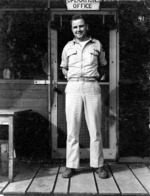 | 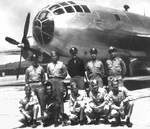 |
Charles Sweeney Timeline
| 27 Dec 1919 | Charles Sweeney was born. |
| 28 Apr 1941 | Charles Sweeney joined the United States Army Air Corps; he would later become the pilot of B-29 Superfortress bomber Bockscar that delivered the atomic bomb on Nagasaki, Japan. |
| 4 May 1945 | Charles Sweeney became the commanding officer of the 393rd Bombardment Squadron, Heavy which was a part of the USAAF 509th Composite Group designated to deliver the atomic bombs when they are ready. |
| 29 Jul 1945 | A test bomb in the shape of the atomic bomb Little Boy, designated L-6, was loaded onto a B-29 bomber. The pilot Charles Sweeney then flew the aircraft from Tinian, Mariana Islands to Iwo Jima, Japan, where emergency procedures for loading the bomb onto a standby aircraft were practiced. |
| 28 Jun 1946 | Charles Sweeney, the pilot of Bockscar that dropped the atomic bomb on Nagasaki, retired from the United States Army. |
| 16 Jul 2004 | Charles Sweeney passed away. |
Did you enjoy this article or find this article helpful? If so, please consider supporting us on Patreon. Even $1 per month will go a long way! Thank you. Share this article with your friends: Stay updated with WW2DB: |


Visitor Submitted Comments
21 Nov 2011 04:44:33 AM
My dad is curtis j sweeney was only uss wasp and the u s s lexington.
18 Jan 2015 05:16:56 AM
Anyone have information about his involvement in Bostons leather businesses?
All visitor submitted comments are opinions of those making the submissions and do not reflect views of WW2DB.
» Atomic Bombing of Hiroshima and Nagasaki
Associated Aircraft:
» B-29 Superfortress
Related Books:
» The Last Train from Hiroshima
- » 1,150 biographies
- » 337 events
- » 44,024 timeline entries
- » 1,242 ships
- » 350 aircraft models
- » 207 vehicle models
- » 375 weapon models
- » 123 historical documents
- » 260 facilities
- » 470 book reviews
- » 28,627 photos
- » 431 maps
George Patton, 31 May 1944

Please consider supporting us on Patreon. Even $1 a month will go a long way. Thank you!

Or, please support us by purchasing some WW2DB merchandise at TeeSpring, Thank you!
28 Jan 2011 05:17:11 AM
Wow...he died two days after I turned Ten. :/ That's a little weird, but really cool at the same time.