


Atlanta
| Country | United States |
| Ship Class | Atlanta-class Light Cruiser |
| Builder | Federal Shipbuilding and Drydock Company, Kearny, New Jersey, United States |
| Laid Down | 22 Apr 1940 |
| Launched | 6 Sep 1941 |
| Commissioned | 24 Dec 1941 |
| Sunk | 13 Nov 1942 |
| Length | 541 feet |
| Beam | 52 feet |
| Draft | 20 feet |
| Speed | 33 knots |
| Crew | 673 |
| Armament | 16x5in, 9x1.1in, 8x21in torpedo tubes |
Contributor: C. Peter Chen
ww2dbaseAtlanta was the lead ship of her class of light cruisers. She had her shakedown training in the Chesapeake Bay off Maryland and then Casco Bay off Maine. After post-shakedown repairs at the New York Navy Yard, she sailed for Panama Canal Zone on 5 Apr 1942 and made her way to Pearl Harbor on 23 Apr. After some anti-aircraft practice, she sailed for Nouméa, New Caledonia with a destroyer, an oiler, and a transport on 10 May. She then joined Task Force 16 and returned to Pearl Harbor in preparation for suspected Japanese offensive in the Midway region. During the ensuing Battle of Midway she screened carrier Hornet. After the battle she remained in Hawaii area for repairs, anti-aircraft and shore gunnery practice, and other non-combat duties until 15 Jul 1942 when she sailed for South Pacific.
ww2dbaseDuring the Guadalcanal Campaign, Atlanta joined Task Force 61 and screened carriers as they launched aerial bombardments against Guadalcanal before the invasion. She remained in the area in the same anti-aircraft role, credited in this period with shooting down several Japanese aircraft. Her executive officer Commander Campbell Emery wrote later "[t]he ship functioned as designed in all respects and can be considered an efficient unit" when describing the experience during this time. On 28 Oct, Rear Admiral Norman Scott broke his flag aboard Atlanta, and the ship became the flagship of Task Force 64.2. With Scott onboard she bombarded Japanese position on Guadalcanal and escorted transports in the nearby waters.
ww2dbaseOn 12 Nov, Atlanta and other ships under the command of Rear Admiral Daniel Callahan were struck by 25 Japanese bombers as they guarded transports and cargo ships in their escape from a suspected Japanese attack. The aerial assault was fought off, but it was followed several hours later by a surface engagement against two Japanese battleships and a full compliment of cruisers and destroyers. The ensuing First Naval Battle of Guadalcanal was a great melee, one of the most ferocious naval engagements in the entire war. At 0150, Japanese search lights were switched on Atlanta, and she became the first target of Japanese guns. As Japanese guns exploded all around the ship, Rear Admiral Scott was killed on the flag bridge, along with many of his senior staff officers. After one or two torpedo hits, Atlanta was dead in the water within minutes of the start of battle. She remained afloat until after day break. At about 1400, Captain Samuel Jenkins noted that all efforts to save the ship were becoming useless, and ordered the ship's abandonment. After evacuation, she was sunk by demolition charges at 2015 on 13 Nov 1942 three miles west of Lunga Point in northern Guadalcanal.
ww2dbaseSources: the Struggle for Guadalcanal, Wikipedia.
Last Major Revision: Mar 2006
Light Cruiser Atlanta Interactive Map
Photographs
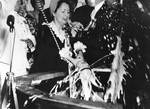 | 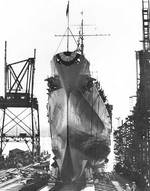 | 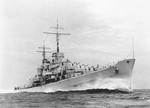 | 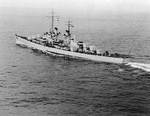 |
Atlanta Operational Timeline
| 24 Dec 1941 | Atlanta was commissioned into service. |
| 25 Oct 1942 | United States Navy Task Force 64 consisting of USS Washington, USS Atlanta, USS San Francisco, USS Helena, USS Lardner, USS Lansdowne, USS Buchanan, USS Fletcher, USS Walke, USS Benham, USS McCalla, USS Aaron Ward, and USS Laffey bound for Savo, Solomon Islands was joined by USS Nicholas as an additional escort. As Nicholas came alongside Washington to exchange mail, Nicholas struck Washington’s side. The battleship was undamaged but Nicholas sustained hull damage from her anchor being pressed into the ship. Nicholas was able to resume her full duties immediately, however. |
| 13 Nov 1942 | Cruiser USS Atlanta was sunk by Type 93 torpedoes launched from Japanese destroyer Akatsuki; destroyer USS Barton was sunk by Type 93 torpedoes launched from Japanese destroyer Amatsukaze; and destroyer USS Laffey was sunk by Type 93 torpedoes launched from unidentified Japanese destroyers. |
| 29 Oct 1945 | Battleship USS Iowa, cruiser USS Atlanta, and destroyer USS Nicholas departed Seattle, Washington bound for San Pedro, California, United States. |
| 1 Nov 1945 | Battleship USS Iowa, cruiser USS Atlanta, and destroyer USS Nicholas arrived at San Pedro, California, United States. |
Did you enjoy this article or find this article helpful? If so, please consider supporting us on Patreon. Even $1 per month will go a long way! Thank you. Share this article with your friends: Stay updated with WW2DB: |


Visitor Submitted Comments
9 Jan 2008 10:55:40 AM
I have tried to determine that myself and it seems to be July 1 and 2nd when she was drydocked for scraping and repainting of her hull. Check out my web site at www.ussatlanta.com and click on the History link.
22 Nov 2010 11:55:38 AM
My Granddad went down with the Atlanta, Im still searching for Action reports from her, any help would be apreittiated, Email me @ BB_22minnesota@live.com
9 Apr 2014 05:41:39 PM
I was aboard the Atlanta as a Radarman during modification and Operation Sailor Hat. Best duty I ever had.
4 Oct 2014 06:30:26 PM
James Rotschafer, Captain Jenkins' diary is on fold3.com about the sinking.
10 Feb 2016 05:06:58 PM
Where is the Atlanta CL-104 don't see it listed where
23 Apr 2022 02:21:13 PM
My father and uncle served aboard the Atlanta CL51. I had the honor of being part of a documentary which included an extensive dive on her. BTW she was hit by one torpedo that exploded and there was a suspected, by some, second hit which didn’t explode. Check out my web site. www.ussatlanta.com
All visitor submitted comments are opinions of those making the submissions and do not reflect views of WW2DB.
» Jenkins, Samuel
» Scott, Norman
Event(s) Participated:
» Guadalcanal Campaign
» Preparations for Invasion of Japan
Document(s):
» US Aircraft Carrier Functions
» US Aircraft Carrier Operational Status By Month
» US Carrier Time Operational
- » 1,150 biographies
- » 337 events
- » 44,164 timeline entries
- » 1,242 ships
- » 350 aircraft models
- » 207 vehicle models
- » 375 weapon models
- » 123 historical documents
- » 260 facilities
- » 470 book reviews
- » 28,642 photos
- » 431 maps
Captain Henry P. Jim Crowe, Guadalcanal, 13 Jan 1943

Please consider supporting us on Patreon. Even $1 a month will go a long way. Thank you!

Or, please support us by purchasing some WW2DB merchandise at TeeSpring, Thank you!
28 Jun 2007 06:43:39 PM
Does anyone know when the Atlanta had her hull painted?