


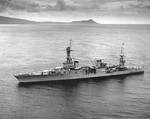
Augusta
| Country | United States |
| Ship Class | Northampton-class Heavy Cruiser |
| Hull Number | CA-31 |
| Builder | Newport News Shipbuilding |
| Laid Down | 2 Jul 1928 |
| Launched | 1 Feb 1930 |
| Commissioned | 30 Jan 1931 |
| Decommissioned | 16 Jul 1946 |
| Displacement | 9,050 tons standard |
| Length | 600 feet |
| Beam | 66 feet |
| Draft | 16 feet |
| Speed | 32 knots |
| Crew | 735 |
| Armament | 9x203mm, 8x127mm, 8x7.62mm anti-aircraft, 6x533mm torpedo tubes |
Contributor: C. Peter Chen
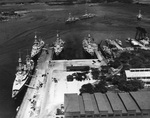
ww2dbaseImmediately after USS Augusta's shakedown and training cruiser, she was assigned as Vice Admiral Arthur Willard's flagship for the Scouting Force. She was re-classified a heavy cruiser in Aug 1931. She performed exercises and fleet problems at various locations in US waters until 20 Oct 1933 when she sailed for China. Arriving at Shanghai, China on 9 Nov 1933, she became the flagship of the Asiatic Fleet. In this role, she made extensive visits to such places as Manila, Yokohama, Kobe, Tsingtao, Hong Kong, Batavia, Bali, Guam, Canberra, Melbourne, and Perth, among others, for the next several years.
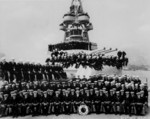
ww2dbaseDuring the Second Battle of Shanghai in Aug 1937, Augusta was moored in Shanghai to observe Japanese maneuvers while her Marine detachment disembarked to guard Shanghai's neutral international zone. While there, she was mistakenly bombed (though the bombs missed) by Chinese aircraft; large American flags were painted atop the three main batteries to prevent similar mistakes. Nevertheless, she still received casualties when Chinese anti-aircraft shells came down on her on 20 Aug, though she remained in Shanghai to provide intelligence on Japanese troops. She finally left on 6 Jan 1938 after the Dec 1937 incident of the Japanese air attack on American gunboat Panay near Nanjing (Nanking). She did, however, made several more trips along the Chinese coast, and made several port calls at Shanghai.
ww2dbaseAfter refitting at Mare Island Navy Yard in California, United States spanning from Dec 1940 to Apr 1941, Augusta was transferred to the Atlantic Fleet as Admiral Ernest King's flagship. In Jun 1941, she was chosen as President Franklin Roosevelt's flagship for the Aug 1941 meeting with Winston Churchill in Argentia, Newfoundland, Canada; Roosevelt and Churchill discussed and finalized the Atlantic Charter aboard Augusta. Roosevelt left the ship on 14 Aug after transferring his flag aboard another ship for his return trip.
ww2dbaseAfter the Japanese attack on Pearl Harbor, Rear Admiral Royal Ingersoll took over the command of the Atlantic Fleet and had his flag aboard Augusta until 12 Jan 1942. She patrolled the waters off of the east coast of the United States, in the Caribbean Sea, and off western Africa. On 23 Oct 1942, Rear Admiral H. Kent Hewitt broke his flag aboard her, making her the flagship of Task Force 34; at this time, General George Patton was among the high ranking officers aboard the heavy cruiser in preparation for the Operation Torch landings in North Africa in the following month. During the landing operations, Augusta escorted the landing transports while at the same time provided the firepower needed to counter French naval and coastal batteries off Casablanca. During an engagement with stationary French battleship Jean Bart, she was straddled by shells, but was not damaged. After the successful landings of Operation Torch, she returned to the Atlantic on convoy duties, including spending some time under British Royal Navy control.
ww2dbaseOn 25 Apr 1944, King George VI of Britain had lunch with Rear Admiral Alan Kirk aboard Augusta.
ww2dbaseIn Jun 1944, Augusta participated in the Normandy campaign as Lieutenant General Omar Bradley's transport. On 6 Jun, she fired 51 rounds from her main battery upon shore targets starting at 0618. On 10 Jun, Bradley disembarked to establish his command on land. On 1 Jul, she sailed for the Mediterranean Sea with Task Group 120.6, making port calls at Mers el Kebir, Palermo, Naples, and Corsica. In Aug 1944, she participated in Operation Dragoon on the coast of Southern France. On 15 Aug, she fired 15 rounds at Port Cros Island, 63 more on the next day, and 138 the day after; the German-French fort on the island surrendered on the last day of Allied naval bombardment. She remained in the area for naval gunfire support for the remainder of the Dragoon operation; by the time Dragoon was drew to a close, she had fired over 700 rounds of 203mm shells.
ww2dbaseIn Sep 1944, Augusta returned to the United States to undergo overhaul and repairs in Philadelphia. In Nov 1944, she suffered a mysterious explosion that killed three shipyard workers and four navy men. She sailed from the shipyard on 26 Jan 1945 for Puerto Rico, and on 21 Feb made a return trip as one of the escorting ships of cruiser Quincy which carried President Roosevelt back from the Yalta Conference. She remained at various locations on the east coast of the United States until the end of the European War. On 7 Jul 1945, she transported President Harry Truman, Secretary of State James Byrnes, and Admiral William Leahy to Antwerp, Belgium for the Potsdam Conference. After the end of the Pacific War, she was modified for Operation Magic Carpet to bring troops home from Europe. She was decommissioned in mid-1946 and sold for scrap on 9 Nov 1959 to Robert Benjamin of Panama City, Florida, United States.
ww2dbaseSource: Wikipedia.
Last Major Revision: Aug 2006
Heavy Cruiser Augusta (CA-31) Interactive Map
Photographs
 |  |  |  |
Videos
 |
Augusta Operational Timeline
| 30 Jan 1931 | Augusta was commissioned into service. |
| 25 Jul 1937 | Destroyer Squadron 29 of US Asiatic Fleet departed Yantai, Shandong Province, China and made rendezvous with USS Augusta at sea. |
| 28 Jul 1937 | USS Augusta and Destroyer Squadron 29 of US Asiatic Fleet arrived at Vladivostok, Russia. |
| 1 Aug 1937 | Destroyer Squadron 29 of US Asiatic Fleet departed Vladivostok, Russia for Yantai, Shandong Province, China while USS Augusta departed the same port for Qingdao, Shandong Province, China. |
| 12 Aug 1937 | USS Augusta delivered 50 Marines and 57 Navy personnel to reinforce the US 4th Marine Regiment stationed at Shanghai, China. |
| 13 Aug 1937 | USS Augusta departed Qingdao, Shandong Province, China with Admiral Harry Yarnell of US Asiatic Fleet aboard. |
| 20 Aug 1937 | While moored in the Huangpu River in Shanghai, China in the evening, the crew of USS Augusta gathered on the well deck for movies. A Chinese anti-aircraft shell intended for a Japanese reconnaissance aircraft flying nearby landed on the American cruiser, killing Seaman 1st Class Freddie J. Falgout and wounding 18 others. |
| 21 Aug 1937 | Photographer Harrison Forman boarded USS Augusta in Shanghai, China to document the event in which an errant Chinese anti-aircraft shell killed one American sailor and wounded 18 others. |
| 22 Apr 1942 | With 68 US Army P-40 Warhawk fighters loaded aboard USS Ranger, Ranger and cruiser USS Augusta departed Narragansett Bay, Rhode Island bound for Trinidad. |
| 28 Apr 1942 | USS Ranger and Augusta arrived at Port of Spain, Trinidad. |
| 29 Apr 1942 | USS Ranger and Augusta continue with their aircraft ferrying assignment and depart Port of Spain, Trinidad bound for Africa’s Gold Coast. |
| 21 May 1942 | USS Ranger and Augusta arrived at Port of Spain, Trinidad. |
| 23 May 1942 | USS Ranger and Augusta departed Port of Spain, Trinidad bound for Quonset Point, Rhode Island. |
| 2 Jun 1942 | USS Ranger and USS Augusta departed Quonset Point, Rhode Island bound for Argentia, Newfoundland. |
| 5 Jun 1942 | USS Ranger and Augusta arrived at Argentia, Newfoundland. |
| 20 Jun 1942 | USS Ranger and USS Augusta departed Argentia, Newfoundland bound for Quonset Point, Rhode Island. |
| 22 Jun 1942 | USS Ranger and USS Augusta arrived at Quonset Point, Rhode Island. |
| 1 Jul 1942 | With 72 US Army P-40 Warhawk fighters loaded aboard USS Ranger, Ranger and cruisers USS Augusta and Juneau departed Narragansett Bay, Rhode Island bound for Trinidad. |
| 6 Jul 1942 | USS Ranger, Augusta, and Juneau arrived at Port of Spain, Trinidad. |
| 8 Jul 1942 | USS Ranger and Augusta continue with their aircraft ferrying assignment and depart Port of Spain, Trinidad bound for Africa’s Gold Coast. |
| 30 Jul 1942 | USS Ranger and Augusta arrived at Port of Spain, Trinidad. |
| 31 Jul 1942 | USS Ranger and Augusta departed Port of Spain, Trinidad bound for Norfolk, Virginia. |
| 5 Aug 1942 | USS Ranger and Augusta arrived at Norfolk, Virginia. |
| 23 Aug 1942 | USS Ranger and Augusta departed Norfolk, Virginia bound for Quonset Point, Rhode Island. |
| 25 Aug 1942 | USS Ranger and Augusta arrived at Quonset Point, Rhode Island. |
| 16 Jul 1946 | Augusta was decommissioned from service. |
Did you enjoy this article or find this article helpful? If so, please consider supporting us on Patreon. Even $1 per month will go a long way! Thank you. Share this article with your friends: Stay updated with WW2DB: |


Visitor Submitted Comments
19 Oct 2015 02:30:18 PM
Wonderful idea Phonse for you to reach out and help behind the scenes. I would also like to be copied on any photos you have available as we would be interested in displaying them at our museum as well as on our website promoting the Atlantic Charter meeting.
1 Apr 2016 03:19:56 PM
Came across a book called 'Atlantic Meeting' written by H.V. Morton [1943]. There are two deck images of President Roosevelt and Winston Churchill aboard the Agusta. Some interesting images of Capt. Elliott Roosevelt aboard the Agusta as well. I don't know how well these images have been distributed in the US over the past years?
1 Jul 2016 06:43:11 PM
I have just recently discovered a library book from aboard the USS Augusta. The last date I can find in it puts it on the ship in 1944. I searched the ship and came to this page first. Any suggestions as to what I should do with this book would be much appreciated! Thank you
11 Nov 2016 08:27:33 PM
My father, Joseph Goldstein was a Chief Petty Officer on that ship during WW2
11 Nov 2016 08:37:09 PM
If you come across photos that need retouching, I would be most happy to help out. I can take care of that and hopefully restore to the best quality possible
20 Jan 2017 05:37:51 PM
Hello, I am trying to find a crew manifest... I was told my grandfather served on this ship.. where doI start?
 David Stubblebine says:
21 Jan 2017 12:16:22 PM
To Anthony Stover (above):
To find out more about your grandfather’s Navy service, the best starting point is to see his service record. You can request a copy from the National Archives. See: https://www.archives.gov/veterans/military-service-records.
Additionally, Fold3.com has very complete Muster Rolls for WWII ships but this is a subscription site that will cost you money to access. I know of no free source to see these records except to visit the National Archives in person (St Louis, MO for Navy service records and College Park, MD for most other Navy records).
28 Sep 2017 03:39:39 PM
My grandfather serve on this ship his name was Robert dishman bock is there any info on him?
6 Oct 2017 11:06:55 AM
I am writing a history of FDR's meeting with Churchill off Newfoundland in 1941. It's a long shot but I wonder if any crew members aboard the USS Augusta are still alive? If anyone knows of anyone please reply. Thank you
9 Dec 2017 02:59:41 PM
My dad, John Leimbach, was on this ship all during WWII, he was only 16 when he signed up. The only thing he ever mentioned was the events when the Presidents were on board. He never even mentioned to us his ship was the flagship during the Normandy Invasionl He started having nightmares and flashbacks on his deathbed, that is the first time we ever heard of the horror he witnessed. Unfortunately, we lost him on December 14, 2000 at the age of 77. I have original his John Wanamaker Department Store Photo displayed in my home along with his discharge pin. My brother has his full uniform as well.
31 Jan 2018 01:10:11 PM
I had a friend; now deceased; who served on the U.S.S. Augusta before, and after Pearl Harbor. He was a storekeeper, and spoke very well of his ship, and shipmates.
2 Mar 2018 03:48:14 AM
My father James Ritchie USMC was on the Augusta operation torch. I am trying to find the crew list for that 1942 invasion. I once found it but cannot now.
Thank you
20 Apr 2018 02:51:18 PM
My grandfather Jonas Bolanz Weil served on the Augusta.
9 Jul 2018 08:44:29 AM
My father, Jesse Wallace, was the CO of the USS Augusta (or the Augi-maru) as he referred to it.
12 Sep 2018 09:23:49 AM
My fathers name at the time he was on the ship was Joseph Goldstein. He was Chief Petty Officer. He would get aspirin for President Roosevelt when he was meeting with Churchill and Stalin. Is there an official list for the crew?
18 May 2019 08:54:17 AM
My father was Walter Harry Dunnican. He served on the Augusta right out of USNA Class of 45.
He is the Ensign in the picture of Truman and King George
https://ww2db.com/image.php?image_id=17123
He Passed away in 1961.
All visitor submitted comments are opinions of those making the submissions and do not reflect views of WW2DB.
» Second Battle of Shanghai
» Atlantic Charter Conference
» Operation Torch
» Normandy Campaign, Phase 1
» Invasion of Southern France
- » 1,150 biographies
- » 337 events
- » 44,024 timeline entries
- » 1,242 ships
- » 350 aircraft models
- » 207 vehicle models
- » 375 weapon models
- » 123 historical documents
- » 260 facilities
- » 470 book reviews
- » 28,630 photos
- » 431 maps
Winston Churchill, 1935

Please consider supporting us on Patreon. Even $1 a month will go a long way. Thank you!

Or, please support us by purchasing some WW2DB merchandise at TeeSpring, Thank you!
3 Oct 2015 01:22:58 PM
I am seeking photo of inside of USS Augusta,I am looking for photo of the conference table the atlantic charter was drafted on,would appreciate any help you can assist.We have the conference table in our museum and am looking for photo of it on the USS Augusta.Would also would like to give you permission to pass this along to all navy associations,thankyou.