


Texas
| Country | United States |
| Ship Class | New York-class Battleship |
| Builder | Newport News Shipbuilding |
| Laid Down | 17 Apr 1911 |
| Launched | 18 May 1912 |
| Commissioned | 18 Mar 1914 |
| Decommissioned | 21 Apr 1948 |
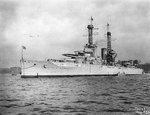
| Displacement | 27,000 tons standard |
| Length | 573 feet |
| Beam | 106 feet |
| Draft | 29 feet |
| Speed | 21 knots |
| Crew | 954 |
| Armament | 10×14-in, 21x5-in, 4x3-lb, 4x21-in torpedo tubes |
Contributor: C. Peter Chen
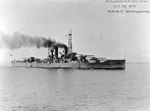
ww2dbaseCommissioned in 1914, the battleship Texas first saw action on 26 May 1914 off Veracruz, Mexico as she supported the US expedition that seized a custom house. She returned to the US on 8 Aug and joined the Atlantic Fleet on 6 Sep. She served a second tour off Mexico between Oct and Dec 1914. During WW1, she trained gunnery crews for service on merchant ships between Apr and Aug 1917, spent some time under repairs, then sailed for Britain on 30 Jan 1918. She joined Division 9/6th Battle Squadron of the Britain's Grand Fleet on 11 Feb at Scapa Flow, and performed convoy duties and a few sorties. On 20 Nov 1918, she sailed with the Grand Fleet to meet the surrendering German fleet. During the inter-war years, she became the first American battleship to carry an aircraft and then served in both Pacific and Atlantic Oceans. In Jan 1928, she served as President Calvin Coolidge's ship to Havana, Cuba, for the Pan-American Conference.
ww2dbaseWhen the European War began on 1 Sep 1939, Texas was the flagship of the Atlantic Squadron. She performed neutrality patrols and performed convoy missions for transports bound for Britain. After the United States was engaged in WW2, she patrolled and performed convoy missions all over the Atlantic, though she found herself bound for Britain most frequently.
ww2dbaseOn 23 Oct 1942, Texas set sail as a member of Task Group 34.8 for North Africa. She arrived at Port Lyautey in the morning of 8 Nov and engaged in bombardment in the afternoon of that day. She cruised along the Moroccan coast for the following week to offer gunfire support whenever needed. She used 273 rounds of her 14-inch ammunition and six rounds of her 5-inch ammunition during the week. She returned to the United States on 16 Nov and continued to perform convoy duties.
ww2dbaseAt the night of 5 Jun 1944, Texas sailed from southern England to support the Normandy landings the next morning. At about 0650 in the morning of 6 Jun, Texas was among the massive fleet that fired thousands of rounds at coastal fortifications, beach obstacles, and inland transportation junctions. In the morning of 7 Jun, her 14-inch main battery broke up German troop concentrations at Surrain and Trevieres; at that evening, she destroyed a mortar position that had been plaguing beach operations. In the morning of 8 Jun, she fired on Isingny and Trevieres. Between 11 and 15 Jun, she provided support for the advancing Allied forces. After the troops moved out of the range of her guns, she moved to Cherbourg with battleship Arkansas and bombarded fortifications surrounding the port city. A 280-mm shell from one of the Cherbourg coastal guns struck Texas at the fire control tower, kill one and wounding many on the bridge; some time later, a 240-mm armor piercing shell hit her on port bow, but it did not explode. Despite the two hits, she continued to fire her primary guns until she retired at 1600. She sailed to Plymouth, England, for repairs for damage received during the Normandy campaign.
ww2dbaseOn 15 Jul 1944, Texas departed Belfast Lough for Tunisia in preparation of an invasion of southern France. On 15 Aug, she arrived off St. Tropez during the night. At 0651 the next morning, she began the pre-landing bombardment on defensive fortifications. She remained in the immediate region for the following two days to provide support until the land troops marched past her range. She left the French coast on 16 Aug and returned to New York for repairs.
ww2dbaseThree months later, Texas sailed for the Pacific. She reached Pearl Harbor in Dec 1944 and departed for Ulithi on 10 Feb 1945, where she prepared to support the invasion of Iwo Jima. She was one of the vessels that bombarded the island for nearly three days, and then remained in the waters nearby to provide gunfire support. She left Iwo Jima in late Feb and returned to Ulithi to prepare for the invasion of Okinawa. She fired shells from her main guns for six days with no answer from the shore; only aircraft attempted to interfere, but Texas escaped any harm. The ground troops attacked on 1 Apr, and the battleship remained for nearly two months to provide support.
ww2dbaseIn late May 1945, Texas retired to leyte where she lay at anchor when the war ended. On 23 Sep, she left Okinawa with troops for San Pedro, California, United States. She made three more round trips between Hawaii and California in 1945 to bring servicemen home.
ww2dbaseTexas was decommissioned in 1948. She was towed to San Jacinto State Park where she became a museum ship. For more information, please see Dennis Mitchell's USS Texas BB-35 website.
ww2dbaseSource: Wikipedia.
Last Major Revision: Jan 2007
Battleship Texas Interactive Map
Photographs
 |  |  |  |
Texas Operational Timeline
| 18 Mar 1914 | Texas was commissioned into service. |
| 14 Sep 1939 | Aircraft carrier USS Ranger and battleships USS New York and Texas are designated as a striking force held in reserve at Hampton Roads, Virginia in support of destroyers and Coast Guard cutters on Neutrality Patrols in the Atlantic. |
| 8 Oct 1943 | USS Texas began escorting an Allied convoy from New York, New York, United States to Britain. |
| 12 Nov 1944 | USS Missouri, Texas, Arkansas, Shamrock Bay, Wake Island, and a destroyer escort departed Norfolk, Virginia, United States bound for the Panama Canal. |
| 17 Nov 1944 | USS Missouri, Arkansas, and Texas entered the Panama Canal and anchored in Gatun Lake overnight. |
| 18 Nov 1944 | USS Missouri, Texas, Arkansas, Shamrock Bay, and Wake Island completed their transit of the Panama Canal. |
| 21 Apr 1948 | The battleship USS Texas (BB-35) was taken over by the State of Texas to be preserved as a memorial in a specially-dredged canal in San Jacinto State Park, Texas, United States. |
Did you enjoy this article or find this article helpful? If so, please consider supporting us on Patreon. Even $1 per month will go a long way! Thank you. Share this article with your friends: Stay updated with WW2DB: |


Visitor Submitted Comments
18 Dec 2006 03:45:29 PM
I understand it all her action no one on ship was killed
19 Dec 2006 03:30:16 AM
Actually, there was only one combat fatality- Helmsman Chris Christensen was at the wheel on the Bridge when the German shell hit the armored conning tower directly beneath the Bridge. The blast was deflected upwards due to the heavy armor of the Conning Tower (which was the original Bridge of the ship back in 14) and Helmsman Christensen bled out down in the Operating Rm. Capt. Baker was knocked silly briefly as he was right on the outside of the Bridge and all the other crew in the Bridge were wounded- some severe and some not so severe.
As for peacetime deaths, there were a few that I know of: a shell fell on a crewmember during replenishment and crushed him, a CPO had a heart attack sometime in the 30s, probably a couple more that I am unaware of.
19 Dec 2006 03:48:25 AM
Oops, forgot the date: 25 June, 1944, off the coast of Cherbourg. Wikipedia has a couple of discrepencies in their description of the ships service: she departed Belfast, bound for Algeria, on July 15- not June 16th, 44. She arrived off St Tropez on Aug 15, 44- not July 14th. See this link for a lot of the technical information: http:www.bb35library.com
Please remember that we give special Hard Hat Tours of areas that are off-limits to the public to fund our restoration work! Go to http:www.usstexasbb35.com for more info and booking. Hope to see you folks aboard in 2007 (we only have these tours until the weather gets warm- which is about April in south TX).
12 Feb 2010 06:01:24 PM
Is there another record somewhere on the combat fatality and wounded? I know my father was wounded and I told another killed on board the Texas during the D-Day invasion.
12 Jun 2011 12:23:55 PM
My father was a radio man on the USS Texas during WWII. I was wondering if there was anyone here remember him. His name was Ralph E. Wood.
15 Nov 2011 12:20:32 PM
I grew up within bicycle distance from SJSP. I love the Big T. If anyone has not seen her, it's about time ya did.
12 Apr 2012 10:27:46 AM
I am trying to find my uncle Arthur P. Welch's name on the roster or something. He served from approx 1942-1944 when they docked in England before the invasion on Normandy and was hit and killed by a bus in 1944. He has no children to carry on his name and anything or anywhere I can find out something about his service would be gratefully appreciate. He was from Newburyport Massachusetts..he was 33 years old when he was killed. Thank you so very much.
4 Apr 2013 02:31:27 PM
My father George Albert Foster was on the Texas during WW2 and I remember a picture of the crew on deck showing the rooster flag.We are trying to get info on his battle ribbons and medals.
26 Sep 2013 11:44:10 AM
I am trying to find when my father served on the Texas. His name was Calvin Thomas Redden. I thnk it was around 1939
Thank You, John
24 Feb 2014 01:30:27 PM
One of the WWII veterans here in North Carolina who was aboard the USS Texas in the Atlantic and the Pacific as a gunner died February 23, 2014. I was hoping he could visit his old ship on more time, but he did not. Rev. A. Sykes
3 May 2014 12:07:34 PM
Dear Rev. A Sykes: My dad was also a gunner on the USS Texas. His name was Herman Deane. He passed Nov. 1994. I have pics and a book with info on the ship my dad left me. I could email some of this to you if u would like.
Sincerely, Therese
23 May 2014 11:27:21 PM
My Father was born in Mexico City in 1909. In 1914, when the USS Texas was sent to Vera Cruz during the Mexican Revolution, Americans in Mexico were told to go to Vera Cruz and board the Battleship for safe harbor. My Grandmother and Dad went by train. The ship's tailor made my Dad a white cotton twill sailor suit complete with bell-bottom trousers, a laced up fly and a flap at the back of the neck. The little suit, which I have still have today is 100+ years old. I don't know how long they had to remain on board. Our family loves the old girl and are so proud of her long, remarkable service. -Houston, TX-
6 Jul 2014 05:17:06 AM
have some photographs of arthur pearson on the deck of uss texas dated 1913
19 Jul 2014 11:06:55 AM
I have some photographs of Lieutenant Arthur Pearson taken on 7th of May 1914 on the deck of the USS Texas taken by his wife Gurtie. I would happily send copies to the family if there are any. John
13 Dec 2014 06:27:18 AM
My father just passed away on Nov. 3, 2014. My father, Code Pennington, was a helmsman on the Texas during WW II. He was relieved by the helmsman who was killed and was awoken to steer the ship from below after the attack. So proud of his service and of all the men and women who have served.
24 Mar 2015 04:02:51 PM
My Dad was on the Texas at least at Iwo Jima.
He was a cook, maybe even the captians cook if they had that???He always wanted to visit the ship but i never got to take him. I found 2 silk squares maybe place settings or napkins if anyone knows. He would have either gone by the name Charles E. Cucknell. Or Charles E. Cooke, im not sure when he changed his name.
Is there any type of database on the crew?? i know that would be a long list but i thought i would ask.
Thanks All.
27 Jun 2015 09:27:13 PM
Ancestry.com has US World War II Navy Muster Rolls from 1938-1949. Here is a link to begin your search:
http://search.ancestry.com/search/db.aspx?dbid=1143
10 Aug 2015 11:29:56 AM
My brother Michael De Cesare served on the Texas from 1942-1945. Passed away in 2005. Miss him a lot.
17 Oct 2015 12:43:08 PM
I was watching a documentary on WW2 on a German channel, even though I don't understand German, I found the commentary on the USS Texas very impressive and tried to know more about the USS Texas. This is how I landed on this page.
17 Feb 2016 04:39:08 PM
My father was on the Texas in WW2 I was wondering if there was a crew listing or if could find out when he served onboard. Has was Robert G Anderson .
Thanks
 David Stubblebine says:
17 Feb 2016 08:21:02 PM
To Ron Anderson:
The Muster Rolls for the USS Texas show Apprentice Seaman Robert G. Anderson USN #300-22-20 of Chicago, IL who enlisted 29 Oct 1940 was received aboard USS Texas 21 Dec 1940 from the Great Lakes Naval Training Station and on 3 Apr 1943 Water Tender 2nd class Robert G. Anderson was transferred off USS Texas to the Receiving Station at Philadelphia, PA.
11 Sep 2016 02:09:48 PM
Looking to find record or information on
Gregory G. Bucilla, Lieutenant - USS TEXAS
Battleship 1943 - 1945
Please assist.
Son
9 Oct 2016 05:40:16 PM
I am looking for any info on LT. (lg) Garrett B. James in his service on the Texas during WWII .
13 Feb 2017 03:21:23 PM
My grandfather Oliver Pierce was on this ship. He passed away last week at the age of 98, and was still doing well until then.
4 Mar 2017 10:26:53 AM
I have a photo of lieutenant Arthur pearson standing on the deck of uss texas on may 7 1914 ,it was taken by his wife gurtie .anyone know of him
12 Jun 2017 06:28:23 PM
I was looking through pictures o USS
TEXAS and saw a group of engineers and saw a man named pierce,.I m a pierce and was wondering if you and your grandfather and I were related.i was sorry to hear of his death,I thank him and all ww2 veteran because they saved the world for us.dwp
7 Aug 2017 05:38:08 PM
My father in law was Lloyd D Nelson-Jerry is the name he went by. Would be interested in knowing the dates he was on the USS Texas. I do have his medical records and a letter saying his other records are lost. I also have several photos I would love to make copies and sent to the families of crew members. Thank you for all you do with this site. Vicki
5 Jul 2018 02:13:49 PM
Uncle Leo Francis Stout hitchhiked from Iowa @ 16 in 1923 to Chicago joined the navy served USS TEXAS 1923-1927rated as an engineer was involved with the modernization of the Texas- handpicked & plank owner of the Saratoga last ship Medusa - killed 1932
24 Oct 2018 03:57:19 PM
Would like to know the names of usmc personnel aboard the USS Texas Jan-April, 1942
21 Jan 2019 02:07:43 PM
I've got the Detachment photograph with all names from June 1944.
5 Jun 2019 06:42:32 AM
What was the total tonnage sunk by the USS TEXAS in her lifetime?
Alan Chanter says:18 Feb 2020 02:54:34 AM
The USS Texas achieved a number of notable firsts: it was the first US battleship to mount anti-aircraft guns and to control gunfire with directors and range-keepers (forerunners of today’s computers); it was the first US battleship to launch an aircraft, from a platform on No.2 turret; and it was the first US naval vessel to host a permanently assigned contingent of marines. But by World War Two, the Texas was already showing her age and much of its equipment was already obsolete.
10 Jun 2020 08:29:40 AM
I had a family member who served aboard the USS Texas on D-Day and would love to see or get a copy of the detachment photo if at possible.
14 Oct 2023 12:31:42 AM
The Texas is also the only remaining ship to see action in both World Wars.
All visitor submitted comments are opinions of those making the submissions and do not reflect views of WW2DB.
» Start of the Battle of the Atlantic
» United States Neutrality Patrol
» Operation Torch
» Normandy Campaign, Phase 1
» Invasion of Southern France
» Battle of Iwo Jima
» Okinawa Campaign
- » 1,150 biographies
- » 337 events
- » 44,024 timeline entries
- » 1,242 ships
- » 350 aircraft models
- » 207 vehicle models
- » 375 weapon models
- » 123 historical documents
- » 260 facilities
- » 470 book reviews
- » 28,625 photos
- » 431 maps
Thomas Dodd, late 1945

Please consider supporting us on Patreon. Even $1 a month will go a long way. Thank you!

Or, please support us by purchasing some WW2DB merchandise at TeeSpring, Thank you!
17 Dec 2006 07:23:10 PM
She also was the first battleship to have an experimental new thing called radar back in the 1930s. The German shell that struck the ship and didnt explode is on display in the forecastle. Some folks touch it for good luck...kinda like Irelands Blarney Stone I guess. Great looking page youve got here!