


Błyskawica
| Country | Poland |
| Ship Class | Grom-class Destroyer |
| Builder | J. Samuel White, Cowes, Britain |
| Laid Down | 1 Sep 1935 |
| Launched | 1 Oct 1936 |
| Commissioned | 25 Nov 1937 |
| Decommissioned | 1 May 1976 |
| Displacement | 1,975 tons standard |
| Length | 374 feet |
| Beam | 37 feet |
| Draft | 11 feet |
| Speed | 39 knots |
| Crew | 192 |
| Armament | 8x102mm anti-aircraft, 4x40mm anti-aircraft, 4x20mm anti-aircraft, 6 torpedo launchers |
Contributor: C. Peter Chen
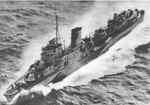
ww2dbaseBłyskawica was a British-built destroyer of the Polish Navy. On 29 Aug 1939, she was among the three destroyers that participated in Operation Peking, aimed at preventing the total loss of the Polish Navy in the likely case of a war with Germany. After an uneventful run-in with German light cruiser Königsberg and a destroyer, the destroyers made rendezvous with British destroyers Wanderer and Wallace, then at 1737 on 1 Sep they docked in Edinburgh. She remained in service under the Polish banner (though under command of the British Royal Navy) for the remainder of the war. On 7 Sep 1939, she made contact with a German submarine, resulting in possibly the first combat between Allied and Axis warships. In May 1940, Błyskawica and her sister ship Grom bombarded German positions and downed two German aircraft off the coast of Norway; Grom was sunk during that campaign. During the German invasion of France, she helped evacuate French and British troops from Dunkirk during Operation Dynamo. In 1941, her 120mm guns were replaced with British 102mm anti-aircraft guns.
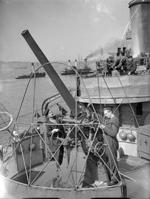
ww2dbaseOn the nights of 4 and 5 May 1942, 160 German bombers raided the shipyards at the Isle of Wight town of Cowes; Błyskawica was coincidentally there for repairs and helped to defend the shipyard with her anti-aircraft weapons. Although the shipyards and the town suffered serious damage from the raids, Błyskawica's quick plunge into action possibly saved the town from worse fate.
ww2dbaseFor the remainder of the war, Błyskawica performed convoy and patrol duties in the Atlantic Ocean and the Mediterranean Sea. She and other British warships engaged in battle with German destroyers on 8 Jun 1944 off Ushant, France, in the English Channel.
ww2dbaseBłyskawica returned to Poland after the war. On 1 May 1976 she became a museum ship in the Baltic port city of Gdynia. She is now the oldest preserved destroyer in world.
ww2dbaseSource: Wikipedia.
Last Major Revision: Apr 2007
Destroyer Błyskawica Interactive Map
Photographs
 |  |  |  |
Błyskawica Operational Timeline
| 25 Nov 1937 | Błyskawica was commissioned into service. |
| 4 May 1942 | Polish destroyer Błyskawica was undergoing an urgent refit at the J Samuel White shipyard at Cowes on the Isle of Wight, United Kingdom (the same shipyard where she was built) when the area was bombed by the German Luftwaffe, dropping 200 tons of bombs. Błyskawica left her moorings, anchored outside the harbor, and opened up such a fierce and lengthy anti-aircraft barrage that her guns had to be doused with water and more ammunition had to be ferried across from Portsmouth. Generally considered a successful raid from the German point of view, Błyskawica is credited with keeping it from being much worse. |
| 1 May 1976 | Błyskawica was decommissioned from service. |
Did you enjoy this article or find this article helpful? If so, please consider supporting us on Patreon. Even $1 per month will go a long way! Thank you. Share this article with your friends: Stay updated with WW2DB: |


Visitor Submitted Comments
18 Jan 2020 06:20:52 PM
My father Edmund Urbanski was on the Grom as well and on the suicide run to Murmansk during WW2. I have been looking for some additional information on him and the Grom.
19 Sep 2020 03:04:19 PM
the Blyskawica, the Polish destroyer which saved our town, in the air raid. Another reason for my love for the Polish people! If you Google the name, you will be told the story of the battle. My father helped to build the ship, which is now on display at Gdynia in Poland, where I have seen it, on a visit. The Grom was also built at my father's shipyard. Thank God, and the Blyskawica, that I am still alive.
Blessings,
David Jones
21 Oct 2021 06:52:54 AM
My father DWT Cuthbert ditched in the Mediterraenean while serving in the RAF possibly 1943. He was a navigator on a Wellington Mk4 bomber.After 4 days in and out of a dingy with a broken jaw his crew were rescued by the Blyskawica. Dad served the rest of the war in S.Africa.
All visitor submitted comments are opinions of those making the submissions and do not reflect views of WW2DB.
» Operation Peking
» Invasion of Denmark and Norway
» Invasion of France and the Low Countries
- » 1,150 biographies
- » 337 events
- » 43,917 timeline entries
- » 1,241 ships
- » 350 aircraft models
- » 207 vehicle models
- » 374 weapon models
- » 123 historical documents
- » 260 facilities
- » 470 book reviews
- » 28,541 photos
- » 432 maps
Captain Henry P. Jim Crowe, Guadalcanal, 13 Jan 1943

Please consider supporting us on Patreon. Even $1 a month will go a long way. Thank you!

Or, please support us by purchasing some WW2DB merchandise at TeeSpring, Thank you!
5 Sep 2016 08:35:12 PM
My dad Joseph K Mozdzanowski server on two Polish destroyers during ww2. One was the Grom but I'm not sure of the other one. He was sunk twice, once in Norway. Since he passed we are trying to get a manifest indicating he served on those ships. All help is appreciated.