


Juneau
| Country | United States |
| Ship Class | Atlanta-class Light Cruiser |
| Hull Number | CL-52 |
| Builder | Federal Shipbuilding and Drydock Company, Kearny, New Jersey, United States |
| Laid Down | 27 May 1940 |
| Launched | 25 Oct 1941 |
| Commissioned | 14 Feb 1942 |
| Sunk | 13 Nov 1942 |
| Displacement | 6,826 tons standard; 8,470 tons full |
| Length | 542 feet |
| Beam | 53 feet |
| Draft | 21 feet |
| Machinery | Two geared turbines, two screws |
| Power Output | 75,000 shaft horsepower |
| Speed | 32 knots |
| Crew | 673 |
| Armament | 8x2x127mm Mark 12 guns, 4x4x28mm AA guns, 8x20mm Oerlikon AA cannons, 8x533mm torpedo tubes, 6x depth charge projectors, 2x depth charge tracks |
| Armor | 20-95mm belt, 32mm deck, 32mm turrets, 63mm conning tower |
Contributor: C. Peter Chen
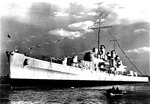
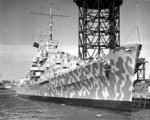
ww2dbaseThe first Juneau of the Atlanta-class light cruisers was designated CL-52 in the United States Navy. She was commissioned three months after the United States entered WW2 with Captain Lyman K. Swenson in command. She had an accelerated shakedown cruise along the Atlantic coast due to the demand of the war and sailed for the Caribbean Sea to patrol off Maritinique and Guadeloupe Islands against Vichy French naval forces in the region. After some time in the North Atlantic, she departed from the Caribbean Sea for the Pacific Theater on 22 Aug 1942. She joined Rear Admiral Leigh Noyes' Task Force 18 on 19 Sep 1942. On 15 Sep, carrier Wasp was hit by three torpedoes from the Japanese submarine I-19, and was scuttled by destroyer Lansdowne at 2100 that evening; Juneau and destroyers rescued the survivors and delivered them to Espiritu Santo, New Hebrides, on 16 Sep. On 17 Sep, she joined Task Force 17 and sailed for Guadalcanal. On 26 Oct, she participated in the Battle of Santa Cruz Islands, where she was a part of the anti-aircraft screen that together downed about 20 Japanese aircraft during the battle; however, the screen was not able to save carrier Hornet, which was badly damaged and sank the next day. Because of the loss of Hornet, Juneau was transferred to the Enterprise group to provide additional anti-aircraft capability just in time for the next round of Japanese air attacks before the battle waned several hours later. On 8 Nov, she sailed from Nouméa, New Caledonia as a unit of Task Force 67 under the command of Rear Admiral Richmond K. Turner to escort transports to Guadalcanal. During the day of 12 Nov, the convoy was attacked by Japanese torpedo bombers, and Juneau, once again as anti-aircraft ship, downed six. That evening, the convoy was engaged in what was later named the First Naval Battle of Guadalcanal. Cruisers Helena, Portland, and Juneau sailed in a close line into the battle; one of the torpedoes of a spread that aimed at the group of three ships struck Juneau on the port side, disabling her almost at the onset of the battle, rendering her useless. On the next day, she sailed for Espiritu Santo for repairs, but was intercepted by Japanese submarine I-26 and was hit by two torpedoes. She exploded, broke in two, and sank. Helena and San Francisco, both damaged from the previous night's battle, continued on without turning back to rescue Juneau's survivors. More than 100 survivors floated on the open waves, waiting for rescue that would not arrive for another eight days; by then, only 10 remain. Captain Swenson also died while waiting for the rescuers.
ww2dbaseThe second Juneau of the Altanta-class was launched during the war (15 Jul 1945) but WW2 ended before she was completed and commissioned; she was designated CL-119 in the US Navy.
ww2dbaseSource: Wikipedia.
Last Major Revision: Jun 2007
Light Cruiser Juneau (CL-52) Interactive Map
Photographs
 |  |  |  |
Juneau Operational Timeline
| 27 May 1940 | The keel of light cruiser Juneau was laid down by Federal Shipbuilding and Drydock Company in Kearny, New Jersey, United States. |
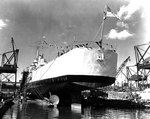
| 25 Oct 1941 | Juneau was launched at the Federal Shipbuilding and Drydock Company yard in Kearny, New Jersey, United States, sponsored by wife of Mayor Harry Lucas of Juneau, US Territory of Alaska. |
| 14 Feb 1942 | USS Juneau was commissioned into service with Captain Lyman K. Swenson in command. |
| 20 Feb 1942 | Chiaki Matsuda was made the commanding officer of old battleship Hyuga. |
| 1 Jul 1942 | With 72 US Army P-40 Warhawk fighters loaded aboard USS Ranger, Ranger and cruisers USS Augusta and Juneau departed Narragansett Bay, Rhode Island bound for Trinidad. |
| 6 Jul 1942 | USS Ranger, Augusta, and Juneau arrived at Port of Spain, Trinidad. |
| 22 Aug 1942 | USS Juneau set sail from the Caribbean Sea for the Pacific Theater of War. |
| 16 Sep 1942 | USS Juneau arrived at Espiritu Santo, New Hebrides and disembarked survivors of USS Wasp. |
| 17 Sep 1942 | USS Juneau was assigned to Task Force 17 and departed from Espiritu Santo, New Hebrides for Guadalcanal, Solomon Islands. |
| 19 Sep 1942 | USS Juneau was assigned to Task Force 18. |
| 5 Oct 1942 | Task Force 17 (USS Hornet, Northampton, Pensacola, Juneau, San Diego, 3 destroyers) struck Japanese installations around the southern end of Bougainville in the Solomon Islands (Buin-Faisi-Tonolai Raid). |
| 26 Oct 1942 | USS Juneau served as a part of the anti-aircraft screen during the Battle of Santa Cruz Islands. |
| 8 Nov 1942 | USS Juneau departed Nouméa, New Caledonia. |
| 12 Nov 1942 | During the day, USS Juneau downed six Japanese aircraft while protecting Task Force 67. After sundown, during the First Naval Battle of Guadalcanal, she was struck by a torpedo on the port side, rendering her useless. |
| 13 Nov 1942 | USS Jueanu, while sailing for Espiritu Santo, New Hebrides for repairs sustained during the previous night, was intercepted by I-26, which fired two Type 95 torpedoes. One struck on the port side, sinking the light cruiser very quickly. 687 lives would eventually be lost; only 10 survived. |
| 17 Mar 2018 | In the Solomon Islands, the crew of Research Vessel Petrel made sonar contact with what would later be identified as the wreck of USS Juneau. |
| 18 Mar 2018 | In the Solomon Islands, the crew of Research Vessel Petrel identified the wreck that they had found on the previous day was that of USS Juneau. |
Please consider supporting us on Patreon. Even $1 per month will go a long way! Thank you. Please help us spread the word: Stay updated with WW2DB: |


Visitor Submitted Comments
11 Nov 2010 09:02:36 AM
My great uncle parished on the USS Juneau. His name was James Edward Mallett. He was just 18 yrs old.
13 Nov 2010 09:49:00 AM
My Dad was one of the survivors ( Henry J. Gardner)...he spoke of how he survived in the shark infested waters and saw many die. He also had written a short account of his story for the Navy. Although he may not have been "top-notch" in rank, he will ALWAYS be a man I will respect, honor and love. He passed away in 1984. RIP Dad.
1 Dec 2010 11:45:52 AM
My uncle James Edward Mallett, whom I never got to meet. Died on The USS Juneau.
My mother Janet Pitchford still talks about him.
25 Oct 2015 08:19:14 PM
My husband's brother died on the USS Juneau CL-52 He was
21 years old. I wonder if they will ever find any debre of the
ship-they did go to the bottom and take pics of the Atlanta--
there has to be some wreckage-quite a bit on the Atlanta even
tho' one person said it was burning from one end to the other
and they blew it up after taking survivors off.
11 Jan 2018 05:32:08 PM
I have been working on a Silent Hero project for my ww2 seminar and have researched a man named Clarence Daniel Powell who was a 25 year old coxswain aboard the ship, presumed MIA. Is truly a tragic story may all 673 men aboard rest in peace
21 Mar 2018 09:21:18 AM
My Great Uncle Jimmy was on died on the Juneau. I never met him either but my father talked about hi all the time.
23 Mar 2018 08:04:43 AM
Juneau has been found by Paul Allen's people on the R/V Petrel.
13 Apr 2018 06:13:09 AM
I understand that my distant cousin John Walker Page, Jr. son of John Walker Page, Sr. from White Sulphur Springs, W. VA was listed as missing January 26th 1942 or 1943 on the navy department casualty list. Mrs. Imelda Hughes Smith of Charleston was noted as a cousin. If anyone has more information on John please email me. Thank you. I am doing an extensive Ancestory study on my relatives.
13 Mar 2021 06:05:12 AM
My grandfather's older brother (Elmer J. Travis, Sea 2nd class), from Liberty NY, went down on the Juneau. Wish I could find a pic of him. RIP, thank you for your sacrifice! (...and all the others!)
31 May 2021 06:45:18 AM
Danny Camden looking for pictures of Elmer J Travis, Liberty,NY.
All visitor submitted comments are opinions of those making the submissions and do not reflect views of WW2DB.
» Guadalcanal Campaign
» Solomon Islands Campaign
Document(s):
» Letters between Alleta Sullivan and Franklin Roosevelt
- » 1,159 biographies
- » 337 events
- » 44,601 timeline entries
- » 1,243 ships
- » 350 aircraft models
- » 207 vehicle models
- » 376 weapon models
- » 123 historical documents
- » 261 facilities
- » 470 book reviews
- » 28,639 photos
- » 429 maps
Winston Churchill

Please consider supporting us on Patreon. Even $1 a month will go a long way. Thank you!

Or, please support us by purchasing some WW2DB merchandise at TeeSpring, Thank you!
17 May 2010 08:41:26 AM
My grandfather was one of the 10 survivors, Henry Gardner. If he did not survive my dad would have never been born, nor I.