


Canberra (Baltimore-class)
| Country | United States |
| Ship Class | Baltimore-class Heavy Cruiser |
| Builder | Bethlehem Fore River Shipyard |
| Laid Down | 3 Sep 1941 |
| Launched | 19 Apr 1943 |
| Commissioned | 14 Oct 1943 |
| Decommissioned | 7 Mar 1947 |
| Displacement | 13,600 tons standard |
| Length | 673 feet |
| Beam | 71 feet |
| Draft | 26 feet |
| Machinery | General Electric geared turbines with four screws |
| Power Output | 120,000 shaft horsepower |
| Speed | 33 knots |
| Crew | 1,142 |
| Armament | 9x203mm guns, 12x127mm guns, 48x40mm guns, 24x20mm guns |
| Armor | 6in belt, 8in turrets, 2.5in deck, 6.5in conning tower |
| Aircraft | 4 |
| Recommissioned as Boston-class cruiser | 15 Jun 1956 |
| Final Decommission | 2 Feb 1970 |
Contributor: C. Peter Chen
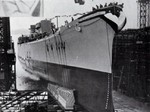
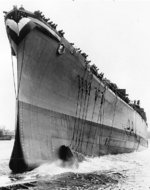
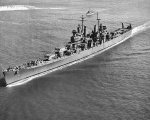
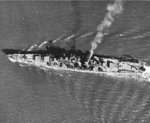
ww2dbaseUSS Canberra was named after the Australian ship that sank at the Battle of Savo Island; in appreciation, the Australian government named the next Tribal-class destroyer HMAS Bataan in honor of the battle in the Philippine Islands. USS Canberra's first major action was the Battle of the Philippine Sea in Jun 1944. In Oct 1944, US Navy aircraft attacked Taiwan in preparation for the Philippine Islands invasion; on 13 Oct, the Japanese launched a counter-attack against American Fast Carrier Task Force, and Canberra was severely damaged by a torpedo.
ww2dbaseAfter WW2, Canberra was decommissioned on 7 Mar 1947 and placed in the reserve fleet at Puget Sound Naval Shipyard in Bremerton, Washington, United States. On 4 Jan 1952, she was redesigned as a guided missile heavy cruiser; the conversion work took place at Camden, New Jersey, United States between 30 May 1952 and 1 Jun 1956. Upon completion of the conversation, she was re-classified as a Boston-class cruiser. Between 3 Mar and 24 Oct 1960, she sailed around the world to demonstrate her missile capabilities to American allies. In 1962, she participated in the actions during the Cuban Missile Crisis. During the Vietnam War, she was deployed five times between 1965 and 1969, lending her guns to support ground troops. On 6 Apr 1967, Canberra's sailor Doug Hegdahl was blown overboard by one of the 127-millimeter guns and was captured by the North Vietnamese; Hegdahl survived the ordeal, and became a witness to North Vietnamese atrocities. She returned from Vietnam on 19 Jan 1969 and was decommissioned in early 1970.
ww2dbaseCanberra was sold to National Metal on 31 Jul 1980 and scrapped in California, United States. Her bell was presented to Australian Prime Minister John Howard by US President George W. Bush on 10 Sep 2001 to commemorate 50 years of the ANZUS treaty; it is now located at the Australian National Maritime Museum at Darling Harbor, Sydney, New South Wales, Australia.
ww2dbaseSource: Wikipedia.
Last Major Revision: Jul 2009
Heavy Cruiser Canberra (Baltimore-class) Interactive Map
Photographs
 |  |  |  |
Canberra (Baltimore-class) Operational Timeline
| 14 Oct 1943 | Canberra (Baltimore-class) was commissioned into service. |
| 7 Mar 1947 | Canberra (Baltimore-class) was decommissioned from service. |
Did you enjoy this article or find this article helpful? If so, please consider supporting us on Patreon. Even $1 per month will go a long way! Thank you. Share this article with your friends: Stay updated with WW2DB: |


Visitor Submitted Comments
All visitor submitted comments are opinions of those making the submissions and do not reflect views of WW2DB.
» Mariana Islands Campaign and the Great Turkey Shoot
» Philippines Campaign, Phase 1, the Leyte Campaign
|
- » 1,150 biographies
- » 337 events
- » 44,024 timeline entries
- » 1,242 ships
- » 350 aircraft models
- » 207 vehicle models
- » 375 weapon models
- » 123 historical documents
- » 260 facilities
- » 470 book reviews
- » 28,625 photos
- » 431 maps
Chiang Kaishek, 31 Jul 1937

Please consider supporting us on Patreon. Even $1 a month will go a long way. Thank you!

Or, please support us by purchasing some WW2DB merchandise at TeeSpring, Thank you!
30 Sep 2020 10:16:31 PM
The Canberra naming had some very interesting subtext. In 1942 Australia was in crisis. As a British dominion many Australians felt deserted by the mother country and were terrified at the prospect of a Japanese invasion. At the same time most Australians looked to the US as a suitable security replacement for the UK. Both countries shared a common heritage and language. George Orwell, in his novel '1984' spoke off a union of sovereign states called Oceania, embracing the USA, Canada, the UK, Australia and New Zealand. Many Australians felt attracted to such an idea. Naming an American ship after an Australian city rather than an American city was most likely an opening feeler in that direction. The talk at the time was that the six Australian states would become six extra American states. The movement while having strong grass roots support never really gained critical mass.