


Belfast
| Country | United Kingdom |
| Ship Class | Town-class Light Cruiser |
| Builder | Harland and Wolff Shipyard, Belfast, Northern Ireland, United Kingdom |
| Laid Down | 10 Dec 1936 |
| Launched | 17 Mar 1938 |
| Commissioned | 5 Aug 1939 |
| Decommissioned | 24 Aug 1963 |
| Displacement | 11,553 tons standard |
| Length | 613 feet |
| Beam | 69 feet |
| Draft | 20 feet |
| Machinery | Four Admiralty 3-drum boilers, four steam powered Parsons single reduction geared turbines, four shafts |
| Power Output | 80,000 shaft horsepower |
| Speed | 32 knots |
| Crew | 850 |
| Armament | 1939: 4x3x6in, 4x2x4in QF Mk XVI, 6x2x2pdr AA, 2x4x0.5in AA, 2x3x21in torpedo tubes. 1959: 4x3x6in, 4x2x4in QF Mk XVI, 6x2x40mm AA |
| Aircraft | Two Supermarine Walrus Aircraft (removed in the later part of WW2) |
Contributor: Andrew Nguyen
ww2dbaseIn 1936, the British Royal Navy attempted to acquire two enlarged and improved versions of the Southampton class light cruisers. The two cruisers would have a main armament of sixteen six-inch guns in four turrets and weigh in at 10,000 tons, which the Washington Naval Treaty would allow. Unfortunately, it proved impossible to manufacture the main armament so the British Admiralty settled for a main armament of twelve 6-in guns in four turrets. This had the benefit of freeing up room for more armor and anti-aircraft protection. The Royal Navy would build two ships under the specifications and named them Belfast and Edinburgh, with their sub-class bearing the name of the latter.
ww2dbaseCompleted on March 17, 1938 and joining the fleet on August 5, 1939, HMS Belfast joined the 18th cruiser squadron. Total costs for her operation was 2,141,514 British pounds and includes 75,000 pounds for the guns and 66,500 pounds for the aircraft. Her commander was Captain G A Scott DSO RN.
ww2dbaseIn September World War II, HMS Belfast saw action as part of the maritime blockade Britain imposed on Germany. On October 9, 1939, Belfast successfully seized the German liner SS Cap Norte as she attempted to return to Germany in the disguise of a neutral vessel. As the Cap Norte was the largest enemy merchantman capture thus far and under admiralty law, the crew of the Belfast received a substantial monetary compensation.
ww2dbaseRetaliation came quickly on November 21, 1939 for as Belfast left the Firth of Forth, she ran into a German magnetic mine that the German submarine U-21 left behind. Although the crew had no fatalities and twenty-one injured, HMS Belfast suffered heavy damage to her hull and machinery. Putting in to Davenport for repairs, the cruiser would not return to the war for three years.
ww2dbaseAfter repairs, which increased her weight to 11,500 tons, HMS Belfast returned to service as flagship of the 10th cruiser squadron in November 1942. Under the command of Rear-Admiral Robert Burnett, Belfast provided close range heavy cover for convoys transporting supplies and equipment to the Soviet Union. Alongside the Germans, the Belfast had to deal with the harsh weather of the Arctic Ocean. In between convoy duties, she participated in offensive sweeps with British battleships and aircraft carriers.
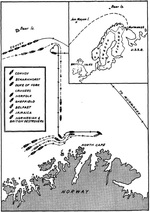
ww2dbaseOn the day after Christmas in 1943, HMS Belfast participated in the Battle of the North Cape as she and other British warships, including the battleship HMS Duke of York, engaged and sank the German battle cruiser Scharnhorst as the German warship was hunting for the Arctic convoys.
ww2dbaseAfter participating as an escort for a British carrier strike against the German battleship Tirpitz in March of 1944, HMS Belfast would head back to England. On June 6, 1944 and as the flagship of bombardment force E as part of the Eastern Naval Task Force, Belfast participated in the D-Day landings. Providing gunfire support to British and Canadian forces hitting the Gold and Juno beaches, Belfast was one of the first ships to begin the opening bombardment at 5:30am.
ww2dbaseRemaining in the area for five weeks, HMS Belfast provided impressive gunfire support to British and Canadian forces as they fought their way inland near the city of Caen. After providing supporting fire for Operation Charnwood, Belfast returned to England for a short refit and rest before heading to the Far East. When she arrived in the Pacific, HMS Belfast was to have participated in operations to drive the Japanese out of Malaya but the Japanese surrender made that point moot. She still found service in the Pacific as a transport ship for thousands of prisoners from Japanese prison camps and as a peacekeeping patrol ship during the Chinese Civil War.
ww2dbaseFive years later, HMS Belfast participated in the Korean War when she provided gunfire support for United Nations land-based forces. She began providing gunfire starting eleven days after the invasion began and would be doing so for a total of 404 days. Belfast received damage on July 29, 1952 when Communist shore-based artillery hit her with a shell, killing one sailor and wounding four.
ww2dbaseAfter refits that lasted from January 1956 to January 1959, HMS Belfast would participate mainly in naval exercises for three more years before the Royal Navy removed her from active service in 1962.
ww2dbaseDue to efforts of the Imperial War Museum, which began in 1967, HMS Belfast did not end up in the scrap heap and ended up as a museum ship in October 1971. Her location is near London's Tower Bridge.
ww2dbaseSources: Imperial War Museum HMS Belfast, HMS Belfast article on Wikipedia.
Last Major Revision: Nov 2009
Light Cruiser Belfast Interactive Map
Photographs
 |  |  |  |
Maps
 |
Belfast Operational Timeline
| 5 Aug 1939 | Belfast was commissioned into service. |
| 21 Feb 1943 | HMS Cumberland provided additional cruiser cover with HMS Belfast and HMS Norfolk during passage of Russian Convoy JU53 and returning Convoy RA53. |
| 24 Aug 1963 | Belfast was decommissioned from service. |
Did you enjoy this article or find this article helpful? If so, please consider supporting us on Patreon. Even $1 per month will go a long way! Thank you. Share this article with your friends: Stay updated with WW2DB: |


Visitor Submitted Comments
7 Apr 2010 01:41:08 PM
dear Peter was checking your page out and was wondering if you knew where i could find any info with regards to crew list for ss cap norte as i believe my father who was a sailor on ss cap norte and a prisoner of war was captured in the first few weeks of ww2.
28 Feb 2011 06:02:34 AM
My grandfather was assigned to HMS Belfast and I believe he was a stoker and radio operator. I don't know when he served but I do believe it was around the second world war. I am keen to know more of the Belfast and it's crew can any one point me to good sources of info?
3 Nov 2011 08:01:03 AM
would like to know if there is a crew list for hms belfast 1944-47 as my dad owen thomas jones served aboard her but never talked about it.all he would say was a great gang of lads and how cold the russian convoys were
6 Aug 2012 03:09:21 PM
my grandad served on hms belfast in ww2 not sure when, as he would not talk about it, but said she was a great ship. was wondering were i could find photos of him, and did she have a crest of any kind, or which flag she carried, thanks
18 Oct 2012 10:28:40 AM
I visited HMS Belfast the other weekend and there was a man there that I think he said his name was Reg Platton. He said he served on the ship in the war and showed me the Chritmas menu from 1944. It was great talking to him and I wanted to find out more but about him but can't. Thanks for all who served on this ship
20 Oct 2012 09:21:49 PM
My Father was the last Chief Engineer on HMS Belfast. He was posted to Singapore where I was born. He sailed her back to the U.K. where she was made a museum opposite the Tower of London. When I visited the ship a few years after my Father's passing, the guide turned out to be a crew member that served with my Father in the engine room. It was a magical moment.
9 Dec 2012 01:34:36 PM
My late uncle, Leslie Holland served on the Belfast. He was one of gunner crew during the second world war. He was serving at the time the Belfast finished off the German battleship Scharnhorst. It was so interesting to hear his stories when I was a child.
14 Dec 2012 08:34:35 AM
My father Cyril blakeway i believe was a petty officer on the belfast in the 1940s told me about the russian convoys and how bitterly cold it was and the sinking of Scharnhorst.great memories him talking of the belfast
19 Dec 2012 03:44:11 PM
I'm the Grandson of Fred Hunter who I think commisiomed & served on the Belfast between 1938-42. I'm going on old memories I have from my grandad who died in 1977(when I was 7yrs old) & had his ashes thrown from the Belfast. I'm over from Australia for Christmas & new year & was wanting to know more about his time in the Royal Navy & on board the Belfast. I hope you can help me find out more.
King Regards
Craig H Marshall.
17 Nov 2013 06:35:51 AM
My dad served on the Belfast 1942-45, it would be good to know if there is a crew list, or to hear from anyone who served/had relatives who served on her.
23 Nov 2013 10:09:18 PM
Our father was on the belfast at the battle that sunk the scharnhorst. We are seeking information about him. What was his duties on board, what was he required to do, rank etc. As he is no longer alive we can not ask him these questions and it is only now that we are tracing family histories that these questions have arisen.We are also trying to locate information about the Arctic Star medal he received but unfortunately we can not locate Any information you could provide would be greatly appreciated. His name was Donald Leslie Lowry aged 19 at the time of the Scharnhorst battle. He was from Stonehouse England. Thank you kindly Jeanette and Judith Lowry.
17 Jan 2014 02:43:33 PM
Jeanette and Judith, my great grandad was on the ship at the same time as your Father but unfortunately he passed away on Boxing Day, he never spoke much but said he always had a laugh with the lads and that they pulled 67 out of the water the night the scharnhorst was sunk. His name was Gordon Arthur Hinds and was a sick bay attendant Danielle Clark
3 Jun 2014 09:20:25 AM
My grandad served on HMS Belfast in world war 2 his name is William welsh. He was from Newcastle upon Tyne.I can't find anything about his time on HMS belfast.
6 Jun 2014 10:17:12 AM
LOOKING FOR THE CREW LIST FOR BELFAST 1944 AND 1945. My uncle Robert Dunn served in belfast during those years.
20 Sep 2014 06:10:52 PM
Does anyone know the where abouts of a seaman Alfie Duffle i think that is the correct spelling. My mum and uncle feel he was killed on the Belfast they are very keen to know as he stayed with them and nanna when docked in Australia
19 Oct 2014 12:12:24 AM
My Grandfather was Alfred Ernest Forrest, Senior Commissioned Gunner. He served on HMS Belfast 1942-44. On Arctic convoys and also escorted King George VI to visit the home fleet at Scapa. Also with battle of North Cape 26th December 1943. Received his Arctic Star posthumously this year. A whole crew list would be very interesting.
2 Feb 2015 03:58:54 AM
My father Cecil Holden served on HMS Belfast, I have his diary for 1944 when he was still in the sea cadets and 1946 when he was on another ship in the east so he must have been on Belfast in 1945. How can I access a crew list and obtain details of Belfasts sailing routes, activities at that time. I would be vey gratefull for this information,
23 Jun 2015 07:13:30 PM
My Grandfather was on the Belfast. His name was Gordon Alymore.
30 Jan 2016 08:51:11 AM
MY FATHER SERVED ON THE BELFAST 1938 TO 1945 SEPTEMBER
AFTER SERVING 27YRS IN THE R.N.
HIS RANK WAS LEADING STOKER NO K62947 J.R.ANDERSON.
PASSED AWAY 1962.
2 Apr 2016 12:58:32 AM
She carried 6 twin 4inch AA mounts and not the 4 usually carried by British light cruisers
3 May 2016 06:33:03 AM
I am trying to find the crew list for the HMS BELFAST as i am trying to find my papa's info on Ancestry. and get any background information that i may be able to get.
I have a picture in my livingroom of my papa while he was serving that was drawn by another sailer.
24 Oct 2016 08:52:25 PM
Members who served with HMS Belfast
https://www.forcesreunited.co.uk/units/1368/hms-belfast
3 Feb 2018 04:02:53 AM
I am looking for information on canadian soliders on the hms Belfast.
My grandfather's name is William Wesley Roe
born 1924. from canada (died 1996)
He served on the hms Belfast so i have been told for many many years. but i can't find any information.
He was apparently a gunner. I don't know how to find his info.
he also received medals while in service
(later stolen in life)
10 Nov 2018 12:45:41 AM
I beleave my uncle served on HMS Belfast Geoffrey Holt
6 Dec 2018 09:26:56 AM
Hello,I am trying to find information on my late farther in law who we think served on HMS Belfast during ww2,I really don't know how to start,he never talked about it and the family really don't know if he did or serve on this ship as a stoker we think ,any help is appreciated.
19 Mar 2019 02:17:22 AM
My dad served on HMS Belfast think he was a gunner ? He passed away in 1994 I have some photos of him and his friends would love to see others peoples photos of the Belfast
7 Jun 2019 08:32:00 AM
My uncle John Cyril Collin served on HMS Belfast during world war 11
8 Jun 2019 08:03:17 AM
My uncle Harry Smith also served on HMS Belfast during world war 11. Unfortunately i do not have any further info as he never talked to me about the war.
9 Jun 2019 10:56:59 AM
Hello.
I believe my dad may have been a sub lieutenant on the Belfast on D day.
Is there a crew list anywhere?
Thank you!
1 Jan 2020 12:09:09 AM
My uncle Alfred( Alf ) Sheridan served on the Belfast on the COLA arctic convoys as well as the Battle of North Cape. All I know is he was in the engine room.Is a crew list from this time available Thanks Shaun Sheridan
9 May 2020 03:23:08 AM
Hi, my pop served on the hms Belfast during World War II. His name was Herbert slack. I have no other info and would love to find out more about it. If anyone can point me in the right direction that would be great. He immigrated to Australia after the war.
15 Nov 2020 11:45:50 AM
I have been told by my dad that my grandad served on this ship and his name is John shaw
13 Dec 2020 09:26:42 AM
Are there any crew lists?
My grandfather Thomas Gilbert RM, served on HMS Belfast throughout WWII.
7 Nov 2021 03:24:41 AM
My uncle Alfred (Alf) Sheridan was on the Belfast at North Cape in the engine room keeping them cool. Is he mentioned in any records.
Thanks
Shaun Sheridan
16 Aug 2022 01:00:15 PM
I have a 1942 King George sixpence coin turned into a pendant. The back side has "C.T.M." on it followed by "Belfast, N.I." and '1944'. Is this coin/pendant related to this ship? CTM could be Chief Torpedoman's Mate (except that is a US Navy acronym).
29 Apr 2024 04:05:43 PM
I believe my grandad served on hms Belfast. He’s name was Joseph simms I would love to find a crew list for the Belfast, many thanks
Lee cook
25 May 2024 05:33:09 PM
My uncle was a chief petty officer stoker on the Belfast, amongst other ships, in the Second World War
All visitor submitted comments are opinions of those making the submissions and do not reflect views of WW2DB.
» Arctic Convoys
» Battle of the North Cape
» Normandy Campaign, Phase 1
Related Books:
» Imperial War Museum: HMS Belfast
- » 1,150 biographies
- » 337 events
- » 44,024 timeline entries
- » 1,242 ships
- » 350 aircraft models
- » 207 vehicle models
- » 375 weapon models
- » 123 historical documents
- » 260 facilities
- » 470 book reviews
- » 28,627 photos
- » 431 maps
Winston Churchill, 1935

Please consider supporting us on Patreon. Even $1 a month will go a long way. Thank you!

Or, please support us by purchasing some WW2DB merchandise at TeeSpring, Thank you!
24 Mar 2010 07:07:43 AM
The HMS Belfast Light Cruiser was granted today on the 24th of March, 2010 by Russian President Dmitri Medvedev with Diploma for heroism and courage during the World War II at support of the soviet ship caravans.
It was an example of joint struggle against mutual enemy during the war - fascism and fascist ideology.
I'd like to congratulate Director of imperial military museum to this occasion and wish him 7 feet under the keel.