


He 111 Doppel-Blitz
| Country | Germany |
| Manufacturer | Heinkel Flugzeugwerke |
| Primary Role | Medium Bomber |
| Maiden Flight | 25 February 1935 |
Contributor: C. Peter Chen
ww2dbaseThe Heinkel He 111 Doppel-Blitz medium bombers' original design was civilian in nature as Ernst Heinkel aimed to produce a new generation of fast passenger airliners. After the Günter brothers successfully completed their He 70 Blitz project, that design eventually became the foundation upon which they drew the one for He 111. Because the heritage of the He 111 project traced back to He 70 Blitz ("Lightning"), the new design was named Doppel-Blitz ("Double Lightning"). After two variants of prototypes, the third variant began to show practical promise, but it was deemed underpowered so those built were sold off to China in 1935. In early 1936, the third prototype variant boosted power output with Daimler-Benz engines, allowing the aircraft to reach a top speed of 360 kilometers per hour, and it generated interest within the German Air Force, Luftwaffe. An order from the Luftwaffe was given, and the construction proceeded in secret under the guise of a civilian order. This secrecy gave the Luftwaffe some advantage; many He 111 aircraft, disguised as Deutsche Lufthansa airliners, flew reconnaissance missions over Britain, France, and the Soviet Union in 1937. Some of them also served in the Spanish Civil War, during which they proved themselves as combat worthy bombers by outrunning many of the hostile interceptors. Before the European War began, it was already recognized that He 111 bombers were fast and powerful enough to perform a wide variety of missions.
ww2dbaseWhen the European War began in Sep 1939, He 111 bombers were the standard medium bombers of the Luftwaffe. During the Battle of Britain, they were regularly seen over British cities. In that battle, although these bombers were durable and often returned home safely after being riddled by bullets and shrapnel, more and more guns were added to the aircraft in later designs to bolster their defensive capabilities, which came at a cost of their performance. In 1940, after Junkers began building the better-performing Ju 88 bomber in sufficient numbers, and He 111 bombers' role shifted to become a tactical support bomber, flying a range of high altitude and dive bombing missions in direct support of ground troops during Operation Barbarossa, Battle of Stalingrad, Battle of Kursk, and other engagements on the Eastern Front. In the early stages of the Russo-German War, a small number of them served in weather reconnaissance roles and pathfinder roles; as the tide turned and German troops began finding themselves trapped in pockets, many He 111 bombers became transport aircraft, flying food and ammunition into encircled areas, unloading either on the ground or airdropping them out of bomb bay doors. In this role, their air crews were among the last German witnesses of combat at the doomed German efforts at Stalingrad, Breslau (now Wroclaw), and Berlin. He 111 aircraft would remain in service until the end of the European War.
ww2dbaseDuring the production life between 1935 and 1944, about 7,300 He 111 bombers were built. There were a great number of variants due to the different engine types available for use during different times in the production life. Many of these machines also saw service with minor Axis nations such as Bulgaria, Hungary, and Romania. The Spanish company CASA also produced a number of He 111 bombers for use with the Spanish military; these heavily modified Spanish-built bombers had the designation of CASA 2.111.
ww2dbaseSources:
John Weal, He 111 Kampfgeschwader on the Russian Front
Wikipedia
Last Major Revision: May 2007
He 111 Doppel-Blitz Timeline
| 25 Feb 1935 | The prototype He 111 medium bomber made its maiden flight with test pilot Gerhard Nitschke at the controls. |
| 19 Aug 1944 | F6F-5 Hellcat fighters flying from USS Tulagi became the first US Navy Hellcats to score aerial victories in the European Theater when fighters from Squadron VOF-1 shot down three Heinkel He-111 medium bombers south of Lyon in southern France. |
SPECIFICATIONS
H-3
| Machinery | Two Junkers Jumo 211D-2 liquid-cooled inverted V-12 engines rated at 1,200hp each |
| Armament | 5x7.92mm Rheinmetall-Borsig MG 15 machine guns, 1x20mm MG FF cannon, optional 1x7.92mm Rheinmetall-Borsig MG 17 machine gun in tail, 2,000-3,000lb bombs, optional 1xFZG-76 |
| Crew | 5 |
| Span | 22.60 m |
| Length | 16.40 m |
| Height | 4.20 m |
| Wing Area | 87.50 m² |
| Weight, Empty | 7,720 kg |
| Weight, Loaded | 11,300 kg |
| Weight, Maximum | 12,400 kg |
| Speed, Maximum | 415 km/h |
| Service Ceiling | 7,800 m |
| Range, Normal | 2,150 km |
H-6
| Machinery | Two Jumo 211F-1 liquid-cooled inverted V-12 engine rated at 1,300hp each |
| Armament | Up to 7x7.92mm MG 15 or MG 81 machine guns, some of them replaced by 20mm MG FF cannon or 13mm MG 131 machine gun, 2,000kg of bombs |
| Crew | 5 |
| Span | 22.60 m |
| Length | 16.40 m |
| Height | 3.90 m |
| Wing Area | 86.50 m² |
| Weight, Empty | 7,720 kg |
| Weight, Loaded | 12,030 kg |
| Weight, Maximum | 14,075 kg |
| Speed, Maximum | 400 km/h |
| Service Ceiling | 8,390 m |
| Range, Normal | 2,800 km |
Photographs
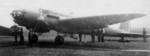 | 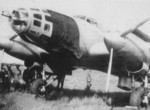 |  | 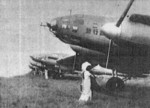 |
Did you enjoy this article or find this article helpful? If so, please consider supporting us on Patreon. Even $1 per month will go a long way! Thank you. Share this article with your friends: Stay updated with WW2DB: |


Visitor Submitted Comments
 Alan Chanter says:
2 Nov 2007 04:59:39 AM
By the 1st September 1939 earlier models of the Heinkel III had been almost exclusively replaced in the Luftwaffe. The first-line Kampfgruppen comprised 808 bombers of this type including 349 He.111Ps and 400 He.111Hs. The two models differed from each other primarily in the type of powerplant. The P series having Daimler-Benz DB 601A engines, whilst the H Series had Junkers Jumo 211 engines. In early 1940 the decision was made to standardize on the Jumo 211 engine. Both types participated in the Battle of Britain.
All visitor submitted comments are opinions of those making the submissions and do not reflect views of WW2DB.
» Battle of Britain
Related Book:
» He 111 Kampfgeschwader on the Russian Front
Related Document:
» German Luftwaffe Losses, Jul-Sep 1940
|
- » 1,150 biographies
- » 337 events
- » 44,024 timeline entries
- » 1,242 ships
- » 350 aircraft models
- » 207 vehicle models
- » 375 weapon models
- » 123 historical documents
- » 260 facilities
- » 470 book reviews
- » 28,622 photos
- » 431 maps
Captain Henry P. Jim Crowe, Guadalcanal, 13 Jan 1943

Please consider supporting us on Patreon. Even $1 a month will go a long way. Thank you!

Or, please support us by purchasing some WW2DB merchandise at TeeSpring, Thank you!
3 Apr 2006 10:31:18 AM
i never knew any of that stuff i guess its pretty cool