


Manchurian Strategic Offensive
Contributor: C. Peter Chen
ww2dbaseAt the Tehran Conference in Nov 1943 and at the Yalta Conference in Feb 1945, Soviet leader Joseph Stalin had agreed declare war on Japan three months after Germany would be defeated. On 5 Apr 1945, the Soviet Union informed Japan that the Soviet Union would not renew the Soviet-Japanese Neutrality Pact of 1941, which ensured non-aggression between the two nations through 13 Apr 1946. At 2300 hours Transbaikal time on 8 Aug 1945, Soviet Foreign Minister Vyacheslav Molotov informed Japanese ambassador Sato that the Soviet Union was revoking the neutrality pact with a declaration of war effective on 9 Aug; at this point, the neutrality pact was still six months from its natural expiration.
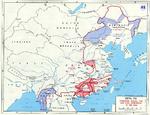
ww2dbaseAt one minute past midnight on 9 Aug 1945, or 61 minutes after the declaration of war, Soviet troops organized in three fronts poured into Japanese-occupied northeastern China, a region also known by its historical name of Manchuria. Northeastern China had been governed by the Japanese-sponsored puppet regime of Manchukuo since 1932. The Soviet troops were of the Far Eastern Command under the overall command of Marshal Aleksandr Vasilevsky, who devised a giant pincer movement against the unprepared Japanese troops. In Vasilevsky's plan, the Transbaikal Front under Marshal R. Y. Malinovsky was to attack from the west across the Inner Mongolian desert and over the Greater Khingan mountain range, with Mukden (Shenyang), Liaoning Province, China as the primary target; the attached 36th Army was to break off after the initial invasion and head toward Harbin and Qiqihar to meet the 2nd Far East Front. The 2nd Far East Front under General M. A. Purkayev attacked in the center largely in a support role only, with the primary objectives of securing Harbin and Qiqihar, upon the successful completion of which, the front was to move toward the port of Lushunkou (Russian: Port-Artur; Anglicized: Port Arthur) of the city of Dalian, Liaoning Province after the 1st Far East Front completed its primary objectives. Finally, from the east over the Lesser Khingan mountain range, the 1st Far East Front under Marshal K. A. Meretskov was to capture the cities in east, including Changchun; its secondary objective was to cut off Japanese escape routes into Korea, and its tertiary objective was to invade and occupy northern Korea. In total, 1,577,725 men in 89 divisions with the support of 3,704 tanks, 1,852 self-propelled guns, 27,086 artillery pieces, and 3,721 aircraft were utilized in the invasion.
ww2dbaseOn the Japanese side, General Otsuzo Yamada's Kwangtung Army fielded only 600,000 men organized in 25 divisions (two of which were armored divisions) and six independent mixed brigades; they were further supported by the 40,000-strong Manchukuo Defense Force in 8 divisions and the 10,000-strong militia force of the puppet state of Mengjiang in the Inner Mongolia region of China. In terms of heavy equipment, the Japanese had 1,215 armored vehicles (most of which were light tanks, tankettes, and armored cars), 6,700 artillery pieces, and 1,800 aircraft. In terms of training, the Kwangtung Army at this time was more so of a counter-insurgency force rather than a typical military force, thus it was poorly prepared to defend against a full scale invasion. Additionally, Japanese intelligence had failed to realize the scale of the Soviet movement toward the east, perhaps not expecting the Soviet Union to betray the Soviet-Japanese Neutrality Pact.
ww2dbaseThe attack from the west was a complete surprise to the Japanese, who did not expect the Soviet troops to cross the Greater Khingan mountain range, said to be impassable. In addition to the element of surprise, the greater mobility enjoyed by the Soviet forces, plus the usage of airborne units at key airfields, caused the Japanese lines to completely crumble. Fighting continued despite the Japanese foreign ministry had expressed Emperor Showa's wish to end the war on 10 Aug 1945. On the Soviet side, the commanders received explicit orders to push forward. Meanwhile, some of the Japanese commanders ceased fighting after hearing of Emperor Showa's edict, while some were determined to fight until the very end. On 14 Aug, Soviet troops reached the Yalu River vicinity but stiff Japanese resistance prevented them from reaching the river itself in great numbers. On 18 Aug, several amphibious landings were made in northern Korea, Sakhalin island, and in the Kurile Islands, with the latter politically driven for the goal of post-war occupation.
ww2dbaseAlthough geographically distant from northeastern China, the Soviet Kurile Islands Landing operation was considered a branch of the greater Manchurian Strategic Offensive operation. The Soviet 87th Rifle Corps and elements from other units landed on various islands, largely overrunning defenses manned by the Japanese 91st Infantry Division (at islands of Shiashkotan, Paramushiro, Shumshu, and Onekotan), 42nd Division (at Shimushiro), and the 89th Infantry Division (at Iturup and Kunashiri). Japanese troops surrendered on 23 Aug 1945, but pockets of resistance continued until the very end of the Pacific War.
ww2dbaseBack in northeastern China, by 20 Aug, the cities of Mukden, Changchun, and Qiqihar were all declared secure. On 2 Sep, Japan formally surrendered. On 8 Sep, American troops landed at the port city of Inchon, Korea to prevent the Soviet Union from occupying all of Korea.
ww2dbaseAt the end of the campaign, the Soviet Union suffered 12,031 killed and 24,425 wounded. Japanese forces suffered somewhere between 21,000 and 60,000 killed. A very large number of Japanese were taken prisoner by the Soviets. A large number of Chinese and Japanese civilians suffered atrocities at the hands of the invading Soviet troops not unlike the fate suffered by German civilians in eastern Germany months earlier.
ww2dbaseEpilogue
ww2dbaseThe Japanese northern-most home island of Hokkaido was in the invasion plans, but Japan surrendered before Soviet forces were ready to mount such an invasion. During the Allied occupation of Japan, the Soviet Union repeatedly demanded Hokkaido be administered by Soviet forces independent of the Supreme Commander of Allied Personnel, but General Douglas MacArthur sternly opposed the idea, and threatened the Soviet representative General Kuzma Derevyanko with military action should Soviet forces set foot on the island. Derevyanko, knowing well that MacArthur was not bluffing, advised Moscow to halt any plans for Hokkaido.
ww2dbaseThough most westerners believed that the atomic bombings of Hiroshima and Nagasaki were the events that drove Japan to surrender, the atomic bombs were actually only part of the equation. Historians such as Tsuyoshi Hasegawa and Dan van der Vat argued that the Soviet declaration of war was as important a factor, if not more so, in the Japanese decision to capitulate. During the last months of the war, it had been evident that the Japanese, not knowing the secret agreement for the Soviet Union to declare war on Japan, were seeking Soviet assistance as a neutral power to negotiate surrender terms with the western Allies. With the seemingly neutral Soviet Union suddenly changing face and tearing up the non-aggression pact, Japan suddenly lost its last hope, which affected the Japanese psyche tremendously.
ww2dbaseThe Nivkh and Orok peoples, native to Sakhalin island, were deported by the Soviets as a collective punishment for some having worked for the Japanese as spies. The fact that equally many of them spied for the Soviets against Japan was ignored.
ww2dbaseIn terms of future consequences, the Soviet occupation of northeastern China allowed the Chinese Communist forces to recuperate and rebuild, eventually winning the Chinese civil war.
ww2dbaseIn 1983, United States Army historian Lieutenant Colonel David Glantz coined the name Operation August Storm to describe this Soviet operation against Japan, and this American name had since been used in some western literature instead of the original Soviet name of Manchurian Strategic Offensive.
ww2dbaseSources:
Dan van der Vat, The Pacific Campaign
Douglas MacArthur, Reminiscences
Wikipedia
Last Major Update: Sep 2010
Manchurian Strategic Offensive Interactive Map
Photographs
 |  |  |  |
Maps
 |
Manchurian Strategic Offensive Timeline
| 14 Jun 1945 | Otozo Yamada met with his top Kwangtung Army officers in Xinjing (Changchun), China to plan defenses against a potential Soviet invasion. |
| 28 Jun 1945 | Joseph Stalin ordered the planning for war with Japan, adding that "[a]ll preparations were to be carried out in the greatest secrecy" as the Soviet Union and Japan were still engaged in neutrality with each other per the 1941 pact. |
| 11 Jul 1945 | Japanese ambassador to the Soviet Union Naotake Sato failed to convince Vyacheslav Molotov to engage their two nations in a formal peace treaty. |
| 12 Jul 1945 | Japanese representatives in the Soviet Union requested a update on the Japanese inquiry on the extension of the 1941 non-aggression treaty, getting little in the way of a response. |
| 25 Jul 1945 | Lavrentiy Beria informed Joseph Stalin that the railroad connecting Komsomolsk and the port city of Sovetskaya Gavan in Khabarovsk Krai, eastern Russia had completed. |
| 8 Aug 1945 | At 2300 hours, the Soviet Union tore up the non-aggression treaty with Japan and declared war; the invasion would begin 61 minutes later at the start of the following day. |
| 9 Aug 1945 | Emperor Kangde of the puppet nation of Manchukuo was advised that his capital would soon be relocated from Xinjing (Changchun), Jilin Province, China to Tonghua, Andong Province, China as a response to the Soviet invasion. |
| 9 Aug 1945 | At one minute after midnight, Soviet troops crossed the border into northeastern China, which was administered by the Japanese-sponsored puppet state of Manchukuo. |
| 11 Aug 1945 | Emperor Kangde, the royal court, and most of the ministers of the puppet nation of Manchukuo evacuated Xinjing (Changchun), Jilin Province, China. |
| 12 Aug 1945 | Soviet forces in the Manchuria region of northeastern China had advanced 200 miles in four days. Meanwhile, Soviet Pacific Fleet attacked northern Korea, seizing the Japanese naval base at Rashin and the port of Yuki. |
| 13 Aug 1945 | Emperor Kangde, the royal court, and most of the ministers of the puppet nation of Manchukuo arrived at Dalizigou, Tonghua, Andong Province, China. |
| 17 Aug 1945 | Joseph Stalin ordered Aleksandr Vasilevsky to continue the fighting with Japan despite of the Japanese intention to surrender. |
| 18 Aug 1945 | Soviet troops landed on Paramushiro, Kurile Islands, Japan. |
| 18 Aug 1945 | Nearly 4,000 Japanese troops surrendered along the Hailar River in Liaobei Province, China, effectively ending organised resistance. |
| 19 Aug 1945 | Soviet SMERSH operatives convinced General Otozo Yamada to surrender at Xinjing (Changchun), China. |
| 20 Aug 1945 | Soviet forces declared the cities of Mukden (Liaoning Province), Changchun (Jilin Province), and Qiqihar (Nenjiang Province) in northeastern China secure. |
| 22 Aug 1945 | Joseph Stalin ordered his generals to abandon the plans to land on Hokkaido, Japan. |
| 22 Aug 1945 | Japanese forces in the Manchuria region of northeastern China surrendered. In the two-week campaign, the Japanese had lost 80,000 killed and wounded and 54,000 taken prisoner, including 143 generals. The Soviets had lost 8,200 dead and 22,000 wounded. |
| 23 Aug 1945 | The Soviet Union announced that all Japanese resistance in the Manchuria region of northeastern China had ceased. Meanwhile, Soviet troops received the surrender of the Japanese garrison at Paramushiro, Kurile Islands. |
| 25 Aug 1945 | Soviet UKR SMERSH agents captured Cossack leader Lieutenant General D. F. Semenov at Dalian, Liaoning, China. |
| 28 Aug 1945 | Soviet troops landed at Rubetzu Bay on Iturup, Kurile Islands, Japan, as well as nearby islands of Kunashir, Shikotan, Sibotzu, Taraku-Shima, Uri-Shima, Akiuri, and Suiseto. |
| 8 Sep 1945 | American troops landed at Inchon, Korea to prevent the Soviet Union from breaking the previous agreement for Soviet troops to only occupy northern Korea. The US commanding officer, Lieutenant General John Hodge, also arrived on the same day. Not yet briefed in the Korean political situation and lacking any staff officers who were knowledgeable about Korea, Hodge declined to meet the delegation from the Committee for the Preparation for Korean Independence. |
| 21 Sep 1945 | Aleksandr Vadis reported to Soviet SMERSH officer Isai Babich that, between 9 Aug and 18 Sep 1945, 2,249 were arrested in northeastern China (666 Japanese military intelligence officers and agents, 569 Japanese policemen, and 552 Soviet citizens). |
Please consider supporting us on Patreon. Even $1 per month will go a long way! Thank you. Please help us spread the word: Stay updated with WW2DB: |


Visitor Submitted Comments
10 Aug 2010 03:19:04 AM
1)In 1945 there wasn't "Russia". There was Soviet Union.
2)There wasn't Soviet-Japanese non-aggression pact. There was Neutrality pact.
3)It is very interesting, how 640 000 Japanese and Manchurian soldiers transformed into 80 000 killed and 640 000 captured.
4)Soviet Union wasn't going to occupy whole Korea. There was an agreement, that Nothern Korea would be under Soviet zone of influence, Southern Korea would be under American one.
5)Liberation of Kurils and Sakhalin had military background: Soviet Union desired Sea of Okhotsk to be internal sea.
3 Aug 2012 09:56:32 PM
How did the soviet invasion benefit Mao? When did the soviets pull out of Manchuria and whatpart did they retain of Manchuria?
8 Aug 2014 12:01:36 PM
This thesis seems far-fetched. Many Japanese (as the author points out) wanted to surrender before the Soviets even got in there. The truth seems more like the Soviets simply took advantage of the work the US did. Guess they paid us back in Europe
22 Apr 2015 05:48:25 PM
I am sorry to just now comment on your post, but the Japanese didn't want to surrender. The Japanese soldiers were brutal fighters who would rather die than be caught. In fact, in the Battle of Okinawa, the Japanese jumped off what is now referred to as Mabuni (Suicide) Cliff. Even the Japanese citizens feared capture and killed themselves.
8 Aug 2015 06:24:18 AM
The Emporer's speech on Aug 14 makes extensive note of the atomic bomb as one of the important reasons for the termination of war, but no mention of the Soviet attack. I know of a lot of thinking recently is that the Manchurian actions were as important, if not not more important in the Japanese decision to surrender. But why was it not mentioned?
8 Aug 2015 05:36:17 PM
Key dates should be explicitedly defined.
On May 8, 1945, Germany signed the surrender paper. This freed up millions of allied combat troops for deployment against Japan. The US used the first atomic bomb on Hiroshima on August 6, 1945, and three days later, August 9, Nagasaki was bombed. All the major combatant nations knew of this weapon's existence. On August 8, the USSR, Stalin, tore up the Neutrality agreement with Japan and attacked the next day August 9. Within hours, Emperor Hirohito historically over rode the Supreme Council for the Direction of the War who had unamiously voted to fight to the death. The Emperor ordered surrender. A failed coup d'état followed and the Emperor addressed the people for the first time in history with this decision (He was god.) on August 15.
Critics of US policy have claimed that Stalin's good office might have obtained peace without the use of atomic weapons. After Germany's collapse, there is nothing to substantiate this conjecture. Stalin grabed while his enemy was weak.
22 May 2016 12:20:52 PM
reason for japanese surrender has nothing to do with reason for bomb use... obvious there are several reasons for each choice.
25 Jan 2017 08:45:50 AM
The reason why the Russian invasion was critical to Japan surrendering is that all the steel, coal and oil industries that Japan relied on to manufacture their war machine was based in Manchuria.
8 Aug 2017 09:42:18 AM
The Soviet Union's entry certainly was a factor, but the firebombing of Tokyo and other cities as well as the Atomic bombs were the primary factor. As mentioned, the Japanese ruling family was already considering ending the war before the Soviet invasion. The bombs prevented an invasion that would have cost considerably more military and civilian. Given that the Americans had a better reputation for protecting civilians from occupation forces, the Emperor chose best for his country. The Russian occupation forces had reputations as savage as ISIS.
8 Aug 2017 12:30:56 PM
The Japanese did what the Germans should have done - surrender to the U.S. to forestall a Soviet invasion, which would have resulted in the partitioning of their country.
8 Aug 2017 01:17:46 PM
"Moreover, the enemy has begun to employ a new and most cruel bomb, the power of which to do damage is, indeed, incalculable, taking the toll of many innocent lives. Should we continue to fight, it would not only result in an ultimate collapse and obliteration of the Japanese nation, but also it would lead to the total extinction of human civilization."
Quote, unquote, Emperor Hirohito to his subjects. No mention of the Soviets.
8 Aug 2017 05:19:58 PM
The Japanese had already decided to surrender before the Soviets attacked on Aug. 9th. That attack may have iced the cake, but it was evidently not a deciding factor.
19 Aug 2017 01:40:13 AM
So, I understand that the main motive was the criminal attack with nuclear bombs. Well, in fact the Americans were the only nation using nuclear weapons against a foe. Good for you Chaps!The Russians were brutal, not like the Americans with their bombs, mercifully killing more than 180.000 people in two strikes...... What is wrong with you guys?
24 Oct 2017 02:57:13 PM
Both the writers of this slanted crap and the brainwashed nationalist readers who inhabit this joint seem to forget that the Soviet Union was bound by treaty signed with the USA to attack Japan within 90 days of the surrender of Germany. This they did, AT THE REQUEST OF THE USA.
USA whining about it decades later is not only stupid, but irrelevant. The mass murdering Japanese got what they bloody well deserved.
31 Jan 2018 04:50:19 PM
someone stated that the Americans were brutal and criminal with the dropping of the bombs, but they seem to forget that invading Japan would have cost around 2 million lives, both civilian and military for both sides as the Japanese civilians would most likely join in to the fight to the death
8 Aug 2018 04:58:45 AM
The Soviets had already taken something around 20 million casualties. Just like our boys in Europe, they were ready for the war to end.
Ask any one of the men who had just defeated the Germans if they favored the bomb being dropped.
It is sickening the way modern socialists attempt to paint Stalin as anything other than one of the most evil men to have ever lived.
8 Aug 2018 06:05:00 AM
A Bombs or Soviet intervention?
Probably both, but do not underestimate the reality of mass starvation facing mainland Japan in late July of 1945. We should also not discount the likely prospect of a mass amphibious invasion of Japan that would be carried out by the full, vengeful, and by then, focused efforts of the United States of America. Given how the island campaigns had gone up to that point in the “war without mercy,” the mass extermination of the Japanese race was not an unthinkable outcome if you were living in Japan. By August of 1945, the only two options left to Japan were to either surrender or die.
8 Aug 2018 07:17:17 AM
The Communist takeover of China, Notth Korea, and elswhere resulted in greater brutality and democide than the Japanese atrocities...and the Japanese acts were absolutely horrible. The allies, without Russia, had pushed the Japanese back ftom thrir Pacific and South Asia positions to the Japanese islands. Without air defenses, Japan was a sitting duck. The Soviet revocation of the non-aggression treaty added weight to Jspan's eventual surrender.
8 Aug 2018 09:11:09 AM
I read some of the silly comments about "criminal" bombings and such on this board. All I can say is the *** got what they deserved. Japan is far far better off now than it would have been had there been a negotiated peace that left their government in place.
8 Aug 2018 11:17:40 AM
As we have learned over the years, it was both the Bomb and the Russians entering the war that caused Japan to capitulate. Whatever the cause, many of our generation are here today because the war ended as it did. My Dad was getting ready to ship from Europe to the Pacific when the war ended. He and many others might have died and we would never been born. Thank you President Truman.
8 Aug 2019 12:01:10 PM
Although the Soviet invasion may have affected the Japanese "psyche", it's silly to think it seriously influenced their decision to surrender. America was nuking Japan, and our navy was on their doorstep. The Soviets had almost no navy, and would not have been able to invade the Japanese home islands.
8 Aug 2019 01:11:56 PM
The Japanese were surprised by the Soviet attack because the 2 nations had entered into a non-aggression pact. (So much for treaties with the Russians.)
The Japanese surrender after a mere 2 weeks of fighting exploded the myth that the Japanese would fight to the death. The Kuomintang Army was Japan's finest land based fighting force.
After the surrender, approximately 600,00 Japanese soldiers were whisked off to Soviet slave labor camps where most of them were brutally worked to death. So, besides honor, they had plenty of reason not to surrender.
All visitor submitted comments are opinions of those making the submissions and do not reflect views of WW2DB.

» Khudyakov, Sergei
» Meretskov, Kirill
» Nemoto, Hiroshi
» Vasilevsky, Aleksandr
» Yamada, Otozo
Locations:
» China
» Korea
Document:
» Truman's Diary Entry, 17 Jul 1945
|
- » 1,182 biographies
- » 337 events
- » 45,132 timeline entries
- » 1,249 ships
- » 350 aircraft models
- » 207 vehicle models
- » 376 weapon models
- » 123 historical documents
- » 261 facilities
- » 470 book reviews
- » 28,431 photos
- » 365 maps
Chiang Kaishek, 31 Jul 1937

Please consider supporting us on Patreon. Even $1 a month will go a long way. Thank you!

Or, please support us by purchasing some WW2DB merchandise at TeeSpring, Thank you!
15 Apr 2010 10:46:03 AM
Thanks for the info and that was an efficient use of resources for Russia maybe a little overkill but it worked and thats all that matters.