


Battle of Shanxi
Contributor: C. Peter Chen
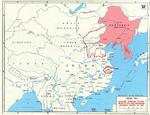
ww2dbaseTaiyuan, the capital of Shanxi Province, became the next the primary target of the Japanese Army in northern China after it had secured the Beiping-Tianjin region. Shanxi was the territory of progressive warlord Yan Xishan, who generally leaned toward the Nationalist central government, and was sternly anti-Japanese; Chiang Kaishek had entrusted Yan with the defenses of the region as the commander of the Second War Zone. Though Yan distrusted the Communists, he had invited the Communist 8th Route Army to enter Shanxi and made its commanding officer Zhu De the Deputy Commander of the Second War Zone in order to counter the incoming foreign threat. The Japanese offensive began on 1 Sep 1937 with Itagaki Seishiro's 5th Division and the 11th Mixed Brigade from Beiping (now Beijing) moving toward Huaili in Chahar Province. The Chinese defensive line was consisted mostly of Yan's Shanxi troops, troops of Communist 115th Division, and Nationalist troops sent by the central government as reinforcement. While Shanxi troops fought valiantly to defend their home privince, the Nationalist units were inefficient due to their allegiance to Chiang Kaishek rather than Yan Xishan, and the Communist troops increasingly avoided direct confrontation with the Japanese. The disunity led to the abandonment of the city of Datong on 13 Sep, allowing a large coal supply to be captured by the Japanese. The Chinese fell back to Yanmenguan, Niangziguan, and Pingxingguan gates of the Great Wall.
ww2dbaseBattle of Pingxingguan
25 Sep 1937
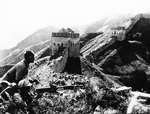
ww2dbaseOn 25 Sep 1937, the Japanese reached Pingxingguan. Taking advantage of the Great Wall gate's placement, Lin's 6,000-strong Communist division ambushed the Japanese troops passing in the narrow road fifteen feet below it. The ambushed was triggered at dawn at great losses to the Japanese, and at noon attacks were launched against the Japanese center and rear. At the end of the battle, the Communists inflicted 400 to 500 casualties amongst the Japanese, while suffering 400 casualties themselves. Over 100 trucks laden with weapons, ammunition, and other supplies were captured by the Communists. This created a great boost in morale for the Communists, as it was the first (and the last) victory achieved by the Communists, but it contributed little strategic importance. After the war, Communist propaganda would dramatically inflate the importance of this battle. Japanese analysis after the war blamed this loss on the "victory disease," where Japanese officers were too proud and too careless after the string of successes they had experienced in China thus far.
ww2dbaseBattle of Xinkou
13 Sep-11 Nov 1937
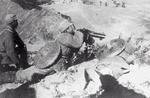
ww2dbaseMeanwhile, Shanxi troops and Nationalist troops fell back to Xinkou, which was flanked by Wutaishan and Yunzhonshan mountains, thus advantageous for defense. On 2 Oct, the Japanese 2nd Brigade of the Chahar Expeditionary Force attacked Gouxian, and the Chinese 19th Army held until 9 Oct. The Japanese 15th Brigade of the Chahar Expeditionary Force then pressed on against Yuanping, defeating Jiang Yuzhen's 196th Brigade of the 34th Army on 12 Oct. On the next day, a large column of 50,000 Japanese troops began the main assault on Xinkou, supported by over thirty aircraft, over forty heavy artillery pieces, and over fifty tanks. On 16 Oct, the Chinese counterattacked, slowing Japanese momentum. On 19 Oct, the 769th Regiment of the 120th Division successfully attacked the Yangmingbao airfield and destroyed 24 Japanese aircraft on the ground.
ww2dbaseWith aerial support, on 26 Oct Japanese commando battalions broke through Chinese lines and pushed the defenders back along the Shijiazhuang-Taiyuan Railway. On 11 Nov, the remaining Chinese forces in Xinkou finally abandoned their position and retreated back toward Taiyuan to avoid envelopment.
ww2dbaseAlthough the Japanese finally broke through, the prolonged battle exhausted the Japanese Itakagi Division, forcing the Japanese to send in more troops, attacking Taiyuan from a second direction, in the east. Taiyuan was lost after a brief battle, and the Japanese captured a key railway junction and the Taiyuan military arsenal, the only arsenal in China capable of building field artillery pieces. Yan relocated his headquarters to the field, but as the Japanese took control of Linfen and Lingshi, he was forced to relocate yet again, this time across the provincial border with Shaanxi Province. With the Communists refusing to confront the Japanese directly, and Yan having lost about 90% of his forces, the loss of Taiyuan effectively ended organized Chinese military resistance against the Japanese in northern China.
ww2dbaseSources:
Jung Chang and Jon Halliday, Mao
Wikipedia
Last Major Update: Sep 2006
Battle of Shanxi Interactive Map
Photographs
 |  |  |
Maps
 |
Battle of Shanxi Timeline
| 1 Sep 1937 | In China, under the command of Itagaki Seishiro, Japanese 5th Division and 11th Mixed Brigade marched from Beiping toward Chahar and Shanxi Provinces. |
| 13 Sep 1937 | Japanese troops captured Datong, Shanxi, China and its large supply of coal. Chinese troops fell back to Yanmenguan, Niangziguan, and Pingxingguan gates of the Great Wall. |
| 25 Sep 1937 | Battle of Pingxingguan: Communist Chinese forces successfully ambushed Japanese forces at this gate of the Great Wall of China. |
| 2 Oct 1937 | Japanese 2nd Brigade of the Chahar Expeditionary Force attacked Gouxian, Shanxi, China, defended by Chinese 19th Army. |
| 12 Oct 1937 | Japanese troops captured Gouxian, Shanxi, China. |
| 13 Oct 1937 | 50,000 Japanese troops marched for Xinkou, Shanxi, China, supported by 30 aircraft, 40 pieces of artillery, and 50 light tanks and tankettes. |
| 16 Oct 1937 | Chinese troops counterattacked the Japanese at Xinkou, Shanxi, China, slowing Japanese momentum. |
| 19 Oct 1937 | 769th Regiment of Chinese 120th Division attacked the Yangmingbao airfield in Shanxi, China, destroying 24 aircraft on the ground. |
| 26 Oct 1937 | Japanese commando battalions broke through Chinese lines and pushed the defenders back along the Shijiazhuang-Taiyuan Railway in Shanxi, China. |
| 11 Nov 1937 | Chinese troops at Xinkou, Shanxi, China abandoned the city and fell back toward Taiyuan. |
Did you enjoy this article or find this article helpful? If so, please consider supporting us on Patreon. Even $1 per month will go a long way! Thank you. Share this article with your friends: Stay updated with WW2DB: |


» Fu, Zuoyi
» Itagaki, Seishiro
» Sun, Chu
» Sun, Lianzhong
» Wei, Lihuang
» Yan, Xishan
» Zhao, Chengshou
Location:
» China
- » 1,150 biographies
- » 337 events
- » 44,024 timeline entries
- » 1,242 ships
- » 350 aircraft models
- » 207 vehicle models
- » 375 weapon models
- » 123 historical documents
- » 260 facilities
- » 470 book reviews
- » 28,631 photos
- » 431 maps
Chiang Kaishek, 31 Jul 1937

Please consider supporting us on Patreon. Even $1 a month will go a long way. Thank you!

Or, please support us by purchasing some WW2DB merchandise at TeeSpring, Thank you!