


Alexander von Falkenhausen
| Surname | Falkenhausen |
| Given Name | Alexander |
| Born | 29 Oct 1878 |
| Died | 31 Jul 1966 |
| Country | Germany |
| Category | Military-Ground |
| Gender | Male |
Contributor: C. Peter Chen
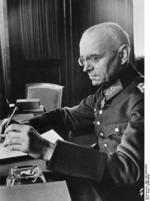
ww2dbaseErnst Alexander Alfred Herrmann von Falkenhausen was born in Germany from a line of Bavarian officers. He was the nephew of Ludwig von Falkenhausen, the German Governor General of Belgium during WW1. He entered military academy in 1897 and was later commissioned as a second lieutenant in the German Army in 1897. He married Paula von Wedderkop, daughter of a German aristocrat. He then spent time in China fighting in the Boxer Rebellion and in Japan as a military attaché before WW1. During WW1, he served with the Ottoman Army as the Chief of Staff of the Turkish 7th Army in Palestine, earning the honor of Pour le Mérite for his gallantry. After the war he became one of the few who remained with the German Army. He was involved with the border negotiations between Germany and Poland, and then in 1927 he headed the Dresden Infantry School.
ww2dbaseIn 1930, Falkenhausen retired from the German Army and served as a military adviser to Chiang Kaishek, training Chinese troops to fight Japanese aggression in China. He played a vital role in the modernization of the Chinese military of all branches, and his guidelines for the defense of China written in Jul 1935 heavily influenced the campaign the Chinese carried out during the Second Sino-Japanese War which began two years later; namely, a war of attrition which Japan could not afford to engage in, and the use of guerrilla warfare. In 1936, Adolf Hitler officially appointed Falkenhausen a member of the German military mission in China. After the Second Sino-Japanese War began, he was sometimes seen in Chinese Army uniform, which was an inspiration to the Chinese troops he was training. During the Second Battle of Shanghai in Sep 1937, he personally led troops in Luodian, earning further respect from fellow Chinese officers. As Germany and Japan grew closer, along with Germany's preparations for the European War, Falkenhausen was recalled by the German Army in Jul 1938. As he said goodbye to Chiang, he promised him that he would never reveal any Chinese military secrets to the Japanese, and it was apparent that he had kept his word.
ww2dbaseReturning to Europe, Falkenhausen first served as an infantry general, then was briefly a high-ranking commander at Dresden. In 1940 he was named the military governor of Belgium, where he was accused of atrocities involving execution of prisoners of war and the deportation of Jews. He was dismissed on 18 Jul 1944 on various charges, and then two days later, the 20 Jul Plot failed to assassinate Adolf Hitler. For his involvement with the conspirators of the plot, he was arrested and sent to concentration camps. Before that, however, post war records showed that even before the July Plot, he had already offered his support for a possible coup d'etat by Field Marshal Erwin von Witzleben.
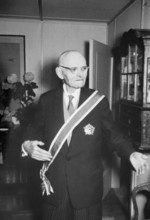
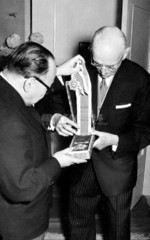
ww2dbaseAfter the war, Falkenhausen was captured by the Allies at a concentration camp and deported to Belgium for war trials. In Mar 1951 he was sentenced to 12 years, but was acquitted three weeks later when evidence was found that he attempted to save as many Jews and Belgians as possible from harm as the head of the German occupation government in Belgium. When he turned 75 in Oct 1953, Chiang, now President of China, sent him a gift check for US$12,000 as a sign of continued appreciation for what he had done for China. Falkenhausen died in Nassau, Germany, in 1966.
ww2dbaseSources: Jewish Virtual Library, Joric, Spartacus Educational, Wikipedia.
Last Major Revision: Jun 2007
Photographs
 |  |  |
Alexander von Falkenhausen Timeline
| 29 Oct 1878 | Alexander von Falkenhausen was born. |
| 31 Jul 1966 | Alexander von Falkenhausen passed away. |
Please consider supporting us on Patreon. Even $1 per month will go a long way! Thank you. Please help us spread the word: Stay updated with WW2DB: |


Visitor Submitted Comments
1 Nov 2009 11:17:47 PM
Chinese people will never forget those who made contributions to China, never!
26 Jan 2013 01:31:27 PM
Because Germany lost the war. Heroic German Generals are rarely mentioned. The Allies seem to forget that because the best of *** Army were bogged down and died in China, the American and British would have much harder time to defeat the Jap; if it weren't for the German trained Chinese Army.
27 Jan 2013 09:53:07 AM
General Falkenhausen along his his predecessor Max Bauer, and all his German officers laid the foundation of Whampoo Central Military Academy. Unlike all the previous instructors from Russia, all they cared was turn Chinese into communist, which we later see in the civil war after defeat of Japanese. General Falkenhausen actually worn Republican Chinese Army uniform led troops in defense of Shanghai. As General Chiang Kai Shek wrote to General Falkenhausen at his 72nd birthday, "friend of China"
19 Apr 2015 10:34:37 AM
General Alexander von Falkenhausen was a Prussian royal through a natural connection and his attitudes were representative: no hatred for Jews unless they were Communists. great hatred of Communists, and a friendly and respectful attitude toward the Chinese. His utter contempt for Hitler was part of the same equation.
All visitor submitted comments are opinions of those making the submissions and do not reflect views of WW2DB.

» Second Battle of Shanghai
- » 1,178 biographies
- » 337 events
- » 45,089 timeline entries
- » 1,245 ships
- » 350 aircraft models
- » 207 vehicle models
- » 376 weapon models
- » 123 historical documents
- » 261 facilities
- » 470 book reviews
- » 28,480 photos
- » 365 maps
General Douglas MacArthur at Leyte, 17 Oct 1944

Please consider supporting us on Patreon. Even $1 a month will go a long way. Thank you!

Or, please support us by purchasing some WW2DB merchandise at TeeSpring, Thank you!
2 Jan 2006 01:15:45 PM
Some of the evidence presented to the war crime courts that freed von Falkenhausen were from a Chinese woman named Qian Xiuling, who knew him from his days as an advisor to Chiang Kai Shek. It was her who appealed to him for the lives of over a hundred Belgian hostages in 1944 and it was these people that provided the evidence.