


Yosuke Matsuoka
| Surname | Matsuoka |
| Given Name | Yosuke |
| Born | 3 Mar 1880 |
| Died | 26 Jun 1946 |
| Country | Japan |
| Category | Government |
| Gender | Male |
Contributor: C. Peter Chen
ww2dbaseYosuke Matsuoka was born in Yamaguchi Prefecture, Japan. In 1893, he traveled to the United States with a cousin and settled in Portland, Oregon. He initially lived at the Methodist Mission, then was taken in by widower William Dunbar and his family. Dunbar's sister, Mrs. Isabelle Beveridge, helped Matsuoka adjust to American society, and Matsuoka would speak fondly of her long after her death in 1906. He was raised a Christian by Mrs. Beveridge and remained religious for his stay in the United States. He attended the Atkinson Grammar School in Portland, taking on the English nickname Frank. He briefly lived in Oakland, California, United States and went to Oakland High School with his brother Kensuke Matsuoka. He returned to Portland to study law, working odd jobs to pay for his tuition. He graduated from the University Oregon law school in 1900.
ww2dbaseMatsuoka returned to Japan in 1902. He passed the foreign service examinations and entered foreign service. In 1904, he became the vice consul to the Japanese consulate in Shanghai, China. Through the following about 30 years, he rose through the ranks of foreign service. In 1933, he announced Japan's departure from the League of Nations after Japan was criticized for violating Chinese sovereignty in Manchuria, leading the Japanese delegation out of the assembly hall. He retired from foreign service in the 1930s and became the President of the South Manchurian Railroad. In 1940, he was appointed Minister of Foreign Affairs by Prime Minister Fumimaro Konoe. In that role, he was among the primary supporters of Japan joining the Tripartite Pact, and pushed for a vision of a four-power partnership (Germany, Italy, Japan, and Russia) to counter the potential future British-American alliance. After realizing the relationship between Germany and Russia was irreconcilable, he orchestrated the Russo-Japanese non-aggression treaty in Apr 1941 without participation from Germany. In Jun 1941, Adolf Hitler persuaded Matsuoka in the idea of a Japanese front in the war against Russia. From that point on, Matsuoka lobbied heavily for the start of a Russo-Japanese war. Around this time, he also began to provoke the United States diplomatically, which alarmed Konoe, who wished to avoid any confrontation with the United States. In Jul 1941, Konoe's entire government resigned, and Konoe was immediately reappointed to the Prime Minister position; Konoe chose not to reappoint Matsuoka back to his position, choosing Admiral Teijiro Toyoda instead.
ww2dbaseMatsuoka was captured by the Allies in 1945 and was tried for war crimes. He died in 1946 before the trial was completed.
ww2dbase Matsuoka is now enshrined at the Yasukuni Shrine in Tokyo, Japan. A memo written by Emperor Showa declassified in 2006 revealed that the former Emperor stopped visiting the shrine because the enshrinement of war criminals; "they even enshrined Matsuoka and [Toshio] Shiratori", he wrote.
ww2dbaseSource: Wikipedia.
Last Major Revision: Oct 2009
Yosuke Matsuoka Interactive Map
Photographs
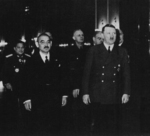 |  | 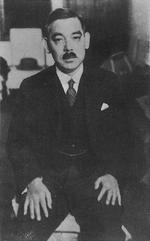 | 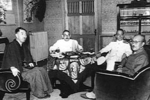 |
Yosuke Matsuoka Timeline
| 3 Mar 1880 | Yosuke Matsuoka was born. |
| 2 Aug 1935 | Yosuke Matsuoka was named the President of the South Manchuria Railway. |
| 24 Mar 1939 | Yosuke Matsuoka stepped down as the President of the South Manchuria Railway. |
| 19 Mar 1940 | Yosuke Matsuoka departed Berlin, Germany. |
| 22 Jun 1940 | Yosuke Matsuoka was named the Minister of Foreign Affairs in Japanese Prime Minister Prince Fumimaro Konoe's new government. |
| 27 Feb 1941 | Yosuke Matsuoka arrived in Berlin, Germany. |
| 26 Mar 1941 | Japanese Foreign Minister Yosuke Matsuoka arrived in Berlin, Germany. He was not met by Joachim von Ribbentrop immediately as his German counterpart was busy with the recent political developments in Yugoslavia. |
| 27 Mar 1941 | Japanese Foreign Minister Yosuke Matsuoka met with German Foreign Minister Joachim von Ribbentrop in Berlin, Germany in the morning; Ribbentrop noted to Matsuoka that the United States was intimidated by the Axis alliance thus would not enter into the war even if Japan joined in to strike at British possessions in Asia. In the afternoon, Matsuoka met with Adolf Hitler. |
| 28 Mar 1941 | Japanese Foreign Minister Yosuke Matsuoka again met with German Foreign Minister Joachim von Ribbentrop in Berlin, Germany. |
| 14 Jul 1941 | Japanese Ambassador Hiroshi Oshima informed German Foreign Minister Joachim von Ribbentrop that, in regards to the 10 Jul 1941 request for Japan to attack Vladivostok, Russia, Japanese Foreign Minister Yosuke Matsuoka was in agreement with the proposal but the Japanese cabinet in general did not agree with such a suggestion. |
| 23 Jul 1944 | In response to the American request for Chiang Kaishek to accept communist forces in his army, Chiang expressed that he would accept the request only if the Nationalist reserve forces would be off-limits to Joseph Stilwell, and if American Lend-Lease supplies would be controlled by Chiang. This counteroffer was to be rejected in the following month. |
| 26 Jun 1946 | Yosuke Matsuoka passed away. |
Did you enjoy this article or find this article helpful? If so, please consider supporting us on Patreon. Even $1 per month will go a long way! Thank you. Share this article with your friends: Stay updated with WW2DB: |


Visitor Submitted Comments
All visitor submitted comments are opinions of those making the submissions and do not reflect views of WW2DB.
» Indochina Campaign
» The Tripartite Pact
» Soviet-Japanese Neutrality Pact
» Tokyo Trial and Other Trials Against Japan
Document(s):
» Matsuoka's Opening Address at Franco-Thai Mediation
» Message from Churchill to Matsuoka
Related Books:
» Japan 1941: Countdown to Infamy
» Japan 1941: Countdown to Infamy
- » 1,150 biographies
- » 337 events
- » 44,024 timeline entries
- » 1,242 ships
- » 350 aircraft models
- » 207 vehicle models
- » 375 weapon models
- » 123 historical documents
- » 260 facilities
- » 470 book reviews
- » 28,622 photos
- » 431 maps
Joachim von Ribbentrop, German Foreign Minister, Aug 1939

Please consider supporting us on Patreon. Even $1 a month will go a long way. Thank you!

Or, please support us by purchasing some WW2DB merchandise at TeeSpring, Thank you!
10 Jul 2014 08:10:42 PM
...more about Matsuoka Yosuke in: JAPAN 1941 Countdown to Infamy; Chapter 2, p. 58 The Return of Don Quixote...by ERI HOTTA, Alfred A. Knopf, NYC, 2013.