


Gerd von Rundstedt
| Surname | Rundstedt |
| Given Name | Gerd |
| Born | 12 Dec 1875 |
| Died | 24 Feb 1953 |
| Country | Germany |
| Category | Military-Ground |
| Gender | Male |
Contributor: C. Peter Chen
ww2dbaseGerd von Rundstedt was born into a Prussian aristocratic family in Aschersleben, Germany. Following his father's footsteps as a career army officer, he joined Germany's elite military academy in 1902 and served in WW1. By 1918, he held the rank of major and was chief of staff for his division. After WW1 ended von Rundstedt remained with the small post-war German army. In 1932, he was appointed the commander of the 3rd Infantry Division, and in 1934 he joined with General Wilhelm Leeb to politically oppose the pro-Nazi movements within the army. He eventually resigned from the army on 31 October 1938 from his growing discontent at the Nazi policies, at 62 years of age.
ww2dbaseTwo years later, however, Rundstedt was recalled into service. He supported Erich von Manstein's plan to invade France, and used his political ties to ensure that particular invasion plan was used as part of the westward offensive. He led seven panzer divisions, three motorized divisions, and 35 infantry divisions during the invasion of France. However, he himself did not fully understand the speed factors of the blitzkrieg warfare. While General Heinz Guderian's tanks drove far in advance of the slower German infantry to attack the British Expeditionary Forces at Dunkirk, Rundstedt advised Guderian to pause his advance so that the infantry could catch up for a well-formed conventional attack on the British troops. This decision might had avoided unnecessary losses conservatively, but it also allowed the British and French troops to relatively safely withdraw from Dunkirk.
ww2dbaseOn 19 Jul 1940, Rundstedt was promoted to Field Marshal, and was a part of the planning for Operation Sealion and later the planning for Holland, Belgium, and France's coast defenses.
ww2dbaseIn Jun 1941, Rundstedt led Army Group South into Russia as a part of Operation Barbarossa. He made slow progress compared to other German generals, however he was key in the fall of Kiev, where 665,000 Russian prisoners were taken. He later participated in the battles at Kharkov and Rostov. Despite his recommendations to Hitler warning the dangers of venturing deep into Russia, Adolf Hitler decided against Rundstedt's comments and pressed on with the advance. His forces suffered a defeat after a Russian army counter-attack near Rostov, and was blamed by Hitler for the defeat. After his request for German troops to withdraw from the region was rejected, Hitler replaced Rundstedt with General Walther von Reichenau. Rundstedt was sent to France in Mar 1942 to defend the Atlantic coast.
ww2dbaseAfter the Normandy landings and the Germans' failed attempt to take Antwerp at the Ardennes offensive (Battle of the Bulge), in Mar 1944 Runstedt urged Hitler to negotiate a peace settlement with the Allies, which was prompted rejected. He again lost his post, this time to General Günther von Kluge. Field Marshal Wilhelm Keitel recalled Hitler commenting at this time that Rundstedt "is an old man, he has lost his nerve. He isn't master of the situation any longer, he'll have to go." He later joined the Army Court of Honor which expelled hundreds of officers suspected of treason against Hitler. Rundstedt was captured by the American 36th Infantry Division on 1 May 1945. He suffered a second heart attack during interrogations (the first occurred during the Russian campaign), and the interrogation was paused briefly. He was transferred to Britain, where he was interviewed by military historians including Basil Liddel Hart and Brian Horrocks for his personal accounts of the war. He was released by the British in Jul 1948, and he retired to Hanover where he would spend the rest of his life.
ww2dbaseGerman commanders generally held high regards for Rundstedt, but understood that the general was more fitting for a WW1-style trench war than a modern mobile war. "Rundstedt always enjoyed complete authority and had an excellent head for operations", Alfred Jodl said, however "[o]n account of his age, he was not so well-fitted to spur men on to superhuman efforts in an adverse situation."
ww2dbaseSources: Battle of the Bulge/Dark December, In the Service of the Reich, Wikipedia.
Last Major Revision: May 2006
Photographs
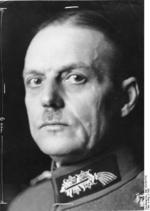 | 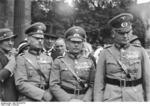 | 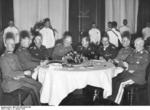 | 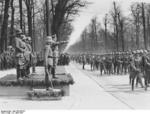 |
Gerd von Rundstedt Timeline
| 12 Dec 1875 | Gerd von Rundstedt was born. |
| 30 Oct 1943 | A report from German Commander-in-Chief, West Field Marshal Gerd von Rundstedt appeared on Adolf Hitler's desk. It described the shabby situation on the English Channel coast in France. Consequently Field Marshal Erwin Rommel would be despached by the German High Command to insect the Atlantic Wall defences and to submit a report. |
| 3 Feb 1944 | German Field Marshal Gerd von Rundstedt issued additional orders that supported swift severe reprisals against any acts of resistance. The orders also explicitly attribute any potential innocent civilian casualties the fault of resistance group and not of the German occupation. |
| 3 Sep 1944 | Feldmarschal von Rundstedt took command of German forces in the West. |
| 1 May 1945 | Allied forces captured German Field Marshal Gerd von Rundstedt in Bad Tölz, Germany. |
| 24 Feb 1953 | Gerd von Rundstedt passed away. |
Please consider supporting us on Patreon. Even $1 per month will go a long way! Thank you. Please help us spread the word: Stay updated with WW2DB: |


Visitor Submitted Comments
19 Dec 2006 11:28:26 AM
Kann sein Enkel Gerd sich bitte mit mir in Verbindung setzen? Jörg ist gestorben und ich brauche ihn jetzt.
21 Dec 2006 12:28:31 PM
Very enlightening interpretation of this outstanding leader. In view of recent military history, it is probably true that, at his age, he did not well understand Blitzkrieg. Few generals did, in any army
 Alan Chanter says:
27 Oct 2007 03:23:23 AM
von Rundstedt was something of an eccentric. He seldom wore the uniform of a General, much preferring that of the 18th Infantry Regiment (of which he was an honoury Colonel). Sometimes this led to him being addressed mistakenly as COLONEL, which he found highly amusing.
28 Dec 2008 01:51:05 PM
one of the outstanding german generals, of world war 2..as usual he critized hitler and was sacked..he was right never should have gone into russia..
13 Feb 2009 10:17:58 AM
this is highly interesting but you've left out a good bit. i only know this cuz i am related to Gerd von Rundstedt!
All visitor submitted comments are opinions of those making the submissions and do not reflect views of WW2DB.
» Invasion of Poland
» Invasion of France and the Low Countries
» Operation Barbarossa
- » 1,167 biographies
- » 337 events
- » 44,617 timeline entries
- » 1,244 ships
- » 350 aircraft models
- » 207 vehicle models
- » 376 weapon models
- » 123 historical documents
- » 261 facilities
- » 470 book reviews
- » 28,520 photos
- » 365 maps
Joachim von Ribbentrop, German Foreign Minister, Aug 1939

Please consider supporting us on Patreon. Even $1 a month will go a long way. Thank you!

Or, please support us by purchasing some WW2DB merchandise at TeeSpring, Thank you!
16 Jan 2006 09:55:14 PM
interesting