


Shiro Ishii
| Surname | Ishii |
| Given Name | Shiro |
| Born | 25 Jun 1892 |
| Died | 9 Oct 1959 |
| Country | Japan |
| Category | Medicine |
| Gender | Male |
Contributor: C. Peter Chen
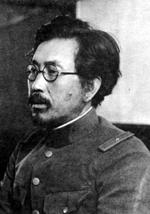
ww2dbaseShiro Ishii was born in Shibayama Village, Sanbu District, Chiba Prefecture, Japan. He studied medicine at the Kyoto Imperial University. In 1922, after joining the Japanese Army, he was assigned to the 1st Army Hospital and Army Medical School in Tokyo, Japan. In 1924, he returned to Kyoto Imperial University for post-graduate studies. Between 1928 and 1930, he traveled to the West, researching biological and chemical warfare from the experience from WW1. In 1932, he was chosen by the Japanese Army to begin biological warfare research at the Zhongma Fortress in Beiyinhe, which was outside of Harbin in Manchuria, northeast China (Manchukuo). In 1935, Ishii shut down the Zhongma Fortress due to a security breach, and shortly after set up a very large facility in Pingfang, which was 24 kilometers south of Harbin; the new facility had 150 buildings over six square kilometers of land, and the facility was publicly known as a water purification research center. In 1940, he was appointed the Chief of Biological Warfare Section of the Japanese Kwantung Army, while at the same time holding the title of the head of the Bacteriological Department of the Japanese Army Medical Academy. In 1941, his unit was formally renamed the Epidemic Prevention and Water Purification Department of the Kwantung Army, also known as Unit 731. In 1942, he began conducting tests of germ warfare agents on Chinese prisoners of war, Chinese civilians, and in combat. Some of the germs he experimented with included bubonic plague, cholera, and anthrax, among others. Between 1942 and 1945, he was the Chief of the Medical Section of the Japanese First Army. In 1945, as the end seemed near, Japanese troops attempted to destroy Unit 731's headquarters to destroy all evidence; as part of this effort, Ishii ordered 150 remaining subjects killed.
ww2dbaseAfter the war, Ishii was arrested by American troops. As with all other Unit 731 leaders, he was granted immunity by Allied leaders in exchange for their knowledge in biological and chemical warfare. According to Cambridge University lecturer Richard Drayton, Ishii moved to Maryland, United States to continue his research of biological weapons, but his daughter Harumi noted that Ishii remained in Japan after the war. He passed away from throat cancer in Tokyo, Japan in 1959.
ww2dbaseSource: Wikipedia.
Last Major Revision: Nov 2009
Photographs
 |
Shiro Ishii Timeline
| 25 Jun 1892 | Shiro Ishii was born. |
| 9 Oct 1959 | Shiro Ishii passed away. |
Did you enjoy this article or find this article helpful? If so, please consider supporting us on Patreon. Even $1 per month will go a long way! Thank you. Share this article with your friends: Stay updated with WW2DB: |


Visitor Submitted Comments
21 Apr 2017 08:09:58 AM
I need more facts
8 Oct 2017 01:28:30 PM
How did the actions of Shiro Ishii, particularly Unit 731, affect other people?
15 Jan 2018 02:29:57 PM
Good ol' mass-murdering psychopath
7 Feb 2019 11:06:40 AM
To Ishii, what was the appeal of running the unit? Why did he do it?
7 Feb 2019 11:10:21 AM
Why did he do it though? What was the appeal?
4 Apr 2019 11:06:03 PM
Quite frankly, the USA lost their ability to speak from the moral high ground about WW2 the second the granted immunity to Ishii. The race to beat the Soviets was more important than justice to a man who was every bit as evil as Mengele.
All visitor submitted comments are opinions of those making the submissions and do not reflect views of WW2DB.
- » WW2DB's 19th Anniversary (29 Dec 2023)
- » Looted Painting "Madonna with Child" Returned to Poland (2 Jun 2023)
- » Wreck of USS Mannert L. Abele Found (29 May 2023)
- » Wreck of Montevideo Maru Found (25 Apr 2023)
- » Accidental Detonation of a WW2-Era Bomb in Great Yarmouth (10 Feb 2023)
- » See all news
|
- » 1,146 biographies
- » 337 events
- » 43,422 timeline entries
- » 1,237 ships
- » 349 aircraft models
- » 207 vehicle models
- » 372 weapon models
- » 123 historical documents
- » 259 facilities
- » 468 book reviews
- » 28,395 photos
- » 432 maps
Captain Henry P. Jim Crowe, Guadalcanal, 13 Jan 1943

Please consider supporting us on Patreon. Even $1 a month will go a long way. Thank you!

Or, please support us by purchasing some WW2DB merchandise at TeeSpring, Thank you!
23 Dec 2011 11:57:35 PM
where are the pictures of the fortress of death?