


Friedrich Paulus
| Surname | Paulus |
| Given Name | Friedrich |
| Born | 23 Sep 1890 |
| Died | 1 Feb 1957 |
| Country | Germany |
| Category | Military-Ground |
| Gender | Male |
Contributor: C. Peter Chen
ww2dbaseFriedrich Paulus was born in Breitenau to Ernest and Bertha Paulus. He enlisted in the Prussian Army in 1910, and was promoted to second lieutenant the year after. He married a woman of Romanian aristocracy, Elena Rosetti-Solescu, on 4 Jul 1912, and from that point in his life he acted in an aristocratic manner, including his insistence personal cleanliness even in the most gruesome battlefields. After participating in WW1 in Macedonia, France, and Serbia, Paulus held various staff posts. In 1935, he would be named the chief of staff for the Panzer Headquarters, where he caught the attention of Hitler, and was promoted to a leadership position. He was transferred to the German 10th Army to take command in 1939.
ww2dbasePaulus led forces in Poland in 1939 during the invasion, and later also took part in the invasion of Belgium, Holland, and France. The 10th Army would be renamed the 6th Army during that campaign. He prepared his troops with rigorous training for an invasion of Britain that never took place. In 1940 he served as the Deputy Chief of Staff of the Army General Staff. Starting in 1941, he served briefly under Erwin Rommel in North Africa before being transferred to the Russian Front. He later was appointed a commanding general in that theater in Jan 1942. He was a key contributor for planning of Operation Barbarossa. He was successful in capturing Kharkov in May 1942, and was largely successful in the entire Caucasus region. Nevertheless, he had never been a support of the campaign against Russia. As a senior officer before Operation Barbarossa, he warned against such an invasion, citing that the enormous front would overstretch German strength.
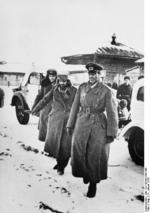
ww2dbaseAs Paulus moved his troops toward Stalingrad, the difficulties set in as he had previously warned. In the following month, Russian forces launched a counterattack that eventually surrounded the German 6th Army in the city of Stalingrad. Adolf Hitler promoted Paulus to the rank of Field Marshal in Jan 1943, hoping that it would inspire him to fight to the death in Stalingrad (no Field Marshal hard ever surrendered to the enemy in German history). Very soon after the promotion, however, he surrendered his forces on 2 Feb 1943. He became a prisoner of war in Russia until 1953. During his captivity, he joined the Russian-sponsored National Committee for a Free Germany, and urged the German people to turn their backs on the Nazi government. During the Nuremberg Trials, Paulus acted as a witness.
ww2dbasePaulus passed away in Dresden in 1957 as an inspector in the city's police force.
ww2dbaseCertain sources cite Paulus as "von Paulus", adding the "von" prefix that indicates aristocracy, which is not correct. His father, a school teacher, was not of noble blood; the only connection Paulus had to aristocracy was through his marriage with Elena Rosetti-Solescu.
ww2dbaseSources: DHM Object Database, Spartacus Educational, Wikipedia.
Last Major Revision: Apr 2007
Friedrich Paulus Interactive Map
Photographs
 |  |  |  |
Friedrich Paulus Timeline
| 23 Sep 1890 | Friedrich Paulus was born in Guxhagen, Germany. |
| 4 Jul 1912 | Friedrich Paulus married Elena Rosetti-Solescu. |
| 27 Apr 1941 | German Deputy Chief of Staff Friedrich Paulus arrived in Libya. |
| 12 Sep 1942 | General Friedrich Paulus began a fresh offensive toward Stalingrad, Russia with artillery and aerial bombardments. His ground troops then reached the strategically vital hill 102 of Mamayev Kurgan which overlooked the city. This hill, an important line of defence for centuries, would now see a bloody struggle by both sides as its loss would allow the Germans to control the entire river, across which all Soviet supplies had to travel. By the end of the day, the Soviet 62nd Army had been reduced to 90 tanks, 700 mortars and 20,000 men. |
| 17 Apr 1943 | Matome Ugaki chaired a conference at the 8th Base Force Headquarters at Rabaul, New Britain. Among other topics, the admirals discussed the lack of armor on Japanese aircraft and the concern that Isoroku Yamamoto was soon to personally visit the front lines. |
| 1 Feb 1957 | Friedrich Paulus passed away in Dresden, Germany. |
Please consider supporting us on Patreon. Even $1 per month will go a long way! Thank you. Please help us spread the word: Stay updated with WW2DB: |


Visitor Submitted Comments
1 Feb 2017 10:00:52 PM
Your reports are thick enough to give a broad view of matters that relate. They are sufficient enough for one to be interested to consider studying further. Thank you
14 Aug 2021 08:50:41 AM
Good simple overview
All visitor submitted comments are opinions of those making the submissions and do not reflect views of WW2DB.

» Invasion of Poland
» Invasion of France and the Low Countries
» Second Battle of Kharkov
» Battle of Stalingrad
- » 1,178 biographies
- » 337 events
- » 45,089 timeline entries
- » 1,245 ships
- » 350 aircraft models
- » 207 vehicle models
- » 376 weapon models
- » 123 historical documents
- » 261 facilities
- » 470 book reviews
- » 28,488 photos
- » 365 maps
General Douglas MacArthur at Leyte, 17 Oct 1944

Please consider supporting us on Patreon. Even $1 a month will go a long way. Thank you!

Or, please support us by purchasing some WW2DB merchandise at TeeSpring, Thank you!
17 Jun 2009 04:58:03 PM
Your reports are thinner than a second grader's book report or an entry in a cheap encyclopedia. It tells nothing but poses as substantial. You are phonies and any average high school student could beat you.No wonder you censor your comments. Ecccch! Yikes!