


Myoko
| Country | Japan |
| Ship Class | Myoko-class Heavy Cruiser |
| Builder | Yokosuka Naval Arsenal |
| Laid Down | 25 Oct 1924 |
| Launched | 16 Apr 1927 |
| Commissioned | 31 Jul 1929 |
| Decommissioned | 8 Jun 1946 |
| Displacement | 10,980 tons standard; 13,300 tons full |
| Length | 662 feet |
| Beam | 68 feet |
| Draft | 21 feet |
| Machinery | 4 geared turbines, 12 boilers |
| Power Output | 130,000 shaft horsepower |
| Speed | 36 knots |
| Range | 8,000nm at 14 knots |
| Crew | 773 |
| Armament | 10x203mm, 6x120mm (pre-1934), 8x127mm (post-1934), 2x13mm machine guns |
| Armor | 4in main belt, 1.375in main deck, 1in turrets, 3in barbettes |
| Aircraft | 2 |
Contributor: C. Peter Chen
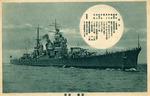
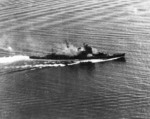
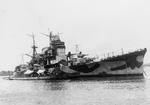
ww2dbaseNamed after a mountain in Niigata Prefecture, Myoko was the lead ship of the four-member class of heavy cruisers. At the start of the Pacific War, she participated in the invasion of the Philippines in Dec 1941, providing cover for the landings at Davao and Legaspi. In late Dec 1941, she was reorganized, along with all other members of Cruiser Division 5, and assigned under Rear Admiral Raizo Tanaka. On 4 Jan 1942, she was attacked by American B-17 bombers, and was hit by one 500-lb bomb; she was drydocked at Sasebo for repairs. On 1 Mar 1942, she participated in the Battle of the Java Sea, sharing the credit for disabling the British destroyer Encounter that eventually led to her scuttling. In Apr 1942, she unsuccessfully gave chase to the carriers that launched the Doolittle raiders who bombed the Japanese home islands. In May 1942, Myoko was part of the escort for the Tulagi invasion force in the Battle of the Coral Sea, then in the following month she sailed with the Midway invasion force though she did not participate in combat. In late-Jun 1942, she sailed with Cruiser Division 5 to support the newly captured Aleutian Islands. On 11 Oct 1942, Myoko sailed as a part of the Second Fleet from Truk for Guadalcanal. After some time refitting at Sasebo, she returned to Guadalcanal again to assist in its evacuation. In May 1943, she assisted the evacuation of Kiska in the Aleutian Islands. In Jun 1943, she was fitted with four Type 96 25mm anti-aircraft gun mounts and a Type 21 air search radar set; the work was completed at Sasebo. In Nov 1943, she sailed under the banner of Cruiser Division 5 as escorts for four destroyer transports carrying 1,000 troops for Bougainville. The fleet made contact with an American force, and the Battle of Empress Augusta Bay ensued. At the conclusion of the battle, the Japanese scored a victory, but Myoko suffered some damage as the result of a collision with destroyer Hatsukaze; Hatsukaze was seriously damaged and was eventually sunk at the end of the battle. On 17 Nov, she arrived at Sasebo and received eight single-mount 25mm anti-aircraft guns, then acted as convoy escorts in the Truk-Palau area until May 1944. In Jun 1944, she participated in the Battle of the Philippine Sea. Later in the war, she acted as a floating battery at Singapore. After the war, she was scuttled off Port Swettenham, Malaya.
ww2dbaseSource: Wikipedia.
Last Major Revision: Mar 2007
Heavy Cruiser Myoko Interactive Map
Photographs
 |  |  |  |
Myoko Operational Timeline
| 31 Jul 1929 | Myoko was commissioned into service. |
| 1 Nov 1929 | Captain Yoshiyuki Niiyama, commanding officer of Nachi, took on a dual role as the commanding officer of cruiser Myoko. |
| 22 May 1939 | Myoko, flagship of Vice Admiral Koichi Shiozawa of Japanese Navy 5th Fleet, arrived in Xiamen, China in response to recent British, French, and American troop arrivals in the international zone. |
| 8 May 1943 | Yamato, Chuyo, Unyo, Myoko, Haguro, Yugure, Naganami, Samidare, and Ushio departed Truk, Caroline Islands. |
| 13 May 1943 | Yamato, Chuyo, Unyo, Myoko, Haguro, Yugure, Naganami, Samidare, and Ushio arrived at Yokosuka, Japan. Later on the same day, Yamato departed for Kure, Japan. |
| 8 Jun 1946 | Myoko was decommissioned from service. |
Please consider supporting us on Patreon. Even $1 per month will go a long way! Thank you. Please help us spread the word: Stay updated with WW2DB: |


» Omori, Sentaro
Event(s) Participated:
» Battle of Xiamen
» Guangdong Operation
» Battle of Hainan
» Invasion of the Philippine Islands
» Dutch East Indies Campaign, Java
» Battle of Coral Sea
» Battle of Midway and the Aleutian Islands
» Guadalcanal Campaign
» Solomon Islands Campaign
» Mariana Islands Campaign and the Great Turkey Shoot
Partner Sites Content:
» Myoko Tabular Record of Movement
- » 1,167 biographies
- » 337 events
- » 44,606 timeline entries
- » 1,243 ships
- » 350 aircraft models
- » 207 vehicle models
- » 376 weapon models
- » 123 historical documents
- » 261 facilities
- » 470 book reviews
- » 28,507 photos
- » 365 maps
Winston Churchill, on the RAF

Please consider supporting us on Patreon. Even $1 a month will go a long way. Thank you!

Or, please support us by purchasing some WW2DB merchandise at TeeSpring, Thank you!