


Shinyo
| Country | Japan |
| Ship Class | Shinyo-class Escort Carrier |
| Builder | Kure Naval Arsenal |
| Laid Down | 30 Apr 1935 |
| Commissioned | 15 Nov 1943 |
| Sunk | 17 Nov 1944 |
| Displacement | 17,500 tons standard; 20,586 tons full |
| Length | 621 feet |
| Beam | 85 feet |
| Draft | 27 feet |
| Machinery | 2 AEG steam turbines, turbo-electric transmission, 2 shafts |
| Power Output | 26,000 shaft horsepower |
| Speed | 22 knots |
| Crew | 942 |
| Armament | 1943: 8x127mm/40cal dual purpose guns, 30x25mm anti-aircraft guns; post-1944: 8x127mm/40cal dual purpose guns, 50x25mm anti-aircraft guns |
| Aircraft | 27 operational, 6 in reserve |
| Elevators | 2 |
Contributor: C. Peter Chen
ww2dbaseWhen the European War began in Sep 1939, the German ocean liner Scharnhorst owned by Norddeutscher Lloyd was at the port of Kobe, Japan; Scharnhorst was built at Bremen, Germany by Deutsche Schiff- und Maschinenbau AG in 1934. Because the German Navy had no presence in the east to escort her home, Scharnhorst was trapped in Japan. Her passengers aboard the ship eventually made it back to Germany via the Trans-Siberian Railway.
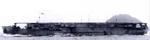
ww2dbaseIn Jun 1942, Japan's carrier was seriously damaged after the Midway debacle. At this point, the Japanese Navy had already offered to purchase Scharnhorst for military use, and at this point, as the deal had just been struck, it was decided that instead of a troop ship as originally thought, she was to be converted into an escort carrier. The work began in Sep 1942 after she was towed into Kure Naval Shipyard, Japan. Her construction used steel from the canceled 4th Yamato-class battleship hull. She retained her original machinery, while external bulges were added to increase stability. She was fitted with two elevators and a single hangar, giving her the capacity to operate 27 aircraft and to carry 6 spare aircraft frames. She joined the Japanese Navy Grand Escort Command in Dec 1943 as the escort carrier Shinyo under the command of Captain Shizue Ishii.
ww2dbaseIn Jul 1944, Shinyo began to escort convoys. On 14 Nov, she departed from Imari Bay in Japan to escort Convoy HI-81 of transports carrying the Japanese Army 23rd Infantry Division. The convoy was bound for Luzon in the Philippine Islands with a stopover at Taiwan. Right before noon on 15 Nov, transport Akitsu Maru in the convoy was attacked by American submarine Queenfish and sank, and Shinyo's aircraft failed to find the attacker. On 16 Nov, the convoy stopped off Korea to shake off any further submarine attacks; while at this location, Convoy MI-27 sailed close to HI-81, making the appearance of one very large convoy fleet. On 17 Nov, HI-81 departed at 0800 hours, and was spotted by an American B-29 bomber at about 1215; Shinyo's aircraft failed to climb fast enough to intercept. At 1815, transport Mayasan Maru was sunk by submarine USS Picuda with loss of over 3,000 lives. At 2303, she was attacked by submarine USS Spadefish, which fired six torpedoes at her. Four or fewer torpedoes struck her on the starboard side, igniting her aviation fuel tank. Spadefish surfaced and attacked Shinyo with her gun, but by that time Shinyo was already a floating inferno. She listed rapidly to starboard, settling aft. She sank stern first in the Yellow Sea near the Korean island of Jeju; the exact sinking time is not known, but it was likely to be between 2330 and 0030 on 18 Nov. Ships of MI-27 performed rescue on the next day, 18 Nov, and found that of the 1,160 onboard Shinyo at the time sinking, only somewhere between 130 to 200 men survived. Captain Ishii was among those killed.
ww2dbaseSources: Nihon Kaigun, Wikipedia.
Last Major Revision: Apr 2009
Photographs
 |
Shinyo Operational Timeline
| 15 Nov 1943 | Shinyo was commissioned into service. |
Did you enjoy this article or find this article helpful? If so, please consider supporting us on Patreon. Even $1 per month will go a long way! Thank you. Share this article with your friends: Stay updated with WW2DB: |


Visitor Submitted Comments
All visitor submitted comments are opinions of those making the submissions and do not reflect views of WW2DB.
» Japanese Aircraft Carrier Functions
» Japanese Aircraft Carrier Operational Status By Month
» Japanese Aircraft Carrier Specifications
» Japanese Aircraft Carrier Time Operational
Partner Sites Content:
» Shinyo Tabular Record of Movement
|
- » 1,150 biographies
- » 337 events
- » 44,024 timeline entries
- » 1,242 ships
- » 350 aircraft models
- » 207 vehicle models
- » 375 weapon models
- » 123 historical documents
- » 260 facilities
- » 470 book reviews
- » 28,627 photos
- » 431 maps
Joachim von Ribbentrop, German Foreign Minister, Aug 1939

Please consider supporting us on Patreon. Even $1 a month will go a long way. Thank you!

Or, please support us by purchasing some WW2DB merchandise at TeeSpring, Thank you!
25 Nov 2012 01:09:04 AM
i love it