


Admiral Scheer
| Country | Germany |
| Ship Class | Deutschland-class Heavy Cruiser |
| Builder | Kriegsmarinewerft |
| Yard Number | 123 |
| Slip/Drydock Number | I |
| Ordered | 19 May 1931 |
| Laid Down | 25 Jun 1931 |
| Launched | 1 Apr 1933 |
| Commissioned | 12 Nov 1934 |
| Sunk | 9 Apr 1945 |
| Displacement | 12,100 tons standard; 16,200 tons full |
| Length | 610 feet |
| Beam | 71 feet |
| Draft | 24 feet |
| Machinery | 8xMAN diesel engines with two screws |
| Power Output | 52,050 shaft horsepower |
| Speed | 28 knots |
| Range | 8,900nm at 20 knots |
| Crew | 1,150 |
| Armament | 6x280mm, 8x150mm, 8x530mm torpedo tubes |
| Armor | 140mm turret face, 58mm belt, 41mm deck |
| Aircraft | 2 |
Contributor: C. Peter Chen
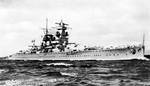
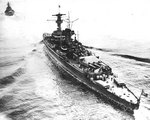
ww2dbaseAdmiral Scheer was a Deutschland class heavy cruiser named after Admiral Reinhard Scheer, the victor of Battle of Jutland in 1916. Almost two years after Captain Wilhelm Marschall took over as her first skipper, she was sent to Spain to evacuate German civilians during the country's civil war. She also delivered German weapons to Francisco Franco's Nationalist forces. On 31 May 1937 she bombarded Republican installations at Almería in reprisal for an air attack on the heavy cruiser Deutschland two days earlier. The actions in the Spanish Civil War prepared her crew for actions in the military phase of WW2 that began in Sep 1939.
ww2dbaseAlong with the other heavy cruisers in her class, Admiral Scheer was considered a ship with revolutionary designs. She was laid down with the philosophy that she must be faster than ships with superior firepower, while she must also achieve superior firepower against ships faster than her. The result was a class of ships that were well suited for merchant raiding missions.
ww2dbaseOn 4 Sep 1939, Admiral Scheer was attacked by British bombers at Wilhelmshaven. She took down four bombers with her anti-aircraft guns and suffered minor damage from three bombs. On 14 Oct 1940 under the command of Captain Theodor Kranke she left for a raiding mission; she sank six ships on 5 Nov during her first engagement with a British merchant convoy. She continued on to sink ten more ships during the course of the next few months, venturing as far as the Indian Ocean with her oiler ship Nordmark. She returned to Kiel on 1 Apr 1941 after a 46,000-nautical mile journey.
ww2dbaseOn 2 Jul 1942 she was sent on a sortie again, searching for convoys in the North Atlantic transporting supplies to Russia. She bombarded the Russian meteorological station at Cape Zhelaniya on 25 August, and then sank the armed ice breaker Aleksandr Sibiryakov, though she failed her primary mission of finding a convoy known in the vicinity. She went on to bombard a radio station at Novy Dikson before returning to Wilhelmshaven without any kills to report.
ww2dbaseIn the fall of 1944 Admiral Scheer provided coastal fire support to retreating army units on the Sorvemaa Peninsula in the Baltic Sea. In Jan and Feb 1945 she provided some bombardment support. At the night of 9 Apr 1945, she was attacked and sank by 300 British Royal Air Force bombers while in port at Kiel.
ww2dbaseSource: Wikipedia.
Last Major Revision: Feb 2006
Heavy Cruiser Admiral Scheer Interactive Map
Photographs
 |  |  |  |
Admiral Scheer Operational Timeline
| 25 Jun 1931 | The keel of Admiral Scheer was laid down by Reichsmarinewerft in Wilhelmshaven, Germany. |
| 1 Apr 1933 | Admiral Scheer was launched at Wilhelmshaven dockyard in Germany. |
| 12 Nov 1934 | Admiral Scheer was commissioned into service. |
| 31 May 1937 | Albatros escorted Admiral Scheer as the heavy cruiser bombarded Spanish Republican naval facilities at Almería, Spain. |
| 21 Jul 1940 | British Hampden bombers from No. 61 and No. 144 Squadrons attacked German cruiser Admiral Scheer at Wilhelmshaven, Germany, causing no damage. |
| 12 Sep 1940 | Nordmark began supporting cruiser Admiral Scheer. |
| 5 Nov 1940 | German pocket battleship Admiral Scheer approached Allied convoy HX-84 in the North Atlatic in the late afternoon, and British armed merchant cruiser Jervis Bay moved in to intercept. Hopelessly outgunned, Jervis Bay was sunk within 15 minutes of the gun battle; 190 were killed and 65 survived; Captain Fegen of Jervis Bay would be awarded the Victoria Cross posthumously for his efforts to slow Admiral Scheer. Nevertheless, Admiral Scheer was able to sink 5 additional British ships in the convoy before the convoy scattered and escaped, killing an additional 208 sailors. |
| 24 Nov 1940 | HMS Cumberland joined Hunting Group in search for German battleship Admiral Scheer off Brazil. |
| 24 Nov 1940 | German heavy cruiser Admiral Scheer stopped British ship Port Hobart near the Azores; the crew was imprisoned and Port Hobart was scuttled. |
| 1 Dec 1940 | German heavy cruiser Admiral Scheer sank British ship Tribesman 500 miles west of the Cape Verde islands; 8 were killed and 14 survived. |
| 18 Dec 1940 | German cruiser Admiral Scheer captured British ship Duquesna in the South Atlantic 800 miles south of Cape Verde Islands, capturing 91 crew and 8 passengers. Captain Theodor Krancke of Admiral Scheer purposefully allowed Duquesna to radio to help in order to distract the Royal Navy, hoping to indirectly help cruiser Admiral Hipper to break out into the Atlantic Ocean from the Denmark Strait. Duquesna, with 3,500 tons of frozen beef and 15 million eggs on board, was kept in operation by the Germans in the South Atlantic until 18 Feb 1941 to supply German ships in the area. |
| 18 Dec 1940 | HMS Cumberland diverted with HMS Enterprise to join HM Cruiser Newcastle in renewed search for Admiral Scheer. then reported between Rio de Janeiro and the Plate. Later was also deployed to search for commerce raider Pinguin. |
| 18 Jan 1941 | German cruiser Admiral Scheer captured Norwegian tanker Sandefjord 1,000 miles off the coast of Angola, Portuguese West Africa. The ship, along with her cargo of 11,000 tons of crude oil, was sent to France as a prize ship. |
| 20 Jan 1941 | German cruiser Admiral Scheer sank British ship Stanpark and captured Dutch ship Barneveld 1,000 miles off the coast of Angola. |
| 14 Feb 1941 | German armed merchant cruiser Atlantis, with a fleet of two prize ships and one supply ship, made rendezvous with German cruiser Admiral Scheer. The ships transferred supplies amongst each other while prize ship tanker Ketty Brøvig refueled Admiral Scheer. |
| 20 Feb 1941 | German heavy cruiser Admiral Scheer sank Greek steamer Grigorios C II (27 survivors were taken prisoner) and captured British tanker British Advocate west of the Seychelles Islands in the Indian Ocean. Advocate was to be sent to France as a prize ship. |
| 21 Feb 1941 | German heavy cruiser Admiral Scheer sank British ship Canadian Cruiser 575 miles west of the Seychelles Islands in the Indian Ocean. Before being taken prisoner, the crew radioed for help, which was received by British cruiser HMS Glasgow. |
| 22 Feb 1941 | German cruiser Admiral Scheer sank Dutch collier Rantau Pandjang off the east coast of Africa. Distress signals were received by British cruiser HMS Glasgow, which was already aware of Admiral Scheer's presence by the sinking of British ship Canadian Cruiser on the previous day. HMS Glasgow launched her seaplane to search for the German raider, but the aircraft would return without any findings. |
| 1 Mar 1941 | German cruiser Admiral Scheer entered the South Atlantic from the Indian Ocean. |
| 17 Mar 1941 | German armed merchant cruiser Kormoran and submarine U-124 made rendezvous with cruiser Admiral Scheer 1,150 miles southwest of Cape Verde Islands. U-124 transferred quartz aboard Admiral Scheer for her radar; although planned, the transfer of torpedoes from Kormoran to U-124 was canceled due to rough seas. |
| 21 May 1941 | Nordmark completed supported cruiser Admiral Scheer. |
| 4 Sep 1941 | German cruiser Admiral Scheer departed the Baltic Sea for Oslo, Norway. |
| 8 Sep 1941 | British Flying Fortress bombers unsuccessfully attacked the German cruiser Admiral Scheer in Oslofjord, Norway. |
| 9 Sep 1941 | German cruiser Admiral Scheer was ordered to sail from Oslo, Norway for Swinemünde, Germany (now Swinoujscie, Poland). |
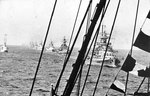
| 21 Feb 1942 | German cruiser Admiral Scheer, cruiser Prinz Eugen, and 5 destroyers departed Brunsbüttel, Germany for Bergen, Norway. RAF Coastal Command attempted to intercept them, but most of the aircraft failed to find them, and the lone bomber that did was shot down. |
| 22 Feb 1942 | German cruiser Admiral Scheer, cruiser Prinz Eugen, and 5 destroyers arrived at Bergen, Norway. British RAF aircraft continued to attack this force, again unsuccessfully, losing 3 Albacore carrier aircraft in the process. The force would depart Bergen after sundown for Trondheim, Norway. |
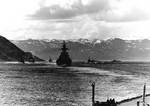
| 16 Aug 1942 | Admiral Scheer departed Ofotfjord near Narvik, Norway at 1500 hours, embarking on Operation Wunderland to raid Soviet merchant shipping. A Russian-speaking radio intelligence team was brought on board to help decipher intercepted messages. Admiral Scheer was escorted by destroyer Z16 Friedrich Eckoldt, destroyer Z15 Erich Steinbrink, and destroyer Z4 Richard Beitzen. |
| 18 Aug 1942 | German cruiser Admiral Scheer, destroyer Z16 Friedrich Eckoldt, destroyer Z15 Erich Steinbrink, and destroyer Z4 Richard Beitzen entered Kara Sea. |
| 25 Aug 1942 | Admiral Scheer spotted Soviet ice breaker Alexander Sibiyakov in the Kara Sea at 1100 hours. At 1500 hours, Admiral Scheer sank Alexander Sibiyakov, killing 80; the Soviet ship was able to send out a distress signal before her sinking. At 1545 hours, Admiral Scheer intercepted a radio message from the Soviet Western Sector Command Headquarters of Northern Sea Route Main Directorate, informing Soviet ships of her presence. Out of precaution, Admiral Scheer turned to the northwest, away from known Soviet bases. |
| 27 Aug 1942 | Admiral Scheer approached Port Dikson in northern Russia at 0105 hours, intending to attack the command center of the Soviet Northern Sea Route with a 180-man landing party, not knowing the port was well-defended with 50 NKVD troops, 300 militia, 2 anti-tank guns, 1 anti-aircraft gun, 1 750mm howitzer, and large caliber coastal guns. As Admiral Scheer approached to bombard, Soviet flagship Dezhnev was disabled at 0145 hours (7 were killed), followed by Soviet ship Revolutionary. To Admiral Scheer's surprise, 152mm coastal guns opened fire; although the Soviet coastal gun crews could not see through the thick smoke from Dezhnev and Revolutionary and could only fire in Admiral Scheer's general direction, it was enough to force Admiral Scheer to break off the attack. At the end of the engagement, Port Dikson saw its radio station, oil depot, coal storage, and power station damaged or destroyed. |
| 28 Aug 1942 | Admiral Scheer made rendezvous with German destroyers near Bear Island, Norway. |
| 30 Aug 1942 | Admiral Scheer arrived at Schemenfjord near Narvik, Norway. |
| 20 Nov 1944 | Admiral Scheer, Prinz Eugen, Z35, Z36, and Z43 began shelling Soviet positions during the evacuation of the Sõrve (German: Sworbe) peninsula on the Estonian island of Saaremaa (German: Ösel). |
| 24 Nov 1944 | Admiral Scheer, Prinz Eugen, Z35, Z36, and Z43 completed shelling Soviet positions during the evacuation of the Sõrve (German: Sworbe) peninsula on the Estonian island of Saaremaa (German: Ösel). |
Did you enjoy this article or find this article helpful? If so, please consider supporting us on Patreon. Even $1 per month will go a long way! Thank you. Share this article with your friends: Stay updated with WW2DB: |


» Start of the Battle of the Atlantic
» Operation Berlin
» East Prussian Offensive
» East Pomeranian Offensive
- » 1,150 biographies
- » 337 events
- » 43,917 timeline entries
- » 1,241 ships
- » 350 aircraft models
- » 207 vehicle models
- » 375 weapon models
- » 123 historical documents
- » 260 facilities
- » 470 book reviews
- » 28,549 photos
- » 432 maps
Chiang Kaishek, 31 Jul 1937

Please consider supporting us on Patreon. Even $1 a month will go a long way. Thank you!

Or, please support us by purchasing some WW2DB merchandise at TeeSpring, Thank you!