


Minneapolis
| Country | United States |
| Ship Class | New Orleans-class Heavy Cruiser |
| Builder | Philadelphia Navy Yard |
| Laid Down | 27 Jun 1931 |
| Launched | 6 Sep 1933 |
| Commissioned | 19 May 1934 |
| Decommissioned | 10 Feb 1947 |
| Displacement | 9,950 tons standard |
| Length | 588 feet |
| Beam | 62 feet |
| Draft | 19 feet |
| Speed | 32 knots |
| Crew | 708 |
| Armament | 9x8in guns, 8x5in guns, 8x0.50cal guns |
Contributor: C. Peter Chen
ww2dbaseUSS Minneapolis held her shakedown cruise in European waters between Jul and Sep 1934. On 4 Apr 1935, she departed from the Philadelphia Navy Yard in Pennsylvania, United States for San Diego, California, United States via the Panama Canal. Upon arrival on 18 Apr, she joined the Scouting Force of United States Navy Cruiser Division 7. In early 1939, she cruised in the Caribbean Sea, ending that tour at Pearl Harbor, US Territory of Hawaii in 1940.
ww2dbaseWhen Pearl Harbor was attacked by Japanese aircraft on 7 Dec 1941, Minneapolis was performing gunnery exercise about 20 miles away. She patrolled the waters around Hawaii until late Jan 1942, and then joined the screening force for carrier Lexington as Lexington's aircraft struck Japanese positions in the Gilbert and Marshall Islands in Feb and disrupted Japanese shipping in Central and South Pacific in Mar 1942. In this role, she shot down three G4M bombers on 1 Feb. Between 4 and 8 May, she escorted Lexington during the Battle of the Coral Sea; Minneapolis shot down three Japanese aircraft during the battle and rescued Lexington's survivors when the carrier was lost. Between 3 and 6 Jun 1942, she participated in the Battle of Midway, and then underwent repairs at Pearl Harbor. Between 7 and 9 Aug, she escorted carriers during the landings at Tulagi and Guadalcanal in the Solomon Islands. On 30 Aug, she towed the torpedo-damaged carrier Saratoga out of the front lines. Between Sep and Oct, she remained in the Guadalcanal region in support of operations.
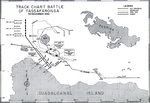
ww2dbaseOn 29 Nov 1942, as the flagship of Rear Admiral Carleton Wright's Task Force 67, USS Minneapolis sailed to intercept a Japanese force attempting to reinforce Guadalcanal, and was engaged in the Battle of Tassafaronga. At 2306, the first Japanese destroyer was detected, but Wright delayed the order to launch torpedoes until 2320 because he thought the range was still too far at 2306. At 2320 hours, 20 torpedoes were launched by destroyers, followed by cruiser and destroyer gunfire. Japanese destroyers charged forward at 24 knots and used American gunfire flashes as target to launch their torpedoes. At 2327 hours, two torpedoes struck Minneapolis at the port bow and at number two fireroom, disabling her. Behind her, USS New Orleans turned hard to avoid a collision with Minneapolis, only to run into another torpedo, which sheered off her bow. Damage control teams of both cruisers would be successful in keeping them afloat so they could receive repairs at Tulagi. Minneapolis was out of commission for months as she received extensive repairs at Mare Island Naval Shipyard in California.
ww2dbaseUSS Minneapolis returned to the Pacific War in Aug 1943. She bombarded Wake Island on 5 Oct. In Nov and Dec, she screened a carrier group during the Gilbert and Marshall Islands Campaigns. As the carriers attacked Palau, Truk, Satawan, Ponape, and other islands across the Pacific Ocean, Minneapolis followed, providing anti-aircraft protection. On 14 Jun 1944, her guns fired on Japanese targets on Saipan in the Mariana Islands ahead of the amphibious invasion. Between 19 and 20 Jun, during the Battle of the Philippine Sea where Japanese air power was seriously damaged, she again provided anti-aircraft support for carriers. Between 8 and 9 Aug, she bombarded Guam, Mariana Islands. Between 6 Sep and 14 Oct, she provided naval gunfire support for the ground operations in the Palau Islands. On 17 Oct, she entered Leyte Gulf in the Philippine Islands during the invasion, and shot down five Japanese aircraft and participated in the Battle of Surigao Strait on 25 Oct. Between 4 and 18 Feb 1945, screened carriers as well as provided gunfire support for the operations at Lingayen Gulf, Bataan, and Corregidor at Luzon, Philippine Islands. On 25 Mar, she bombarded Kerama Retto off Okinawa, Japan in preparation for the invasion of that island at the start of the Okinawa Campaign. On 1 Apr, she bombarded the Japanese airfield and other targets near Naha, Okinawa. On 12 Apr, off Okinawa, she shot down four suicide planes launched during Operation Kikusui. In the evening of 12 Apr, with badly worn gun barrels, she sailed for the Bremerton Navy Yard in Washington, United States for repairs. She returned to the Pacific War near the end.
ww2dbaseOn 9 Sep 1945, USS Minneapolis was Admiral Thomas Kinkaid's flagship as the admiral accepted the surrender of Japanese forces in Korea. Minneapolis then covered the United States Marines landing at the forts of Dagu (Wade-Giles romanization: Taku) in Tianjin, China and Qinhuangdao (Postal Map romanization: Chinwangtao), Hebi Province, China. In late 1945, she brought troops back to the United States, and was placed in reserve on 21 May 1946 in Philadelphia, Pennsylvania. She was decommissioned in the following year. She was sold for scrapping on 14 Aug 1959 to Union Metals and Alloys Corporation. She was broken up in Jul 1960 at Chester, Pennsylvania.
ww2dbaseSource: Wikipedia.
Last Major Revision: Nov 2008
Heavy Cruiser Minneapolis Interactive Map
Photographs
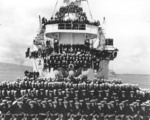 | 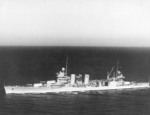 | 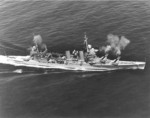 |  |
Maps
 |
Minneapolis Operational Timeline
| 19 May 1934 | Minneapolis was commissioned into service. |
| 20 Feb 1942 | A Japanese H6K flying boat piloted by Lieutenant (jg) Noboru Sakai spotted a US carrier force 460 miles northeast of New Britain; US pilot Jimmy Thatch of Fighting Squadron 3 (VF-3) flying from USS Lexington shot down Sakai's aircraft at 1112 hours, but not before Sakai had alerted others. At 1202 hours, Burt Stanley and Leon Haynes, also of VF-3, shot down another H6K aircraft flown by Warrant Officer Kiyoshi Hayashi north of Lexington. At 1420 hours, 17 Type 1 bombers of Japanese 4th Air Group, led by Lieutenant Masayoshi Nakagawa, were launched from Rabaul, with the first wave reaching Lexington at 1625 hours. The first wave of 9 bombers were all shot down without causing any damage to Lexington (Nakagawa tried to crash into Lexington as he fell from the sky, but fell short by less than 1 mile). US Navy Lieutenant Albert Vorse of VF-3 shot down one of these bombers for his first aerial kill. The second wave attacked USS Lexington and USS Minneapolis at 1705 hours, still causing no damage; Edward "Butch" O'Hare shot down 3 and damaged 4 Japanese bombers. Only 2 Japanese bombers arrived back at Rabaul at the end of the day; 100 Japanese bomber crewmen were lost during the attacks, and Japan also lost 20 men with the H6K reconnaissance flights earlier in the morning. O'Hare was given credit for 5 kills, making him an "Ace in a Day" and leading to him being awarded the Medal of Honor. With the element of surprise lost, Lexington broke off her intended raid on Rabaul. Because of the loss of so many bombers, the Japanese delayed their plans to invade Lae, New Guinea. |
| 28 May 1942 | USS Enterprise and Task Force 16 departed Pearl Harbor, US Territory of Hawaii for Midway Atoll. |
| 30 Nov 1942 | Near Guadalcanal, Solomon Islands, a formation of US cruisers sailing from Espiritu Santo ambushed a nighttime fast destroyer convoy led personally by Rear Admiral Raizo Tanaka south of Savo Island in the Solomons. Tanaka's quick thinking led to a Japanese victory in the Battle of Tassafaronga. Cruisers USS Northampton, USS Pensacola, USS Minneapolis, and USS New Orleans (New Orleans-class) were badly damaged by torpedoes. Cruiser USS Northampton was sunk by Type 93 torpedoes launched by Japanese destroyer Oyashio. Light cruiser USS Honolulu reported gunfire hits (along with other ships) on Japanese destroyer Takanami which broke apart and sank. |
| 9 Jan 1943 | USS Nicholas departed Espiritu Santo, New Hebrides to rendezvous with the damaged USS Minneapolis and escort the cruiser back to Espiritu Santo, New Hebrides. |
| 15 Feb 1943 | Battleship USS Mississippi, cruiser USS Minneapolis, and destroyers USS Shaw and McKean departed Suva, Fiji bound for Pago Pago, Samoa. |
| 18 Feb 1943 | Battleship USS Mississippi, cruiser USS Minneapolis, and destroyers USS Shaw and McKean arrived at Pago Pago, Samoa. |
| 19 Feb 1943 | Battleship USS Mississippi, cruiser USS Minneapolis, and destroyers USS Shaw, Boggs, and McKean departed Pago Pago, Samoa bound for Pearl Harbor, Hawaii. |
| 2 Mar 1943 | Battleship USS Mississippi, cruiser USS Minneapolis, and destroyers USS Shaw, Boggs, and McKean arrived at Pearl Harbor, Hawaii. |
| 19 Feb 1944 | Armed merchant cruiser Akagi Maru, cruiser Katori, destroyer Maikaze, destroyer Nowaki, and minesweeping trawler Shonan Maru No. 15 departed Truk, Caroline Islands at 0430 hours for Yokosuka, Japan. After 0500 hours, Truk came under attack by many US carrier aircraft. A number of aircraft spotted the group and attacked, sinking Akagi Maru and damaging Katori and Maikaze; at least one US F6F fighter was shot down during the attack on this group. Battleship New Jersey, battleship Iowa, cruiser Minneapolos, cruiser New Orleans, destroyer Bradford, and destroyer Burns then approached at about 1300 hours about 64 kilometers (40 miles) northwest of Truk. Maikaze fired a spread of torpedoes, which missed the two battleships. Gunfire from Minneapolis and New Orleans started a fire on Maikaze, causing an explosion, and leading to her sinking at 1343 hours; all aboard were lost. Then, New Jersey sank Shonan Maru No. 15 with her port side 5-inch battery. Next, Iowa opened fire on Katori, straddling Katori with the first salvo. Katori fired torpedoes, but all of them missed. Iowa's gunfire eventually overwhelmed and sank Katori; Captain Tamekiyo Oda was among those killed. Nowaki alone escaped the attack. |
| 18 Jul 1944 | USS St. Louis joined with cruisers USS Wichita and USS Minneapolis for a bombardment of Asan Beach, Guam. |
| 12 Oct 1944 | Task Group 77.2 consisting of battleships USS Tennessee, USS California, USS Pennsylvania, USS Maryland, USS West Virginia, and USS Mississippi with cruisers USS Honolulu, USS Portland, USS Minneapolis, USS Denver, and USS Columbia departed Seeadler Harbor, Manus bound Leyte Gulf, Philippines. |
| 27 Nov 1944 | US Navy Task Group 77.2 consisting of battleships USS Maryland, USS West Virginia, USS Colorado, and USS New Mexico, cruisers USS Denver, USS St. Louis, USS Columbia, USS Minneapolis, and USS Montpelier, destroyers USS Nicholas, USS Waller, USS Eaton, USS Cony, USS Mustin, USS Conway, USS Pringle, USS Lang, USS Sigourney, USS Saufley, USS Aulick, USS Renshaw, USS Taylor, USS Edwards, and USS Mugford, tanker USS Caribou, and other patrol craft were patrolling in Leyte Gulf, Philippines when the group came under a concentrated Japanese special air attack from 20 to 30 aircraft. All but two of the Japanese planes dived on the formation in the sustained attack. Submarine chaser SC-744 was sunk and battleship Colorado and cruisers St. Louis and Montpelier were damaged. |
| 29 Nov 1944 | US Navy Task Group 77.2 consisting of battleships USS Maryland, USS West Virginia, and USS New Mexico, cruisers USS Denver, USS Columbia, USS Minneapolis, USS Montpelier, and USS Portland, destroyers USS Nicholas, USS Waller, USS Cony, USS Conway, USS Pringle, USS Lang, USS Saufley, USS Aulick, USS Renshaw, USS Edwards, USS Mugford, and USS Connor, and other patrol craft were patrolling in Leyte Gulf, Philippines when the group came under a Japanese air attack where special attack aircraft that damaged Maryland, Saufley, and Aulick. |
| 10 Feb 1947 | Minneapolis was decommissioned from service. |
Did you enjoy this article or find this article helpful? If so, please consider supporting us on Patreon. Even $1 per month will go a long way! Thank you. Share this article with your friends: Stay updated with WW2DB: |


Visitor Submitted Comments
11 Apr 2011 09:27:43 PM
I am looking for a George Rogers. I found his log book in a junk box form my uncles old fleet lockers club in long Beach CA. Last entry was in Honolulu 1941.
30 May 2011 06:29:29 AM
My brother was reassigned to the Minneapolis, after the USS W.Va. was destroyed at Pearl Harbor. I wish to contact any person that also served on the Minneapolis.
15 Aug 2012 02:29:02 PM
My dad was on the ship during the war. I have a b/w sketch of the ship that I have admired all my life. Dad passed in 2010. Sadly I never knew where it came from. Pearl or somewhere else? I have contacted a few people and no one knows. I want to find out if it's a print or an original.
Ok to contact me at stormchaserInGB@aol.com
13 Jun 2013 11:22:34 PM
my father was on board the minnie in '44 and '45.
he is 92 and maintaining, living next door to me here in ohio.
he has the book, the war cruise of the uss minneapolis. it is the 1990 revised copy of the orignal 1946 edition that he picked up at the reunion in las vegas. in it, are ship's rosters.
chouser...there is a george rogers listed as being on board prior to oct. '45
the chapter containing the rosters indicates that
one of the original writers had addresses (i think wartime home addresses. there is an address in idaho for this writer. keep in mind that this info is from 1990, and don't know at this moment if he is still with us.
i will check with him and see if he knows. there hasn't been a reunion in many many many years.
michel, anonymous, lisa...
what are their names???
feel free, tlm02270@yahoo.com
timm
14 Jun 2013 01:16:21 PM
when i said i would check with him, i am refering to my father. i don't know the fellow from idaho
13 Feb 2015 03:10:01 AM
my grandfather was charles"Tommie or Pinky" tomlin. he has been gone for 9 years now. I miss him dearly. He was my PawPaw
23 May 2015 06:46:07 AM
my dad norman sperre was a 1st class pharmacists mate on lci 350 441 and terror.he spoke of having a buddy gervase keefe of ct,who was killed in action.he may have been on uss minnnesota.
8 Oct 2015 05:29:17 PM
my father served as gunneres mate 1st class from 1942 to 1945
22 Jun 2016 06:25:54 PM
My father charles j sutton was cpo metal smith on minn. from 1939 to 1945 [hi brothers and sisters
22 Feb 2017 02:40:42 PM
My Dad George K. Rost WT3C I've been trying to find someone that knew him
21 Aug 2017 09:06:44 PM
My father, Alfred R. Poudrier (died 2010), was a Seaman F/C on the Minnie under command of Adm. "Ollie" Oldendorf during the Battle of Surigao Strait (10/25/44).
Does anyone remember him ?
You may email me at arthurriel@outlook.com.
Please put "I Remember Your Dad" in the heading of the email.
20 Sep 2017 01:08:14 PM
My father, James L. Leggett (Jim), was on the Minnie from 1939 to 1945 approximately. Wondered if anyone knew him. Put "Your Dad" in the heading
13 Aug 2018 06:39:16 PM
My Father was on The Minneapolis and i wouldn’t be here if anything had happened to him. He passed in 2002
12 Oct 2018 06:17:55 AM
John Charles Curd, S2c, USN-I service number 839 44 54 served on the ship 26 June 1943 until 1945. His brother Lloyd is 99 years old and will be delighted with these discoveries and would enjoy hearing from family.
3 May 2020 04:02:15 PM
My father, John Henry Egnew, was on this ship from 1943-1945. He would be honored to have his name associated with this page. He passed away in 2012.
6 Jun 2020 09:39:20 AM
My father Kenneth Malcomb Starratt served as radio man on this ship in Pacific,ww11
Any one who knew him it would be great to hear.
He died in 1988.
I am his daughter
1 Jul 2020 11:45:43 AM
My father was Jack Harris Seaman 1st Class on the "Minny" from 1942 -1946. Would like to hear from anyone with information about locating a crewsbook from any of those years.
3 Oct 2020 10:10:59 PM
My Father William “Bill” Slater served on the Minnie.
Any info please contact. Bill passed away in 2004
7 Dec 2021 06:25:03 PM
My father, Charles E Huggins Jr. was also a radioman on the Minny. Was on board 12/7/41.
10 Aug 2022 10:54:42 AM
I am looking for a photo of Raymond Engram who was on the Minny in Sept and Oct 1945, I believe he was a Radioman.
All visitor submitted comments are opinions of those making the submissions and do not reflect views of WW2DB.
» Action off Bougainville
» Battle of Coral Sea
» Battle of Midway and the Aleutian Islands
» Guadalcanal Campaign
» Gilbert Islands Campaign
» Marshall Islands Campaign
» Mariana Islands Campaign and the Great Turkey Shoot
» Philippines Campaign, Phase 1, the Leyte Campaign
» Philippines Campaign, Phase 2
Document(s):
» US Navy Report of Japanese Raid on Pearl Harbor, Enclosure E, USS Minneapolis
- » 1,150 biographies
- » 337 events
- » 43,917 timeline entries
- » 1,241 ships
- » 350 aircraft models
- » 207 vehicle models
- » 375 weapon models
- » 123 historical documents
- » 260 facilities
- » 470 book reviews
- » 28,549 photos
- » 432 maps
Chiang Kaishek, 31 Jul 1937

Please consider supporting us on Patreon. Even $1 a month will go a long way. Thank you!

Or, please support us by purchasing some WW2DB merchandise at TeeSpring, Thank you!
15 Dec 2010 11:32:24 AM
my father inlaw served on the minneapoilis when pearl harber was attacked n after any way to get info hes still alive 88