


Izumo
| Country | Japan |
| Ship Class | Izumo-class Armored Cruiser |
| Builder | Armstrong Whitworth & Co Ltd, Elswick, Newcastle upon Tyne, England, UK |
| Laid Down | 1 May 1898 |
| Launched | 19 Sep 1898 |
| Commissioned | 25 Sep 1900 |
| Sunk | 24 Jul 1945 |
| Displacement | 9,906 tons standard; 10,395 tons full |
| Length | 434 feet |
| Beam | 69 feet |
| Draft | 24 feet |
| Machinery | Multi-expansion engines, 24 boilers, 2 shafts |
| Bunkerage | 1412 tons coal |
| Power Output | 14,500 shaft horsepower |
| Speed | 21 knots |
| Range | 7,000nm at 10 knots |
| Crew | 648 |
| Armament | 4x203mm guns, 14x152mm guns, 12x12pdr guns, 8x2.5pdr guns, 4x450mm torpedo tubes |
| Armor | 88-175mm main belt, 125mm upper belt, 67mm deck, 150mm turret, 150mm casemate, 356mm conning tower |
| Aircraft | 1 |
Contributor: C. Peter Chen
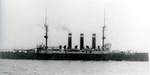
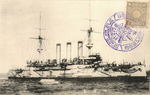
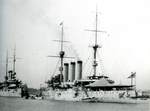
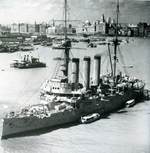
ww2dbaseIzumo was the lead ship of her class of armored cruisers, built by the British near the turn of the century. During the Russo-Japanese War, she was the flagship of Japanese 2nd Fleet's Admiral Hikonojo Kamimura; in that war, she participated in the Battle off Ulsan on 14 Aug 1904 and the Battle of Tsushima on 26 May 1905. In 1909, she celebrated the 140th anniversary of the founding of San Francisco, California, United States, visiting several other American ports during the trip. During WW1, she patrolled foreign waters as far as the Mediterranean Sea as a part of the Allied fleet. In the 1919 Naval Review, Emperor Taisho took the helm of Izumo briefly during fleet maneuvers. On 1 Sep 1921, she was reclassified a 1st Class coastal defense vessel and operated in the Japanese home islands for the following several years. When Japan invaded China in 1937, thus starting WW2 in Asia, she was the flagship of the Japanese 3rd Fleet. During the Second Battle of Shanghai, she was attacked unsuccessfully by Chinese torpedo boats. On 14 Aug 1937, she was attacked by a group of Chinese Air Force aircraft led by Captain Claire Chennault. At 0400 on 8 Dec 1941, moment after the Pacific War began, Izumo forced the surrender of American gunboat USS Wake and sank the British gunboat HMS Peterel. During the war, she was retrofitted with anti-aircraft weapons and served in the Inland Sea as a training vessel. She was sunk at dock at Kure, Japan in an American air attack in 1945, near the end of the war. Her wreck was raised in 1947 for scrapping.
ww2dbaseSource: Wikipedia.
Last Major Revision: Jan 2009
Armored Cruiser Izumo Interactive Map
Photographs
 |  |  |  |
Izumo Operational Timeline
| 25 Sep 1900 | Izumo was commissioned into service. |
| 7 Dec 1941 | Japanese armored cruiser Izumo sank British river gunboat HMS Peterel in Shanghai, China. |
Please consider supporting us on Patreon. Even $1 per month will go a long way! Thank you. Please help us spread the word: Stay updated with WW2DB: |


Visitor Submitted Comments
24 Mar 2014 10:50:08 AM
The attack on HMS Peterel was not at the start of the war, as is described in the article. The Japanese had not declared war on the British Empire when it attacked the Peterel and the Japanese action was therefore in breach of international law. It was the British who declared war on Japan - but this was AFTER the Japanese attack.
 David Stubblebine says:
24 Mar 2014 06:15:02 PM
To G Bee:
I do not mean this as a flippant question but, by your way of thinking, do you consider the attack on Pearl Harbor not part of the war?
14 May 2015 12:15:40 PM
Is it known where Izumo was in 1935-1936 ? Was she in Shang'hai ?
18 Jul 2015 06:09:03 PM
I was wondering if there was any information in Izumo during the 1914-1918 war. I am interested in her time on the west coast and being stationed in Barkley Sound. Is there a way of getting information from the Japanese Navel archives? Or does anyone here have information? Thank you...
27 Jan 2024 02:20:34 AM
Perfetto: Grazie!
All visitor submitted comments are opinions of those making the submissions and do not reflect views of WW2DB.
» Hiroyasu
» Niimi, Masaichi
Event(s) Participated:
» Second Battle of Shanghai
Partner Sites Content:
» Izumo Tabular Record of Movement
- » 1,167 biographies
- » 337 events
- » 44,606 timeline entries
- » 1,243 ships
- » 350 aircraft models
- » 207 vehicle models
- » 376 weapon models
- » 123 historical documents
- » 261 facilities
- » 470 book reviews
- » 28,501 photos
- » 365 maps
Thomas Dodd, late 1945

Please consider supporting us on Patreon. Even $1 a month will go a long way. Thank you!

Or, please support us by purchasing some WW2DB merchandise at TeeSpring, Thank you!
3 May 2009 10:14:21 PM
Was looking for info, on her use in Canada, dering WW1 as a defender of Canada's shores. any info or direction would be great.
Mark Giles