


Kaiten-class Midget Submarine
| Country | Japan |
| Displacement | 8 tons standard |
| Length | 48 feet |
| Beam | 3 feet |
| Machinery | 2xType 93 oxygen torpedo motors rated at 550hp |
| Range | 42nm |
| Crew | 1 |
| Armament | 1x1,550kg warhead |
| Submerged Speed | 30 knots |
Contributor: David Stubblebine
This article refers to the entire Kaiten-class; it is not about an individual vessel.
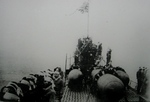
ww2dbaseThe Kaiten were truly human guided torpedoes. Many authors do not include the Kaiten as a midget submarine since it is more of a person going on a torpedo ride; but they were machines whose design included transporting a person under the water and they fit the midget sub definition otherwise.
ww2dbaseKaitens were the first Japanese "Special Attack" weapons, vehicles whose use involved the certain death of the crew, though their first successful use followed the Kamikaze aircraft by about a month. Proposals for human torpedoes were made in 1943 and were approved in early 1944, initially with provision for the survival of the operator. However, the extreme peril facing Japan after the loss of the Marianas in June 1944 led to acceptance of the pilot's death as an inevitable consequence of Kaiten use.
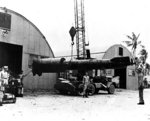
ww2dbaseThe initial Kaiten Type 1 was converted from a 24-inch Type 93 torpedo. A new 39-inch forward section containing the warhead, additional fuel, oxygen tanks, and the pilot's compartment was grafted to the torpedo's middle and after sections, producing an overall length of just over 48 feet. Speed could be varied from 12 knots, giving a range of some 85,000 yards, to 30 knots and a range of about 25,000 yards. For guidance, the pilot had a short periscope. The Kaiten's immense 3,400-pound explosive warhead, more than three times the size of the Type 93 torpedo's original warhead, was capable of producing catastrophic damage in the target ship. Over 300 Type 1 Kaitens were produced in 1944-45; but only two are known to have been used to successfully sink enemy vessels.
ww2dbaseLarger Kaiten Type 2 and Type 4 had hulls about 4.5 feet in diameter and 55 feet long. The warhead was as large or larger than that of the Type 1 and performance was better. The Type 2 was not built in any quantity but some 50 of the less-ambitious Type 4's were reportedly built in 1945. There was also an experimental Type 3 of similar size to the Types 2 & 4 and a Type 10. Only the Type 1 was deployed operationally, however.
ww2dbaseOperational Uses
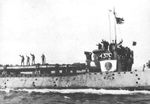
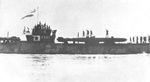
ww2dbaseOn 20 November 1944, five submarine-launched Kaitens penetrated the US anchorage at Ulithi in the Caroline Islands. Only one had any success, however, sinking the fleet oiler USS Mississinewa amidst pillars of thick black smoke that could be seen throughout the fleet. Eight months later on 24 July 1945, east of the Philippines, another Kaiten sunk the Buckley-class destroyer escort USS Underhill. These two incidents are the only confirmed successful Kaiten attacks, although some Japanese sources list higher numbers.
ww2dbaseSources: Wikipedia; Naval History & Heritage Command; Combined Fleet; Japan-101; US Naval Institute; Aerospaceweb.org; DANFS (CL-49).
Last Major Revision: Feb 2009
Kaiten-class Midget Submarine Interactive Map
Photographs
 |  |  |  |
Kaiten-class Midget Submarine Operational Timeline
| 10 Jul 1944 | The Japanese Navy established the 1st Special Submarine Training Base Group at Otsujima in Tokuyama Bay, 80 kilometers southwest of Hiroshima, Japan, under the command of Rear Admiral Mitsuri Nagai. The unit was to train future manned-torpedo pilots. |
| 8 Nov 1944 | The first Operation Gen mission featuring special attack Kaiten submarines was launched from Otsujima in Tokuyama Bay in southwestern Honshu, Japan. This mission was launched more than a month behind schedule. Submarines I-36, I-37, and I-47 eached carried four Kaiten submarines for this mission. |
| 19 Nov 1944 | Japanese submarine I-37 was sunk by American ships off Ulithi, Caroline Islands; the four Kaiten submarines aboard that she was supposed to deliver for Operation Gen were also lost. |
| 20 Nov 1944 | Japanese submarines I-36 and I-47 each delivered five Kaiten submarines off Ulithi, Caroline Islands. Only one of the Kaiten submarines would find a target, setting the fleet oiler Mississinewa, full of aviation fuel, aflame. |
| 1 Jan 1945 | Five Japanese submarines departed Inland Sea, Japan with Kaiten submarines aboard. I-36 sailed for Ulithi in the Caroline Islands, I-48 for Hollandia in New Guinea, I-53 for Palau Islands, I-56 for the Admiralty Islands, and I-58 for Guam in the Mariana Islands. |
| 12 Jan 1945 | Kaiten submarines launched by Japanese submarines I-36, I-53, I-56, and I-58 struck targets at Ulithi in the Caroline Islands, Palau Islands, Admiralty Islands, and Guam in the Mariana Islands, respectively. The motherships reported 18 sinkings total, but actual damage done was far less and no ship was sunk. |
| 6 Mar 1945 | Operation Gen No. 2 was canceled by the Japanese; it was a new campaign against the American fleet using Kaiten special attack submarines. |
| 31 Mar 1945 | In the Philippine Sea, Japanese submarine I-361 with its deck loaded with five Kaitens was spotted on the surface by US Navy Lt(jg) Sam Stovall flying a TBM-3E Avenger from USS Anzio. The Avenger released a Mark 24 FIDO acoustic homing torpedo and I-361 was lost with all 76 hands plus the five Kaiten pilots. |
| 28 Jun 1945 | Freighter USS Antares spotted a periscope and wake 100 yards from her starboard quarter off Saipan, Mariana Islands at 1329 hours. A hard maneuver to the starboard side avoided the torpedo, but the crew soon spotted a kaiten human-piloted torpedo approaching from the port side. At 1331, the freighter began firing at the kaiten, hitting it with the 2-inch gun and destroying it. At 1344 hours, another periscope was spotted; her guns opened fire on it, but the Japanese submarine I-36 would be able to dive and flee the area. |
| 24 Jul 1945 | The destroyer escort USS Underhill was sunk off the Philippine Islands by a Japanese Kaiten midget submarine with the loss of 112 crew. |
Did you enjoy this article or find this article helpful? If so, please consider supporting us on Patreon. Even $1 per month will go a long way! Thank you. Share this article with your friends: Stay updated with WW2DB: |


Visitor Submitted Comments
 David Stubblebine says:
5 Feb 2013 05:28:27 PM
I must admit that I was only able to make a preliminary check on this idea but what I found was this: The sources suggesting the Indianapolis may have been sunk by a Kaiten seem to be intentionally vague about it. The commander of the submarine that sunk the cruiser, Mochitsura Hashimoto, has been extremely clear and consistent on this point – he fired conventional torpedoes at Indianapolis and he says three of them struck the cruiser (the US version usually says two but it matters little). After the war, Hashimoto testified at the US Navy Court Martial of the Indianapolis captain and described the attack in excruciating, almost absurd, detail; he described it as a conventional torpedo attack. In Hashimoto’s book, Sunk!, he chronicles his submarine career in great detail from Pearl Harbor to the end of the war. In the book, he is never reluctant to describe the occasions when he did launch Kaitens and there is no reason to believe he would say he fired torpedoes at Indianapolis when he really launched Kaitens. If there really is a chance Indianapolis was sunk by a Kaiten, the people who think so need to bring forth some better evidence. So far, I don’t think it is so.
13 Jun 2016 10:33:57 AM
I was a Radioman aboard LST 739 in the convoy where UNDERHILL was sunk by a Kaiten. The Captain of that DE thought that one of the Kaitens was a submarine and attempted to ram it. Unfortunately is was the equivalent of ramming a torpedo. I have the messages that stated that very act.
All visitor submitted comments are opinions of those making the submissions and do not reflect views of WW2DB.
» Kaiten Submarine Missions
» Planned and Actual Tokko Naval Weapon Production, 1945-1946
Related Books:
» Kaiten: Japan's Secret Manned Suicide Submarine and the First American First Ship It Sank
» Kamikaze: Japanese Special Attack Weapons 1944-45
- » 1,150 biographies
- » 337 events
- » 43,917 timeline entries
- » 1,241 ships
- » 350 aircraft models
- » 207 vehicle models
- » 374 weapon models
- » 123 historical documents
- » 260 facilities
- » 470 book reviews
- » 28,540 photos
- » 432 maps
Joachim von Ribbentrop, German Foreign Minister, Aug 1939

Please consider supporting us on Patreon. Even $1 a month will go a long way. Thank you!

Or, please support us by purchasing some WW2DB merchandise at TeeSpring, Thank you!
5 Feb 2013 06:51:04 AM
There is a desputed suggestion that the cruiser Indianapolis, which was returning to Leyte from Guam after delivering key components of the atomic bombs that were dropped on Japan, may also have been sunk by a Kaiten.