


Amagiri
| Country | Japan |
| Ship Class | Fubuki-class Destroyer |
| Builder | Ishikawajima Shipyards, Tokyo, Japan |
| Laid Down | 28 Nov 1928 |
| Launched | 27 Feb 1930 |
| Commissioned | 10 Nov 1930 |
| Sunk | 23 Apr 1944 |
| Displacement | 1,780 tons standard; 2,080 tons full |
| Length | 388 feet |
| Beam | 34 feet |
| Draft | 11 feet |
| Machinery | Four Kampon type boilers, two Kampon type Ro geared turbines, two shafts |
| Power Output | 50,000 shaft horsepower |
| Speed | 38 knots |
| Range | 5,000nm at 14 knots |
| Crew | 219 |
| Armament | 3x2x127mm 50 caliber Type 3 naval guns, up to 22x25mm Type 96 AA guns, up to 10x13mm AA guns, 9x610mm torpedo tubes, 36 depth charges |
Contributor: David Stubblebine
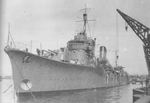
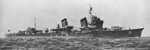
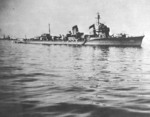
ww2dbaseAmagiri, a 1750-ton Fubuki-class destroyer, is probably best remembered as the Japanese vessel that rammed John F. Kennedy's PT-109 the night of 2 August 1943, splitting the wooden PT boat in two.
ww2dbaseAmagiri ("Heavenly Mist") was the fifteenth of twenty-four Fubuki-class destroyers and was the fifth in an improved series with modified turrets that could elevate her main battery 25-35 degrees higher than earlier guns, thus creating a dual-use battery that could also be used against aircraft. She was built at Ishikawajima Shipyards in Tokyo, Japan, completed November 1930, and spent the next decade taking part in combat exercises. During the later 1930s, Amagiri participated in operations connected with the Sino-Japanese War. When the Pacific War began on 8 December 1941, Amagiri covered landings on the coast of Thailand. Later involved with the campaign to conquer Malaya and Singapore, she engaged two British destroyers off the Malay coast on the night of 27 January 1942. She also supported the invasion of western Java in February and served with Admiral Yamamoto's force in the Battle of Midway.
ww2dbaseIn Fall 1942, Amagiri participated in the 14-15 October and 14 November bombardment missions during the Guadalcanal Campaign. She helped escort the last major Japanese convoy to that island on 15 November. Employed as a high-speed transport during the Central Solomons Campaign, she participated in the Battle of Kula Gulf on the night of 5-6 July 1943. While on another reinforcement run to Vila on 2 August, Amagiri engaged other PT boats in Blackett Strait, south of Kolombangara. That night she rammed and sank the U.S. motor torpedo boat PT-109. Lt. Cmdr. Kohei Hanami, who commanded Amagiri at that time, attended President Kennedy's inauguration in 1961.
ww2dbaseLater in 1943, Amagiri was at Rabaul during the U.S. carrier air raids on 5 & 8 November and carried troops to Bougainville on 6-7 November. Another reinforcement mission to Bougainville, on 24-25 November 1943 resulted in the Battle of Cape Saint George, in which Amagiri escaped pursuing U.S. destroyers led by Captain Arleigh Burke.
ww2dbaseOn 23 April, after departing Singapore with Aoba and Oi bound for Davao, Amagiri struck a naval mine in Makassar Strait 55 nautical miles (102 km) south of Balikpapan. As she took over two hours to sink, there were few casualties.
ww2dbaseAmagiri was struck from the navy list on June 10, 1944.
ww2dbaseSources: Wikipedia; CombinedFleet.com.
Last Major Revision: Oct 2009
Destroyer Amagiri Interactive Map
Photographs
 |  |  |
Amagiri Operational Timeline
| 10 Nov 1930 | Amagiri was commissioned into service. |
| 1 Apr 1942 | Vice Admiral Jisaburo Ozawa's Malaya Force, Second Expeditionary Fleet, departs Mergui, Burma and steams into the Bay of Bengal in the Indian Ocean Raids to attack merchant shipping. The force includes light carrier Ryujo and cruisers Chokai, Suzuya, Kumano, Mikuma, Mogami, and Yura. |
| 5 Apr 1942 | Following Admiral Jisaburo Ozawa’s force’s attack on the British naval base at Colombo, Ceylon, the force is split creating a Northern Group commanded by Rear Admiral Takeo Kurita consisting of cruisers Kumano and Suzuya; the Center Group consisting of the carrier Ryujo and cruisers Chokai and Yura under Ozawa; and the Southern Group comprised of cruisers Mogami, and Mikuma under Captain Shakao Sakiyama for the purposes of smaller raids against merchant shipping. |
| 6 Apr 1942 | Sakiyama's Southern Group of Mogami, Mikuma and destroyer Amagiri sank four merchantmen totaling 19,000 tons with two of them finished off with torpedoes from Amagiri. |
| 11 Apr 1942 | Ozawa's Force arrived at Singapore to conclude a successful sortie into the Indian Ocean. |
| 5 Sep 1942 | Yugure, Fubuki, Amagiri, and Kagero landed 370 men and supplies at Taivu, Guadalcanal, Solomon Islands. |
| 9 Dec 1942 | Amagiri and Yugure departed Shortland Islands, Solomon Islands at 1230 hours on a transport run to Guadalcanal. They arrived at Guadalcanal at 2011 hours, unloaded, and departed at 2315 hours. |
| 10 Dec 1942 | Amagiri and Yugure arrived at Shortland Islands, Solomon Islands at 0700 hours. |
| 12 Dec 1942 | Amagiri and Yugure departed Shortland Islands, Solomon Islands at 1230 hours on a transport run to Rekata Bay, Santa Isabel Island, Solomon Islands. |
| 13 Dec 1942 | Amagiri and Yugure arrived at Shortland Islands, Solomon Islands. |
| 15 Dec 1942 | Amagiri and Yugure departed Shortland Islands, Solomon Islands at 1230 hours on a transport run to Rekata Bay, Santa Isabel Island, Solomon Islands. |
| 16 Dec 1942 | Amagiri and Yugure arrived at Shortland Islands, Solomon Islands. |
| 2 Aug 1943 | US Navy torpedo boat PT-109, commanded by Lieutenant (jg) John F. Kennedy, was rammed by a Japanese destroyer Amagiri in the Blackett Strait between Kolombangara and Arundel in the Solomon Islands. |
| 5 Nov 1943 | During the US raid on Rabaul, New Britain, Amagiri was damaged by a near miss. |
Did you enjoy this article or find this article helpful? If so, please consider supporting us on Patreon. Even $1 per month will go a long way! Thank you. Share this article with your friends: Stay updated with WW2DB: |


Visitor Submitted Comments
All visitor submitted comments are opinions of those making the submissions and do not reflect views of WW2DB.
» Invasion of Malaya and Singapore
» Dutch East Indies Campaign, Java
» Battle of Midway and the Aleutian Islands
» Guadalcanal Campaign
» Solomon Islands Campaign
Related Books:
» PT 109
Partner Sites Content:
» Amagiri Tabular Record of Movement
- » 1,150 biographies
- » 337 events
- » 44,024 timeline entries
- » 1,242 ships
- » 350 aircraft models
- » 207 vehicle models
- » 375 weapon models
- » 123 historical documents
- » 260 facilities
- » 470 book reviews
- » 28,631 photos
- » 431 maps
Captain Henry P. Jim Crowe, Guadalcanal, 13 Jan 1943

Please consider supporting us on Patreon. Even $1 a month will go a long way. Thank you!

Or, please support us by purchasing some WW2DB merchandise at TeeSpring, Thank you!
5 Mar 2024 03:56:02 PM
This ship is a good example of the illegal salvaging problem currently plaguing Indonesian waters. Shortly after her wreck was discovered in 2003, the entire ship was cut up and brought to the surface to be sold for scrap metal. The same thing happened to the wrecks of HMAS Perth, HNLMS De Ruyter, and many other ships sunk in Southeast Asia.